Paycheck Power Worksheet
NYC DOE Career & Financial Management Unit: Personal Cash Flow & Budgeting
Paycheck Power Worksheet
Budgeting Strategies, Cash Flow Systems & Workplace Financial Decision-Making
Standard: Level 3+
Student:
Date:
Period:
Score:
Part 1
Foundational Strategy Check
Standard 1.1 • Strategy Selection
Scenario: A student earns $200 every two weeks from a weekend retail job. They want a simple budgeting strategy that automatically sets aside 20% ($40) for emergency savings before spending on anything else.
Which budgeting strategy specifically focuses on prioritizing savings before paying discretionary or living expenses?
A Envelope Budgeting
B Zero-Based Budgeting
C Pay Yourself First
D Variable Cost Budgeting
Core Rationale:
Part 2
Workplace Financial Lexicon
Key Concepts for Level 3+ Writing
Fixed Expense Constant Cost
A recurring cost that stays the same amount each payment cycle regardless of choices.
Example: $60/mo fixed phone bill or $15 monthly Netflix plan.
Variable Expense Fluctuating Cost
A cost that changes week to week depending on personal spending behavior and usage.
Example: $20 on fast food one week and $45 the next week.
Pay Yourself First Priority
Treating your savings goal as your primary, mandatory obligation the moment you get paid.
Example: Auto-transferring $40 straight to savings upon deposit.
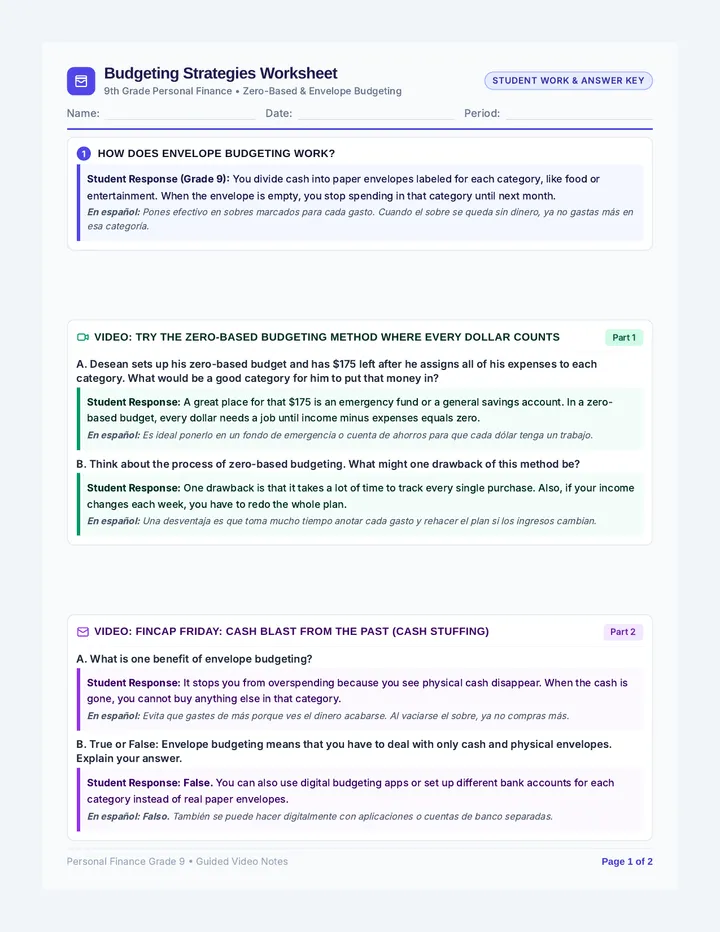
Envelope Budgeting Cash Discipline
Placing physical cash allocations into labeled envelopes for discretionary categories.
Example: $30 in "Fast Food"; once empty, category spending halts.
Zero-Based Budgeting Balance = $0
Assigning every single dollar of net pay to an exact category so $0 remains unplanned.
Example: On $100: $50 transit, $30 food, $20 savings ($0 left unassigned).
The 50 / 30 / 20 Framework Proportions
Divides net pay: 50% Essential Needs, 30% Discretionary Wants, 20% Direct Savings.
Example: Needs (subway pass, lunch) vs. Wants (hoodies, boba, gaming).
Student Output Mastery Targets (NYC DOE CFM Standards)
Apply Zero-Based & Pay-Yourself-First principles.
Evaluate debit card habit drains on savings goals.
Construct Level 3+ argument using sentence frames.
Demonstrate Accountable Talk for peer defense.
NYC DOE Career and Financial Management • Workplace Readiness Series Page 1 of 2
Part 3
Workplace Case Study & Level 3+ Writing
Applied Financial Decision-Making
The Retail Paycheck Dilemma Budget Leak Analysis
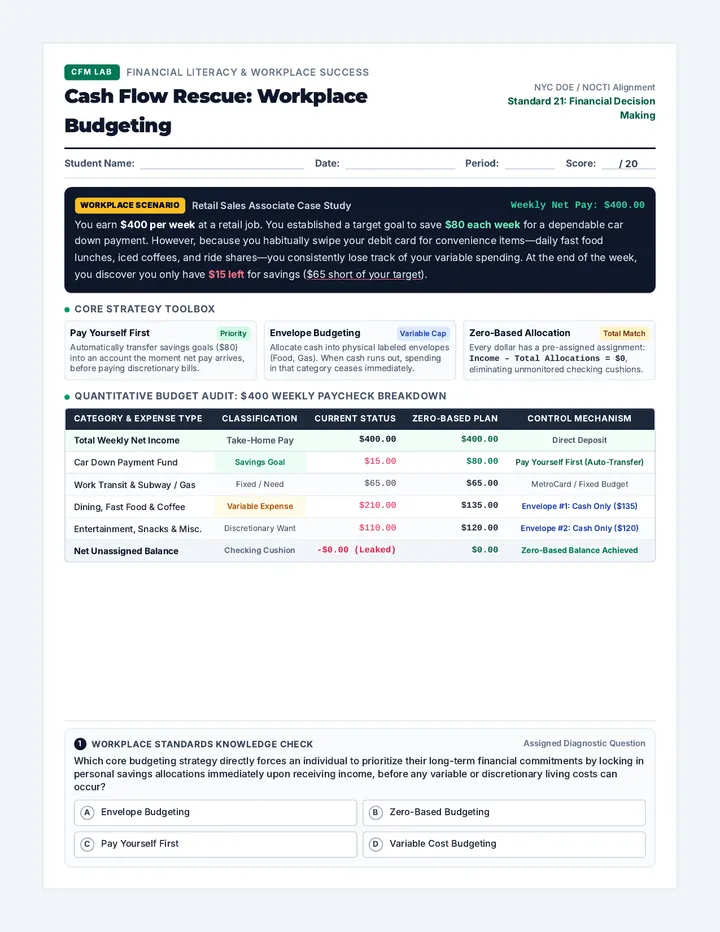
You earn $400 per week at a retail job. You set a goal to save $80 each week (20% of net pay) for a car down payment. However, because you use a debit card for daily fast food, coffee, and transit, you lose track of variable transactions and end up with only $15 left for savings at week's end.
Weekly Net Pay $400.00
Target Savings (20%) $80.00
Actual Saved $15.00
Weekly Deficit -$65.00
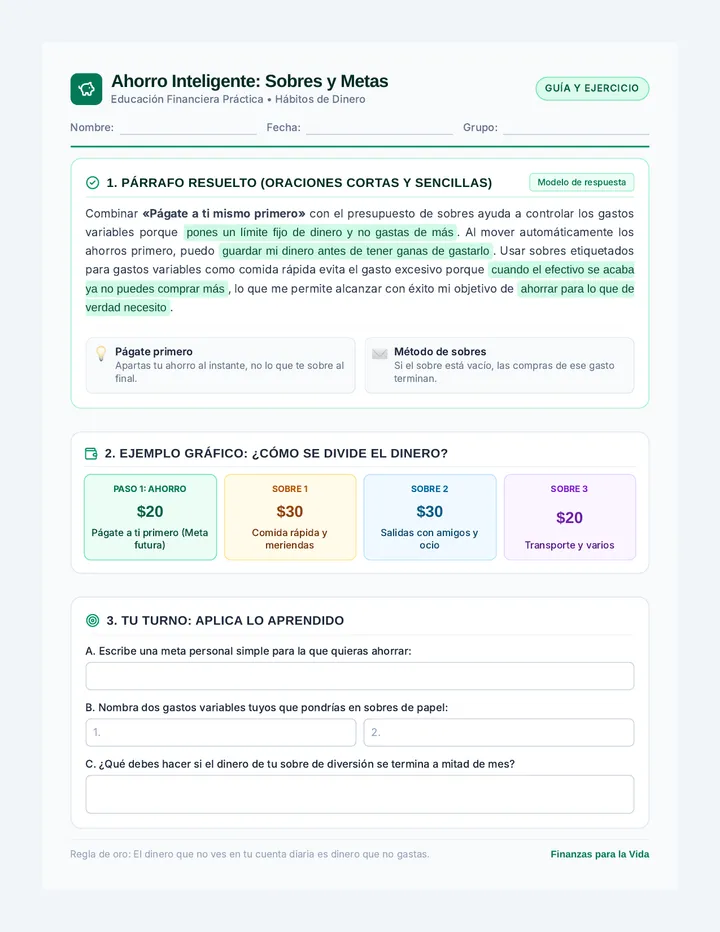
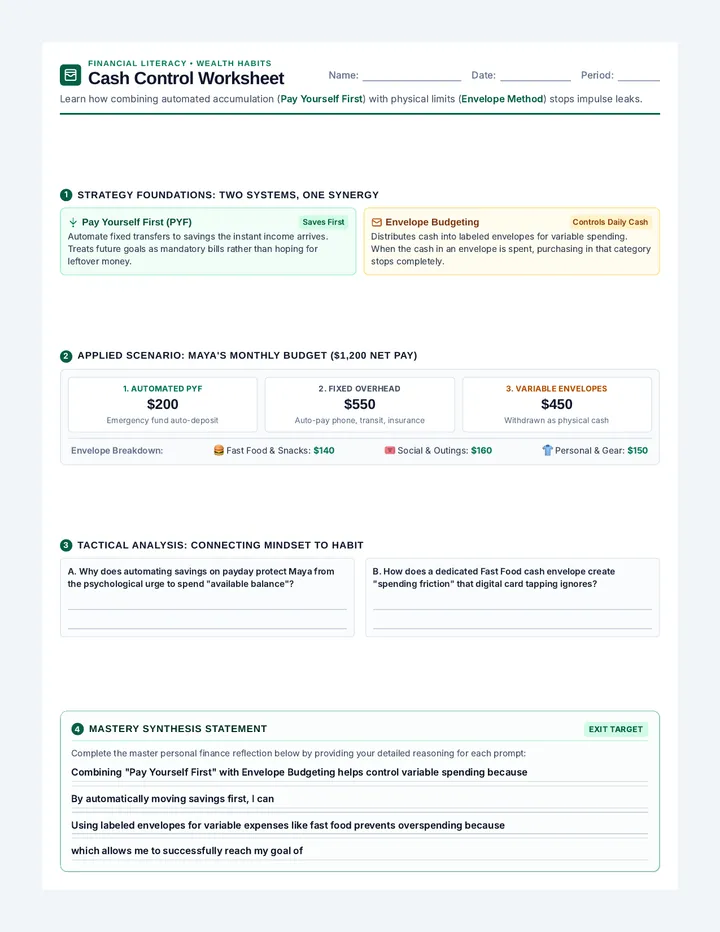
Strategy 1: Pay Yourself First
Automatically transfer $80 directly to a separate car savings account immediately upon deposit—treating savings as non-negotiable obligation #1.
Strategy 2: Envelope Budgeting
Withdraw designated cash into labeled envelopes (Food, Transit, Leisure). Once an envelope is empty, spending in that category stops completely.
Class Comment Drop Prompt
NOCTI Level 3+ Writing
How can combining the "Pay Yourself First" strategy with Envelope Budgeting help you reach a specific savings goal while keeping variable expenses under control?
Sentence Frame Assist (Scaffolded Structure):
“Combining ‘Pay Yourself First’ with Envelope Budgeting helps control variable spending because _____________________. By automatically moving savings first, I can _____________________. Using labeled envelopes for variable expenses like fast food prevents overspending because _____________________, which allows me to successfully reach my goal of _____________________.”
Student Written Rationale (Compose Below) Use career vocabulary and justify both strategies
Level 3+ Writing Self-Check
Used 2+ terms (Fixed, Variable, Discretionary) Justified $80 automated savings obligation Explained physical cash boundary mechanism
Accountable Talk & Peer Defense
Partner Response Notes / Classmate Rationale:
Rubric Alignment: NOCTI 21st Century Skills & NYC DOE CFM Standards Page 2 of 2