Safe Harbor Facilitator Guide Steady Ground • Session 1 of 6
Safe Harbor Facilitator Guide
Focus: Orientation, Safety Agreements & 5-4-3-2-1 Sensory Grounding
30 Minutes
High School Counseling
Session Objective
Establish psychological safety, non-graphic discussion boundaries, define self-regulation vs. suppression, and teach the 5-4-3-2-1 grounding anchor to de-escalate emotional flooding.
Safety & Disclosure Protocol
Maintain the Non-Graphic Rule : share emotions and urge intensity (0–10 scale), never specific methods, tools, or physical details. Immediate 1-on-1 check-in if imminent risk occurs.
Minute-by-Minute Session Protocol
00–05 min
Welcome & Grounding Check-In
Welcome students. Pass out confidentiality commitment. Prompt: "On a 1–10 scale, what is your emotional weather today (stormy, foggy, sunny)?" Emphasize that all feelings are welcome.
05–12 min
Establishing the 4 Group Agreements
Collaboratively affirm: 1) What is shared stays in room (except safety/harm risk); 2) No graphic details of self-harm; 3) Right to pass; 4) Non-judgmental support. Have members sign or nod agreement.
12–22 min
Skill Demonstration: 5-4-3-2-1 Sensory Anchor
Explain that grounding anchors the prefrontal cortex during high emotional distress. Guide group through physical practice: 5 things seen, 4 felt physically, 3 heard, 2 smelled, 1 tasted/positive truth. Complete worksheet section 1.
22–30 min
Reflection, Anchor Practice & Safe Checkout
Pair share: "Which sense pulled you out of your head most effectively?" Provide individual 0–10 safety ratings before departure. Remind students of counselor open-door & crisis contacts.
Facilitator Framing Script
"Urges to self-harm often happen when emotional pain feels bigger than our ability to soothe it. This group is not about judgment; it is a lab where we learn tangible skills to ride out intense waves without harming our bodies."
24/7 Crisis Links
Call/Text: 988
Text Line: HOME to 741741
Trevor: 1-866-488-7386
Grounding Senses Handout Steady Ground • Student Tool 1
Grounding Senses Handout
Reconnecting your brain to the present moment when emotions feel overwhelming.
Name:
Date:
Current Distress Scale (0–10): 0 = Completely calm, 10 = Maximum emergency
Start Rating:
Post-Practice:
The 5-4-3-2-1 Sensory Grounding Technique
5 Five things you can SEE around the room (look for specific shapes, shadows, or colors):
4 Four things you can physically FEEL right now (feet on floor, texture of jeans, ring, air temperature):
3 Three distinct sounds you HEAR (hum of lights, footsteps outside, your own breathing):
2 Two things you can SMELL (or two favorite calming scents you can vividly imagine):
1 One thing you can TASTE or one true grounding statement (e.g., "I am safe right now in this chair" ):
My Quick Pocket Anchor
When I feel an urge or emotional surge in class, one sensory anchor I will quietly use is:
Confidentiality Note: We keep group discussions safe and private, unless someone is in immediate danger.
Crisis Text Line: 741741 • Lifeline: 988
Body Reset Facilitator Guide Steady Ground • Session 2 of 6
Body Reset Facilitator Guide
Focus: Autonomic Arousal & DBT TIPP Crisis Physiology
30 Minutes
High School Counseling
Session Objective
Demystify why the brain craves physical sensation during emotional storms. Teach TIPP (Temperature, Intense movement, Paced breathing, Paired relaxation) as safe biological circuit breakers.
Session Materials Needed
Ice cubes in individual zip bags or cold gel packs, paper towels, TIPP Crisis Card handouts, and pens. Ensure students with Raynaud's or cardiac issues use paced breathing instead of ice.
Minute-by-Minute Session Protocol
00–05 min
Check-in & Review Grounding Anchor
Review 0–10 scale. Check-in question: "Did anyone use a sensory anchor this week, even for 10 seconds?" Validate all experiences without pressure.
05–12 min
The Biology of Emotional Flooding
Explain that during emotional distress above 7/10, logic shuts down because the sympathetic nervous system triggers fight, flight, or freeze. Emphasize: "You cannot talk yourself out of an autonomic storm; you must change the body's chemistry first."
12–23 min
Live Skill Practice: TIPP in Action
T (Temperature): Hand out ice bags. Place on cheekbones/temples or hold in palms for 30s to trigger the mammalian dive reflex and drop heart rate.P (Paced Breathing): Inhale 4 counts, exhale 7 counts for 3 rounds.P (Paired Muscle): Clench shoulders to ears, release fully on a slow outbreath.
23–30 min
Personal TIPP Selection & Safe Checkout
Have each student circle which TIPP skill felt most accessible on their card. Conduct safety rating (0–10). Reminder: "Ice in the school nurse's office or running cold water in the restroom is a valid, discrete reset tool."
Counselor Caution
If a student reports feeling numb or dissociative rather than hyperaroused, avoid deep muscle relaxation and instead utilize sensory cold/temperature or brisk standing movement to restore presence.
Key Dialectical Mantra
"Your urge to feel physical sensation makes sense when emotions are numb or unbearable. Our work is finding sensations that soothe your brain without damaging your body."
TIPP Crisis Card Handout Steady Ground • Student Tool 2
TIPP Crisis Card Handout
Fast physical circuit breakers to reset your nervous system when distress spikes above 7/10.
Name:
Date:
When emotions reach boiling point, your thinking brain goes offline. TIPP skills target your body directly to slow heart rate and lower adrenaline within minutes.
T Temperature
Cold activates the dive reflex , dropping heart rate quickly. Hold an ice cube, press a cold water bottle to your cheeks/eyes, or splash freezing water on your face for 20–30 seconds.
School Access: Restroom cold water faucet, ice from the nurse's office, chilled drink bottle.
I Intense Movement
Burn off trapped adrenaline through a brief 1-to-2-minute burst of intense physical effort: power-walk up two flights of stairs, do 20 jumping jacks, or push as hard as you can against a wall.
School Access: Walking briskly down the hallway, heavy wall push in the stairwell.
P Paced Breathing
Breathe into your stomach so exhales are longer than inhales. Try the 4-7-8 rhythm : inhale through nose for 4 counts, hold for 2, exhale slowly through mouth for 7 counts.
School Access: Can be done invisibly at your desk during class, during exams, or on the bus.
P Paired Relaxation
Intentionally squeeze one muscle group (fists, shoulders, thighs) tightly for 5 seconds while inhaling. On your exhale, completely unclench and mentally say the cue word: "Release."
School Access: Clenching and unclenching fists beneath a desk or pressing feet into the floor.
My Personalized TIPP Emergency Protocol
1. If an urge spikes while I am at school, the specific TIPP skill I will try first is:
2. A safe location at school where I can step away to regulate for 3 minutes is:
Remember: Changing body temperature or breath pace is physiology, not willpower.
Crisis Text: 741741 • Call/Text: 988
Storm Tracker Facilitator Guide Steady Ground • Session 3 of 6
Storm Tracker Facilitator Guide
Focus: Deconstructing the Emotion Cycle & Somatic Warning Signs
30 Minutes
High School Counseling
Session Objective
Help students identify their personal early somatic warning signs (stomach drop, racing pulse, clenched jaw) before distress reaches crisis level, creating a window for intervention.
Facilitator Safety Guard
Ensure students discuss emotions and triggers (e.g., test anxiety, peer conflict, feeling ignored) without describing self-harm tools or specific injuries in the circle.
Minute-by-Minute Session Protocol
00–05 min
Mindful Arrival & Check-in
0–10 rating check-in. Rapid prompt: "One physical feeling your body had when you woke up this morning (e.g., heavy eyelids, tense neck, lightness)?" Normalize body awareness.
05–13 min
Concept: The Anatomy of an Emotional Storm
Draw the 5-step chain on board: Vulnerabilities (lack of sleep, skipped meals) → Trigger → Body Alarm → Urge Peak → Behavior . Emphasize: "Self-harm never happens out of nowhere; your body sends smoke signals first."
13–23 min
Experiential Activity: Somatic Mapping
Students complete the Trigger Emotion Map Worksheet . Guide them to pinpoint where distress lives in their body (throat constriction, chest weight, fist clenching, cold hands) and their top 2 common vulnerability triggers.
23–30 min
Processing & Regulated Checkout
Pair share: "What is one early smoke signal your body gives before you hit red alert?" Guide a collective 3-breath cycle. Ensure all students check out at a baseline distress level below 5.
Key Inquiry Question
"If your body was an early warning dashboard, what warning light turns on first when stress starts climbing? The sooner we spot the light, the less power the storm has."
Vulnerability Factors (HALT+)
Remind students that hunger, anger, loneliness, tiredness (HALT), sensory overload, and social media scrolling lower resilience and amplify urge intensity.
Trigger Emotion Map Worksheet Steady Ground • Student Tool 3
Trigger Emotion Map Worksheet
Mapping the body's early smoke signals to catch distress before it turns into an overwhelming urge.
Name:
Date:
Early Warning Rule: Urges grow strongest when we ignore our body's quieter warning signals. Catch it at 4/10, not 9/10
Where Distress Lives
Jaw / Head Throat / Chest Stomach knot Restless limbs
Circle or shade where you feel tension first.
1. My Common Physical Signals (Check all that apply)
Tight throat / lump Racing heart / chest pressure Nausea / stomach dropping Clenched teeth or fists Buzzing / tingling skin Feeling spaced out / numb
2. Vulnerability Amplifiers (What makes me vulnerable?)
When I am exhausted, skipped lunch, or on social media too long, my defense shields drop.
3. My Top 2 Situational Triggers
E.g., grades/tests, peer conflict, family tension, feeling criticized, silence.
A.
B.
My Primary "Smoke Signal" Alert
When I notice (write your #1 physical feeling) , it means my alarm is at a 4/10 and I need to pause and use a grounding skill before it hits a 9/10.
Insight: Knowing your triggers doesn't mean avoiding life; it means putting your seatbelt on early.
Crisis Text: 741741 • Lifeline: 988
Urge Surfers Facilitator Guide Steady Ground • Session 4 of 6
Urge Surfers Facilitator Guide
Focus: Urge Wave Dynamics, The 15-Minute Delay & Sensory Substitutes
30 Minutes
High School Counseling
Session Objective
Teach students that an urge is a wave that peaks and recedes within 15–30 minutes if not acted upon. Establish the 15-Minute Delay tactic paired with safe sensory replacement behaviors.
Harm Reduction Stance
Validate that urges are uncomfortable sensations, not commands. We do not fight the wave (which increases panic); we ride it using safe physical substitutes until the neurochemical peak drops.
Minute-by-Minute Session Protocol
00–05 min
Arrival & Grounding Check-In
0–10 scale check. Rapid sharing: "Did your smoke signal alert you to stress this week?" Emphasize self-awareness over perfection.
05–12 min
The Anatomy of an Urge Wave & The 15-Minute Rule
Explain that human neurotransmitters trigger an urge spike that reaches maximum intensity in 10–15 minutes, then must crest and decline. Script: "Never tell yourself 'I can never give in.' Tell yourself: 'I will wait 15 minutes and engage a sensory shift.'"
12–22 min
Activity: Sensory Replacement Menu Mapping
Introduce 4 replacement categories on the handout: Intense Physical (holding ice, biting a lemon, sour candy, popping bubble wrap), Emotional Release (ripping scrap paper, scribbling with red marker, loud music), Soothing (weighted blanket, heating pad, soft hoodie), and Distraction (logic puzzles, phone games). Students select 2 for their kit.
22–30 min
Urge Surfing Rehearsal & Checkout
Lead a brief 2-minute visualization: notice an urge in the mind, imagine sitting on a surfboard watching the wave crest and roll out to sea. Individual safety ratings.
Facilitator Urge-Surfing Script
"An urge is like an itch. The more you obsess or fight it, the bigger it screams. But an urge cannot hurt you; it is just a neurochemical sensation passing through. We breathe, we surf, and we delay."
Clinical Note on Rubber Bands
Current best practices advise against snapping rubber bands as they can reinforce pain-seeking pathways. Prioritize cold temperature (ice/sour candy) and release activities (tearing paper) instead.
Sensory Shift Menu Worksheet Steady Ground • Student Tool 4
Sensory Shift Menu Worksheet
Riding out the urge wave with the 15-Minute Rule and tangible sensory replacements.
Name:
Date:
The 15-Minute Rule: An urge is not permanent. It peaks like an ocean wave, then drops.
Delay action for 15 minutes while engaging your hands and senses.
Ride • Delay • Shift
Choose Your Sensory Substitutes
1. Intense Physical Shock
When you need intense sensory input without injury:
Hold an ice cube tightly in your palm
Eat a Warhead or sour citrus candy
Chew strong cinnamon or mint gum
Bite into a wedge of fresh lemon
2. Emotional & Kinetic Release
When you feel boiling anger, frustration, or panic:
Rip scrap cardboard or magazines into shreds
Scribble heavily with red pen on scrap paper
Punch or scream into a dense pillow
Stomp cardboard boxes flat for recycling
3. Warmth & Deep Comfort
When you feel empty, sad, numb, or isolated:
Wrap tightly in a heavy oversized blanket
Hold a hot mug of herbal tea with both hands
Take a warm shower in a dim bathroom
Put on a comforting hoodie or soft flannel
4. High-Focus Redirection
When your thoughts are spiraling on a loop:
Play a fast mobile puzzle game (Tetris/Wordle)
Count down from 100 by 7s out loud
Listen to one complex song and track the bass line
Organize or sort your backpack or drawer
My 15-Minute Backpack & Bedroom Kit
Item 1 (Tactile / Sensory):
Item 2 (Release / Redirection):
My 15-Minute Self-Contract
"When an urge appears, I commit to setting a timer on my phone for 15 minutes and using one sensory replacement above before making any decision. I will let the wave crest."
Reminder: You don't have to stop the ocean; you just have to learn to surf.
Crisis Text: 741741 • Lifeline: 988
Mindful Anchors Facilitator Guide Steady Ground • Session 5 of 6
Mindful Anchors Facilitator Guide
Focus: Taming the Inner Critic, Opposite Action & Compassionate Self-Talk
30 Minutes
High School Counseling
Session Objective
Expose how self-punishment and shame drive self-harm cycles. Teach DBT Opposite Action and guide students to construct an accessible, compassionate inner coach voice to neutralize severe self-criticism.
The Shame vs. Guilt Shift
Guilt says "I made a mistake." Shame says "I am a mistake and deserve pain." Frame self-harm as an understandable but ineffective attempt to quiet overwhelming self-blame.
Minute-by-Minute Session Protocol
00–05 min
Arrival & Delay Practice Review
0–10 scale check-in. Ask: "Did anyone try delaying a reaction or using a sensory substitute this week? How did the wave feel?" Reinforce any effort, regardless of outcome.
05–12 min
Concept: The Inner Critic vs. The Compassionate Coach
Discuss how the internal voice turns savage during crises (e.g., "You ruin everything" , "Nobody cares" ). Highlight that shame urges us to isolate and punish ourselves. Explain DBT Opposite Action : doing the exact opposite of what the toxic emotion demands.
12–22 min
Activity: Rewriting the Script
Distribute the Compassionate Voice Handout . Ask students: "If your best friend felt this exact despair, would you tell them to hurt themselves? What would you whisper to them instead?" Guide students to write 2 believable, grounded statements they can tell themselves when spiraling.
22–30 min
Affirmation Echo & Regulated Checkout
Voluntary share: "One compassionate truth you want to anchor this week." Conduct safety scale check. Preview next week as Session 6 (graduation and completing the Personal Safety Blueprint).
Believable vs. Toxic Positivity
Avoid generic phrases like "Everything is great!" Teens reject forced optimism. Instead use dialectical realism: "This moment hurts intensely, but I can survive this pain without hurting my body."
Opposite Action Cheat-Sheet
When Shame says: "Hide, curl up, hurt yourself."Opposite Action: Stand tall, uncross arms, reach out to a safe person, or place hands gently over heart.
Compassionate Voice Handout Steady Ground • Student Tool 5
Compassionate Voice Handout
Neutralizing harsh self-blame and building an inner coach who protects your body.
Name:
Date:
The Golden Question: Would you say these exact words to a friend you care about? You deserve the same mercy
Reframing the Internal Narrative
Harsh Inner Critic (Fuels Pain)
Compassionate Inner Coach (Protects Body)
"I ruin everything; I deserve to feel pain."
"I made a mistake, but hurting myself will only add physical wounds to emotional hurt."
"I'm completely alone and a burden to everyone."
"My brain is telling me I'm a burden because I am exhausted. People who care want to help."
"I can't stand this intense feeling another second."
"This wave is peak intensity right now. It is deeply painful, but it is temporary. I can ride it."
My Reframe Workshop
Identify one harsh thought you often think right before an urge hits, and write your compassionate response:
When my brain tells me:
My Coach will remind me:
Opposite Action Practice for Self-Punishment
When shame screams at you to hide, slump over, or hurt your skin, deliberately execute the opposite physical action:
1. Open Posture Uncross arms, lift chin, release shoulders downward.
2. Soothing Touch Place one warm hand over your heart or on your cheek.
3. Reach Out Send a neutral text to a trusted friend or adult.
Anchor Truth: Being gentle with yourself takes far more courage than punishing yourself.
Crisis Text: 741741 • Lifeline: 988
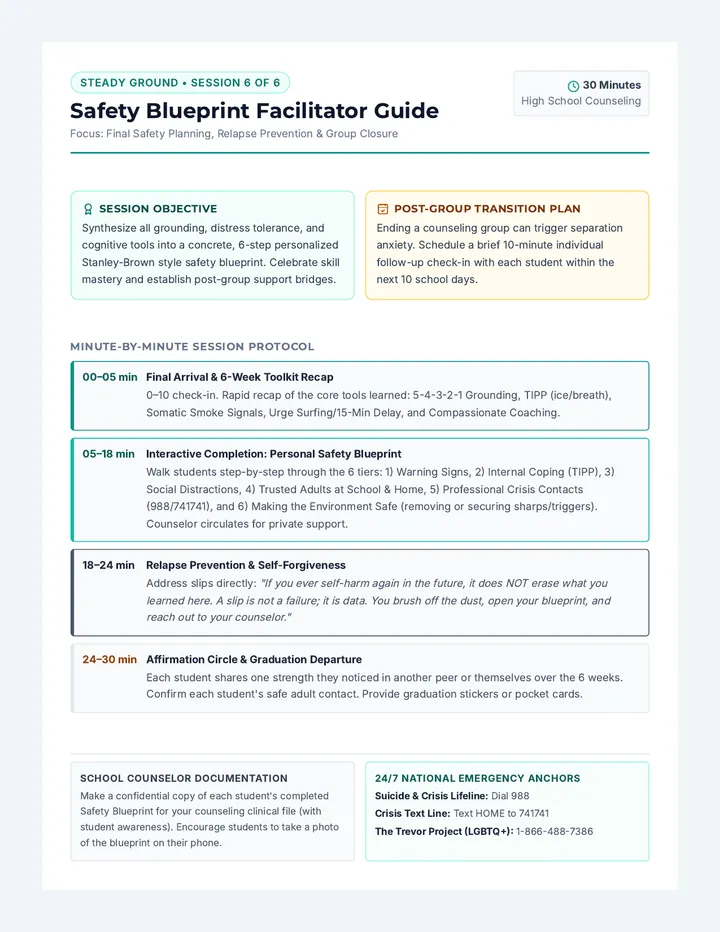
Safety Blueprint Facilitator Guide Steady Ground • Session 6 of 6
Safety Blueprint Facilitator Guide
Focus: Final Safety Planning, Relapse Prevention & Group Closure
30 Minutes
High School Counseling
Session Objective
Synthesize all grounding, distress tolerance, and cognitive tools into a concrete, 6-step personalized Stanley-Brown style safety blueprint. Celebrate skill mastery and establish post-group support bridges.
Post-Group Transition Plan
Ending a counseling group can trigger separation anxiety. Schedule a brief 10-minute individual follow-up check-in with each student within the next 10 school days.
Minute-by-Minute Session Protocol
00–05 min
Final Arrival & 6-Week Toolkit Recap
0–10 check-in. Rapid recap of the core tools learned: 5-4-3-2-1 Grounding, TIPP (ice/breath), Somatic Smoke Signals, Urge Surfing/15-Min Delay, and Compassionate Coaching.
05–18 min
Interactive Completion: Personal Safety Blueprint
Walk students step-by-step through the 6 tiers: 1) Warning Signs, 2) Internal Coping (TIPP), 3) Social Distractions, 4) Trusted Adults at School & Home, 5) Professional Crisis Contacts (988/741741), and 6) Making the Environment Safe (removing or securing sharps/triggers). Counselor circulates for private support.
18–24 min
Relapse Prevention & Self-Forgiveness
Address slips directly: "If you ever self-harm again in the future, it does NOT erase what you learned here. A slip is not a failure; it is data. You brush off the dust, open your blueprint, and reach out to your counselor."
24–30 min
Affirmation Circle & Graduation Departure
Each student shares one strength they noticed in another peer or themselves over the 6 weeks. Confirm each student's safe adult contact. Provide graduation stickers or pocket cards.
School Counselor Documentation
Make a confidential copy of each student's completed Safety Blueprint for your counseling clinical file (with student awareness). Encourage students to take a photo of the blueprint on their phone.
24/7 National Emergency Anchors
Suicide & Crisis Lifeline: Dial 988
Crisis Text Line: Text HOME to 741741
The Trevor Project (LGBTQ+): 1-866-488-7386
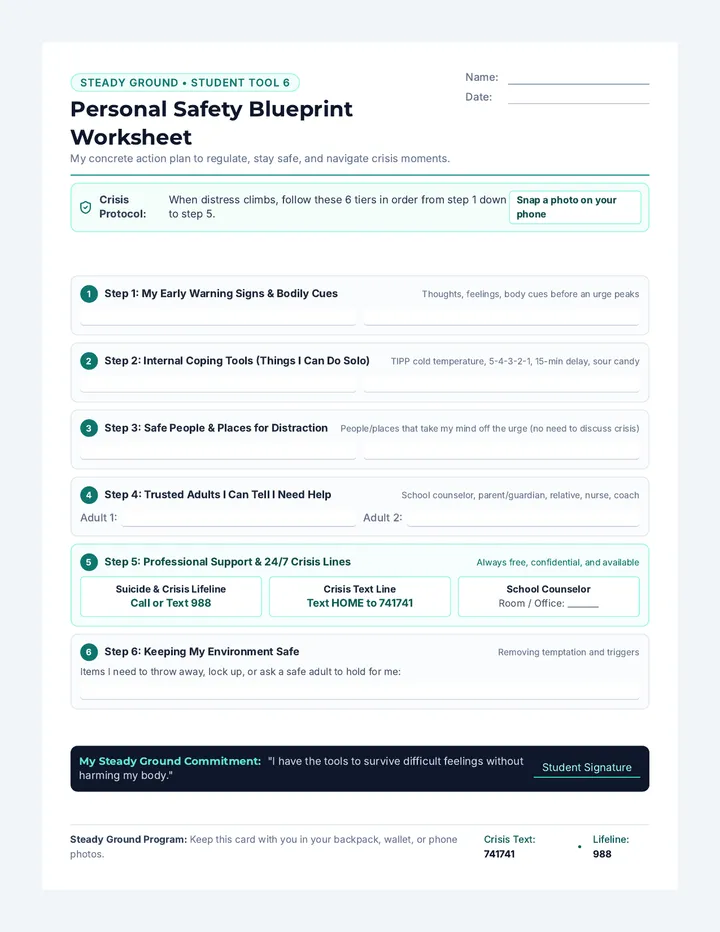
Personal Safety Blueprint Worksheet Steady Ground • Student Tool 6
Personal Safety Blueprint Worksheet
My concrete action plan to regulate, stay safe, and navigate crisis moments.
Name:
Date:
Crisis Protocol: When distress climbs, follow these 6 tiers in order from step 1 down to step 5. Snap a photo on your phone
1Step 1: My Early Warning Signs & Bodily Cues Thoughts, feelings, body cues before an urge peaks
2Step 2: Internal Coping Tools (Things I Can Do Solo) TIPP cold temperature, 5-4-3-2-1, 15-min delay, sour candy
3Step 3: Safe People & Places for Distraction People/places that take my mind off the urge (no need to discuss crisis)
4Step 4: Trusted Adults I Can Tell I Need Help School counselor, parent/guardian, relative, nurse, coach
Adult 1:
Adult 2:
5Step 5: Professional Support & 24/7 Crisis Lines Always free, confidential, and available
Suicide & Crisis Lifeline Call or Text 988
Crisis Text Line Text HOME to 741741
School Counselor Room / Office: _______
6Step 6: Keeping My Environment Safe Removing temptation and triggers
Items I need to throw away, lock up, or ask a safe adult to hold for me:
My Steady Ground Commitment: "I have the tools to survive difficult feelings without harming my body."
Student Signature
Steady Ground Program: Keep this card with you in your backpack, wallet, or phone photos.
Crisis Text: 741741 • Lifeline: 988