Respect Compass Slides
Social-Emotional Workshop
Grades 6–10 • Counselor Series
Agency, Integrity & Boundaries
The True Respect Compass
Balancing genuine respect, healthy cooperation, and the courage to speak up safely.
Respect vs. Obedience
Safe vs. Unsafe Directions
Disagreement Script
Core Distinction
Respect Is Not Just "Doing As Told"
Concept 01
Genuine Respect
Recognizing that someone has dignity, rights, and value—just like you. It is rooted in empathy, listening, and treating others fairly.
• Internal mindset, not just outward actions
• You can respect someone even when you disagree
Cooperative Compliance
Following a rule, procedure, or instruction so that a classroom, team, or community can function safely and smoothly.
• An external behavior needed for community order
• Compliance without understanding can lead to silence
Key Insight: Obeying out of fear is not respect. Real respect honors both the adult's role and your own dignity.
Action Framework
The Four Behavioral Quadrants
Concept 02
1. Respectful Cooperation
Ideal
Following fair, safe adult guidance with a calm, constructive attitude. You understand the rule keeps everyone safe and focused.
2. Respectful Advocacy
Courage
Disagreeing, questioning, or expressing a concern with calm body language, respectful words, and proposed solutions.
3. Disrespectful Defiance
Destructive
Slamming doors, eye-rolling, mocking, screaming, or ignoring standard instructions because of frustration or anger.
4. Blind / Fearful Compliance
Risky
Following harmful, confusing, or dangerous orders without speaking up, solely out of fear, peer pressure, or helplessness.
Our goal is to stay in Cooperation and master Respectful Advocacy.
Safety & Sound Judgment
When to Follow • When to Pause
Concept 03
Follow Right Away
- Emergency & safety rules: Fire alarms, science lab guidelines, crosswalks, bus rules.
- Learning structures: Reasonable classroom expectations that protect everyone's focus.
- Fair adult requests: Simple chores, transitions, and turn-taking routines.
Pause & Advocate
- Boundary violations: Anyone asking you to do something unsafe, degrading, or illegal.
- Unfair misunderstandings: Being blamed for an incident when you need to explain calmly.
- Cruel peer pressure: Demands to exclude, bully, mock, or cheat on a test.
You never have to obey a direction that harms your body, breaks moral laws, or violates your personal safety.
Communication Tool
The 4-Step Disagreement Formula
Skill Set
1
Pause
Check body language. Unclench fists, drop sarcasm, and take one deep breath before speaking.
"Count to 3 quietly"
2
Validate
Show the other person you heard their request or point of view first.
"I understand that..."
3
State View
Share your feeling or fact using calm "I" statements without attacking.
"From my perspective..."
4
Propose
Offer a workable compromise or respectful next step to move forward.
"Could we try..."
Tone is everything: Respectful words spoken with an angry sneer still sound like defiance.
Scenario Analysis
What Would You Do?
Class Discussion
Dilemma A
The Group Project Friction
Your group leader bossily assigns you all the hardest typing work and says, "Do it now or our team fails, I'm the designated captain."
❌ Disrespectful: "You're not my boss, do it yourself!"
❓ Blind Obedience: Quietly doing all the work while fuming.
✅ Respectful Advocacy: "I want our team to succeed, but splitting the sections evenly works best. Let's divide it together."
Dilemma B
The Immediate Lab Rule
Your chemistry teacher firmly yells: "Everyone step away from table three and put on your goggles right now!"
❌ Defiance: Arguing why you need to finish measuring first.
✅ Immediate Compliance: Step back instantly because safety takes priority over personal debate.
💡 Takeaway: Recognize when urgent safety rules require swift cooperation.
Turn to a shoulder partner: How does timing change whether you should comply immediately or advocate?
Wrap-Up
Your Personal Respect Compass
Honor Dignity
Treat teachers, peers, and family with courtesy—even when feelings are frustrated or opinions clash.
Cooperate for Community
Follow fair directions promptly. Teamwork and shared rules keep all of us safe and successful.
Speak Up Respectfully
Never sacrifice your safety or self-respect. Use the 4-step script to advocate with confidence.
Next Step: Complete your Respect Dilemma Journal reflection.
True Respect • Clear Boundaries
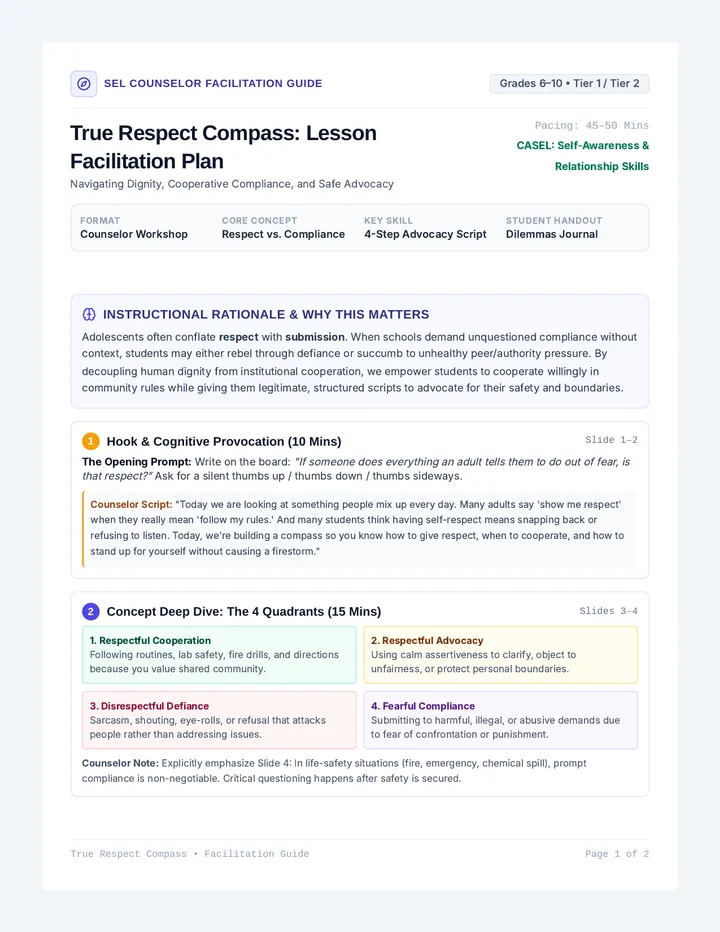
Respect Compass Counselor Guide
SEL Counselor Facilitation Guide
Grades 6–10 • Tier 1 / Tier 2
True Respect Compass: Lesson Facilitation Plan
Navigating Dignity, Cooperative Compliance, and Safe Advocacy
Pacing: 45–50 Mins CASEL: Self-Awareness & Relationship Skills
Format Counselor Workshop
Core Concept Respect vs. Compliance
Key Skill 4-Step Advocacy Script
Student Handout Dilemmas Journal
Instructional Rationale & Why This Matters
Adolescents often conflate respect with submission. When schools demand unquestioned compliance without context, students may either rebel through defiance or succumb to unhealthy peer/authority pressure. By decoupling human dignity from institutional cooperation, we empower students to cooperate willingly in community rules while giving them legitimate, structured scripts to advocate for their safety and boundaries.
1
Hook & Cognitive Provocation (10 Mins)
Slide 1–2
The Opening Prompt: Write on the board: "If someone does everything an adult tells them to do out of fear, is that respect?" Ask for a silent thumbs up / thumbs down / thumbs sideways.
Counselor Script: "Today we are looking at something people mix up every day. Many adults say 'show me respect' when they really mean 'follow my rules.' And many students think having self-respect means snapping back or refusing to listen. Today, we're building a compass so you know how to give respect, when to cooperate, and how to stand up for yourself without causing a firestorm."
2
Concept Deep Dive: The 4 Quadrants (15 Mins)
Slides 3–4
1. Respectful Cooperation Following routines, lab safety, fire drills, and directions because you value shared community.
2. Respectful Advocacy Using calm assertiveness to clarify, object to unfairness, or protect personal boundaries.
3. Disrespectful Defiance Sarcasm, shouting, eye-rolls, or refusal that attacks people rather than addressing issues.
4. Fearful Compliance Submitting to harmful, illegal, or abusive demands due to fear of confrontation or punishment.
Counselor Note: Explicitly emphasize Slide 4: In life-safety situations (fire, emergency, chemical spill), prompt compliance is non-negotiable. Critical questioning happens after safety is secured.
True Respect Compass • Facilitation Guide Page 1 of 2
Applied Skills & Facilitation Guide
Part II: Practice & Intervention
3
Guided Scripting & Partner Roleplay (15 Mins)
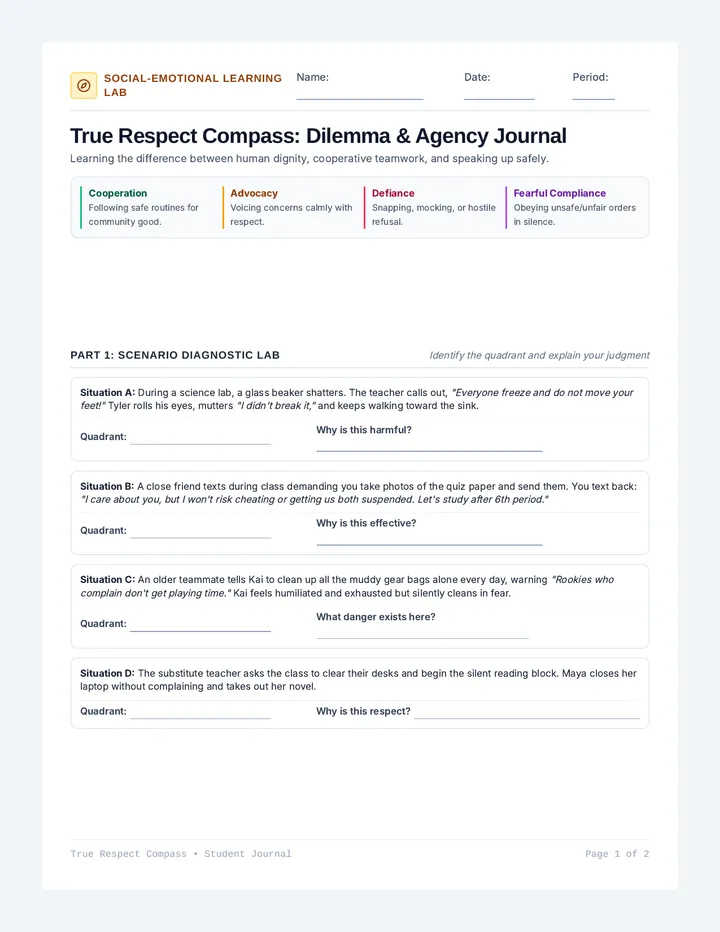
Respect Compass Dilemmas Worksheet
Social-Emotional Learning Lab
Name:
Date:
Period:
True Respect Compass: Dilemma & Agency Journal
Learning the difference between human dignity, cooperative teamwork, and speaking up safely.
Cooperation Following safe routines for community good.
Advocacy Voicing concerns calmly with respect.
Defiance Snapping, mocking, or hostile refusal.
Fearful Compliance Obeying unsafe/unfair orders in silence.
Part 1: Scenario Diagnostic Lab
Identify the quadrant and explain your judgment
Situation A: During a science lab, a glass beaker shatters. The teacher calls out, "Everyone freeze and do not move your feet!" Tyler rolls his eyes, mutters "I didn't break it," and keeps walking toward the sink.
Quadrant:
Why is this harmful?
Situation B: A close friend texts during class demanding you take photos of the quiz paper and send them. You text back: "I care about you, but I won't risk cheating or getting us both suspended. Let's study after 6th period."
Quadrant:
Why is this effective?
Situation C: An older teammate tells Kai to clean up all the muddy gear bags alone every day, warning "Rookies who complain don't get playing time." Kai feels humiliated and exhausted but silently cleans in fear.
Quadrant:
What danger exists here?
Situation D: The substitute teacher asks the class to clear their desks and begin the silent reading block. Maya closes her laptop without complaining and takes out her novel.
Quadrant:
Why is this respect?
True Respect Compass • Student Journal Page 1 of 2
Part 2: The Respectful Advocacy Script Lab
Apply the 4-Step Formula
1. Pause & Breathe • Neutral tone 2. Validate • "I understand that..." 3. Perspective • "From my view..." 4. Propose • "Could we try..."
Challenge 1: Teacher Communication
Context: Your history teacher announces an unannounced 6-page project due tomorrow morning. You already have a major math test scheduled for tomorrow and feel overwhelmed.
Step 2 (Validate the teacher's goal):
Step 3 (State your honest view using calm "I" language):
Step 4 (Propose a respectful compromise or solution):