Breakdown Blueprint Slides
Executive Skills Lab
20-MINUTE FOCUS
The Breakdown Blueprint
How to deconstruct massive assignments, kill the cram cycle, and plan like a project architect.
1
Deconstruct
2
Estimate Effort
3
Calendar Realistically
The Trap
Why Big Projects Derail
The "Later" Myth
"It's not due for two weeks, so I have plenty of time." You view the project as one giant blob instead of distinct tasks.
Result: Sunday at 10:00 PM crisis panic.
The Planning Fallacy
We naturally underestimate how long each step takes by 50% or more, ignoring sports, family, and exhaustion.
Antidote: Build buffer time into every stage.
Big tasks feel overwhelming because your brain cannot picture where to start. Break it down = Calm control
The System
4 Steps to Total Clarity
01
Define
Identify exact deliverables and the teacher rubric requirements.
"What does finished look like?"
02
Chunk
Split the giant project into 4 to 6 separate milestones with tangible outputs.
"What is milestone 1, 2, 3?"
03
Buffer
Estimate minutes needed per chunk, then add 25% safety cushion for roadblocks.
"Estimate time + 25%"
04
Calendar
Assign dates working backwards from deadline minus 1 day for final review.
"Lock in specific work slots"
Rule of Thumb: If a milestone takes more than 90 minutes, break it down further!
Case Study
Deconstructing a 4-Page Research Report
The Vague, Overwhelming Plan
Week 1: "Work on history paper"
Week 2: "Keep writing paper"
Night before: Write 4 pages from scratch until 3 AM
Problem: No specific stopping points, high stress.
The Milestone Breakdown Plan
1. Pick topic & find 3 sources 45 min
2. Thesis statement & 3-point outline 30 min
3. Draft Section 1 & 2 60 min
4. Draft Section 3 & Conclusion 60 min
5. Proofread & Citation Check 30 min
Notice: Each milestone produces a finished mini-product. You can feel momentum!
Scheduling
The "Real Life" Calendar Check
1. Block "Hard" Clashes
First, block out soccer practices, shifts, family dinners, and club meetings. Do not pretend you will work then.
Respect actual constraints
2. Match Energy to Task
Schedule heavy brain work (outlining, drafting) during peak focus; save formatting and citations for lower energy windows.
Smart energy pairing
3. The 24-Hour Buffer
Always schedule your final milestone to finish at least 24 hours BEFORE the deadline. Printer broke? You are covered.
Zero last-minute fire drills
Never plan for a "perfect" week. Plan for a realistic week that includes surprises.
Now Your Turn
Activity Time (15-20 Min)
Your Mission on the Blueprint Sheet:
A
Pick or Choose a Project
Use your actual upcoming multi-day assignment or the provided scenario.
B
Deconstruct 5 Milestones
Break it down, estimate minutes, and add 25% buffer time.
C
Audit Your Competing Life
Block out practices, tests, shifts, and commitments across the next 10 days.
D
Lock in Milestone Dates
Assign exact target dates with a 24-hour buffer before the final deadline.
Ready? Grab your pencil and worksheet. Goal: Zero panic when the due date hits!
Mission Roadmap Worksheet
Executive Skills Project Planning Lab
Breakdown Blueprint: Task Deconstruction
Phase 1 of 2
Chunking & Effort Estimation
Student Name
Class / Period
Date
1 Step 1: Define the Finish Line
Be crystal clear on what "done" actually looks like
Target Project / Assignment Title:
Official Due Date & Time:
Exact Deliverables Required (e.g., 4 pages typed, slide deck, bibliography):
Key Rubric Expectations (What must be high quality to earn full credit?):
2 Step 2: Deconstruct Into 5 Bite-Sized Milestones
Add 25% safety buffer to avoid the Planning Fallacy!
Milestone Action & Tangible Output
Base Est.
+25% Buffer
Target Date
M1
Ex: Topic selection, primary source gathering (3 sources)
M2
Ex: Thesis statement & structured section outline
M3
Ex: Rough draft of Part 1 / First half of project build
M4
Ex: Rough draft of Part 2 / Second half & visual graphics
M5
Ex: Proofreading, citations, final checks (Finish 24h early!)
The 90-Minute Rule: If any single milestone takes longer than 90 minutes, it is not a milestone—it is a project! Divide it in two.
Flip to Page 2 →
Executive Skills Project Planning Lab
Breakdown Blueprint: Real-Life Scheduling
Phase 2 of 2
Conflict Audits & 10-Day Mapping
3 Step 3: Audit Competing Commitments
Where will your time actually go over the next 10 days?
Sports, Jobs & Clubs
List practices, games, shifts:
Other Tests & Projects
List other big deadlines:
Family & Rest
List chores, travel, downtime:
4 Step 4: The 10-Day Calendar Lock-In
Work backwards from the deadline!
Day 1 Date: _____
Life Conflicts:
Milestone Slot:
Day 2 Date: _____
Life Conflicts:
Milestone Slot:
Day 3 Date: _____
Life Conflicts:
Milestone Slot:
Day 4 Date: _____
Life Conflicts:
Milestone Slot:
Day 5 Date: _____
Life Conflicts:
Milestone Slot:
Day 6 Date: _____
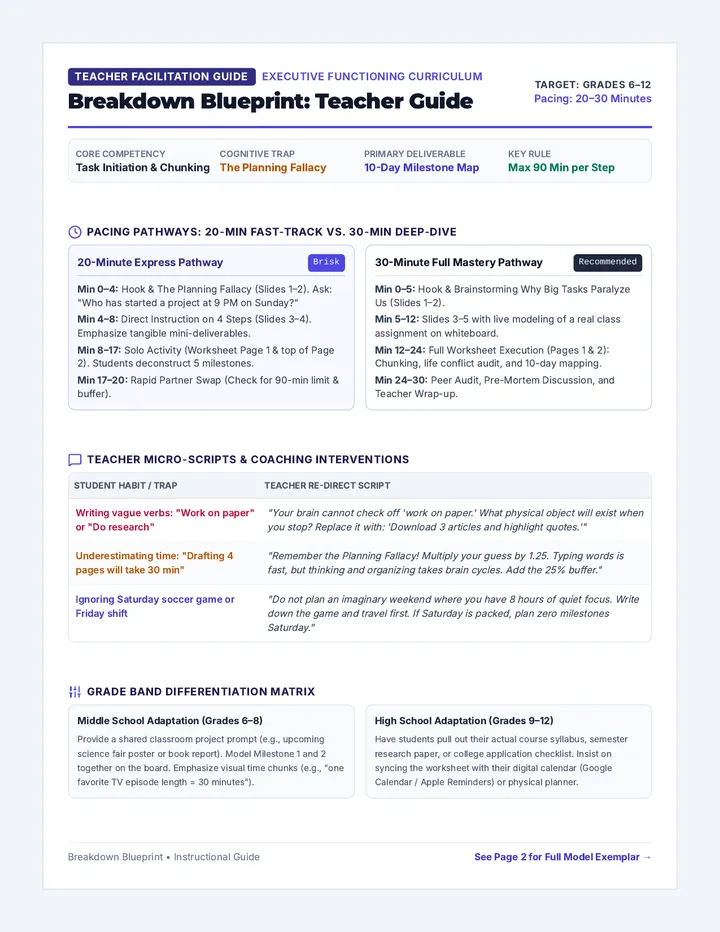
Breakdown Blueprint Teacher Guide
Teacher Facilitation Guide Executive Functioning Curriculum
Breakdown Blueprint: Teacher Guide
Target: Grades 6–12
Pacing: 20–30 Minutes
Core Competency Task Initiation & Chunking
Cognitive Trap The Planning Fallacy
Primary Deliverable 10-Day Milestone Map
Key Rule Max 90 Min per Step
Pacing Pathways: 20-Min Fast-Track vs. 30-Min Deep-Dive
20-Minute Express Pathway Brisk
- Min 0–4: Hook & The Planning Fallacy (Slides 1–2). Ask: "Who has started a project at 9 PM on Sunday?"
- Min 4–8: Direct Instruction on 4 Steps (Slides 3–4). Emphasize tangible mini-deliverables.
- Min 8–17: Solo Activity (Worksheet Page 1 & top of Page 2). Students deconstruct 5 milestones.
- Min 17–20: Rapid Partner Swap (Check for 90-min limit & buffer).
30-Minute Full Mastery Pathway Recommended
- Min 0–5: Hook & Brainstorming Why Big Tasks Paralyze Us (Slides 1–2).
- Min 5–12: Slides 3–5 with live modeling of a real class assignment on whiteboard.
- Min 12–24: Full Worksheet Execution (Pages 1 & 2): Chunking, life conflict audit, and 10-day mapping.
- Min 24–30: Peer Audit, Pre-Mortem Discussion, and Teacher Wrap-up.
Teacher Micro-Scripts & Coaching Interventions
Student Habit / Trap
Teacher Re-Direct Script
Writing vague verbs: "Work on paper" or "Do research"
"Your brain cannot check off 'work on paper.' What physical object will exist when you stop? Replace it with: 'Download 3 articles and highlight quotes.'"
Underestimating time: "Drafting 4 pages will take 30 min"
"Remember the Planning Fallacy! Multiply your guess by 1.25. Typing words is fast, but thinking and organizing takes brain cycles. Add the 25% buffer."
Ignoring Saturday soccer game or Friday shift
"Do not plan an imaginary weekend where you have 8 hours of quiet focus. Write down the game and travel first. If Saturday is packed, plan zero milestones Saturday."
Grade Band Differentiation Matrix
Middle School Adaptation (Grades 6–8)
Provide a shared classroom project prompt (e.g., upcoming science fair poster or book report). Model Milestone 1 and 2 together on the board. Emphasize visual time chunks (e.g., "one favorite TV episode length = 30 minutes").