Test Code Breakers Slides
TOP SECRET MISSION
Grade 2-4 Academy
Code Breakers Agency
What To Do When You're STUCK!
Your secret 4-step mission toolkit to conquer tricky questions and keep your brain calm and powerful.
1
Calm Your Body
2
Hunt the Clues
3
Crack the Code
!
The "Stuck Alert" Is Normal!
Agent Intel
The Freeze Trap
Your heart thumps, your stomach tightens, and your brain whispers: "I have no clue!"
Panic makes you rush and guess blindly.
The Secret Truth
Feeling stuck just means your brain found a high-level puzzle. Every great detective gets stuck before cracking the code!
You have special detective tools to restart!
When you see a monster question: DO NOT RUSH. ACTIVATE PROTOCOL!
1
Step 1: The Brain Reboot
Body Control
1. Hands Down
Put your pencil down on your desk. Unclench your fingers and drop your tight shoulders.
2. 4x4 Box Breath
Breathe in slow for 4 counts... Hold for 4... Breathe out for 4... Oxygen rushes to your thinking brain!
3. Secret Pep-Talk
Whisper in your mind: "I am in control. One question cannot beat me."
Time needed for Brain Reboot: Only 10 to 15 seconds!
2
Step 2: Question Clue Hunter
Investigation
Circle Key Action Words
Look for tricky clue words: NOT, EXCEPT, MAIN, BOTH, DIFFERENCE.
Chop Up Long Stories
Break giant paragraphs into bite-sized sentences. What is happening first?
Kid-Translation Trick
Ask yourself: "If my friend asked me this, what are they really wanting?"
Live Detective Look
"Which detail from the text DOES NOT explain why penguins live in Antarctica?"
Trap alert: Your brain wants to pick what is true! The word "NOT" flips the rules.
Clue Hunt Rule: Never answer until you re-read the exact question question twice!
Step 2 transforms a scary question into a clear set of directions.
3
Step 3: Trash & Treasure
Process of Elimination
Don't try to guess the winning answer immediately. Hunt for the silly imposters first!
1. The Ridiculous Choice
One answer is usually completely bananas or impossible. Slash it out with a bold line!
2. The Sneaky Distractor
Uses words from the story, but answers the wrong question. Slash it!
3. The 50/50 Face-Off
Down to two choices? Now your odds jump from 25% to 50%! Compare both back to text.
Detective Superpower: Throwing away 2 wrong answers makes the right answer glow in the dark!
4
Step 4: Bookmark & Bounce
Time Defense
The 2-Minute Time Rule
If you have been staring at one question for over two minutes, your brain is spinning its wheels.
Spending 10 minutes on one question steals time from questions you know how to solve!
Every question is worth the exact same points!
How to Bounce
- A. Flag or Star the question number on paper or screen.
- B. Make a smart placeholder guess (never leave it blank!).
- C. Bounce forward! Collect points on easier questions.
Your subconscious brain keeps working on it while you move forward!
Circling back with fresh eyes later makes the answer suddenly pop out!
Live Case Study: Put It In Action
Class Trial
The Tricky Case File:
"Marcus has 24 crayons. Elena has twice as many crayons as Marcus. Elena gives 8 crayons to Sam. How many crayons does Elena have now?"
A) 48 crayons Trap! (Forgot to subtract 8)
B) 16 crayons Trap! (Marcus minus 8)
C) 40 crayons CRACKED! (24 x 2 = 48; 48 - 8 = 40)
D) 24 crayons Trap! (Marcus's starting number)
Detective Strategy: Notice the question asked about Elena, not Marcus or Sam!
OFFICIAL DETECTIVE CREED
Repeat After Me, Agents!
"Getting stuck is just my brain warming up for a challenge!"
"I breathe, I reset, and I stay in total control."
"I eliminate silly choices and hunt down true clues."
"I am way smarter than any single test question!"
You are officially ready to crack any test code!
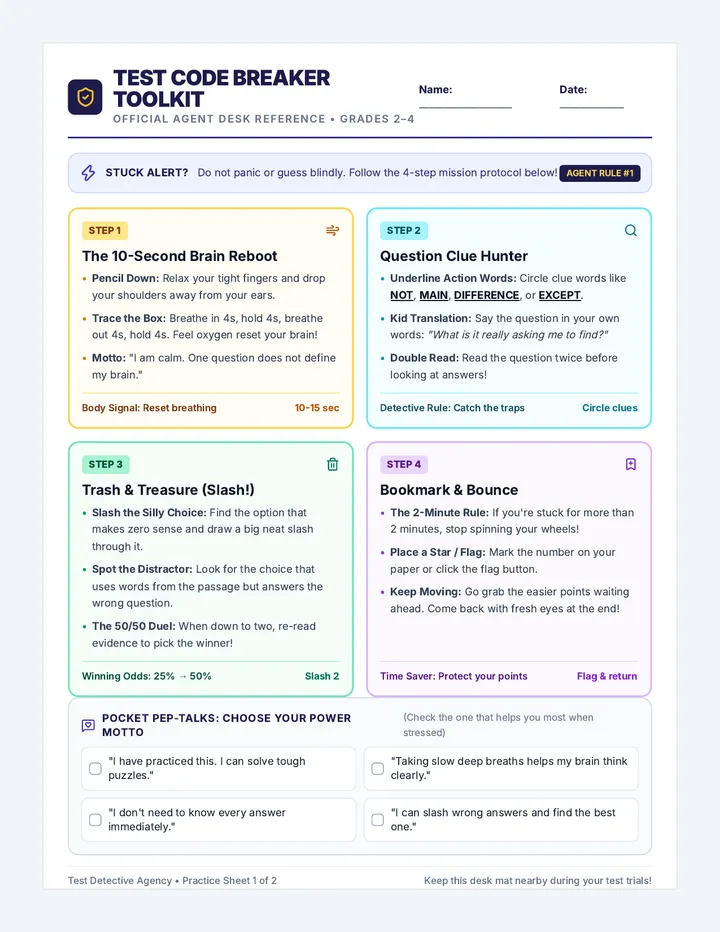
Stuck Buster Toolkit Worksheet
TEST CODE BREAKER TOOLKIT
Official Agent Desk Reference • Grades 2–4
Name: ___________________
Date: _____________
Stuck Alert? Do not panic or guess blindly. Follow the 4-step mission protocol below!
Agent Rule #1
Step 1
The 10-Second Brain Reboot
- • Pencil Down: Relax your tight fingers and drop your shoulders away from your ears.
- • Trace the Box: Breathe in 4s, hold 4s, breathe out 4s, hold 4s. Feel oxygen reset your brain!
- • Motto: "I am calm. One question does not define my brain."
Body Signal: Reset breathing 10-15 sec
Step 2
Question Clue Hunter
- • Underline Action Words: Circle clue words like NOT, MAIN, DIFFERENCE, or EXCEPT.
- • Kid Translation: Say the question in your own words: "What is it really asking me to find?"
- • Double Read: Read the question twice before looking at answers!
Detective Rule: Catch the traps Circle clues
Step 3
Trash & Treasure (Slash!)
- • Slash the Silly Choice: Find the option that makes zero sense and draw a big neat slash through it.
- • Spot the Distractor: Look for the choice that uses words from the passage but answers the wrong question.
- • The 50/50 Duel: When down to two, re-read evidence to pick the winner!
Winning Odds: 25% → 50% Slash 2
Step 4
Bookmark & Bounce
- • The 2-Minute Rule: If you're stuck for more than 2 minutes, stop spinning your wheels!
- • Place a Star / Flag: Mark the number on your paper or click the flag button.
- • Keep Moving: Go grab the easier points waiting ahead. Come back with fresh eyes at the end!
Time Saver: Protect your points Flag & return
Pocket Pep-Talks: Choose Your Power Motto
(Check the one that helps you most when stressed)
"I have practiced this. I can solve tough puzzles." "Taking slow deep breaths helps my brain think clearly." "I don't need to know every answer immediately." "I can slash wrong answers and find the best one."
Test Detective Agency • Practice Sheet 1 of 2 Keep this desk mat nearby during your test trials!
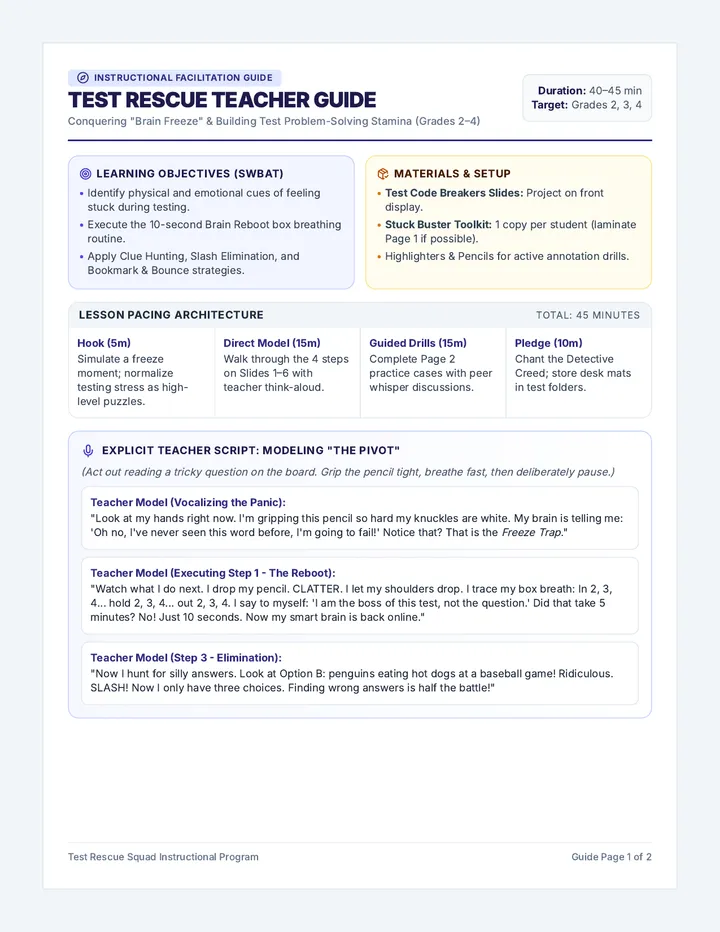
Test Rescue Teacher Guide
Instructional Facilitation Guide
TEST RESCUE TEACHER GUIDE
Conquering "Brain Freeze" & Building Test Problem-Solving Stamina (Grades 2–4)
Duration: 40–45 min
Target: Grades 2, 3, 4
Learning Objectives (SWBAT)
- • Identify physical and emotional cues of feeling stuck during testing.
- • Execute the 10-second Brain Reboot box breathing routine.
- • Apply Clue Hunting, Slash Elimination, and Bookmark & Bounce strategies.
Materials & Setup
- • Test Code Breakers Slides: Project on front display.
- • Stuck Buster Toolkit: 1 copy per student (laminate Page 1 if possible).
- • Highlighters & Pencils for active annotation drills.
Lesson Pacing Architecture Total: 45 Minutes
Hook (5m) Simulate a freeze moment; normalize testing stress as high-level puzzles.
Direct Model (15m) Walk through the 4 steps on Slides 1–6 with teacher think-aloud.
Guided Drills (15m) Complete Page 2 practice cases with peer whisper discussions.
Pledge (10m) Chant the Detective Creed; store desk mats in test folders.
Explicit Teacher Script: Modeling "The Pivot"
(Act out reading a tricky question on the board. Grip the pencil tight, breathe fast, then deliberately pause.)
Teacher Model (Vocalizing the Panic): "Look at my hands right now. I'm gripping this pencil so hard my knuckles are white. My brain is telling me: 'Oh no, I've never seen this word before, I'm going to fail!' Notice that? That is the Freeze Trap."
Teacher Model (Executing Step 1 - The Reboot): "Watch what I do next. I drop my pencil. CLATTER. I let my shoulders drop. I trace my box breath: In 2, 3, 4... hold 2, 3, 4... out 2, 3, 4. I say to myself: 'I am the boss of this test, not the question.' Did that take 5 minutes? No! Just 10 seconds. Now my smart brain is back online."
Teacher Model (Step 3 - Elimination): "Now I hunt for silly answers. Look at Option B: penguins eating hot dogs at a baseball game! Ridiculous. SLASH! Now I only have three choices. Finding wrong answers is half the battle!"
Test Rescue Squad Instructional Program Guide Page 1 of 2
STRATEGIC SUPPORT & TESTING REALITIES
Diagnostic & Implementation
3 Big Elementary Test Traps & Counter-Tactics
1. The "Negative" Word Trap
Words like NOT, OPPOSITE, or trick fast readers who search for what is true.