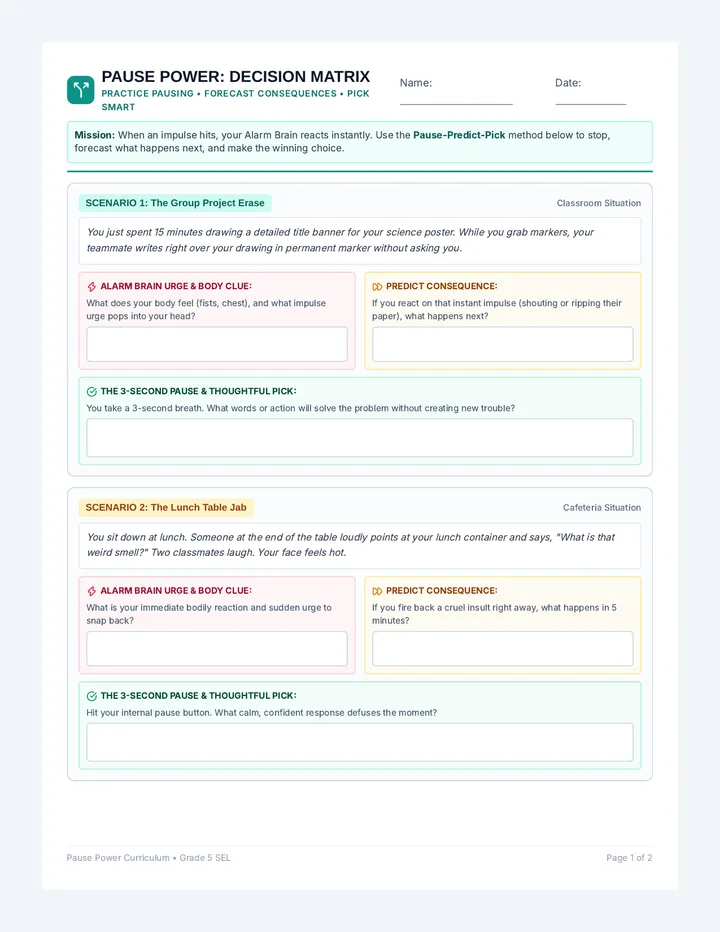
Lane Change Slides Conflict Awareness & Social Skills
Middle School SEL Series
Decision Making & Boundary Setting
STAY IN YOUR LANE
How to stop fueling the fire, spot sneaky instigation, and master the superpower of minding your own business.
Spot Instigation
Starve the Drama
Own Your Space
The Chemistry of Drama
Core Concept
Pouring Gasoline
Instigating Actions
Actions that heat up a clash even if you didn't start the argument.
Chanting "Fight! Fight!" or gathering a crowd
Yelling "You gonna let them talk to you like that?!"
Pulling out a phone to record for likes
Result: Collateral damage & consequences for everyone
Staying in Your Lane
Mind Your Own Business
Deciding not to donate your time, energy, and peace to someone else’s problem.
Refusing to repeat hallway rumors
Walking away from circles forming around arguments
Letting people resolve their own personal disagreements
Result: Zero discipline, maximum peace of mind
Remember: A fire dies in seconds when oxygen and spectators disappear. Spectators give the fire fuel.
Sneaky Instigation: "I Was Just Joking!"
Spot the Trap
Instigating doesn't always look like pushing or yelling. Most drama starts with subtle behaviors:
The "Did You Hear?"
Running to someone with, "Guess what they said about you in 3rd period?"
Motivated by wanting to see an explosion.
The Group Chat Screenshot
Screenshotted private vents and forwarded them to someone else with "Look at this 👀"
Manufacturing drama from behind a screen.
The Sideline Hypeman
Smirking, gasping loudly, or muttering, "Dang, they just disrespected you!"
Pressuring other people to lash out.
Middle School Truth: If you pass along the spark, you are responsible for the fire.
The 4 Roles in Any Conflict
Which One Are You?
1
The Instigator
Stirs the pot, passes rumors, provokes reactions, calls people out to create drama.
Impact: Creates the chaos
2
The Audience / Spectator
Circles around, watches, films, whispers, feeds the conflict with their attention.
Impact: Supplies the stage
3
The Lane Keeper
Recognizes it isn't their business, walks away, refuses gossip, minds their own focus.
Impact: Refuses to feed the drama
4
The Upstander / Cool-Down
Steps in safely ONLY to protect a peer or immediately notifies a trusted adult when safety is at risk.
Impact: De-escalates or gets help
Key Distinction: Staying out of personal arguments is mature. Getting an adult for physical danger is courageous.
Scenario Challenge: What Would You Do?
Class Discussion
Locker Bay Drama
"Jordan is furious because Kai sat at Jordan's usual lunch table. Jordan storms up to you in the locker bay and says: 'You heard what Kai did? Tell me you saw that! We need to go confront him right now.'"
Instigating Response
"Yeah! That was totally disrespectful, let's go get him!"
Spectating Response
Following Jordan down the hall silently just to see what happens.
Lane-Keeping Response
"Bro, it's just a table. That's between y'all—I'm heading to science."
Turn to a neighbor: What makes the Lane-Keeping response hard to say in real life?
Power Phrases: Pocket Scripts
De-escalate & Detach
Memorize these phrases so you don't freeze or get dragged into someone else's storm:
When someone asks you to pick a side
"I'm cool with both of you. That's between y'all."
Sets an immediate neutral boundary.
When someone tries to gossip or bait you
"I don't know anything about that, and I'm staying out of it."
Starves the rumor of an audience.
When an argument starts heating up in front of you
"I'm heading to my locker—see you in class."
Physical detachment breaks the spectator circle.
When you feel the urge to instigate a friend
"Take a breath. It's really not worth getting suspended over."
A true friend cools the fire instead of stoking it.
Saying nothing and walking away is never weak—it is a calculated power move.
Your Daily Challenge
Put It Into Practice
Own Your Peace Today
Before you speak, forward a message, or step into someone else's circle, ask yourself:
Question 1: Is this my business, or am I being an unnecessary spectator?
Question 2: Will what I am about to say add fuel or throw water on the fire?
Question 3: Am I ready to handle the consequences if this blows up?
Ready for the Scenario Activity! Stay in your lane. Protect your energy.
Drama Radar Scenario Activity Middle School Life Skills • Conflict Awareness
DRAMA RADAR: SCENARIO LAB
Name:
Date:
Period:
Fueling (Instigating): Stirring up trouble, hyping up a fight, sharing gossip.
Spectating: Circling up, staring, filming, giving conflict an audience.
Lane-Keeping: Minding own business, walking away, keeping calm.
Part 1: Conflict Role Diagnosis • Read each scenario and mark the behavior.
SCENARIO 1: The Group Chat Leak Digital Dynamics
Devon takes a screenshot of Marcus venting about how annoying Tyler was in PE. Devon immediately sends the screenshot to Tyler with the message: "Look at how Marcus is talking about you behind your back 👀 you gonna let him do that?"
What is Devon doing?
Fueling (Instigating) Spectating Lane-Keeping
What would Tyler's "Lane-Keeping" move be?
SCENARIO 2: The Hallway Hype Hallway / Passing Period
Two 7th graders bump shoulders near the water fountain and start arguing. Within 15 seconds, eight kids rush over to form a tight circle, pulling out their phones and gasping loudly whenever anyone speaks.
How does the circle of kids affect the fighters?
What is the Lane-Keeper move here?
SCENARIO 3: The Lunch Table Bait Cafeteria Dynamics
At lunch, Mia sits down and tells Sarah: "Everyone at table 4 thinks your presentation was embarrassing." Sarah feels her stomach drop and wants to cry or yell across the cafeteria.
Why do you think Mia brought this up?
How can Sarah starve this drama right now?
Turn page for Part 2 • Script Workshop Page 1 of 2
Action Practice • Verbal Boundaries
PART 2: SCRIPT WORKSHOP (FLIP THE SCRIPT)
Drama Radar • Page 2
When someone tries to hook you into their conflict, having words ready prevents you from making things worse. Transform these common Instigating Lines into Lane-Keeping Power Phrases .
Instigating Line: "Bro, don't let them talk to you like that, push them back!"
Rewrite as a Lane-Keeping / Cool-Down Line:
Instigating Line: "Whose side are you on? You have to choose right now."
Rewrite as a Neutral Boundary Line:
Instigating Line: "Send me that recording of them crying, I won't show anyone I swear."
Rewrite as a Firm Refusal:
PART 3: MY PERSONAL "STAY IN YOUR LANE" CODE
1. One situation where I often feel tempted to jump in or spectate (e.g., group chats, lunch fights, rumors):
Lane Check Exit Ticket LANE CHECK • EXIT TICKET
Name:
Date:
Pd:
Quick check on avoiding drama, recognizing instigation, and staying in your lane.
1. Which of these is an example of INSTIGATING (pouring fuel on the fire)?
Saying: "That's between y'all, leave me out of it." Forwarding a rude screenshot to the person it was about. Walking toward your next class when a crowd forms. Telling an adult when someone is about to get hurt.
2. My Pocket Script: Write one sentence you will use if someone tries to pull you into drama this week:
3. Safety Rule: When is "minding your own business" the WRONG thing to do?
Stay In Your Lane • Conflict Awareness Turn in before the bell
Cut here • 2 slips per page
LANE CHECK • EXIT TICKET
Name:
Date:
Pd:
Quick check on avoiding drama, recognizing instigation, and staying in your lane.
1. Which of these is an example of INSTIGATING (pouring fuel on the fire)?
Saying: "That's between y'all, leave me out of it." Forwarding a rude screenshot to the person it was about. Walking toward your next class when a crowd forms. Telling an adult when someone is about to get hurt.
2. My Pocket Script: Write one sentence you will use if someone tries to pull you into drama this week:
3. Safety Rule: When is "minding your own business" the WRONG thing to do?
Stay In Your Lane • Conflict Awareness Turn in before the bell
Drama Detox Teacher Guide Educator Facilitation Plan • Grades 6–8
STAY IN YOUR LANE • TEACHER GUIDE
45–50 MIN LESSON
SEL / Advisory / Health
Learning Target
Students identify overt and subtle instigating behaviors, evaluate bystander impacts, and practice verbal boundary scripts.
CASEL Alignment
Relationship Skills (healthy boundaries), Social Awareness (perspective-taking), and Responsible Decision-Making.
Materials Included
Lane Change Slides (7 slides), Drama Radar Activity (2 pgs), Lane Check Exit Ticket (2-up slip).
Instructional Sequence & Facilitation Roadmap
0–8 MIN
HOOK & BRAIN WARM-UP (Slides 1–2)
Project Slide 1. Ask: "What makes a small disagreement in the hallway suddenly blow up into a screaming match?" Guide students to the concept of the audience and the match . Contrast pouring gasoline (instigating) vs. staying in your lane (walking away).
8–22 MIN
DIRECT INSTRUCTION & ROLES BREAKDOWN (Slides 3–5)
Deconstruct subtle instigation: screenshot sharing, whispered rumors, and chanting. Emphasize: spectators provide the stage . Without a circle of watching eyes and phones, fights almost never happen. Teach the critical safety distinction: minding your business does not mean ignoring physical violence or bullying.
22–38 MIN
SCENARIO LAB ACTIVITY (Drama Radar Handout)
Distribute the Drama Radar Scenario Activity . Students work in pairs to diagnose the 3 real-life middle school scenarios. Call on pairs to share their rewrites for Part 2 (Pocket Scripts). Have students rehearse saying the lines aloud with confident body language.
38–48 MIN
POCKET SCRIPTS & CLOSING EXIT TICKET (Slides 6–7)
Review the 4 pocket scripts on Slide 6. Distribute the half-sheet Lane Check Exit Ticket . Students independently reflect on their own triggers and write down one committed boundary line before leaving.
Turn page for Answer Key & Facilitator Pushback Strategies Page 1 of 2
Facilitation Coaching & Activity Key
HANDLING PUSHBACK & EXEMPLAR ANSWERS
Teacher Guide • Page 2
Navigating Middle School Defensiveness (What they say vs. How to respond)
Student Pushback 1: "I wasn't instigating! I was just asking what they were arguing about!""Curiosity is natural, but stepping into the physical circle adds crowd energy and pressure. If it doesn't involve your schedule or your safety, looking away removes the stage."