Money Moves Slides Financial Literacy 101
Mini-Lesson
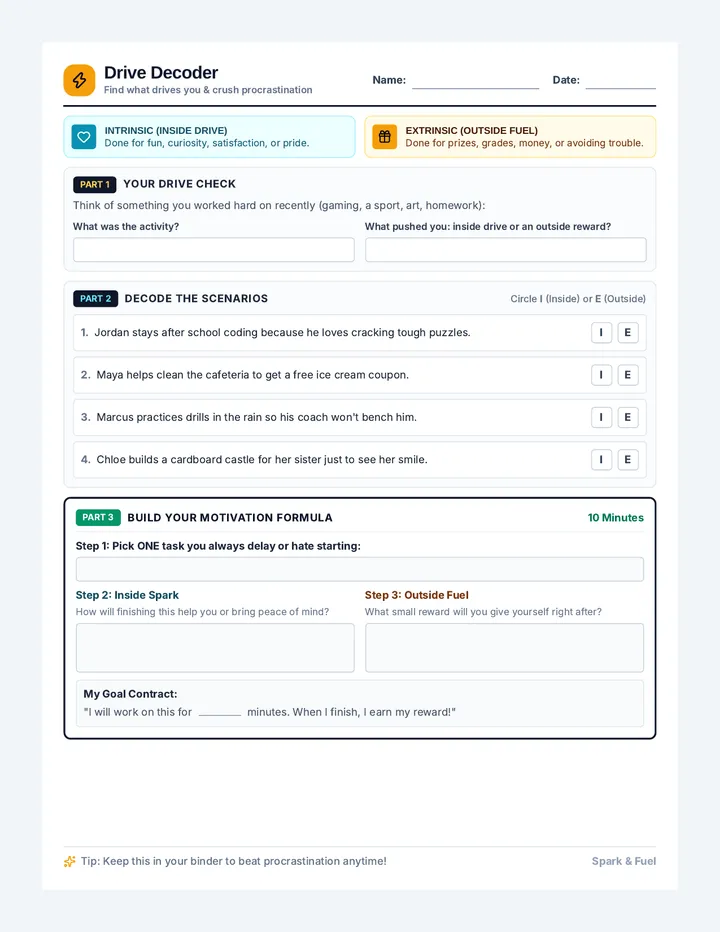
The $10 Dilemma:
Spend It Now or Save for Later?
You just received a crisp $10 bill as a gift. Snacks taste great today, but what happens to your bigger dreams tomorrow?
Evaluate Trade-Offs
Discover Opportunity Cost
Make Smarter Choices
Two Paths for Your $10
The Core Decision
Option A
Spend It Right Away
Buying snacks or candy right now gives you Instant Gratification —immediate happiness that feels great for about 20 minutes.
Outcome: Snacks eaten, wrappers discarded, balance returns to $0.
Option B
Save It in a Bank
Putting it aside practices Delayed Gratification —waiting now so you can buy something bigger, higher-quality, or more lasting later.
Outcome: Your $10 foundation builds toward a major $50 or $100 goal.
Key Question: Is the quick treat worth delaying what you really want most?
The Hidden Concept: Opportunity Cost
Economic Thinking
Opportunity Cost: The next best thing you must give up whenever you make a decision.
Every $1 spent
Is $1 that can no longer work toward your next video game, sneakers, or trip.
Time is a factor
Saving takes patience. Spending takes 30 seconds. Real value rewards patient savers.
Future Freedom
Money in the bank gives you choices, security, and power when an unexpected opportunity arrives.
Remember: Money can only be spent once . What you sacrifice matters just as much as what you buy.
Quick Crunch vs. Big Target
Visualizing the Math
Path 1: Snacks Today
$10 on Soda & Chips
Enjoyment lasts 15-30 minutes
Zero value remaining next week
Goal progress delayed by 100%
Total lasting impact: None
Path 2: Deposit in Savings
$10 into Goal Fund
Covers 20% of a $50 dream purchase
Builds lifelong saving momentum
Lasting satisfaction when goal is reached
Total lasting impact: Achieved goal
Five $10 gifts saved = $50 . That buys a bicycle helmet, concert ticket, or game console accessory!
Your 3-Question Decision Test
Smart Spender Rule
Before spending any gift or earned money, ask yourself:
1
Will this matter in 24 hours?
If the answer is no, you are trading permanent cash for temporary pleasure.
2
Do I have a specific larger goal?
Saving is much easier when you name exactly what you are saving for.
3
Can I compromise with the 50/50 rule?
You could save $7 and spend $3, getting a small treat while honoring your future self!
Next: Complete your worksheet and defend your personal verdict on the $10 gift!
Smart Spenders Worksheet Smart Spenders Worksheet
Financial Literacy: Analyzing Spending, Saving & Trade-Offs
Student Activity
Name: __________________________
Date: __________________
Class/Period: ____________
1
Key Vocabulary Matching
Match each concept to its real-world example by writing the correct letter (A, B, or C) in the bracket.
1. Instant Gratification
Choosing immediate pleasure right now.
Match: [ _____ ]
2. Delayed Gratification
Waiting patiently for a larger future reward.
Match: [ _____ ]
3. Opportunity Cost
The next best option sacrificed by your choice.
Match: [ _____ ]
A: The $10 concert ticket you can't buy because you ate $10 snacks. B: Eating chips immediately. C: Depositing $10 into a savings bank.
2
Case Studies: What Would You Advise?
Case A: Marcus & the $60 Skateboard Fund
$10 Gift Received
Marcus currently has $30 saved toward a $60 skateboard. Friends are heading to the corner store to buy specialty soda and candy ($10 total). He wants to join them.
1. If Marcus spends his $10 on snacks today, what is his exact opportunity cost?
2. Propose a smart compromise Marcus could make instead of choosing all-or-nothing:
Case B: Maya’s Unexpected Cash Envelope
No Target Goal Yet
Maya gets $10 from her aunt. She does not have a specific savings goal right now. Her friend says: "If you don't have something to buy later, you might as well spend it all on treats today!"
Do you agree or disagree with Maya's friend? Give two specific reasons:
3
The $10 Decision Matrix
List two pros and two cons for each choice when you hold a $10 bill.
Option 1: Spend Now on Snacks
Pros (Immediate benefits):
Cons (Losses / Drawbacks):
Option 2: Save in Bank / Goal Fund
Pros (Future benefits):
Cons (Sacrifices):
Smart Money Choices • Student Practice Worksheet • Ready for the final reflection prompt
Future Goals Reflection Future Goals Reflection
Mini-Lesson Synthesis: The $10 Gift Decision
Culminating Reflection
Name: __________________________
Date: __________________
Class/Period: ____________
1
Identify Your Future Goal
Delayed gratification is easier when you have an exciting goal. Define one purchase or milestone you want to reach:
My Target Goal / Item:
Estimated Total Cost:
Target Date / Timeline:
2
Weighing the Dilemma
If you choose to SPEND the $10 right away:
What snack, drink, or item would you get, and how long would that enjoyment last?
If you choose to SAVE the $10 in a bank:
How does this single deposit help build your financial habits and confidence?
3
Your Decision & Written Defense
Prompt Question:
If you receive $10 as a gift, is it smarter to spend it right away on snacks or save it in a bank for a larger future goal? Explain why.
Complete the required sentence frame to start your response:
It is smarter to [ SPEND / SAVE ] the $10 because...
Provide your full explanation below. Support your claim using at least two concepts: instant gratification, delayed gratification, opportunity cost, or personal goal timeline :
Self-Check: Stated clear choice Mentioned opportunity cost Supported with specific reasons
Smart Money Choices • Culminating Reflection • Financial Literacy Unit