Pause Power Teacher Guide PAUSE POWER
5th Grade SEL • Teacher Facilitation Guide
Duration: 45–50 Mins
Lesson Focus & Core Objective
Students learn to interrupt reactive behavior using the Pause-Predict-Pick framework. By recognizing physical impulse signals, calculating realistic outcomes, and choosing thoughtful actions, students build lasting self-regulation skills.
Included Materials
Pause Power Slide Deck
Scenario Decision Sheet
Impulse Radar Reflection
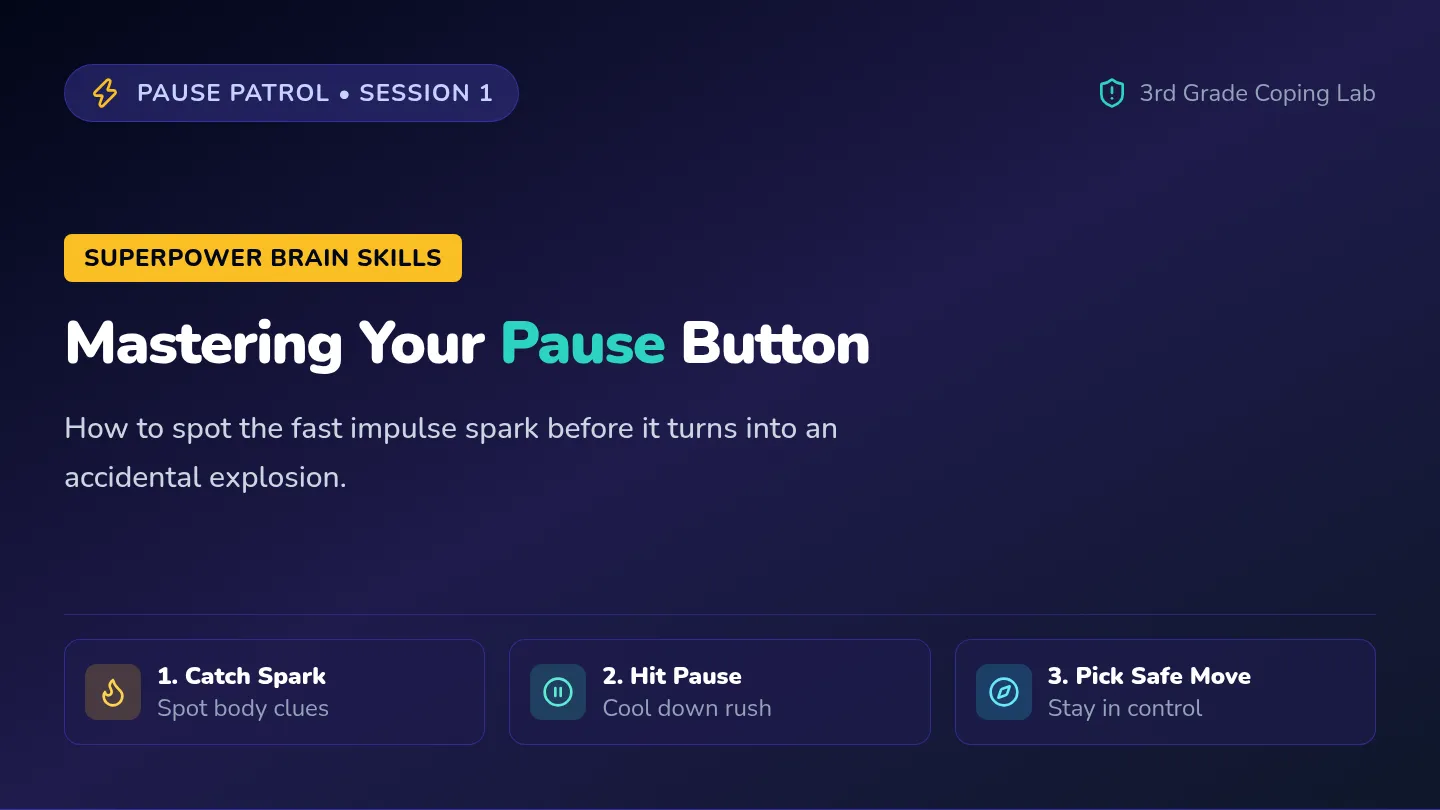
The 3-P Impulse Control Model
1
PAUSE
Freeze physical motion & speech for 3-5 seconds. Take one deep belly breath to let the prefrontal cortex engage.
2
PREDICT
Fast-forward the tape: "If I do this right now, what happens in 5 minutes? How will others react?"
3
PICK
Select the action that protects your goals, respects peers, and avoids unnecessary negative consequences.
Instructional Flow (Phases 1–3)
Phase 1: Hook & Body Clue Hunt (7 Mins) Slides 1–2
Teacher Action: Present the "Remote Control" analogy. Ask: "Have you ever pressed 'Send' or blurted out an answer before your brain caught up?"
Student Goal: Identify bodily impulse cues (heart racing, clenching fists, rapid breathing, fidgeting).
Phase 2: The Science of the "Quick Brain" (10 Mins) Slides 3–4
Teacher Action: Explain the simple battle between the Amygdala ("Alarm Brain") and the Prefrontal Cortex ("Coach Brain"). Teach the 3-second hand-on-chest pause signal.
Key Script: "Impulses are not bad feelings; they are just lightning-fast suggestions. You don't have to obey every suggestion."
Phase 3: Class Scenario Simulation (10 Mins) Slide 5
Teacher Action: Walk through the "Gamer Rivalry" or "Accidental Bump" scenario on screen. Model thinking out loud: "First instinct vs. fast-forwarded outcome."
Interactive Move: Have students display thumbs up (thoughtful choice) or thumbs down (reactive impulse).
Pause Power Curriculum • 5th Grade SEL Page 1 of 2
Facilitation & Differentiation Guide
Pause Power • Grade 5
Phase 4: Small-Group Decision Matrix (12 Mins) Worksheet
Students work in pairs on the Pause Power Scenario Worksheet . They examine 3 authentic fifth-grade situations (group work disagreement, lunch table gossip, recess foul call), trace both paths (Instant Reaction vs. Paused Decision), and document consequences.
Phase 5: Self-Reflection & Radar Check (6 Mins) Exit Ticket
Students complete the Impulse Radar Exit Ticket individually. They rate their impulse hotspots (gaming, teasing, classroom blurting) and craft their personal 3-second pause strategy.
High-Impact Discussion Stems
When asking about bodily sensations:
"Where do you feel an impulse first? In your hands, your jaw, your stomach, or your feet?"
When analyzing consequences:
"If we pick the instant reaction, how will this feel tomorrow morning? What does future-you wish you did?"
When addressing impulsive blurting:
"What is the difference between having an idea and needing to say it instantly? Who is in control?"
When a student feels regret:
"Everyone makes impulsive slips. The power is noticing the cue faster next time. What was your cue?"
Common Misconceptions & Coaching Tips
Misconception:
"Having an impulse means I'm bad." Reinforce that impulses are natural biological surges. Strength is creating the gap between urge and action.
Misconception:
"Pausing means giving up or backing down." Teach students that pausing is a tactical advantage: it keeps them in control of the outcome.
Targeted Differentiation
ELL / Language Support: Provide sentence starters ("My body clue is...", "If I pause, I can...") and visual cue cards for Pause-Predict-Pick.
Kinesthetic / ADHD: Introduce physical anchor gestures: press thumb against index finger for 3 seconds before raising a hand or speaking.
Extension / Leadership: Have students create an "Impulse Forecast Map" for cafeteria lines or group projects to help peers resolve disputes.
Pause Power Curriculum • 5th Grade SEL Page 2 of 2
Pause Power Slides Brain Lab • Grade 5 SEL
Decision Mastery
PAUSE POWER
Master your internal remote control: how to stop, forecast consequences, and make smart moves.
1
Pause Instantly
2
Predict the Future
3
Pick the Smart Move
The First Reaction
What Exactly is an Impulse?
The Lightning Urge
An impulse is a sudden flash of energy telling you to react, speak, or move right now without checking the map first.
"Blurting out an answer, snatching a controller, or yelling back when bumped."
The Golden Truth
Having an impulse is completely normal! Your brain creates urges all day. You don't control the urge, but you always control your action.
Your superpower is the 3-second space between urge and action!
Notice the urge • Freeze the move Pause Power
Brain Architecture
The Tale of Two Brain Engines
Fast & Loud
The "Alarm Brain"
(Amygdala)
• Reacts instantly in less than 0.1 seconds.
• Driven by anger, excitement, or panic.
• Does not care about future consequences!
Calm & Strategic
The "Coach Brain"
(Prefrontal Cortex)
• Needs 3 to 5 seconds to wake up fully.
• Weighs options, rules, and friendships.
• Keeps you out of trouble and in control!
Key Rule: When an impulse strikes, hit pause to let the Coach Brain grab the steering wheel.
The Action Protocol
The 3-P Impulse Control Strategy
P1
PAUSE
Freeze your motion
Take one deep belly breath. Put hands in pockets or on desk. Count: 1... 2... 3...
Gives brain 3 critical seconds
P2
PREDICT
Fast-forward the movie
Ask: "If I do this right now, what happens in 5 minutes? What happens tomorrow?"
Foresee reactions & fallout
P3
PICK
Choose the smart move
Choose the response that protects your reputation, friendships, and goals.
Take proud, calm action
Remember: Pause the body • Predict the movie • Pick the win!
Real-World Test
Scenario: The Art Project Crash
Pause Power Scenario Worksheet PAUSE POWER: DECISION MATRIX
Practice Pausing • Forecast Consequences • Pick Smart
Name:
Date:
Mission: When an impulse hits, your Alarm Brain reacts instantly. Use the Pause-Predict-Pick method below to stop, forecast what happens next, and make the winning choice.
SCENARIO 1: The Group Project Erase Classroom Situation
You just spent 15 minutes drawing a detailed title banner for your science poster. While you grab markers, your teammate writes right over your drawing in permanent marker without asking you.
Alarm Brain Urge & Body Clue:
What does your body feel (fists, chest), and what impulse urge pops into your head?
Predict Consequence:
If you react on that instant impulse (shouting or ripping their paper), what happens next?
The 3-Second Pause & Thoughtful Pick:
You take a 3-second breath. What words or action will solve the problem without creating new trouble?
SCENARIO 2: The Lunch Table Jab Cafeteria Situation
You sit down at lunch. Someone at the end of the table loudly points at your lunch container and says, "What is that weird smell?" Two classmates laugh. Your face feels hot.
Alarm Brain Urge & Body Clue:
What is your immediate bodily reaction and sudden urge to snap back?
Predict Consequence:
If you fire back a cruel insult right away, what happens in 5 minutes?
The 3-Second Pause & Thoughtful Pick:
Hit your internal pause button. What calm, confident response defuses the moment?
Pause Power Curriculum • Grade 5 SEL Page 1 of 2
Part 2: Real-World Scenarios & Your Impulse Fork
Pause Power • Grade 5
SCENARIO 3: The Recess Out Call Playground / Gym
You are on a winning streak in 4-square. Your opponent hits a shot that lands right on the boundary line. Everyone screams "OUT! You're out!" even though you are 100% sure it was inside the square.
Alarm Urge & Physical Signal:
What does your body want to do immediately (kick the ball, scream, refuse to move)?
Predict the Outcome:
If you blow up and refuse to leave, how will the rest of recess go?
The Thoughtful Move (Pick):
How can you pause, accept the call or suggest a replay, and keep the game fun?
Design Your Own Impulse Fork
Think of a situation where you often feel a strong impulse (e.g., losing in a video game, cleaning your room, waiting in line, a sibling taking your things).
My Situation / Trigger:
Pause Power Exit Ticket MY IMPULSE RADAR
Reflection & Personal Commitment
Name:
Date:
Self-awareness is the first step to mastering your pause button. Rate your impulse triggers honestly and map out your personal action plan.
Part 1: Rate Your Impulse Triggers
1 = Rarely Hard • 5 = Very Hard to Resist
1. Blurting out answers or ideas before raising my hand:
1 2 3 4 5
2. Reacting angrily when losing a video game or sports match:
1 2 3 4 5
3. Snapping or rolling my eyes when an adult asks me to do a chore:
1 2 3 4 5
4. Touching things, tapping, or moving around during focus time:
1 2 3 4 5
Part 2: My Body's Early Warning Clue
Check the top 2 ways your body warns you an impulse is firing up:
Clenched fists Fast heartbeat Tight stomach / butterflies Warm or red face Jaw clenching Fidgeting / jittery legs
Part 3: The Fast-Forward Test
Why is taking 3 seconds to "pause and predict" more powerful than saying or doing the very first thing that comes to mind?
Part 4: My Pause Button Commitment
Fill in your custom strategy for when you encounter a strong impulse this week:
When I notice my body clue, I will pause for 3 seconds by:
Before I speak or act, I will ask myself:
Student Signature: Date:
Pause Power Curriculum • Grade 5 SEL Exit Ticket & Reflection