Admissions Edge Tip Sheet Independent School Admissions
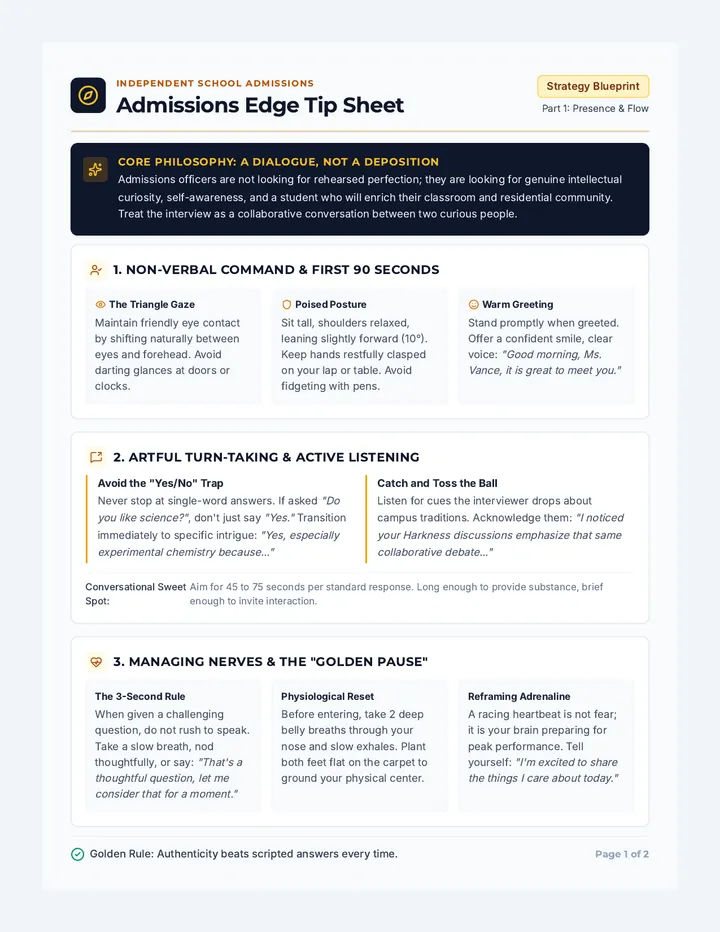
Admissions Edge Tip Sheet
Strategy Blueprint
Part 1: Presence & Flow
Core Philosophy: A Dialogue, Not a Deposition
Admissions officers are not looking for rehearsed perfection; they are looking for genuine intellectual curiosity, self-awareness, and a student who will enrich their classroom and residential community. Treat the interview as a collaborative conversation between two curious people.
1. Non-Verbal Command & First 90 Seconds
The Triangle Gaze
Maintain friendly eye contact by shifting naturally between eyes and forehead. Avoid darting glances at doors or clocks.
Poised Posture
Sit tall, shoulders relaxed, leaning slightly forward (10°). Keep hands restfully clasped on your lap or table. Avoid fidgeting with pens.
Warm Greeting
Stand promptly when greeted. Offer a confident smile, clear voice: "Good morning, Ms. Vance, it is great to meet you."
2. Artful Turn-Taking & Active Listening
Avoid the "Yes/No" Trap
Never stop at single-word answers. If asked "Do you like science?" , don't just say "Yes." Transition immediately to specific intrigue: "Yes, especially experimental chemistry because..."
Catch and Toss the Ball
Listen for cues the interviewer drops about campus traditions. Acknowledge them: "I noticed your Harkness discussions emphasize that same collaborative debate..."
Conversational Sweet Spot: Aim for 45 to 75 seconds per standard response. Long enough to provide substance, brief enough to invite interaction.
3. Managing Nerves & The "Golden Pause"
The 3-Second Rule
When given a challenging question, do not rush to speak. Take a slow breath, nod thoughtfully, or say: "That's a thoughtful question, let me consider that for a moment."
Physiological Reset
Before entering, take 2 deep belly breaths through your nose and slow exhales. Plant both feet flat on the carpet to ground your physical center.
Reframing Adrenaline
A racing heartbeat is not fear; it is your brain preparing for peak performance. Tell yourself: "I'm excited to share the things I care about today."
Golden Rule: Authenticity beats scripted answers every time. Page 1 of 2
Independent School Admissions
Admissions Edge Tip Sheet
Strategy Blueprint
Part 2: Substance & Inquiries
4. The 4 Essential Story Pillars
Prepare 1 concrete anecdote for each
The Academic Curiosity Story
A topic, question, or lab that obsessed you outside normal class requirements. Shows you love learning for its own sake.
The Setback & Resilience Story
A genuine mistake, audition rejection, or bad grade. Focus 20% on the disappointment and 80% on how you adjusted and grew.
The Community & Team Story
A moment you helped an ensemble, resolved peer friction, or mentored a younger student. Demonstrates boarding/campus citizenship.
The Unapologetic Passion Story
Something you do with zero external pressure (sketching, robotics tinkering, baking sourdough, historical podcasts). Shows inner engine.
5. The "Why This School?" Precision Formula
Never give generic answers like "You have high test scores and beautiful dorms." Use this 3-tier structure:
1. Distinct Program / Detail
Name a specific course, signature capstone program, robotics lab, or Harkness discussion table model.
2. Personal Trajectory Alignment
Explain how that exact program connects directly to what you've explored in middle school and want to take further.
3. Your Tangible Contribution
State clearly what energy, club leadership, musical instrument, or positive perspective you will bring to their cohort.
High-Caliber Questions to Ask
Always prepare 3 questions. Ask about culture, not facts found on the home page:
"How do ninth graders best navigate the balance between rigorous coursework and residential/arts life?" "What is a campus tradition that alumni talk about most when they return years later?" "How does the faculty support students when they want to launch a new student initiative?"
Red Flags to Sidestep
Speaking ill of anyone: Never criticize past teachers, classmates, or your current middle school.The Robotic Resume Recital: Avoid reciting awards in a monotone list. Tell the human journey behind the trophy.Parent Puppetry: If you say "My mom wants me to go into pre-law," it signals a lack of self-determination.
Remember: They aren't looking for a finished product; they are looking for a coachable, curious learner. Page 2 of 2
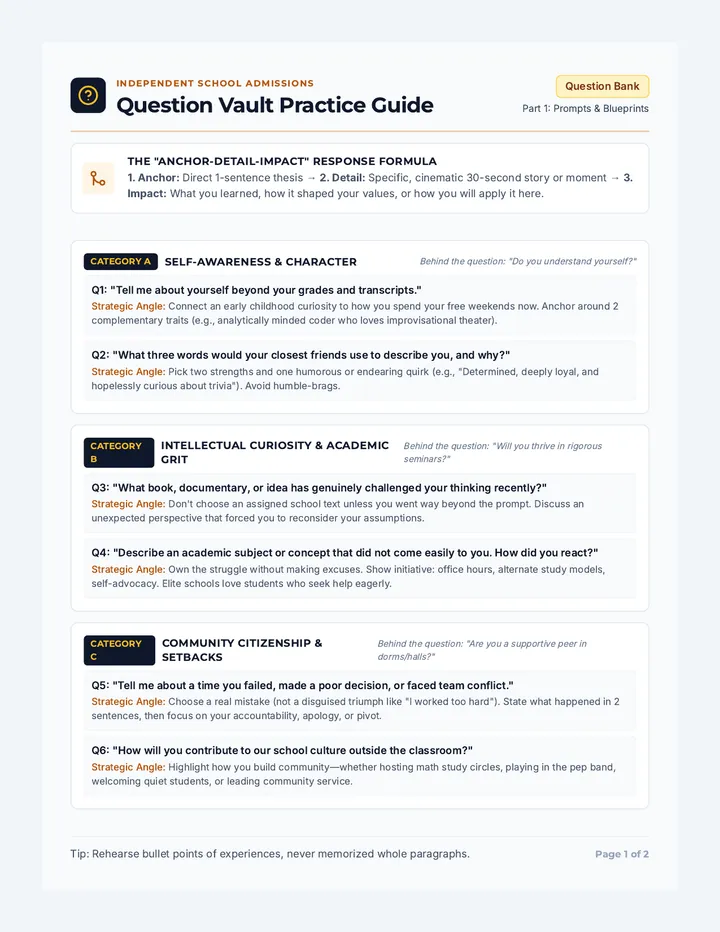
Question Vault Practice Guide Independent School Admissions
Question Vault Practice Guide
Question Bank
Part 1: Prompts & Blueprints
The "Anchor-Detail-Impact" Response Formula
1. Anchor: Direct 1-sentence thesis → 2. Detail: Specific, cinematic 30-second story or moment → 3. Impact: What you learned, how it shaped your values, or how you will apply it here.
Category A
Self-Awareness & Character
Behind the question: "Do you understand yourself?"
Q1: "Tell me about yourself beyond your grades and transcripts."
Strategic Angle: Connect an early childhood curiosity to how you spend your free weekends now. Anchor around 2 complementary traits (e.g., analytically minded coder who loves improvisational theater).
Q2: "What three words would your closest friends use to describe you, and why?"
Strategic Angle: Pick two strengths and one humorous or endearing quirk (e.g., "Determined, deeply loyal, and hopelessly curious about trivia"). Avoid humble-brags.
Category B
Intellectual Curiosity & Academic Grit
Behind the question: "Will you thrive in rigorous seminars?"
Q3: "What book, documentary, or idea has genuinely challenged your thinking recently?"
Strategic Angle: Don't choose an assigned school text unless you went way beyond the prompt. Discuss an unexpected perspective that forced you to reconsider your assumptions.
Q4: "Describe an academic subject or concept that did not come easily to you. How did you react?"
Strategic Angle: Own the struggle without making excuses. Show initiative: office hours, alternate study models, self-advocacy. Elite schools love students who seek help eagerly.
Category C
Community Citizenship & Setbacks
Behind the question: "Are you a supportive peer in dorms/halls?"
Q5: "Tell me about a time you failed, made a poor decision, or faced team conflict."
Strategic Angle: Choose a real mistake (not a disguised triumph like "I worked too hard"). State what happened in 2 sentences, then focus on your accountability, apology, or pivot.
Q6: "How will you contribute to our school culture outside the classroom?"
Strategic Angle: Highlight how you build community—whether hosting math study circles, playing in the pep band, welcoming quiet students, or leading community service.
Tip: Rehearse bullet points of experiences, never memorized whole paragraphs. Page 1 of 2
Independent School Admissions
Question Vault Practice Guide
Mock Rubric
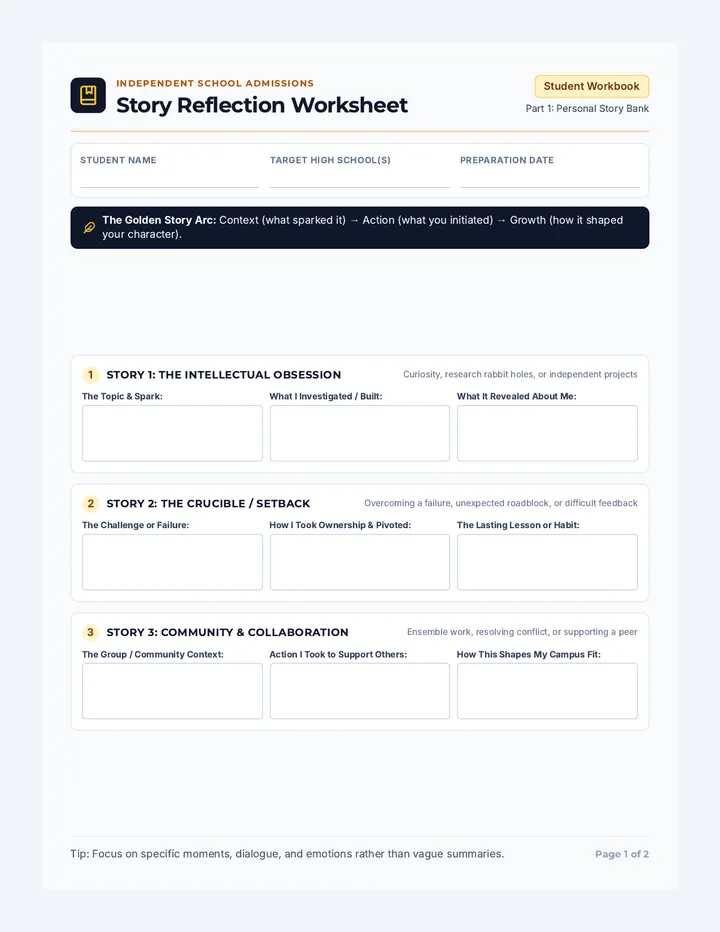
Story Reflection Worksheet Independent School Admissions
Story Reflection Worksheet
Student Workbook
Part 1: Personal Story Bank
Student Name
Target High School(s)
Preparation Date
The Golden Story Arc: Context (what sparked it) → Action (what you initiated) → Growth (how it shaped your character).
1
Story 1: The Intellectual Obsession
Curiosity, research rabbit holes, or independent projects
The Topic & Spark:
What I Investigated / Built:
What It Revealed About Me:
2
Story 2: The Crucible / Setback
Overcoming a failure, unexpected roadblock, or difficult feedback
The Challenge or Failure:
How I Took Ownership & Pivoted:
The Lasting Lesson or Habit:
3
Story 3: Community & Collaboration
Ensemble work, resolving conflict, or supporting a peer
The Group / Community Context:
Action I Took to Support Others:
How This Shapes My Campus Fit:
Tip: Focus on specific moments, dialogue, and emotions rather than vague summaries. Page 1 of 2
Independent School Admissions
Story Reflection Worksheet
Debrief Protocol
Part 2: Reflection & Final Polish
Section A: Post-Mock Self-Assessment
Eye Contact & Poise
Rushed Poised
The Golden Pause
Jumped in Breathed
Authentic Tone
Scripted Natural
Nerve Control
Shaky Grounded
Section B: Performance Diagnostic
1. Which response felt strongest and most authentic? What made it work so well?
2. Which question caused hesitation, rambling, or awkwardness? How will you re-anchor it?
My 3 Core Takeaways
What 3 impressions must the admissions officer remember?
Final 24-Hour Checklist
Reviewed school website, motto & 2 signature programs
Prepared 3 thoughtful questions about student life
Practiced 3-second breathing and smiling in the mirror
Outfit ironed and route mapped to arrive 15 mins early
Be curious, be gracious, and be yourself. You are ready! Page 2 of 2