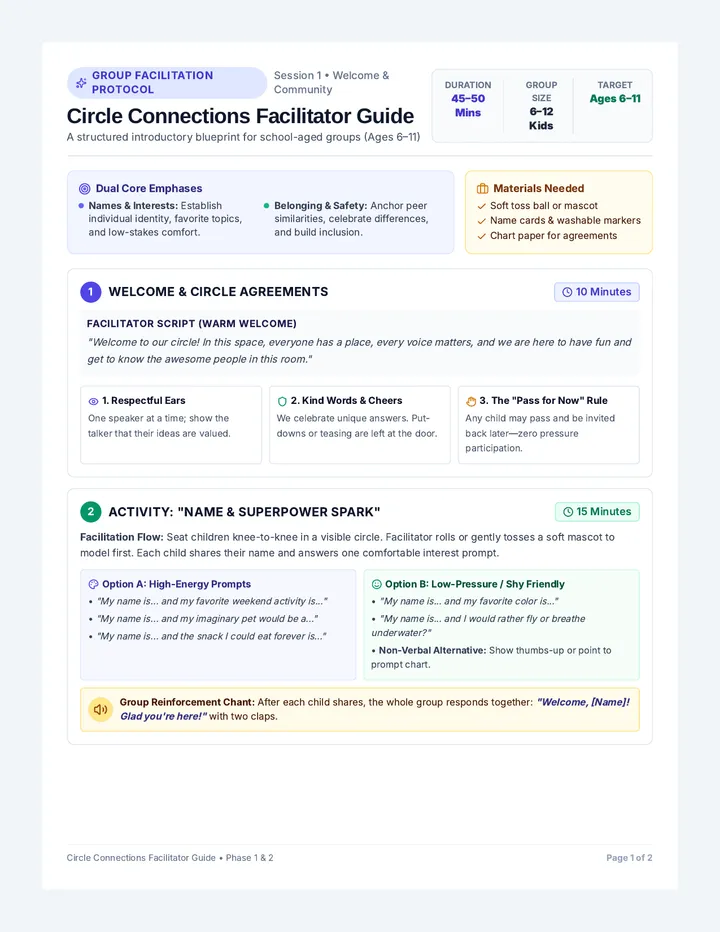
Open Circle Lesson Plan SEL Protocol #04 Grades 2–4 • Social Architecture
The Open Circle Blueprint
Playground Inclusion, Subtle Dynamics & Welcoming Strategies
ESTIMATED TIME 45–55 Minutes
Learning Targets
Identify Subtle Exclusion: Recognize physical cues (back-turning, walling, whispering) that unintentionally lock others out.Architect the "Open Circle": Physically adjust group circles into open crescents/horseshoes welcoming newcomers.Execute 3 Entry Bridges: Deploy the Slide-Over , Rule-Brief , and Role-Offer on the recess yard.
Toolkit Required
• Open Circle Slide Deck
• Circle Maker Game Cards
• Architect Student Journal
• 1 Playground Ball / Cones
Domain: CASEL Relationship Skills
1 The Locked Circle Demonstration (Hook & Spark)
8–10 Mins
Invite 4 student volunteers to form a tight shoulder-to-shoulder ring in the classroom center and pretend to talk about their favorite cartoon or recess game. Ask a 5th student to approach and try to join the conversation without pushing.
Teacher Prompt Script: "Notice where everyone's elbows and heels are pointed. If you're on the outside looking at this tight ring, what invisible message does this shape give off?"
Key Takeaway: Most exclusion on our playground isn't people shouting 'You can't play!' It's geometry—our bodies create closed fortresses by accident.
2 Direct Instruction: Deconstructing Recess Dynamics
15 Mins
Project the Open Circle Slide Deck . Guide students through the contrast between Closed Fortress Circles and Open Crescent Blueprints .
Subtle Exclusion Signals
The Heel Wall: Heels turned completely away.The Speed-Step: Walking slightly faster when approached.The Silent Gaze: Looking at the newcomer then looking back without speaking.
The Open Blueprint Formula
The 45° Angle: Turn one foot outward to leave a gateway.The Eye-Contact Nod: 1-second nod acknowledging arrival.The Verbal Bridge: "Hey Leo, we're talking about four square!"
THE OPEN CIRCLE BLUEPRINT • TEACHER INSTRUCTIONAL GUIDE PAGE 1 OF 2
Instructional Execution & Assessment
Guided Simulation, Debrief & Recess Protocol
Section 3–5
3 Interactive Simulation: Circle Maker Challenge
15 Mins
Divide students into clusters of 4–5. Provide the Circle Maker Game Cards . One student draws a "Playground Dilemma" card (e.g., jump rope rotation, soccer sub-in, lunch-table chatter) while the others act as the group.
Active Roleplay Challenge: The "3-Second Slide"
When the roaming student stands 3 steps away, group members have 3 seconds to execute the Open Circle Shift (stepping back half a pace, opening the shoulder angle) and speak an inclusion prompt: "Hey, want next turn?" or "Slide in right here!"
4 Independent Practice: The Architect Journal
10 Mins
Students complete the Inclusion Architect Journal . They map their typical recess zones, identify their own habits (e.g., "Do I look at the ground when walking past games?"), and author their personal Passcode Phrases for opening circles.
Playground Observation Checklist (Post-Lesson Monitoring)
1. Horseshoe Formations
Students chatting on the blacktop naturally maintain an open "U" shape rather than a locked "O".
2. Role Delegations
Rather than saying "it's full", students offer functional roles (referee, line judge, next batter).
3. Swift Peripheral Scans
Students look up every 2–3 minutes to check if classmates are lingering on the perimeter.
Scaffolded Supports (ELL / Shy)
Provide pre-printed pocket card scripts: "Who's winning?" or "Can I join next round?" Pair socially hesitant students with empathetic recess ambassadors for the first 5 minutes of recess.
Extension / Leadership Challenge
Appoint rotating "Chief Architects" whose covert mission is to spot at least one peer playing alone and invite them into an active game using the Role-Offer method.
THE OPEN CIRCLE BLUEPRINT • TEACHER INSTRUCTIONAL GUIDE PAGE 2 OF 2
Open Circle Slides Blueprint SEL Grades 2–4 • Playground Leadership
SESSION 01
The Open Circle
Blueprint
How small shifts in our body language turn closed playgrounds into welcoming communities.
Recess Social Architecture
Leave Room for One More →
The Big Playground Secret
01 / DISCOVERY
What We Think Happens
People shouting "You can't play with us!" or deliberately pushing people away.
What Actually Happens
Accidental walls! We get so excited playing that our bodies turn into closed locked circles without us realizing.
Most exclusion is not about mean words—it is about body angles!
Two Types of Circles
02 / ARCHITECTURE
The Locked O FEELS: CLOSED
The Fortress Ring
• Backs and heels facing outside
• Tight elbows touching
• No physical door for a newcomer
Signal: "There is no room for you here."
The Open U FEELS: WELCOMING
The Crescent Horseshoe
• Bodies turned outward at 45°
• An intentional open gateway
• Ready to expand when someone walks up
Signal: "You are invited to step right in!"
Architect Rule: Always leave an open gap for a neighbor. Look for the "U" shape!
Spotting Accidental Exclusion
03 / RADAR
1
The Heel Wall
Turning your shoes completely away when someone walks past or stands nearby.
Fix: Pivot one shoe outward!
2
The Whisper Shield
Hiding your mouth or whispering when someone approaches the game area.
Fix: Speak with an open face!
3
The Quick Shift
Walking faster or changing games the second someone asks to play.
Fix: Pause and greet them!
Whenever you spot these cues, you have the superpower to change them!
The 3 Welcoming Bridges
04 / STRATEGIES
A
The Slide-Over Step
Take one step backward to widen the opening without even talking.
Physical Move
B
The Rule-Brief
Say: "Hey! We're playing soccer, 3 touches max. You want red team?"
Clear Context
C
Circle Maker Game Social Simulation Grades 2–4 • 3–5 Players
Circle Maker Playground Game
Practice Spotting Closed Traps & Building Welcoming Open Bridges
GAME ROUND 3–4 Mins Per Card
The 4-Step Simulation Round
1
Draw Scenario
Pick 1 card from Page 2 and read the recess setup.
2
Freeze the Trap
Group strikes the 'Locked Fortress' pose described.
3
The 3s Remix
The Rover walks up; the group shifts into an Open U!
4
Speak Bridge
Use an official Welcome Passcode to earn points.
Player Roles & Missions
The Rover (1 Student)
Approaches the group looking for a way to join. Holds the scenario card and checks whether the circle opened fairly.
The Ring (2–3 Students)
Starts in the closed position. One player must quickly spot the Rover, call out "Shift!" and open the crescent.
The Inspector (1 Student)
Times the shift with hands or counting aloud. Awards 1–3 Architect Points based on eye contact and welcoming tone.
Architect Point Rubric
+1 Point: The Quick Step
At least one person stepped back within 3 seconds to widen the opening.
+1 Point: The Eye-Contact Nod
Someone made friendly eye contact and smiled before speaking.
+1 Point: The Role / Rule Bridge
Explained the game rule or gave a clear spot right away.
Official Welcome Passcodes (Ready-to-Use Phrases) MEMORIZE FOR RECESSS
"Hey! Jump right in next to me—we're playing 4-square."
"We have 4 on this team, want to be our midfielder?"
"Slide over! Room for one more right here in the circle."
"Do you want to run the timer or take the next turn?"
CIRCLE MAKER SIMULATION GAME • INSTRUCTIONS & SCORING PAGE 1 OF 2
Simulation Toolkit
Playground Dilemma Scenario Cards
6 Scenarios
How to play: Cut along dashed lines or point to a card. Rover reads setup; group acts out remix. CUT OR POINT
CARD 01 Zone: Blacktop
The Four-Square Wall
Situation: 4 friends are in squares while 2 wait on the line chatting with backs turned to the blacktop. Maya walks up bouncing a red ball.
Mission: Last person on line steps back and says: "Line starts here Maya! You're 3rd in line."
CARD 02 Zone: Field
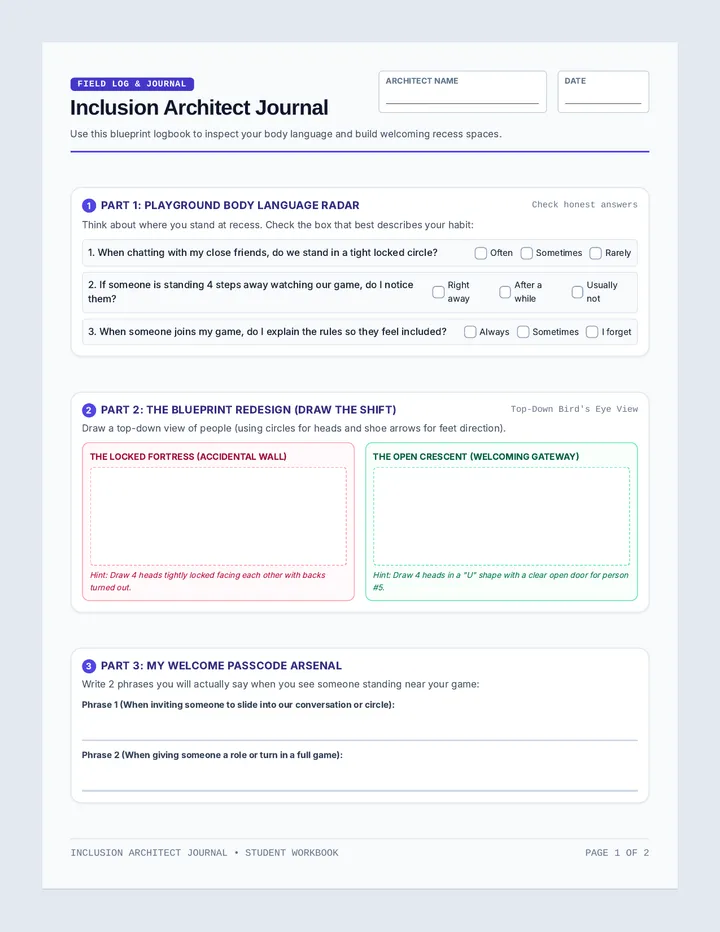
Inclusion Architect Journal Field Log & Journal
Inclusion Architect Journal
Architect Name ________________________
Date ____________
Use this blueprint logbook to inspect your body language and build welcoming recess spaces.
1 Part 1: Playground Body Language Radar
Check honest answers
Think about where you stand at recess. Check the box that best describes your habit:
1. When chatting with my close friends, do we stand in a tight locked circle?
Often Sometimes Rarely
2. If someone is standing 4 steps away watching our game, do I notice them?
Right away After a while Usually not
3. When someone joins my game, do I explain the rules so they feel included?
Always Sometimes I forget
2 Part 2: The Blueprint Redesign (Draw the Shift)
Top-Down Bird's Eye View
Draw a top-down view of people (using circles for heads and shoe arrows for feet direction).
The Locked Fortress (Accidental Wall)
Hint: Draw 4 heads tightly locked facing each other with backs turned out.
The Open Crescent (Welcoming Gateway)
Hint: Draw 4 heads in a "U" shape with a clear open door for person #5.
3 Part 3: My Welcome Passcode Arsenal
Write 2 phrases you will actually say when you see someone standing near your game:
Phrase 1 (When inviting someone to slide into our conversation or circle):
Phrase 2 (When giving someone a role or turn in a full game):
INCLUSION ARCHITECT JOURNAL • STUDENT WORKBOOK PAGE 1 OF 2
Action Blueprint & Weekly Log
Scenario Solving & Playground Field Tracker
Field Edition
4 Part 4: Solve the Recess Dilemma
The Scenario: You and three friends are sitting on the playground curb talking about a video game. Another classmate walks over, stops 5 feet away, and looks down at their sneakers without saying anything. Two of your friends lean closer and keep whispering.
A. What physical move will you make with your body to open the space?
B. What exact words will you say to bring them into the conversation?
C. What can you say to your whispering friends so no one feels awkward?
5 Part 5: 5-Day Recess Architect Field Tracker
Log 1 Action Per Day
After each recess, log one time you opened a circle, offered a role, or welcomed someone in:
Day Playground Zone What Welcoming Move Did You Use?