Strategic Interview Research • Sequence • Lenny.com
Strategic Interview Research
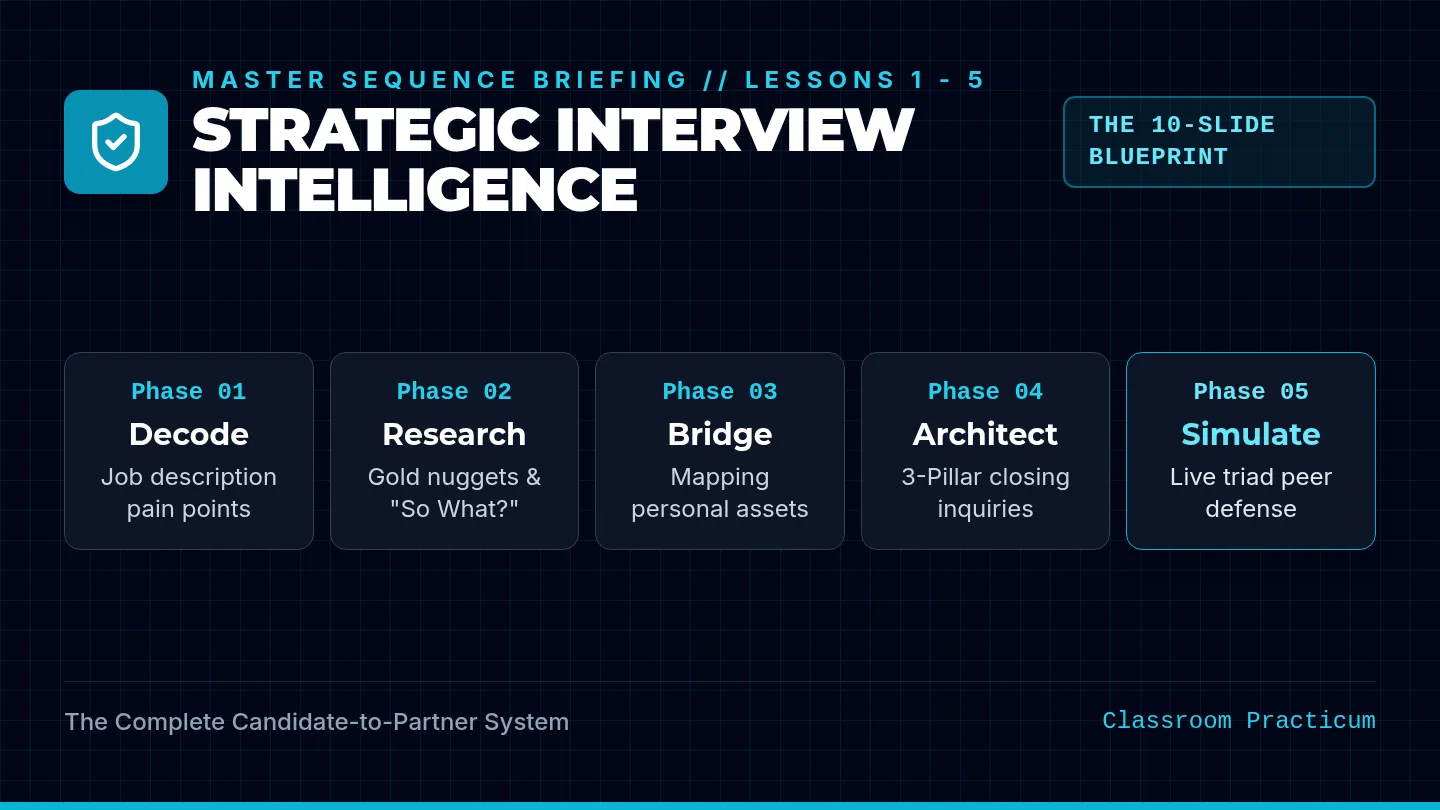
A comprehensive sequence designed to transform 9th-grade students from passive applicants into strategic partners by mastering employer research, job description analysis, and high-impact questioning techniques.
Passing the "So What?" test by digging beyond basic homepage marketing.
Where to Mine Real Nuggets
• Local News & Press Releases: Expansion plans, supply chain pivots, new contracts.
• Leadership Interviews: Podcasts, LinkedIn posts, and quotes about team obstacles.
• Customer Reviews: Gaps where customers complain about service delays.
Source: Verified, recent public data.
The "So What?" Filter
Raw Fact: "SparkStream opened a 3rd dispatch center in Austin."
The "So What?" Translation: "They need reliable inventory tracking to prevent shipment errors across regions."
Facts are worthless without operational meaning.
Target Standard: Have 2 verified Gold Nuggets ready before opening your mouth.
Phase 03 // Lesson 3 Review
The 3-Part Bridge Pitch
How to answer "Why do you want to work here?" by linking pain to personal proof.
Part 01
The Hook
State the company's verified challenge or strategic goal directly to prove you did research.
"I saw that onboarding 40 new suppliers is straining your dispatch queue..."
Part 02
Personal Asset
Present your concrete, proven skill with a quantifiable metric or project outcome.
"In my coursework, I managed tracking logs for 120 client orders with 0 missed deadlines..."
Part 03
The Payoff
Explain the immediate business relief or protection you will deliver on day one.
"I'm here to ensure your inventory tracking stays accurate without lead intervention."
The Bridge Equation: Company Pain + Personal Proof = Irresistible Offer
Phase 04 // Lesson 4 Review
The Question Architect Blueprint
Flipping the power dynamic when asked: "What questions do you have for us?"
Pillar 1
Observation
Ground in public facts or recent initiatives.
"I saw you launched cross-border shipments..."
Pillar 2
Implication
Identify operational strain or team pressure.
"That usually creates customs paperwork bottlenecks..."
Pillar 3
Inquiry
Ask how this seat directly drives the solution.
"How will this role protect transit speed?"
The Impact: You stop being judged and start leading a peer-level strategic consultation.
Phase 05 // Lesson 5 Practicum
The Triad Simulation Protocol
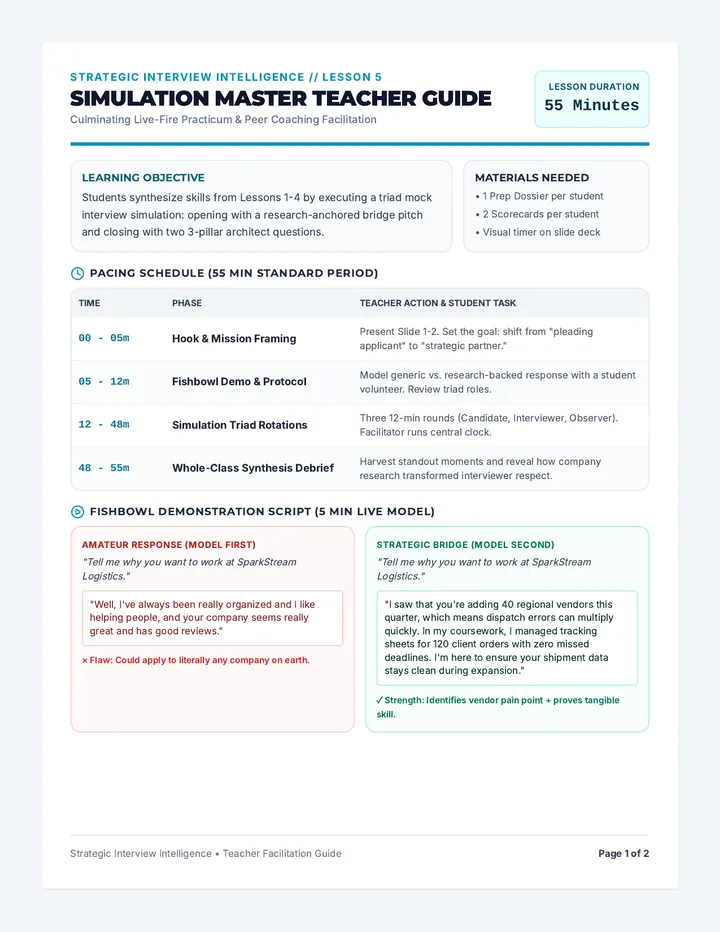
Live-fire practice: Rotate through all three critical perspectives in 12-minute rounds.
1. Candidate
Delivers the research-backed opening bridge statement and initiates 2 targeted architect questions.
Goal: Prove prior homework.
2. Interviewer
Asks core questions from prompt card, probes for specific details, and answers the candidate's closing inquiry.
Goal: Challenge with realism.
3. Observer
Tracks evidence on score rubric. Identifies one standout moment and one critical blindspot.
Goal: Deliver objective data.
Total Practicum Time: 36 Minutes 3 Full Rotations • 12 Min Per Round
Simulation Execution
The 12-Minute Rotation Clock
Precision pacing trains professional agility and composure under real-time constraints.
0:00 - 2:00
Opening Bridge
Candidate delivers tailored pitch linking personal background directly to company need.
First Impression
2:00 - 6:00
Core Defense
Interviewer asks two situational questions. Candidate weaves in researched facts to substantiate answers.
Handling Pressure
6:00 - 9:00
Closing Inquiry
Candidate asks 2 architect questions. The table turns as the candidate steers the conversation.
Architect Phase
9:00 - 12:00
Observer Debrief
Observer delivers feedback using the rubric scorecard. Candidate records one actionable adjustment.
Live Feedback
Central Timer: Listen for the rotation bell every 12 minutes. Prompt feedback beats polite praise
Crisis Agility
Handling Friction & Memory Blanks
What to do when you freeze, get caught off guard, or face unexpected pressure.
1
The 3-Second Pause
Never rush to fill silence. A deliberate breath signals authority and deep executive composure.
"That's an important angle. Let's look at..."
2
The Research Pivot
If you lack a specific figure, pivot cleanly to what you do know about their strategic mission.
"While I don't have that figure, given your goal..."
3
The Clarifier
Turn ambiguity into dialogue by asking the interviewer to specify their exact operational context.
"Are you looking at that from the vendor or client side?"
Executive Reality: Poise isn't knowing everything; it's being completely comfortable thinking under fire.
Sequence Culmination
From Simulation to Career Power
Harvesting the lessons of your 5-phase research journey.
?
The Interviewer Perspective
When candidates mentioned specific company initiatives and bottlenecks, how did your perception shift?
"They didn't feel like a student looking for a paycheck. They felt like an incoming colleague."
!
The Candidate Shift
How did preparing Gold Nuggets and 3-Pillar questions eliminate interview anxiety?
"Having facts ready replaces nervousness with quiet curiosity and genuine confidence."
Permanent Law: Research gives you authority. The interview is simply confirming it.
Standout Moment (The "Hire This Person" Factor):
Critical Blindspot (One Concrete Fix Before Reality):
Strategic Interview Intelligence • Observer Scorecard Page 2 of 2
Ensure interviewers stay in character. Prompt them to ask: "Can you give me an example of how you did that under pressure?"
In The Observer Seat
Confirm observers are actively writing direct quotes and scores on the rubric rather than waiting until the timer rings.
Common 9th Grade Stumbles & Immediate Pivots
Stumble 1: "Trivia Dumping" (Listing company facts without tying to themselves)
Teacher Whisper Prompt: "Add 'and that matters to you because...' at the end of your sentence."
Stumble 2: The Soft Question ("Do you like working here?")
Teacher Whisper Prompt: "Use your 3 pillars: Observation first, then Implication, then Inquiry."
Stumble 3: Vague Peer Feedback ("You did really good!")
Teacher Whisper Prompt: "What specific phrase made you believe they actually read the job post?"
Whole-Class Synthesis Discussion Questions
Q1: To Interviewers: When your candidate cited a specific detail about your company, what happened to your baseline interest?
Q2: To Candidates: How did framing your questions around the employer's challenges change how nervous you felt?
Q3: To Observers: What was the single most impressive bridge statement or question you witnessed in your triad?
Targeted Differentiation
Scaffolding (ELL / Reluctant Speakers)
Provide sentence stems on index cards: "When I researched your project on [X], I realized my experience in [Y] directly helps you solve [Z]." Allow candidate to refer directly to prep notes.
Extension (Advanced / Confident Speakers)
Interviewer delivers an impromptu curveball question: "What if our priorities shifted next week and this initiative was paused?" Candidate must pivot using their gold nugget context.