My Emotional Toolkit Lesson Plan My Emotional Toolkit
Lesson Plan • 9th & 10th Grade
60 Minutes Tier 1 Classroom
Why This Matters
Learning to manage emotions is a crucial life skill that empowers students to navigate challenges, reduce stress, and improve their overall well-being and relationships. This lesson provides practical strategies for emotional self-regulation, building resilience and emotional intelligence.
Preparation
• Review the lesson plan, slide deck, and associated activities.
• Print or prepare for digital display the Emotional Trigger Activity Cards .
• Make copies of the Self-Regulation Strategies Worksheet for each student.
• Ensure projector/whiteboard is ready for the slide deck.
Materials Needed
Projector & Slide Deck
Trigger Activity Cards
Student Worksheets
Markers or Pens
Whiteboard
Learning Objective
Students will be able to identify emotional triggers, develop personal coping mechanisms, and practice self-regulation techniques to manage their emotions effectively, thereby building resilience and emotional intelligence.
Instructional Flow
0:00-0:05
5 MINS
Warm-Up: Emotional Check-in
Begin with a quick emotional check-in. Ask students: "How are you feeling right now? What's one word to describe your current emotion?"
Explain that acknowledging emotions is the first step towards managing them.
Transition by introducing the 'emotional toolkit' concept (Slides 1-2).
0:05-0:20
15 MINS
Understanding Emotions & Triggers
Use Slides 3-5 to define emotions, self-regulation, and triggers.
Facilitate discussion: "What common situations 'trigger' strong emotions for teenagers?"
Introduce Trigger Activity Cards . In small groups or whole class, discuss potential responses to each scenario.
0:20-0:40
20 MINS
Exploring Self-Regulation Tools
Present strategies (Slides 6-10): deep breathing, mindfulness, movement, and talking it out.
For each, briefly explain it and ask for real-life application examples.
Distribute the Self-Regulation Worksheet . Guide students through reflection on current vs. new strategies.
0:40-0:55
15 MINS
Building Your Toolkit
Small groups: Share 1-2 strategies from the worksheet that are most appealing.
Whole-class: "Why do certain strategies resonate? How can practicing these daily help you?"
Emphasize that toolkit building is an ongoing, personal process (Slide 11).
0:55-1:00
5 MINS
Cool-Down: One Takeaway
Ask students to write or share one new strategy or key takeaway.
Collect worksheets for review.
End with an encouraging statement about their growth journey.
My Emotional Toolkit Slide Deck My Emotional Toolkit
How are you feeling today? Let's build some powerful tools together.
Self-Regulation & Resilience
What's an Emotional Toolkit?
🧠
A collection of strategies to manage your feelings effectively.
🛠️
Tools to help you understand , express , and regulate emotions.
🎯
Our Goal: Learn to identify triggers and use healthy coping mechanisms.
Understanding Emotions
😊 😡 😥 🥳
Emotions are natural responses to our experiences.
They give us information about ourselves and the world around us. All emotions are valid , but how we respond to them matters.
What Are Emotional Triggers?
Situations, people, or thoughts that cause a strong emotional reaction .
"It's like a 'switch' for our feelings."
Identifying your triggers is the first step to managing them.
Self-Regulation: Your Inner Control
The ability to manage your emotions, thoughts, and behaviors in different situations.
It's about choosing how you respond , not just reacting .
Why? It helps you stay calm, focused, and make better decisions.
Tool #1: Deep Breathing
Slow, deep breaths can calm your nervous system instantly.
The Method:
Inhale deeply through your nose, hold for a few seconds, exhale slowly through your mouth.
Try it now!
4
In
→
4
Hold
→
6
Out
Tool #2: Mindfulness & Grounding
Paying attention to the present moment without judgment .
Grounding: The 5-4-3-2-1 Technique
👁️
5
See
✋
4
Touch
👂
3
Hear
👃
2
Smell
👅
1
Taste
Tool #3: Movement & Creativity
Physical Activity
Releases endorphins, lowers stress hormones, and physically burns off tension.
Emotional Trigger Activity Cards Emotional Trigger Activity Cards
Discussion Exercise • My Emotional Toolkit
01
Social Media Comparison
You are scrolling through social media and see a friend posting about an amazing trip or achievement that makes your own life feel dull in comparison.
Triggered Emotion(s):
Initial Reaction(s):
02
Academic Pressure
You receive a low grade on a test or assignment that you studied really hard for, and you feel like your effort wasn't enough.
Triggered Emotion(s):
Initial Reaction(s):
03
Friendship Conflict
You overhear a group of friends whispering and laughing, and you get the feeling they might be talking about you or excluding you.
Triggered Emotion(s):
Initial Reaction(s):
04
Family Expectations
Your parents or guardians have very high expectations for your future, and you feel overwhelmed by the pressure to succeed in a specific way.
Triggered Emotion(s):
Initial Reaction(s):
05
Public Speaking
You are asked to give an impromptu presentation in front of your class, and you suddenly feel a rush of anxiety.
Triggered Emotion(s):
Initial Reaction(s):
06
Missed Opportunity
You wanted to try out for a school team or club, but you missed the sign-up deadline, and now you can't join.
Triggered Emotion(s):
Initial Reaction(s):
* Instructions: Discuss each scenario in small groups. Identify possible emotions and reactions.
Self-Regulation Strategies Worksheet My Emotional Toolkit
Self-Regulation Strategies Worksheet
Name:
Date:
Instructions: This worksheet will help you explore different ways to manage your emotions. Reflect on how you currently cope and what new strategies you might want to try.
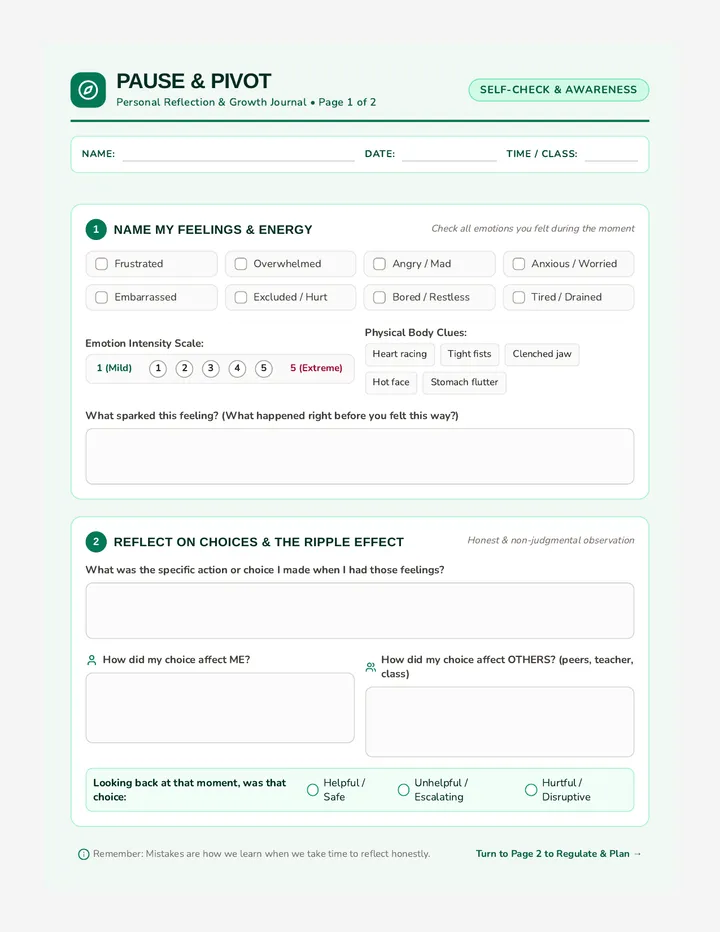
1 Part 1: Identifying Your Go-To Strategies
1. When you feel a strong emotion (anger, sadness, stress), what do you usually do to cope?
2. Are these strategies helpful? Why or why not?
2 Part 2: Exploring New Tools
List at least two specific strategies for each category and explain how they might help you.
A. Body & Breath Strategies
Examples: Deep breathing, muscle relaxation, taking a walk, exercise.
1. Strategy:
How it helps:
2. Strategy:
How it helps:
B. Mind & Focus Strategies
Examples: Mindfulness, grounding (5-4-3-2-1), positive self-talk, distraction.
1. Strategy:
How it helps:
2. Strategy:
How it helps:
C. Connection & Expression Strategies
Examples: Talking to someone, journaling, music, drawing, pets.
1. Strategy:
How it helps:
2. Strategy:
How it helps:
3 Part 3: Building Your Personal Toolkit
Pick THREE strategies you want to try practicing THIS WEEK:
#1
#2
#3
How will you remind yourself to use these strategies?
What is one thing you learned today about managing emotions?
My Emotional Toolkit Quiz Quiz: My Emotional Toolkit
Self-Regulation & Emotional Intelligence
NAME: ___________________________
DATE: ___________________________
01
Which of the following best describes an emotional trigger?
A situation that always makes you happy.
A person who always agrees with you.
A situation or thought that causes a strong emotional reaction.
A strategy for calming down quickly.
02
Explain in your own words what self-regulation means and why it's an important skill to develop.
03
You are feeling overwhelmed with schoolwork and notice your stress levels rising. Which of the following is a self-regulation strategy focused on 'Body & Breath' that you could try?
Scrolling through social media.
Taking a few deep breaths.
Watching TV for an hour.
Ignoring the feeling until it goes away.
04
The 5-4-3-2-1 technique is an example of which type of self-regulation strategy?
Creative Expression
Physical Activity
Grounding/Mindfulness
Talking it Out
05
Name two different self-regulation strategies from the 'Connection & Expression' category and describe how each one could help you manage a strong emotion.
My Emotional Toolkit Quiz Answer Key Quiz Answer Key
My Emotional Toolkit • Teacher Resource
1
Which of the following best describes an emotional trigger?
Correct Answer: C. A situation or thought that causes a strong emotional reaction.
Reasoning: An emotional trigger is something that sparks an intense emotional response. It's not necessarily about happiness or a calming strategy, but rather what initiates a powerful feeling.
2
Explain in your own words what self-regulation means and why it's an important skill to develop.
Suggested Answer: Self-regulation is the ability to manage your emotions, thoughts, and behaviors in different situations. It's important because it allows you to choose how you respond to challenges, stay calm, focus better, and make more thoughtful decisions rather than just reacting impulsively.
Reasoning: Self-regulation is about having control over your internal state and outward actions. It's a foundational skill for mental well-being and positive social interactions.
3
Which of the following is a self-regulation strategy focused on 'Body & Breath'?
Correct Answer: B. Taking a few deep breaths.
Reasoning: Deep breathing is a direct physiological technique that engages the parasympathetic nervous system, helping to reduce heart rate and calm the body's stress response.
4
The 5-4-3-2-1 technique is an example of which type of self-regulation strategy?
Correct Answer: C. Grounding/Mindfulness.
Reasoning: The 5-4-3-2-1 technique involves focusing on the five senses. This actively brings your awareness to the present moment, which is the core principle of grounding.
5
Name two different self-regulation strategies from the 'Connection & Expression' category...
Suggested Answer: 1. Talking to a trusted person: Sharing feelings with a friend or counselor helps process emotions and feel supported. 2. Writing in a journal: Provides a private space to express thoughts without judgment and identify patterns.
Reasoning: Both strategies involve communicating or externalizing feelings rather than suppressing them, which is key to healthy emotional management.