Friendship Soup Slides 1st Grade Counseling • Chef’s Special
🍲
Friendship Soup
What ingredients make a kind, caring, and fun friend?
Warm-Up
Remember What We Learned?
👂
Listening Bodies
We practiced using our eyes, ears, mouth, hands, and feet to show we care!
🐰
Howard B. Wigglebottom
Howard learned that when we really listen, our friends feel happy and safe!
🥣
Ingredient #1
A Listening Body!
👀
Eyes Looking
👂
Ears Listening
🤫
Mouth Quiet
🙌
Hands & Feet Still
🥕 🍅 🥔 🌿
What Goes Into Friendship Soup?
Just like yummy soup needs healthy ingredients, great friendships need kind choices!
Turn & Talk: Tell a partner ONE thing a good friend does!
Yummy Friendship Ingredients
💬
Kind Words
“Thank you!” and “Can I help?”
🧸
Sharing
Letting friends use toys and crayons
🔄
Taking Turns
Waiting patiently in games and lines
🤝
Helping Hands
Checking on a friend who feels sad
In the Pot or In the Trash?
Show 👍 for IN the pot, or 👎 for OUT of the pot!
🗣️
Interrupting a friend
👂
Using a listening body
😢
Saying “You can’t play!”
💛
Inviting someone to join
👩🍳 👨🍳
Time to Make Your Own Soup!
Draw and write 3 yummy ingredients for your Friendship Soup!
Don’t forget: Good friends use Listening Bodies too!
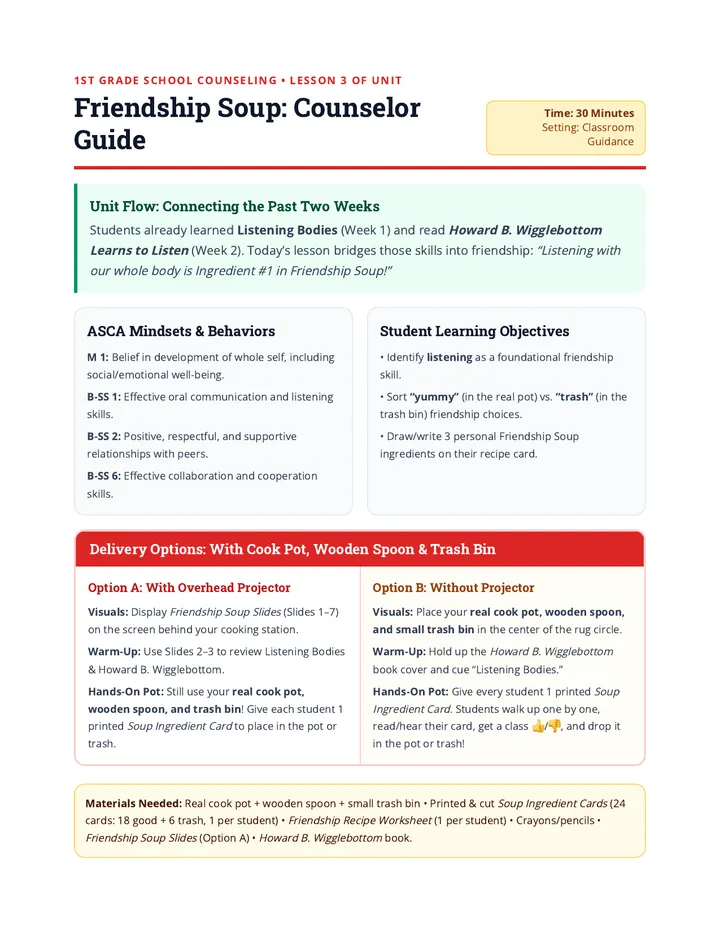
Friendship Soup Counselor Guide 1st Grade School Counseling • Lesson 3 of Unit
Friendship Soup: Counselor Guide
Time: 30 Minutes
Setting: Classroom Guidance
Unit Flow: Connecting the Past Two Weeks
Students already learned Listening Bodies (Week 1) and read Howard B. Wigglebottom Learns to Listen “Listening with our whole body is Ingredient #1 in Friendship Soup!”
ASCA Mindsets & Behaviors
M 1: Belief in development of whole self, including social/emotional well-being.B-SS 1: Effective oral communication and listening skills.B-SS 2: Positive, respectful, and supportive relationships with peers.B-SS 6: Effective collaboration and cooperation skills.
Student Learning Objectives
• Identify listening as a foundational friendship skill.
• Sort “yummy” (in the real pot) vs. “trash” (in the trash bin) friendship choices.
• Draw/write 3 personal Friendship Soup ingredients on their recipe card.
Delivery Options: With Cook Pot, Wooden Spoon & Trash Bin
Option A: With Overhead Projector
Visuals: Display Friendship Soup Slides (Slides 1–7) on the screen behind your cooking station.Warm-Up: Use Slides 2–3 to review Listening Bodies & Howard B. Wigglebottom.Hands-On Pot: Still use your real cook pot, wooden spoon, and trash bin ! Give each student 1 printed Soup Ingredient Card to place in the pot or trash.
Option B: Without Projector
Visuals: Place your real cook pot, wooden spoon, and small trash bin in the center of the rug circle.Warm-Up: Hold up the Howard B. Wigglebottom book cover and cue “Listening Bodies.”Hands-On Pot: Give every student 1 printed Soup Ingredient Card . Students walk up one by one, read/hear their card, get a class 👍/👎, and drop it in the pot or trash!
Materials Needed: Real cook pot + wooden spoon + small trash bin • Printed & cut Soup Ingredient Cards (24 cards: 18 good + 6 trash, 1 per student) • Friendship Recipe Worksheet (1 per student) • Crayons/pencils • Friendship Soup Slides (Option A) • Howard B. Wigglebottom book.
Step-by-Step Facilitation & Pacing
30-Minute Lesson
1. Routine, Conduct & Listening Bodies Cue
2 min
Seat students in a circle around your cook pot, wooden spoon, and trash bin. Cue your routine: “Show me your Listening Body—eyes looking, ears listening, mouth quiet, hands and feet still.” Praise 2–3 students specifically (Domain 2c, 2d).
2. Hook & Bridge from Howard B. Wigglebottom
4 min
Script: “Last week we read about Howard B. Wigglebottom. What happened when Howard started really listening? (Friends felt happy!) Today we’re cooking Friendship Soup in this real pot! Our secret Ingredient #1 is a Listening Body.”
3. Mini-Lesson: Turn & Talk + Cooking Setup
4 min
Turn & Talk: Students tell a partner one thing a good friend does (using Listening Bodies!). Explain that each student will receive one Soup Ingredient Card —some make yummy Friendship Soup, and some belong in the trash!
4. Hands-On Pot Activity: Every Student Adds an Ingredient
10 min
Hand 1 Soup Ingredient Card to each student (mix the 18 good + 6 trash cards). Call students up in small groups or around the circle. Read each card aloud; the class shows 👍 (In the Pot!) or 👎 (In the Trash!). The student drops it in the pot or trash bin, and gives the pot a quick stir with the wooden spoon!
5. Independent Activity: My Friendship Soup Recipe
7 min
Distribute the Friendship Recipe Worksheet . Students draw 3 yummy ingredients in their pot and label them.
Differentiation (Domain 3e): Pre-writers draw and dictate a 1–2 word label; advanced writers write a full sentence (“I will share my crayons”).
6. Closing & Informal Assessment
3 min
Invite 2–3 volunteers to share one ingredient from their pot. Quick check (Domain 3a): “Show me on your fingers: 1 = I’m still learning, 2 = I know how to be a good friend!” Transition smoothly back to the classroom teacher.
Pro Tip for 1st Grade Pacing: Keep transitions snappy with a rhythmic call-and-response (“Chef, Chef!” → “Yes, Chef!” ) so every student gets a turn at the cook pot without losing momentum.
Counselor Evaluation Rubric Alignment
How this lesson demonstrates Proficient–Excellent practice across all four rubric domains.
Domain 1: Planning & Preparation (1a–1e)
1a/1b: Uses developmentally appropriate concrete props (real cook pot, wooden spoon, trash bin) and active participation suited for 6–7 year olds. 1c/1e: Coherently sequences with prior weeks’ lessons (Listening Bodies & Howard B. Wigglebottom ) and aligns to ASCA standards. 1d: Upholds ASCA ethical standards and classroom safety.
Domain 2: The Environment (2a–2e)
2a/2b: Turn-and-Talk and cheering peers at the pot build respectful communication and rapport. 2c/2d: Opening Listening Bodies cue and “Chef, Chef!” call-and-response maintain clear routines. 2e: Inviting circle arrangement around the cooking station works seamlessly with or without a projector.
Domain 3: Delivery of Service (3a–3e)
3a: Pre-check during hook + individual card sorting + closing finger check assess student needs in real time. 3c: Preventative Tier 1 SEL instruction building decision-making and peer problem-solving. 3e: Differentiated worksheet (draw/dictate/write) and projector-free backup ensure responsiveness.
Domain 4: Professional Responsibilities (4a, 4c, 4f)
4a: Post-lesson reflection log below supports objective self-evaluation. 4c: Send home the completed Friendship Recipe Worksheet with a brief note to families/teachers reinforcing “Listening Bodies” and “Kind Words” at home. 4f: Maintains student confidentiality during group sharing.
Post-Lesson Counselor Reflection Log (Rubric 4a)
1. What worked well today (routines, pot/spoon engagement, projector/no-projector setup)?
2. Which students needed extra support or follow-up (Tier 2 small group / check-in)?
Teacher & Family Connection (Rubric 4c): Share a quick 2-sentence email or classroom note: “Today we connected Listening Bodies and Howard B. Wigglebottom to ‘Friendship Soup’! Ask your 1st grader what 3 ingredients they put in their soup pot.”
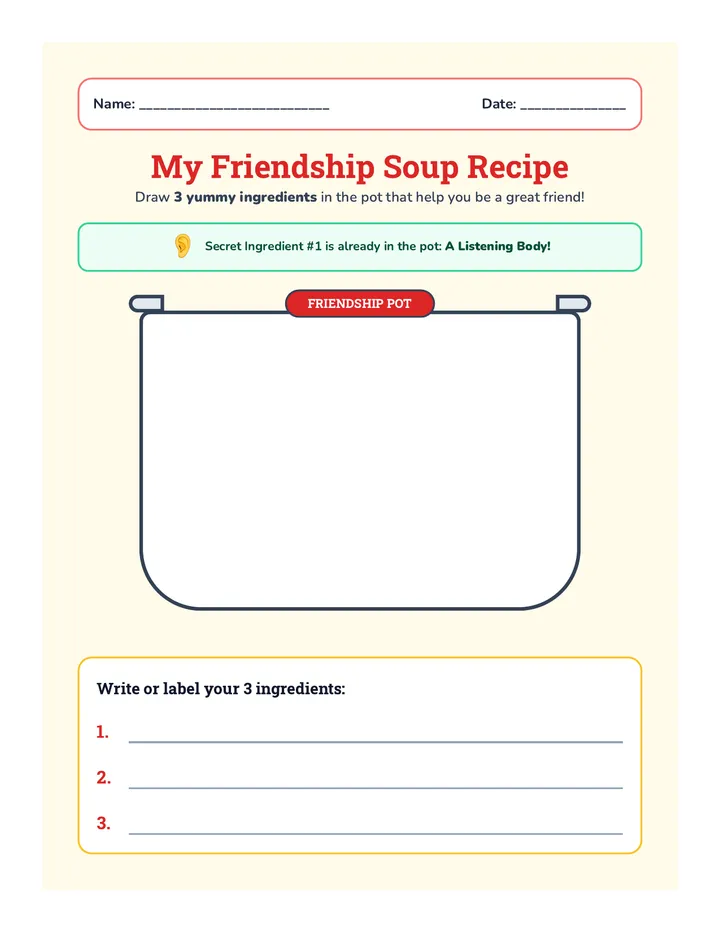
Friendship Recipe Worksheet Name: ___________________________
Date: _______________
My Friendship Soup Recipe
Draw 3 yummy ingredients in the pot that help you be a great friend!
👂
Secret Ingredient #1 is already in the pot: A Listening Body!
FRIENDSHIP POT
Write or label your 3 ingredients:
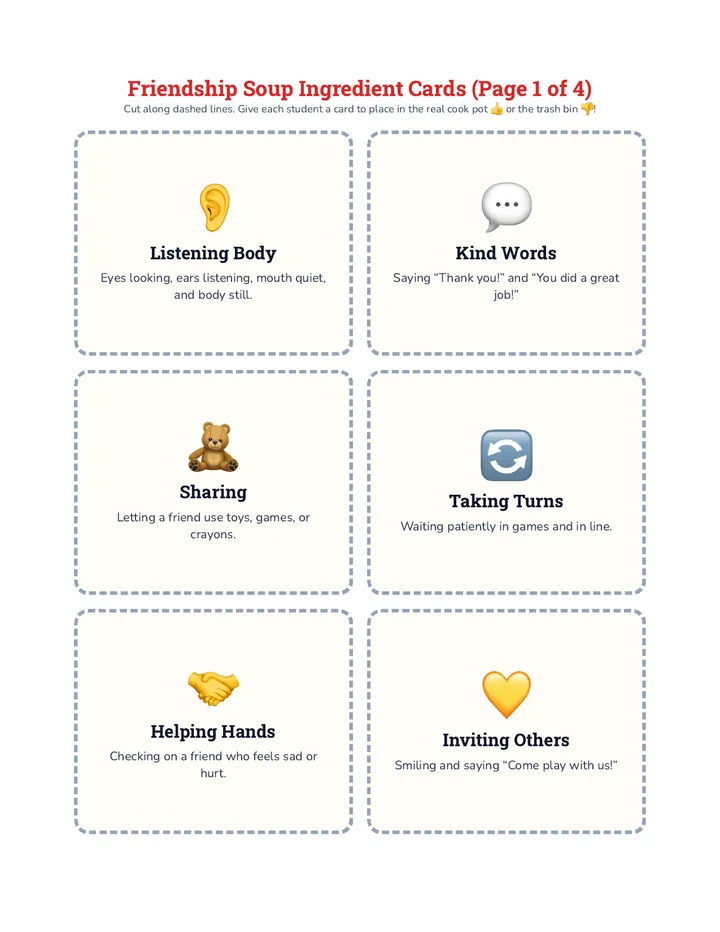
Soup Ingredient Cards Friendship Soup Ingredient Cards (Page 1 of 4)
Cut along dashed lines. Give each student a card to place in the real cook pot 👍 or the trash bin 👎!
👂
Listening Body
Eyes looking, ears listening, mouth quiet, and body still.
💬
Kind Words
Saying “Thank you!” and “You did a great job!”
🧸
Sharing
Letting a friend use toys, games, or crayons.
🔄
Taking Turns
Waiting patiently in games and in line.
🤝
Helping Hands
Checking on a friend who feels sad or hurt.
💛
Inviting Others
Smiling and saying “Come play with us!”
Friendship Soup Ingredient Cards (Page 2 of 4)
Cut along dashed lines. Mix all cards together before handing one to each student!
🩹
Saying Sorry
Saying “I’m sorry, are you okay?” after a mistake.
🙌
Gentle Hands
Keeping hands and feet safe in our own space.
⭐
Being Honest
Telling the truth even when it feels hard.
📣
Cheering Friends On
Saying “You can do it!” when a friend tries.
🙏
Using Manners
Saying “Please” and “Excuse me” to others.
🙋
Asking First
Asking “May I borrow that?” before taking.
Friendship Soup Ingredient Cards (Page 3 of 4)
Cut along dashed lines. Mix all cards together before handing one to each student!
⏳
Being Patient
Waiting calmly while a friend finishes talking.
🌈
Forgiving Friends
Giving a friend another chance after they say sorry.
😊
Friendly Greeting
Saying “Good morning!” with a warm smile.
🧹
Cleaning Up Together
Helping put away blocks, books, or art supplies.
🏆
Good Sport
Saying “Good game!” whether you win or lose.
🐰
Listening Like Howard
Stopping to hear what your friend is saying.
Friendship Soup Ingredient Cards (Page 4 of 4)
Cut along dashed lines. Mix these cards with Pages 1–3 so students sort out the “trash” choices!
🗣️
Interrupting
Talking over a friend while they are still speaking.
😢
Leaving Others Out
Saying “You can’t play with us!” at recess.
😠
Mean Words
Calling a classmate a hurtful or unkind name.
✊
Grabbing Toys
Snatching something out of a friend’s hands.
🚫
Pushing in Line
Shoving someone to get to the front of the line.
👎
Laughing at Mistakes
Giggling when a friend trips or misses a word.