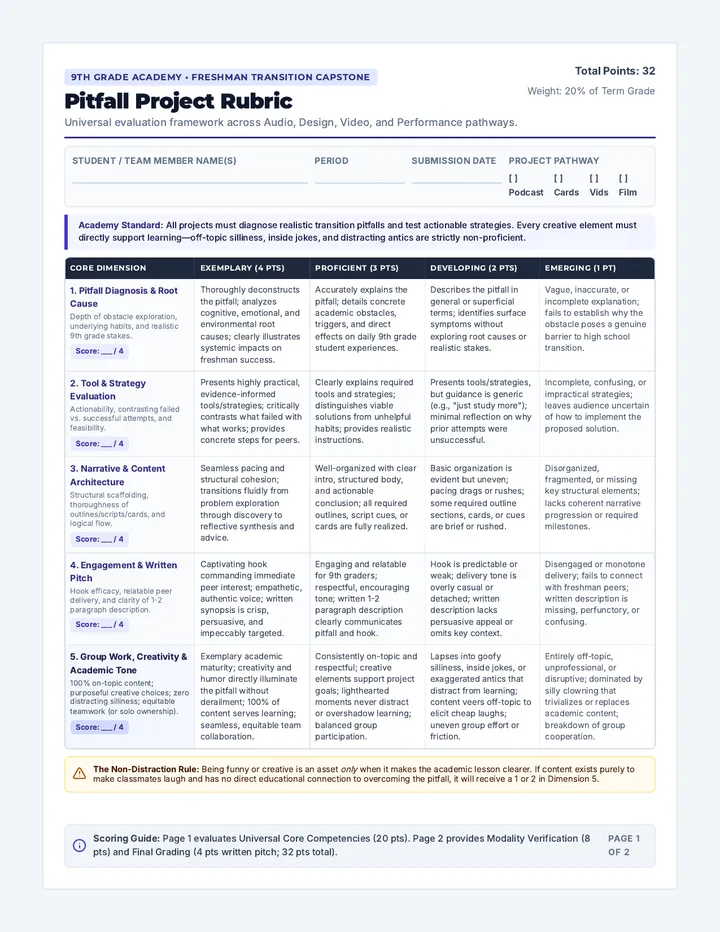
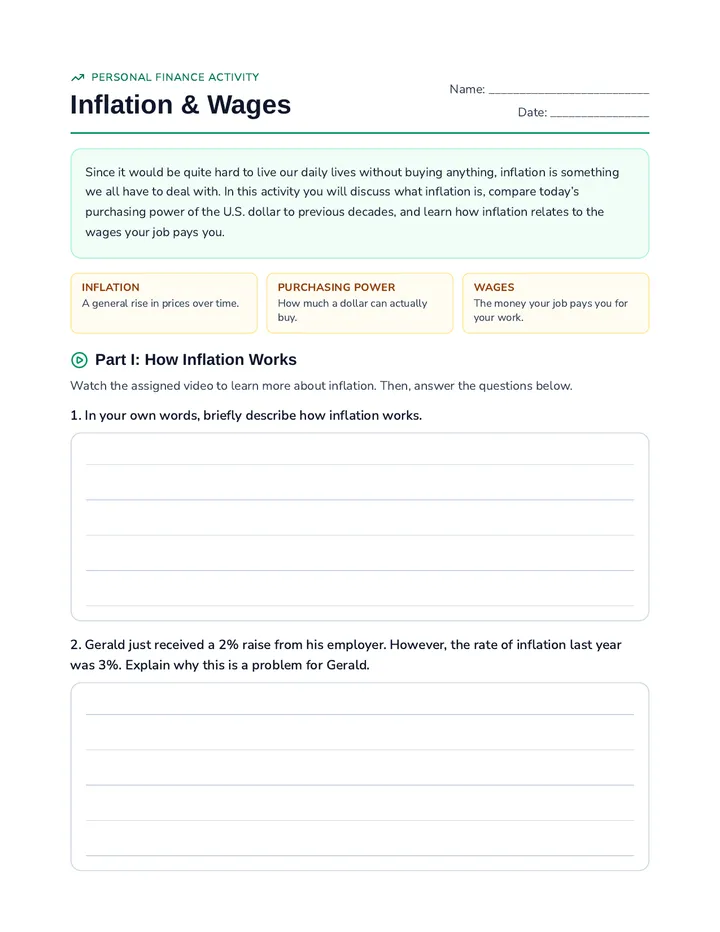
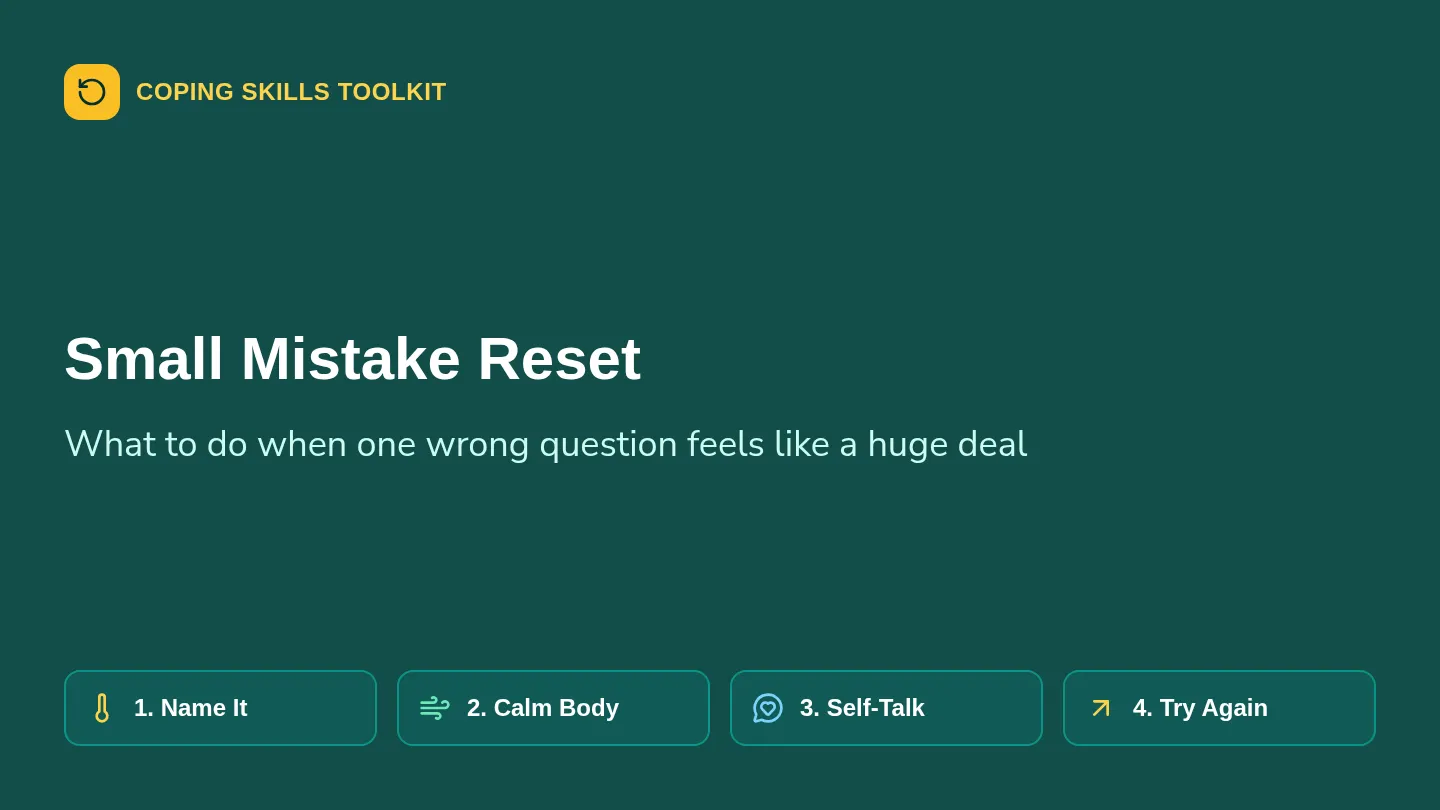
Emotion Radar Slides Steady Minds Studio • Lesson 1
Grade 4 SEL
Body Clues Radar
Learning to notice physical signals, name our feelings accurately, and spot what triggers strong emotions.
1. Body Clues
→
2. Name the Feeling
→
3. Spot the Trigger
All Feelings Are Welcome
Big Idea
Feelings Are Signals
Emotions are like weather—they come and go. Feeling angry, worried, or frustrated does not make you "bad."
Regulation = Steering
Emotional regulation means noticing what you feel and choosing a safe, helpful action—instead of letting the feeling steer for you.
Before you can steer a big feeling, you have to notice it early!
Step 1: Scan Your Body Clues
Body Radar
Head & Face
Hot cheeks, furrowed brow, tight jaw, or racing thoughts.
Chest & Breathing
Fast heartbeat, shallow breaths, or a heavy feeling in your chest.
Stomach
"Butterflies," tight knots, or feeling like you lost your appetite.
Hands & Shoulders
Clenched fists, sweaty palms, raised shoulders, or fidgety feet.
Quick Check: What does your body do right before you feel super frustrated?
Step 2: Name It to Tame It
Word Power
Using specific feeling words helps your brain calm down faster than just saying "I'm mad" or "I'm fine."
Frustrated
Stuck on something hard and wanting it to work.
Overwhelmed
Too many tasks, sounds, or feelings at once.
Worried
Thinking about what might go wrong next.
Disappointed
Hoping for one thing, but getting another.
Embarrassed
Wishing people hadn't seen a mistake.
Restless
High energy in your body that's hard to hold still.
Step 3: Spot the Trigger
Trigger Detective
A trigger is an event, thought, or situation that sparks a strong emotion.
Learning: A tricky math problem or timed test.
Social: Feeling left out at recess or a disagreement.
Environment: A loud room, bright lights, or clutter.
Change: Sudden schedule shifts or losing a game.
Turn & Talk: Read the Scenario
Partner Practice
"Maya practiced her spelling words all week. During the quiz, she blanked on two words. Her cheeks got hot, her shoulders crept up to her ears, and she wanted to crumble her paper."
1. Body Clues?
What did Maya's body do?
2. Feeling Name?
Which word fits best?
3. Trigger?
What sparked the feeling?
Feelings Check Worksheet Feelings Check Worksheet
Steady Minds Studio • Lesson 1: Body Clues Radar
Name: ________________________
Date: ______________
PART 1
Scan Your Body Clues
Circle or check the body clues you notice when you start having a big feeling.
Head & Face
☐ Hot cheeks or ears
☐ Tight jaw or clenched teeth
☐ Racing thoughts
Chest & Breathing
☐ Heart beating fast
☐ Quick, shallow breaths
☐ Heavy feeling in chest
Stomach
☐ "Butterflies" or fluttery feeling
☐ Tight knot or ache
☐ Queasy or uneasy
Hands & Shoulders
☐ Clenched fists
☐ Shoulders pulled up tight
☐ Fidgety feet or tapping
PART 2
Name That Feeling
Read each 4th-grade moment. Circle the feeling word that fits best.
Leo spent 15 minutes building a tall block tower, and someone's backpack accidentally knocked it over.
Proud
Frustrated
Sleepy
Calm
Sam has a math test, a book report, and orchestra practice all on the same afternoon.
Overwhelmed
Bored
Silly
Relaxed
Nina thought she was going to play soccer at recess, but rain moved everyone inside.
Embarrassed
Brave
Disappointed
Grateful
Omar tripped in the hallway right in front of the 5th-grade line, and his face turned red.
Curious
Embarrassed
Jealous
Excited
Feelings Check Worksheet • Page 2 Name: ________________________
PART 3
Trigger Detective
For each scenario, write the trigger (what sparked the feeling) and one body clue the student might notice.
Scenario A: During silent reading, two classmates keep whispering loudly next to Elena, and she can't focus on her chapter.
Trigger:
Possible Body Clue:
Scenario B: Devon gets stuck on a fraction word problem while everyone else around him seems to be finishing fast.
Trigger:
Possible Body Clue:
PART 4
My Personal Radar Check-In
Think about a time this week when you felt a strong emotion at school or home.
1. What was the trigger?
2. Which feeling word describes how you felt?
3. What body clues did you notice?
Emotion Radar Teacher Guide Emotion Radar Teacher Guide
Steady Minds Studio • Lesson 1 • Grade 4 (30–35 Minutes)
Objective: Body Clues, Naming Feelings & Triggers
Pacing & Facilitation Flow
0–5 min (Slides 1–2): Introduce "Feelings are signals, regulation is steering." Normalize all emotions.
5–12 min (Slides 3–4): Lead a quick seated body scan. Introduce the 6 nuanced feeling words.
12–18 min (Slides 5–6): Define triggers and run the Maya Turn & Talk (1 min think, 2 min partner share).
18–30 min (Worksheet): Students complete Feelings Check Worksheet independently or in pairs.
30–35 min (Wrap-Up): Invite 2–3 volunteers to share a body clue they notice often.
Differentiation & Misconceptions
Language Support: Keep Slide 4 visible as a word bank during Part 3 & Part 4 of the worksheet.
Sensory/Privacy Note: Let students know Part 4 can be a small everyday annoyance (like dropping a pencil) if they prefer not to share something personal.
Misconception Watch: Students often confuse a trigger ("my brother took my book") with the reaction ("I yelled"). Remind them: trigger = the spark before the reaction.
Key Discussion Prompts
Slide 3 (Body Clues)
"Why is it helpful to notice tight shoulders or hot cheeks early, before we say or do something?"
Slide 4 (Word Power)
"How is feeling disappointed different from feeling overwhelmed?"
Slide 6 (Maya)
"Clues: hot cheeks, raised shoulders. Feeling: frustrated/worried/embarrassed. Trigger: blanking on the quiz."
Answer Key: Feelings Check Worksheet
Part 1: Scan Your Body Clues
Personal self-check; any checked items are valid.
Part 2: Name That Feeling
Frustrated
Overwhelmed
Disappointed
Embarrassed
Part 3: Trigger Detective (Sample Answers)
Scenario A: Trigger = classmates whispering loudly during silent reading. Body Clue = tight jaw, furrowed brow, restless feet.
Scenario B: Trigger = getting stuck on a math problem while others finish. Body Clue = fast heartbeat, hot cheeks, stomach knot.
Part 4: My Personal Radar Check-In
Accept any logical connection between trigger, feeling word, and body clue.
Reset Toolkit Slides Steady Minds Studio • Lesson 2
Grade 4 SEL
Calm Reset Toolkit
Practicing paced breathing, 5-4-3-2-1 grounding, and safe ways to pause when emotions run high.
Box Breathing
•
5-4-3-2-1 Grounding
•
Safe Pause Moves
Why Hit the Pause Button?
Brain Science
When Feelings Spike
Your alarm center takes over. It's hard to think clearly, listen, or solve problems when your body is in rush mode.
When You Reset
A 15-second pause slows your heart rate and brings your thinking brain back online so you can choose your next step.
Resetting does not erase a feeling—it helps you stay safe and steady while you feel it.
Tool 1: Box Breathing (4-4-4-4)
Breath Reset
1. Breathe In
4 seconds
Slowly through your nose.
2. Hold
4 seconds
Keep shoulders relaxed.
3. Breathe Out
4 seconds
Gently like blowing a bubble.
4. Rest
4 seconds
Before the next breath.
Try It Together
Trace an imaginary square in the air with your finger as we count 4 seconds on each side.
Tip: You can do this silently at your desk anytime!
Tool 2: 5-4-3-2-1 Grounding
Senses Reset
When your mind is racing, use your five senses to come back to right here, right now.
5
Things You See
4
Things You Feel
3
Sounds You Hear
2
Scents You Notice
1
Slow Deep Breath
Tool 3: Safe Ways to Pause
Body Reset
Sip Water or Stretch
Take a slow sip of water or press your palms together for 5 seconds.
Use the Calm Corner
Ask for a 2-minute reset pass in our classroom calm spot.
Doodle or Count Back
Count backward from 20 by 2s, or draw slow spirals on scratch paper.
The 3 Safety Rules
A safe pause never hurts yourself, hurts others, or damages things.
Pick Your Reset Move
Guided Practice
Imagine your group is getting loud and you feel overwhelmed during a project. Which tool from today's toolkit would you try first, and why?
Box Breathing
4-4-4-4 steady breaths
5-4-3-2-1 Grounding
Use your 5 senses
Safe Pause Move
Water, stretch, or calm spot
Calm Choice Worksheet Calm Choice Worksheet
Steady Minds Studio • Lesson 2: Calm Reset Toolkit
Name: ________________________
Date: ______________
PART 1
Try & Rate Your Resets
Practice each reset tool in class, then circle how it felt for your body.
1. Box Breathing (4-4-4-4)
Breathe in 4, hold 4, breathe out 4, rest 4.
Helped a lot A little Not for me
2. 5-4-3-2-1 Grounding
Notice things around you using your 5 senses.
Helped a lot A little Not for me
3. Safe Movement Pause
Press palms together for 5 seconds or take a slow stretch.
Helped a lot A little Not for me
PART 2
Safe Pause Check
A safe pause never hurts yourself, hurts others, or damages things. Circle Safe Pause or Not Safe.
Throwing your pencil across the table when you make a mistake.
Safe Pause Not Safe
Putting your head down for 20 seconds and taking 3 slow breaths.
Safe Pause Not Safe
Asking the teacher if you can get a quick sip of water.
Safe Pause Not Safe
Yelling at a partner when your group disagrees on an answer.
Safe Pause Not Safe
Calm Choice Worksheet • Page 2 Name: ________________________
PART 3
My Classroom 5-4-3-2-1 Map
Look around the room right now and fill in your grounding map.
5 things I can SEE:
4 things I can FEEL (touch):
3 sounds I can HEAR:
2 scents I notice & 1 slow breath:
PART 4
My Go-To Reset Plan
Write a plan you can keep in your folder for tough moments.
1. When I notice these body clues:
2. My first safe pause choice will be:
3. If I still feel big emotions, my backup reset is:
Reset Toolkit Teacher Guide Reset Toolkit Teacher Guide
Steady Minds Studio • Lesson 2 • Grade 4 (30–35 Minutes)
Objective: Breathing, Grounding & Safe Pauses
Pacing & Facilitation Flow
0–5 min (Slides 1–2): Review Lesson 1 body clues; explain why pausing brings the thinking brain back online.
5–12 min (Slide 3): Guide two full rounds of Box Breathing together (4-4-4-4).
12–18 min (Slides 4–6): Practice 5-4-3-2-1 silently, review the 3 Safety Rules, and share partner choices.
18–32 min (Worksheet): Students complete Calm Choice Worksheet.
32–35 min (Wrap-Up): Quick show of hands: who liked Box Breathing vs. 5-4-3-2-1 vs. Movement?
Read-Aloud Breathing Script
"Sit tall with both feet on the floor. Trace up the left side of your imaginary square: Breathe in... 2, 3, 4. Trace across the top: Hold gently... 2, 3, 4. Trace down the right side: Breathe out like blowing a bubble... 2, 3, 4. Trace across the bottom: Rest... 2, 3, 4."
Differentiation: If holding breath feels uncomfortable for any student, tell them to skip the hold and simply breathe in for 4, out for 4.
Setting Classroom Calm-Pause Norms
Clarify the exact signal students should use to request a pause (e.g., placing a "pause card" on their desk corner or raising two fingers). Remind students that a reset is brief (1–2 minutes) and helps them return to learning ready to focus.
Answer Key: Calm Choice Worksheet
Part 1: Try & Rate Your Resets
Personal preference; all ratings are valid. Encourage honest reflection.
Part 2: Safe Pause Check
Not Safe (throwing objects can hurt others or damage property)
Safe Pause
Safe Pause
Not Safe (yelling hurts others' feelings and escalates conflict)
Part 3: My Classroom 5-4-3-2-1 Map
Accept any accurate sensory observations from the classroom (e.g., 5 see: clock, whiteboard, desk, poster, window; 4 feel: chair, pencil, sweater, floor).
Part 4: My Go-To Reset Plan
Check that each student lists a realistic body clue and two safe, classroom-appropriate reset strategies.
Flexible Thinking Slides Steady Minds Studio • Lesson 3
Grade 4 SEL
Flex Thinkers Lab
Managing frustration with flexible thinking, reframing stuck thoughts, and pivoting to Plan B.
Spot Stuck Thoughts
→
Flip to Flex
→
Pick Plan B
Stuck Brain vs. Flex Brain
Mindset Shift
Stuck Brain
Believes there is only ONE right way. Gets mad fast when plans change, and says "I quit!"
Flex Brain
Knows mistakes are part of learning. Looks for Plan B, asks "What else could work?", and keeps going.
Flexible thinking does not mean you love the problem—it means you won't let it stop you.
3 Common Thought Traps
Brain Clues
All-or-Nothing
"If I miss two problems, I'm terrible at math."
Big-Deal Snowball
"My marker dried out—now this whole day is ruined!"
Mind Reading
"Everyone is staring at me and thinks I'm silly."
Which thought trap visits your brain most often during tough schoolwork?
Flip Stuck Thoughts to Flex Thoughts
Reframe
Stuck Thought
"I can't do long division at all."
Flex Thought
"I haven't mastered it YET. I can check step 1."
Stuck Thought
"They changed the rules—this isn't fair!"
Flex Thought
"I'm disappointed, and I can still try the new game."
The 3-Step Problem Pivot
Action Plan
1
Pause & Reset
Take one slow breath so frustration doesn't drive your words.
2
Shrink the Problem
Ask: "What is the ONE small part I can fix right now?"
3
Pick Plan B
Choose a backup idea: try another tool, skip & return, or compromise.
Lab Challenge: Pivot Together
Partner Talk
"You and your partner are making a science poster. Your partner accidentally spells the title wrong in dark marker right across the top."
1. Flip the Stuck Thought
Instead of "It's ruined!", what could you think?
2. What Is Plan B?
How can you solve it without getting a brand-new poster?
Problem Pivot Worksheet Problem Pivot Worksheet
Steady Minds Studio • Lesson 3: Flex Thinkers Lab
Name: ________________________
Date: ______________
PART 1
Stuck Thought or Flex Thought?
Read each thought and circle whether it is a Stuck Thought or a Flex Thought.
"I missed two words on the quiz, so I'm just bad at reading."
Stuck Thought Flex Thought
"My first idea didn't work—let me try drawing a quick diagram."
Stuck Thought Flex Thought
"The swing I wanted is taken, so recess is completely ruined."
Stuck Thought Flex Thought
"It's annoying that the schedule changed, but I can handle it."
Stuck Thought Flex Thought
PART 2
Flip the Stuck Thought
Rewrite each stuck thought as a helpful Flex Thought.
Stuck: "This puzzle is impossible! I'm quitting."
Flex Thought:
Stuck: "My friend didn't sit by me at lunch—they must be mad at me."
Flex Thought:
Stuck: "I spilled water on my paper, so my whole project is trash."
Flex Thought:
Problem Pivot Worksheet • Page 2 Name: ________________________
PART 3
Use the 3-Step Problem Pivot
For each frustrating situation, fill in the three steps to find a calm Plan B.
Challenge 1: You and a classmate both want to use the only green marker at your table to finish your maps before the timer rings.
Step 1 — Pause & Reset (What reset tool will you use?):
Step 2 — Shrink the Problem (What is the small problem to solve?):
Step 3 — Pick Plan B (Write one fair solution or compromise):
Challenge 2: You are working on a hard math page, and your brain feels stuck on Question 4. You feel your jaw getting tight.
Step 1 — Pause & Reset (What reset tool will you use?):
Step 2 — Shrink the Problem (What small step can you check?):
Step 3 — Pick Plan B (What backup move keeps you going?):
Flexible Thinking Teacher Guide Flexible Thinking Teacher Guide
Steady Minds Studio • Lesson 3 • Grade 4 (30–35 Minutes)
Objective: Reframing & Problem-Solving Pivot
Pacing & Facilitation Flow
0–5 min (Slides 1–2): Contrast Stuck Brain vs. Flex Brain using a quick classroom example (e.g., broken pencil tip).
5–12 min (Slides 3–4): Teach the 3 Thought Traps and model flipping stuck thoughts with "yet" and "Plan B."
12–18 min (Slides 5–6): Walk through the 3-Step Problem Pivot and run the Science Poster partner challenge.
18–32 min (Worksheet): Students complete Problem Pivot Worksheet.
32–35 min (Wrap-Up): Share 2 creative Plan B ideas from Challenge 1 & 2.
Coaching Tips & Differentiation
Avoid Toxic Positivity: Flexible thinking is not "pretend everything is great." Validate the frustration first ("It makes sense you're annoyed"), then pivot.
Sentence Starters: Offer starters for Part 2: "I can try...", "Maybe...", "I haven't figured this out yet, so..."
Slide 6 Sample Solutions: Cover the misspelled word with a neat strip of paper, turn it into a decorative banner, or use white-out tape.
Answer Key: Problem Pivot Worksheet
Part 1: Stuck Thought or Flex Thought?
Stuck Thought
Flex Thought
Stuck Thought
Flex Thought
Part 2: Flip the Stuck Thought (Samples)
Puzzle: "This is tricky, so I'll try one corner piece or ask for a hint."
Lunch: "Maybe they didn't see me, or wanted to sit by someone else today. We're still friends."
Spill: "I can blot it with a paper towel and keep working."
Part 3: 3-Step Problem Pivot (Samples)
Challenge 1 (Green Marker):
Step 1: Take 2 deep breaths.
Step 2: We both need green for 1 minute.
Step 3 (Plan B): Take turns (1 min each), or color another section first while waiting.
Challenge 2 (Hard Math):
Step 1: Box breathing or relax shoulders.
Step 2: Circle the part of Question 4 I don't get.
Step 3 (Plan B): Skip #4, finish #5, then come back or ask the teacher.
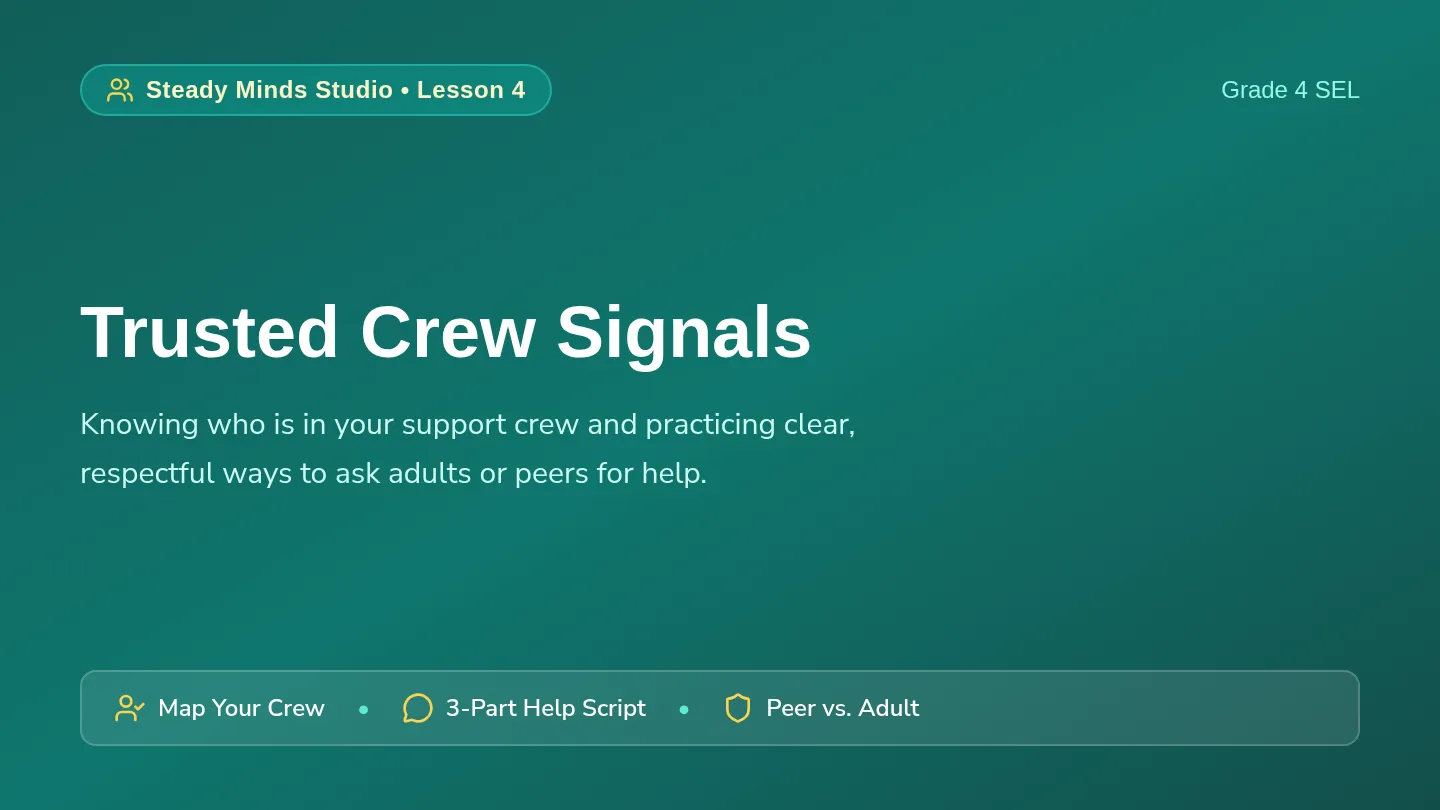
Support Signals Slides Steady Minds Studio • Lesson 4
Grade 4 SEL
Trusted Crew Signals
Knowing who is in your support crew and practicing clear, respectful ways to ask adults or peers for help.
Map Your Crew
•
3-Part Help Script
•
Peer vs. Adult
Asking for Help Is Smart
Teamwork
Nobody Does It Alone
Even athletes, pilots, and teachers rely on a crew. Reaching out when a problem feels too big is a sign of strength.
Ask Early, Not Late
When you ask for support before frustration boils over, it's much easier to explain what you need.
Good help-seeking is calm, clear, and respectful—never demanding or silent forever.
Who Is in Your Trusted Crew?
Support Map
At School
Classroom teacher or aide
School counselor or nurse
Recess or lunch staff
A kind, dependable friend
At Home & Community
Parents, guardians, or grandparents
Older siblings or cousins
Coaches, club leaders, or tutors
Trusted family friends
The 3-Part Help Script
How to Ask
1
Name the Moment
"I'm feeling overwhelmed with..." or "I'm stuck on..."
2
Share What You Tried
"I already tried rereading the directions..."
3
Make a Clear Ask
"Could you show me step 1?" or "Can I take a 2-minute reset?"
Example: "Ms. Lee, I'm feeling frustrated with #6. I tried drawing a model, but I'm still stuck. Could you check my first step?"
Peer Help vs. Adult Help
Smart Match
Ask a Peer When...
You missed a page number or supply
You want a quick partner check
You need someone to sit with at lunch
It's a small, everyday classroom question
Ask a Trusted Adult When...
Someone is hurt, unsafe, or being bullied
You need a calm-corner pause or nurse visit
A conflict keeps going after you tried Plan B
A feeling feels too heavy to carry alone
Practice Your Signal
Role-Play
With a partner, practice using the 3-Part Help Script for this moment: "You feel overwhelmed during group work because two teammates are arguing and nobody is listening to your ideas."
1. Notice
Body Clues
2. Reset
Calm Pause
3. Pivot
Flex Thinking
4. Signal
Trusted Crew
Help Script Worksheet Help Script Worksheet
Steady Minds Studio • Lesson 4: Trusted Crew Signals
Name: ________________________
Date: ______________
PART 1
Map My Trusted Crew
List 2–3 people you trust to help you when you have a big feeling or tough problem.
My School Crew
My Home & Community Crew
PART 2
Peer Help or Adult Help?
Read each situation and circle whether it is best to ask a Peer or a Trusted Adult first.
You forgot which page the reading homework is on.
Peer Trusted Adult
Someone is repeatedly teasing a classmate at recess and won't stop.
Peer Trusted Adult
You feel dizzy and overwhelmed and need to visit the nurse or calm spot.
Peer Trusted Adult
You need a partner to check your spelling words before the quiz.
Peer Trusted Adult
Help Script Worksheet • Page 2 Name: ________________________
PART 3
Write Your 3-Part Help Script
Use the 3 steps: (1) Name the moment, (2) Share what you tried, (3) Make a clear ask.
Script A (Asking an Adult): You are stuck on a science lab step and starting to feel frustrated. Write what you would say to your teacher.
Script B (Asking a Peer): You feel left out during a recess game and want to ask a friend to include you.
PART 4
My Steady Minds Toolkit Summary
Out of all 4 lessons (Body Clues, Calm Reset, Flex Thinking, Trusted Crew), which strategy are you most excited to use this week, and when will you use it?
Support Signals Teacher Guide Support Signals Teacher Guide
Steady Minds Studio • Lesson 4 • Grade 4 (30–35 Minutes)
Objective: Appropriate Help-Seeking
Pacing & Facilitation Flow
0–5 min (Slides 1–2): Normalize asking for help early; connect to Lesson 1–3 tools.
5–12 min (Slides 3–4): Brainstorm school & home crew members. Model the 3-Part Help Script aloud.
12–18 min (Slides 5–6): Clarify Peer vs. Adult help, then run a 3-minute partner role-play using the group-work scenario.
18–32 min (Worksheet): Students complete Help Script Worksheet.
32–35 min (Wrap-Up): Celebrate completing Steady Minds Studio!
Safety & Differentiation Notes
School Support Reminder: Make sure every student can name at least two adults at school (e.g., you + the school counselor/principal) in case home support is sensitive.
Low-Pressure Role-Play: Allow shy students to read the Slide 4 example script first before inventing their own.
Non-Verbal Option: Remind students they can also write a quick sticky note or use a desk signal if speaking out loud feels hard.
Answer Key: Help Script Worksheet
Part 1: Map My Trusted Crew
Accept any appropriate school adults/peers and home/community adults.
Part 2: Peer Help or Adult Help?
Peer (quick everyday classroom question)
Trusted Adult (repeated teasing/bullying needs adult support)
Trusted Adult (health/calm-spot request)
Peer (partner study check)
Part 3: 3-Part Help Scripts (Samples)
Script A: "I'm feeling frustrated on step 3 of the lab. I already reread the directions with my partner. Could you show us how to set up the cup?"
Script B: "I'm feeling left out watching the game. I waited for a turn, and I'd really like to play. Could I join the next round?"
Part 4: Toolkit Summary
Accept any thoughtful reflection naming a strategy from Lessons 1–4 and when to use it.