Mistake Reset Slides Coping Skills Toolkit
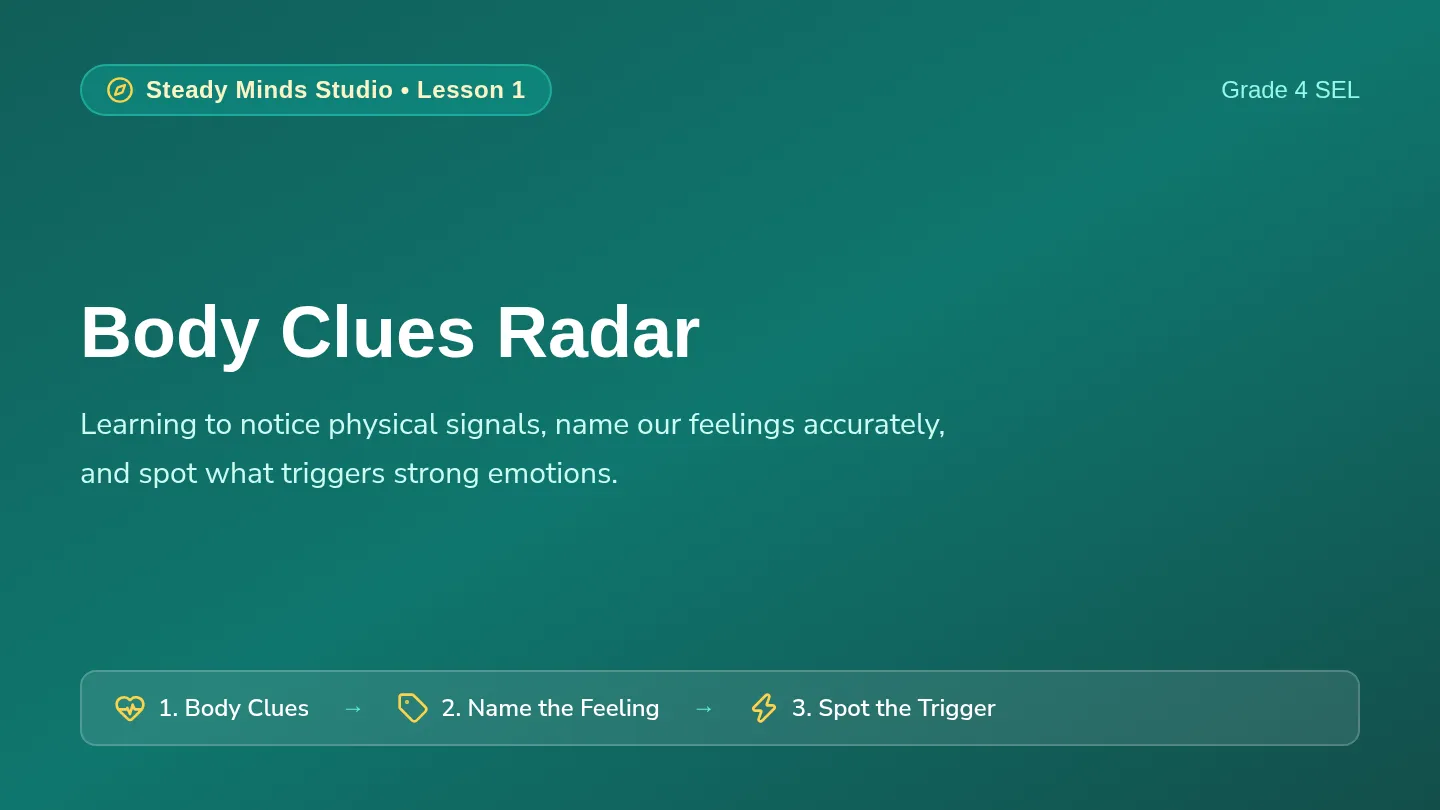
Small Mistake Reset
What to do when one wrong question feels like a huge deal
1. Name It
2. Calm Body
3. Self-Talk
4. Try Again
Why Does One Mistake Feel So Big?
Brain Check
What Your Brain Does
Your brain spots a red mark or wrong answer and hits the loud alarm—even when you are completely safe.
“Uh-oh! Everything is ruined!”
What Actually Happened
Getting one question wrong is a tiny glitch, not an emergency. Your brain just needs a quick reset.
Big reaction + small problem = time to reset!
Your 4-Step Reset Toolkit
Overview
1. Name the Feeling
Notice frustration early and pick a safe, helpful response.
2. Calm Body
Pause, take slow breaths, and relax tight muscles.
3. Helpful Self-Talk
Use encouraging coach words to treat mistakes as clues.
4. Try Again
Fix one step or ask a clear question to keep going.
Step 1: Name the Feeling
Spot It Early
Body Clues to Notice
Hot face or tight jaw
Squeezing your pencil tight
Urge to crumple the paper
Say It to Tame It
“I am feeling frustrated because I missed this question.”
Safe Response
Keep hands safe, keep your paper flat, and start your reset.
Step 2: Calm Body
10-Second Reset
1. Pause
Set your pencil down for 5 seconds so you don’t react too fast.
2. Breathe
Breathe in for 4, hold for 2, breathe out slow for 4.
3. Relax
Drop your shoulders down and shake out tight hands.
Step 3: Helpful Self-Talk
Flip the Script
“I’m bad at this. I always mess up.”
“One wrong answer shows me what to practice.”
“My whole paper is ruined now!”
“Mistakes are how my brain grows stronger.”
Step 4: Try Again
Move Forward
Option A: Fix One Step
Re-read the directions, check your work slowly, and try a different way.
Option B: Ask for Help
“I tried #4 and got stuck on step 2. Can you show me what I missed?”
Progress beats perfection every single time.
Your Turn to Reset
Partner Talk
Scenario
You studied hard, and your teacher hands back your paper. Question #4 has a big X on it. Your face feels hot.
1. Name It
What feeling is showing up?
2. Calm Body
What can your body do?
3. Self-Talk
What coach thought helps?
4. Try Again
What is your next step?
Calm Reset Worksheet Small Mistake Reset
Practice your 4 coping skills when a small mistake feels big
Student Practice
Name:
Date:
1. Name the Feeling
Check the body clues you notice when you get a question wrong:
Hot face
Tight jaw or shoulders
Squeezing pencil tight
Fast heartbeat
Wanting to crumple paper
Eyes watering
Write one safe, helpful response you can choose instead of getting worked up:
2. Calm Body (Try It Now!)
Check off each step
Pause
Put your pencil down for 5 seconds.
Breathe
In for 4, hold for 2, out slow for 4 (twice).
Relax
Drop shoulders and unclench hands.
3. Flip Your Self-Talk
Rewrite each frustrated thought into an encouraging “Coach Thought” that treats mistakes as a chance to learn:
“I’m terrible at this. I give up!”
“Everyone else got it right except me.”
“One wrong answer ruined my whole day.”
My Small Mistake Reflection
Try Again Plan
4. Zoom Out: How Big Is the Problem?
Level 1–2: Tiny Glitch
1 wrong question, spelling error, or small redo. Fixable in minutes.
Level 3: Medium Bump
Confused on a whole page or forgot homework. Needs help or a plan.
Level 4–5: Big Problem
Someone is hurt or unsafe. Needs an adult right away.
Why is getting one question wrong a Level 1–2 glitch instead of a big emergency?
5. Reflect on One Small Mistake
Describe one small mistake you made recently (like missing a question or misreading directions):
What feeling and body clues showed up?
Which Calm Body + Self-Talk skill will you use?
Your Try Again step (how you fixed it or what you will do next time):
6. Build Your Ask-for-Help Script
Practice writing what you can say to a teacher or partner when you get stuck:
“Excuse me, I tried question , and I got stuck on . Can you help me check ?”
Mistake Reset Lesson Guide Small Mistake Reset Guide
Counseling & SEL Facilitation Plan (Grades 3–6)
Educator Guide
Learning Objective
Students will recognize early frustration cues over small mistakes (e.g., a wrong answer) and apply four coping skills—Name the Feeling, Calm Body, Helpful Self-Talk, and Try Again—to recover safely.
Time: 30–35 minutes
Setting: Class or small group
Materials: Slides & Worksheet
Lesson Pacing & Discussion Prompts
1. Hook: Tiny Glitch vs. Loud Alarm (5 min)
Slides 1–2
Ask: “Raise your hand if getting just ONE question wrong has ever made your whole body feel hot, tight, or ready to give up.” Normalize that our brain’s alarm bell sometimes rings too loudly for a tiny problem.
Key Point: Big reaction + small problem = time for a reset, not an emergency.
2. Teach the 4-Step Reset Toolkit (10 min)
Slides 3–7
Name the Feeling: Have students point to where they feel frustration (jaw, face, hands) and practice saying, “I’m feeling frustrated, and I can stay safe.”
Calm Body: Model putting the pencil down, taking two 4-2-4 breaths together, and dropping shoulders.
Helpful Self-Talk: Contrast “Red-Alert Thoughts” with encouraging “Coach Thoughts.”
Try Again: Emphasize the two paths forward: fix one step on your own or ask a specific question.
3. Guided Partner Practice (7 min)
Slide 8
Display the Question #4 scenario. Have pairs walk through all 4 steps aloud in 60 seconds, then invite 2–3 volunteers to share their Coach Thought and Try Again step.
4. Independent Worksheet & Reflection (10 min)
Worksheet pp. 1–2
Distribute the Calm Reset Worksheet. Circulate to support students with flipping self-talk and writing a concrete ask-for-help script they can actually use in class.
Practice Scenarios & Support Notes
Counselor Toolkit
Quick Role-Play Scenarios (Optional Extension)
Scenario A: Math Slip
You forgot to carry a number on #7 and got the whole problem marked wrong.
Ask: What is one step you can re-check?
Scenario B: Read Aloud
You mispronounce a word while reading out loud and feel embarrassed.
Ask: What Coach Thought keeps you going?
Scenario C: Directions
You circled answers instead of underlining them and have to redo three lines.
Ask: How do you keep hands safe?
Common Roadblocks & Counselor Responses
“Breathing doesn’t work when I’m mad.”
Validate that breathing won’t erase the feeling—it just turns the volume down 20% so their thinking brain can come back online.
“I shouldn’t make mistakes at all.”
Gently challenge perfectionism: mistakes are normal data, not a grade on their worth. Share a quick personal example of a small mistake you fixed.
Student shuts down or hides paper.
Offer a quiet 30-second reset pass, point to Step 2 (Calm Body) without lecturing, and check back in with a low-pressure prompt.
Differentiation & Follow-Up
Visual Supports: Post the 4 steps on a desk card or corner anchor chart so teachers can silently tap “Step 2” as a non-verbal cue.
Writing Scaffolds: Allow students who struggle with writing to draw their body clues or dictate their Coach Thought to a partner.
Daily Reinforcement: During math or writing, praise students who use their ask-for-help script after a wrong answer (“I noticed you used your reset and asked a clear question!” ).