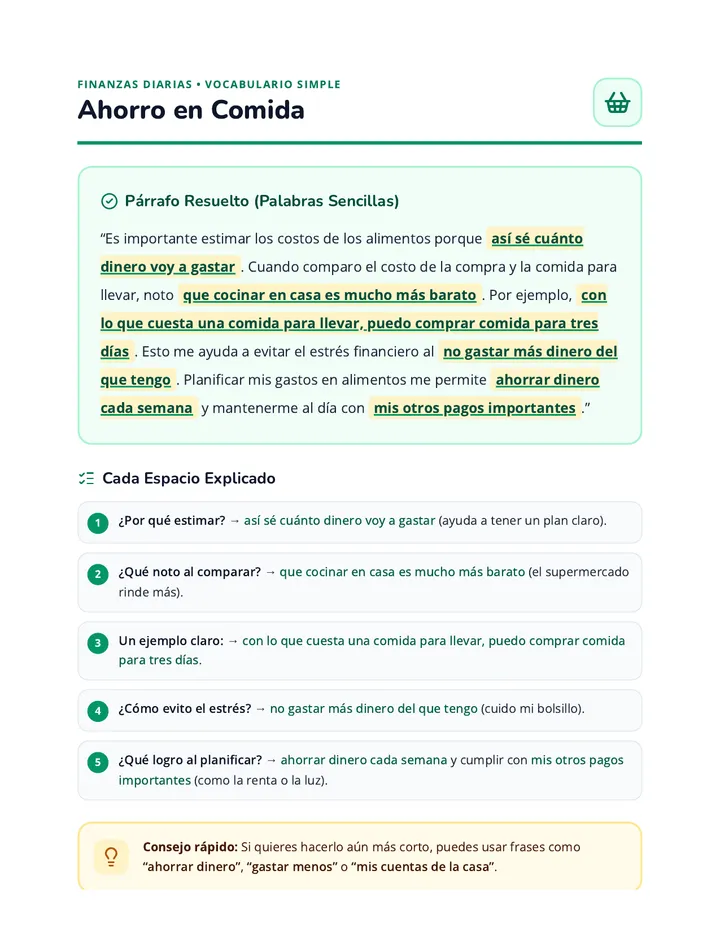
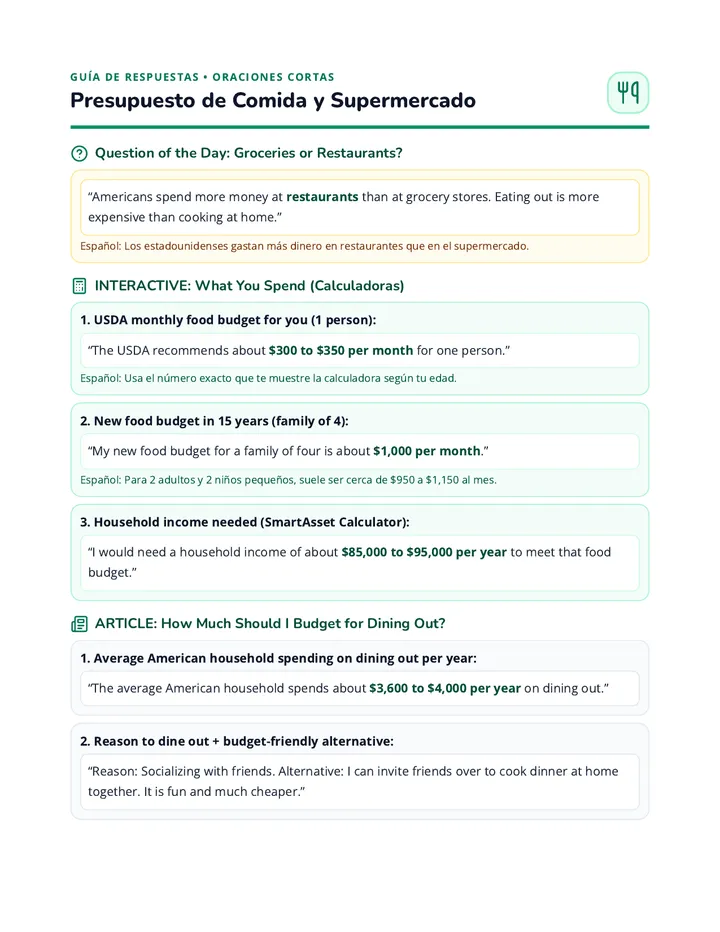
Smart Food Spending GuideLife Skills & Budgeting Smart Food Spending Name: __________________________ Date: ________________ Completed Paragraph (Simple Words) It is important to estimate food costs because it helps me save money and not spend too much. When I compare the cost of groceries and takeout, I notice that groceries cost much less than takeout. For example, one takeout meal can cost $15, while groceries for three home meals cost the same. This helps me avoid financial stress by making sure I have enough money for my bills. Planning my food spending allows me to save extra money and stay on track with my budget. Simple Word Meanings Estimate To guess the cost before you buy. Compare To look at two prices to see which is lower. Groceries vs. Takeout Food to cook at home vs. ready-to-eat food. Financial Stress Feeling worried because you do not have enough money. Bills Money you must pay for rent, water, or lights. Budget A simple plan for how to spend your money. Practice Writing Copy the completed paragraph below, or write your own example.
Inflation and Wages WorksheetPersonal Finance Activity Inflation & Wages Name: __________________________ Date: ________________ Since it would be quite hard to live our daily lives without buying anything, inflation is something we all have to deal with. In this activity you will discuss what inflation is, compare today’s purchasing power of the U.S. dollar to previous decades, and learn how inflation relates to the wages your job pays you. Inflation A general rise in prices over time. Purchasing Power How much a dollar can actually buy. Wages The money your job pays you for your work. Part I: How Inflation Works Watch the assigned video to learn more about inflation. Then, answer the questions below. 1. In your own words, briefly describe how inflation works. 2. Gerald just received a 2% raise from his employer. However, the rate of inflation last year was 3%. Explain why this is a problem for Gerald. Part II: Purchasing Power Over Time Inflation & Wages Compare the approximate U.S. average prices and federal minimum wage across three time periods below, then answer the questions. Item / Wage 1970 1990 Today (Approx.) Gallon of Milk $1.15 $2.78 $4.10 Loaf of Bread $0.24 $0.70 $2.00 Movie Ticket $1.55 $4.23 $11.00 Federal Minimum Wage (per hr) $1.60 $3.80 $7.25 3. Looking at the table, how has the purchasing power of $10 changed since 1970? Give one specific example using the items above. 4. Why is it important to compare your wage increases with the rate of inflation?
Inflation and Wages Answer KeyTeacher Resource Inflation & Wages Answer Key Parts I & II Part I: How Inflation Works 1. In your own words, briefly describe how inflation works. Sample Answer: Inflation is when the prices of everyday goods and services go up over time. Because prices rise, each dollar buys a little bit less than it used to. 2. Gerald just received a 2% raise from his employer. However, the rate of inflation last year was 3%. Explain why this is a problem for Gerald. Sample Answer: Even though Gerald earns 2% more money, the things he buys cost 3% more. His raise did not keep up with inflation, so his real purchasing power actually went down by about 1%—he can afford less than he could the year before. Part II: Purchasing Power Over Time 3. Looking at the table, how has the purchasing power of $10 changed since 1970? Give one specific example using the items above. Sample Answer: The purchasing power of $10 has dropped sharply since 1970. For example, in 1970, $10 could buy about 6 movie tickets ($1.55 each), whereas today $10 is not even enough to buy 1 movie ticket ($11.00). 4. Why is it important to compare your wage increases with the rate of inflation? Sample Answer: Comparing your raise to inflation tells you whether you are truly getting ahead. If prices rise faster than your wages, your paycheck buys less even if the dollar amount on your check looks bigger. Teacher Tip Remind students that historical prices in Part II are approximate U.S. averages. Ask them to notice that the federal minimum wage has stayed at $7.25 since 2009 while grocery prices have continued to rise.