Emotion Radar Teacher Guide Peace Builders Toolkit • Week 1 of 8 • Teacher Guide
Emotion Radar
Core Skill: Calm and Self-Regulate — Noticing Body Clues & Naming Feelings
FORMAT
2 Students • 30m
Learning Objectives
Identify 3 physical body clues that signal rising frustration or anger.
Rate emotional intensity on a 1–5 Feeling Thermometer.
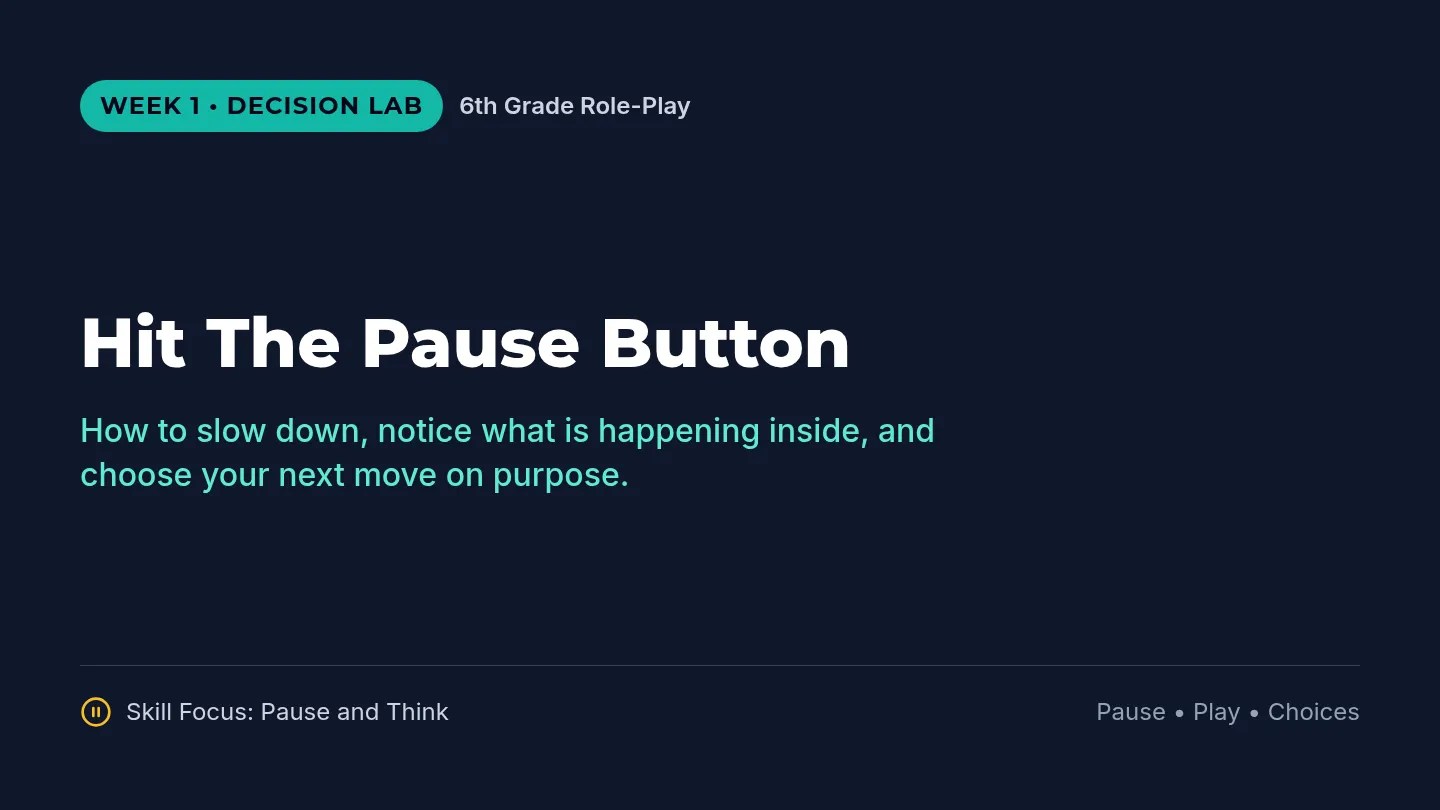
Practice hitting a mental "Pause Button" before reacting to a peer.
Materials & Prep
Emotion Radar Worksheet (1 copy per student)Pencils and colored pencils (green, yellow, red)
Optional: Small timer or "Pause" index card for desk
Step-by-Step Session Plan (30 Minutes)
Dyad Small Group
1. Warm-Up: Group Norms & Check-In 5 min
Welcome both students to the Peace Builders Toolkit . Establish 3 simple norms: Respectful Words, Listening Ears, Try Your Best . Say: "Everyone has disagreements with friends. Our goal over 8 weeks is to become Peace Builders who solve problems without hurting feelings." Ask each student to name one high/low from their week.
2. Mini-Lesson: Body Clues & The Feeling Thermometer 8 min
Introduce the Emotion Radar concept: our bodies send early warning signals before we yell or grab. Point to the 1–5 Thermometer on Page 1 of the worksheet (1 = Cool/Calm, 3 = Warming Up/Annoyed, 5 = Boiling Over/Exploding). Model your own clue: "When I get to a 3, my jaw gets tight and my shoulders rise up."
3. Guided Partner Practice: Spot the Clues 12 min
Have students complete Page 1 (Body Clues & Thermometer check) independently for 4 minutes, then share one clue with each other. Next, read the Page 2 scenarios aloud. For each scenario, students point to their thermometer number and practice saying: "Pause! I am at a ___, I need a second."
4. Wrap-Up & Real-World Mission 5 min
Ask each student to name their #1 early warning clue (the "Level 3" clue). Give them a weekly mission: "This week, try to notice one time your thermometer hits a 3 during recess or class, and hit your invisible Pause Button."
Teacher Mindset: Normalize all feelings! Remind students that feeling angry (a 4 or 5) is human—the goal is noticing it early at a 2 or 3 so we stay in charge of our choices.
Week 1 Teacher Guidance & Coaching Notes
Emotion Radar
Coaching This Two-Student Group
If students already have friction: Keep Week 1 focused on hypothetical scenarios (e.g., recess line, board game) rather than rehashing past arguments between them.Balance airtime: Use a simple talking object or alternate who goes first on every prompt so neither student dominates or withdraws.Make it physical: Have students actually clench their fists for 3 seconds and then release them so they feel the contrast between tense (Level 4) and calm (Level 1).
Guided Scenario Prompts (Use with Worksheet Page 2)
Scenario A: The Missing Marker
"You reach for the last blue marker for your poster, and your partner grabs it first without asking." Ask: What body clue might pop up? What number on the thermometer? Practice the Pause phrase.
Scenario B: The Game Rule Debate
"During four-square at recess, someone says you are 'out,' even though you are sure the ball hit the line." Ask: How fast does your thermometer jump? What happens if you react at a 5 vs. pausing at a 3?
Common Pitfalls
Student says "I never get mad" (offer a relatable mild annoyance like laggy Wi-Fi or losing a turn).
Blaming the other student during sharing—redirect gently to "I" body clues.
Differentiation
Support: Let students circle or draw body clues instead of writing full sentences.Extend: Ask students to notice the difference between "annoyed" (2–3) and "furious" (5).
Quick Observation Tracker (Week 1)
Skill Check
Student A: ____________
Student B: ____________
Names 2+ body clues
☐ Yes ☐ With prompt
☐ Yes ☐ With prompt
Uses 1–5 thermometer accurately
☐ Yes ☐ With prompt
☐ Yes ☐ With prompt
Practices "Pause" phrase
☐ Yes ☐ With prompt
☐ Yes ☐ With prompt
Next Week: Cool Down Moves (Self-Regulation Strategies)
Emotion Radar Worksheet Peace Builders • Week 1 Calm & Self-Regulate
Emotion Radar: Spot Your Clues!
Name: __________________________________
Date: ______________
📡
Before we yell, grab, or shut down, our bodies send us warning clues ! When you notice your clues early, you can hit your Pause Button and stay in charge.
1. My Body Warning Clues
Check the clues you notice in your body when a disagreement starts:
Hot face or ears
Tight fists or shoulders
Fast heartbeat
Butterflies or tight stomach
Loud or fast voice
Wanting to stomp or walk away
Write one other clue your body gives you (or draw it):
2. The 1–5 Feeling Thermometer
Write one feeling word or situation next to each level on the thermometer:
5 • Boiling Over
4 • Very Upset
3 • Warming Up
2 • A Little Bugged
1 • Cool & Calm
Turn to Page 2 for Partner Practice!
3. Hit the Pause Button!
Partner Practice
Our Magic Pause Phrase
"Pause! My radar is at a ___. I need a second."
Scenario A: The Missing Marker
You reach for the last blue marker for your poster, and your partner grabs it first without asking.
Circle your thermometer number: 1 2 3 4 5
What body clue would you notice first?
Scenario B: The Game Rule Debate
During four-square at recess, someone says you are "out," even though you are sure the ball hit the line.
Circle your thermometer number: 1 2 3 4 5
Write what you can say using the Magic Pause Phrase:
4. My Week 1 Peace Builder Mission
This week, my #1 early warning clue to watch out for is:
Great job tuning your Emotion Radar!
Cool Down Moves Teacher Guide Peace Builders Toolkit • Week 2 of 8 • Teacher Guide
Cool Down Moves
Core Skill: Calm and Self-Regulate — Tools to Cool Down Before Responding
FORMAT
2 Students • 30m
Learning Objectives
Demonstrate 3 quick cool-down strategies (Star Breathing, 5-4-3-2-1 Grounding, Safe Space).
Explain why cooling down helps the "thinking brain" take back control.
Select 2 go-to strategies to use during peer disagreements.
Materials & Prep
Cool Down Moves Worksheet (1 per student)Pencils, scissors (optional if cutting pocket card)
Designate a "Cool-Down Corner" chair in the room
Step-by-Step Session Plan (30 Minutes)
Dyad Small Group
1. Warm-Up: Week 1 Radar Check-In 5 min
Ask each student: "Did you notice your thermometer hit a 3 or 4 this week? What body clue popped up?" Praise any awareness, even if they didn't pause yet.
2. Mini-Lesson: Flipping Your Lid vs. Thinking Brain 8 min
Use Dan Siegel's simple hand model: thumb tucked in = feeling brain; fingers curled over = thinking brain. When we hit Level 4–5, we "flip our lid" (fingers pop up). Cool-down moves bring the thinking brain back down so we don't say something we regret.
3. Guided Practice: Try All 4 Cool-Down Moves 12 min
Practice each move on Worksheet Page 1 together physically: (1) Box Breathing (trace a square, 4 sec each side), (2) Turtle Tuck / Shoulder Drop , (3) Silent Count to 10 , (4) Ask for Space ("I need 2 minutes to cool down, then I'll come back" ). Then rate each move and build their Top 2 Plan on Page 2.
4. Wrap-Up: Freeze & Cool Drill 5 min
Play a 2-minute drill: call out a mild stressor ("Someone bumps your desk and spills your pencils!" ). Both students freeze, show a silent breath, and point to their #1 Cool-Down Move.
Key Distinction: Teach students the difference between taking a cool-down break (coming back to solve it) vs. storming off (leaving the problem unfinished).
Week 2 Teacher Guidance & Coaching Notes
Cool Down Moves
Coaching This Two-Student Group
De-stigmatize breathing: Some 3rd graders feel silly doing "deep breaths" in front of a peer. Frame Box Breathing as an athlete's reset trick (basketball free-throw breathing).Practice the "Come Back" promise: If Student A asks for space, Student B might feel ignored. Practice Student B saying, "Okay, I'll wait."
Role-Play Prompts for Asking for Space
Prompt 1: Partner Keeps Talking Over You
Student A feels frustrated and wants to yell. Coach them to hold up a calm hand and say: "I need 30 seconds to cool down so I can listen."
Prompt 2: Losing a Close Partner Game
Student B feels like throwing the dice. Coach them to do 2 rounds of Box Breathing before saying "Good game" or asking for a rematch.
Common Pitfalls
Rushing through breathing in 2 seconds—count aloud slowly ("1... 2... 3... 4...") with them.
Using cool-down time to stew over why the other kid is "unfair."
Differentiation
Support: Let students trace the Box Breathing square right on their worksheet with a finger.Extend: Have students identify which move works best in class (quiet) vs. recess (active).
Quick Observation Tracker (Week 2)
Skill Check
Student A: ____________
Student B: ____________
Demonstrates Box Breathing
☐ Yes ☐ With prompt
☐ Yes ☐ With prompt
Uses respectful "ask for space" line
☐ Yes ☐ With prompt
☐ Yes ☐ With prompt
Chooses 2 personal go-to moves
☐ Yes ☐ With prompt
☐ Yes ☐ With prompt
Next Week: I Statement Builders (Assertive Communication)
Cool Down Moves Worksheet Peace Builders • Week 2 Calm & Self-Regulate
Cool Down Moves: Brain Reset!
Name: __________________________________
Date: ______________
🧊
When your thermometer hits a 3, 4, or 5, your thinking brain needs a quick reset. Try each Cool Down Move below and rate how it feels!
1. Box Breathing 🟦
Trace a square in the air: Breathe IN (4 sec), HOLD (4 sec), Breathe OUT (4 sec), REST (4 sec).
Did it help? 👍 😐 👎
2. Shoulder Drop 🐢
Squeeze your shoulders up to your ears and clench your fists for 3 seconds... then drop and shake them loose!
Did it help? 👍 😐 👎
3. Silent Count to 10 🔢
Close your eyes or look at the floor. Count slowly from 1 to 10 inside your head before speaking.
Did it help? 👍 😐 👎
4. Ask for Space ✋
Say calmly: "I need 2 minutes to cool down, then I will come back to solve this."
Did it help? 👍 😐 👎
Practice Pad: Trace the Box!
Put your finger on the star. Trace slowly around the box while you breathe in, hold, breathe out, and rest.
⭐ Start Here
Turn to Page 2 to build your Cool-Down Plan!
My Personal Cool-Down Plan
Partner Practice
1. Pick Your Top 2 Moves
My #1 Cool-Down Move in the classroom (quiet):
My #2 Cool-Down Move at recess or lunch:
2. Cool-Down vs. Storming Off
Practice with your partner! Write what you can say so your friend knows you are taking a break—not quitting the friendship:
Example: "I'm getting frustrated, so I'm going to take a 1-minute breather and come right back."
Write your own "Ask for Space" sentence:
3. Draw Your Calm-Down Superpower
Draw a quick picture of yourself using your favorite Cool-Down Move when a disagreement happens:
Calm brain = smart choices!
I Statement Builders Teacher Guide Peace Builders Toolkit • Week 3 of 8 • Teacher Guide
I Statement Builders
Core Skill: Communicate Assertively — Respectful Words & "I" Statements
FORMAT
2 Students • 30m
Learning Objectives
Distinguish between Passive (mouse), Aggressive (monster), and Assertive (Peace Builder) voices.
Build a 3-part "I" statement: "I feel ___ when ___ because ___."
Speak directly to a peer using calm eye contact and a steady voice.
Materials & Prep
I Statement Builders Worksheet (1 per student)Pencils
Optional: 3 index cards labeled Mouse, Monster, Peace Builder
Step-by-Step Session Plan (30 Minutes)
Dyad Small Group
1. Warm-Up: Cool-Down Check-In 4 min
Review Week 2: ask each student which Cool-Down Move they tried or remembered this week. Remind them: "Once our thinking brain is back, we are ready to use our words!"
2. Mini-Lesson: Three Ways to Speak Up 8 min
Act out a quick example (someone cuts in line): Passive/Mouse (whispering or saying nothing, staying mad), Aggressive/Monster (yelling "You're so mean, get back!" ), and Assertive/Peace Builder (firm, kind voice: "I feel frustrated when you cut in front of me because I was waiting." ). Introduce the 3-part "I" Statement Blueprint on Worksheet Page 1.
3. Guided Practice: Fix the Blame Words 13 min
Students complete Activity 1 (Voice Match) and Activity 2 (Turn "You" Blame into "I" Statements) on the worksheet. Then pair them up for Activity 3: Student A reads a scenario and delivers their "I" statement face-to-face; Student B practices nodding calmly. Switch roles for the second scenario.
4. Wrap-Up: Assertive Posture Check 5 min
Practice "Peace Builder Posture" together: feet flat, shoulders relaxed, eyes on partner, calm volume. Challenge both students to use one "I" statement this week at school or home.
Coaching Tip: Watch out for disguised "You" statements like "I feel like YOU are being annoying!" Gently coach them back to a true feeling word (frustrated, left out, worried) + the specific action.
Week 3 Teacher Guidance & Coaching Notes
I Statement Builders
Coaching This Two-Student Group
If one student is shy and one is loud: Validate both! The shy student learns that their voice matters (moving from Mouse to Peace Builder), while the loud student learns that firm & calm is stronger than yelling.Keep tone playful during modeling: Let them laugh when you demonstrate the squeaky Mouse and grumpy Monster voices—it lowers defensiveness.
Sample "I" Statements (Answer Reference)
Blame: "You always hog the iPad!"
Peace Builder Fix: "I feel left out when you keep the iPad the whole time because I want a turn too."
Blame: "Stop copying my drawing, you copycat!"
Peace Builder Fix: "I feel annoyed when my idea gets copied because I worked hard to make it my own."
Common Pitfalls
Saying "I feel that you..." instead of a real emotion word.
Using a sarcastic or eye-rolling tone while saying polite words—coach tone + face together!
Differentiation
Support: Provide a 4-word feeling bank (frustrated, hurt, left out, worried) to plug into the blank.Extend: Add a 4th part: "Next time, could we ___?"
Quick Observation Tracker (Week 3)
Skill Check
Student A: ____________
Student B: ____________
Identifies Assertive vs. Aggressive
☐ Yes ☐ With prompt
☐ Yes ☐ With prompt
Builds 3-part "I" statement
☐ Yes ☐ With prompt
☐ Yes ☐ With prompt
Uses calm, respectful tone
☐ Yes ☐ With prompt
☐ Yes ☐ With prompt
Next Week: Listening Superpowers (Active Listening)
I Statement Builders Worksheet Peace Builders • Week 3 Communicate Assertively
I Statement Builders: Speak Strong & Kind!
Name: __________________________________
Date: ______________
The 3-Part "I" Statement Blueprint
1. I feel...
(name your feeling)
2. when...
(tell what happened)
3. because...
(explain why it matters)
1. Spot the Peace Builder Voice
Someone accidentally knocks over your block tower. Circle which response uses a strong, kind Peace Builder voice:
A. "Hey! Watch where you're going, you ruined everything!"
B. (Say nothing, stare at the floor, and stay mad all day.)
C. "I feel frustrated when my tower falls because I worked hard on it."
2. Turn "You" Blame into an "I" Statement
A. Blame words: "You always hog the iPad!" — Rewrite as an "I" statement:
B. Blame words: "Stop copying my drawing, you copycat!" — Rewrite as an "I" statement:
Turn to Page 2 for Partner Practice!
3. Partner "I" Statement Practice
Partner Practice
Feeling Word Bank: frustrated • left out • worried • annoyed • disappointed • hurt • confused
Scenario 1: The Whispering Secret
Two friends are whispering and looking over at you during free time.
I feel...
when...
because...
Scenario 2: Your Own Real-Life Situation
Think of a time a classmate bugged you. Write a full "I" statement and practice saying it calmly to your partner!
4. Peace Builder Posture Check (Check with your partner!)
Calm voice
Looking at partner
No blame words
Strong and kind words build strong friendships!
Listening Superpowers Teacher Guide Peace Builders Toolkit • Week 4 of 8 • Teacher Guide
Listening Superpowers
Core Skill: Communicate Assertively — Active Listening & Reflecting Back
FORMAT
2 Students • 30m
Learning Objectives
Demonstrate whole-body listening (eyes on speaker, quiet hands, no interrupting).
Use the "Echo & Check" move: "So you're saying you feel ___ because ___?"
Take turns as Speaker and Listener during a mild disagreement.
Materials & Prep
Listening Superpowers Worksheet (1 per student)Pencils
1 "Talking Tool" (small ball, marker, or eraser)
Step-by-Step Session Plan (30 Minutes)
Dyad Small Group
1. Warm-Up: The "Bad Listener" Skit 5 min
Ask one student to tell you about their favorite recess game. While they talk, look at the ceiling, tap your pencil, and interrupt with something random. Ask: "How did that feel? Did you feel heard?" Connect: when we interrupt in a fight, the fight gets bigger.
2. Mini-Lesson: Listening Ears & Echo Check 7 min
Introduce the 3 Listening Superpowers on Worksheet Page 1: (1) Eyes & Body Facing Speaker , (2) Wait Until They Finish (park your thought in your brain), and (3) Echo Back ("I heard you say..." ). Explain that echoing does NOT mean you have to agree—it just proves you understood!
3. Guided Partner Practice: Pass the Talking Tool 13 min
Use the Talking Tool for two rounds of Page 2 prompts. Round 1: Student A speaks using an "I" statement; Student B listens without interrupting and uses the Echo Frame. Round 2: Switch roles! Students record what their partner said on Page 2.
4. Wrap-Up: Midpoint Celebration 5 min
Celebrate finishing Week 4 (halfway!). Review how Weeks 1–4 connect: Radar → Cool Down → "I" Statement → Listen & Echo . Next week they become Problem Detectives!
Golden Rule of Echoing: Remind students that "listening to understand" comes before "explaining your side." Everyone wants to feel heard first.
Week 4 Teacher Guidance & Coaching Notes
Listening Superpowers
Coaching This Two-Student Group
If a student interrupts to defend themselves: Gently touch the Talking Tool and say, "Park that thought! It will be your turn right after you echo." Validate accurate echoing: Have the Speaker give a thumbs-up if the Listener got their feeling and reason right.
Partner Echo Prompts (For Page 2)
Round 1 (Mild Opinion):
"Which is better: indoor recess or outdoor recess, and why?" (Low-stakes warm-up so they practice echoing without defensiveness.)
Round 2 (Disagreement Role-Play):
"We only have 10 minutes left and we disagree on which game to play." Speaker gives an "I" statement; Listener echoes before sharing their side.
Common Pitfalls
Listener starts their echo with "Yeah, BUT..." —coach them to stop after the echo!
Parroting word-for-word like a robot; encourage putting it in their own words.
Differentiation
Support: Let the Listener read directly from the sentence frame on Page 1.Extend: Ask the Listener to also name the Speaker's feeling if they didn't say it outright.
Quick Observation Tracker (Week 4)
Skill Check
Student A: ____________
Student B: ____________
Waits without interrupting
☐ Yes ☐ With prompt
☐ Yes ☐ With prompt
Uses Echo Frame accurately
☐ Yes ☐ With prompt
☐ Yes ☐ With prompt
Shows attentive body language
☐ Yes ☐ With prompt
☐ Yes ☐ With prompt
Next Week: Problem Detectives (Identifying the Problem)
Listening Superpowers Worksheet Peace Builders • Week 4 Communicate Assertively
Listening Superpowers: Hear & Echo!
Name: __________________________________
Date: ______________
🎧
Great Peace Builders don't just wait for their turn to talk—they use Listening Superpowers to show their friend, "I hear you!"
1. Check Off the Good Listening Habits
Put a check next to every habit that helps a friend feel heard:
Looking at the speaker
Interrupting to say "No I didn't!"
Keeping hands & feet still
Looking away or rolling eyes
Waiting until they finish talking
Echoing back what you heard
2. The Echo & Check Move
After your partner finishes speaking, repeat back what you heard using this frame:
"So I heard you say you feel ________ when ________. Did I get that right?"
3. Try an Echo!
Your partner says: "I feel disappointed when you pick teams without asking me because I wanted to help choose."
Write what you would echo back:
Turn to Page 2 for Partner Listening!
4. Pass the Talking Tool: Partner Log
Partner Practice
Round 1: Favorite Recess Choice (Warm-Up)
Listen carefully to your partner without interrupting. Write 1–2 sentences about what your partner said:
Round 2: Game Disagreement Role-Play
Listen to your partner's "I" statement about which game to play. Write what they felt and why:
5. Listening Superpower Reflection
What is the hardest part of listening when you are upset? (Example: waiting to talk, not interrupting)
Halfway there! You are becoming a true Peace Builder!
Problem Detectives Teacher Guide Peace Builders Toolkit • Week 5 of 8 • Teacher Guide
Problem Detectives
Core Skill: Solve Problems Together — Naming the Problem Without Blame
FORMAT
2 Students • 30m
Learning Objectives
State a peer conflict neutrally ("The problem is...") without blaming ("You always...").
Identify what both partners want or need in a disagreement.
Separate the person from the problem ("Us vs. The Problem").
Materials & Prep
Problem Detectives Worksheet (1 per student)Pencils
Optional: Small magnifying glass prop for "Detective" role
Step-by-Step Session Plan (30 Minutes)
Dyad Small Group
1. Warm-Up: Blame vs. Fact 5 min
Hold up 1 pencil between the two students. Say: "Pretend you both need this pencil right now. If you say 'He's a pencil hog!' that's blame. What is the actual problem?" Guide them to: "There is only 1 pencil, and 2 people need it."
2. Mini-Lesson: Us vs. The Problem 8 min
Teach the Problem Detective Rule : put the problem on the table between you, not on each other! Show the two-step Detective Case on Worksheet Page 1: (1) What do both people want/need? (2) State the problem in 1 neutral sentence.
3. Guided Partner Practice: Crack the Cases 12 min
Complete Page 1 (Blame vs. Detective Sort) together. Then on Page 2, work through Case File #1 and Case File #2 as a team: Student A names what Person 1 wants, Student B names what Person 2 wants, and together they write the neutral problem statement.
4. Wrap-Up: Detective Motto 5 min
Have both students say the motto aloud: "It's not Me vs. You—it's Us vs. The Problem!" Preview Week 6: once we name the problem, we brainstorm Fair Fixes!
Why This Matters: Kids often jump straight to demanding their own way before anyone agrees on what the problem actually is. Naming both needs cuts defensiveness in half.
Week 5 Teacher Guidance & Coaching Notes
Problem Detectives
Coaching This Two-Student Group
Watch for "Hidden Blame": If a student writes "The problem is Sam is being unfair," ask: "How can we say that without using Sam's name as the problem?" Celebrate perspective-taking: When Student A accurately guesses what Student B needs in a scenario, highlight it as a huge Detective win!
Case File Answer Reference (Worksheet Page 2)
Case File #1: The One-Ball Recess
Both Needs: One wants to play kickball; the other wants to play soccer, and there's only 1 ball. Neutral Problem: "We have two different game ideas and only one ball."
Case File #2: Partner Poster
Both Needs: One wants neat handwriting; the other wants a turn drawing. Neutral Problem: "We both want to help with the poster, but we have different ideas for how to share jobs."
Common Pitfalls
Jumping straight to solutions ("Just flip a coin!" ) before naming the problem.
Forgetting that the other person's want is also valid.
Differentiation
Support: Give the starter: "One person wants ___, and the other wants ___." Extend: Have students bring a real recent disagreement and write it neutrally.
Quick Observation Tracker (Week 5)
Skill Check
Student A: ____________
Student B: ____________
Spots blame vs. neutral statements
☐ Yes ☐ With prompt
☐ Yes ☐ With prompt
Names both people's wants/needs
☐ Yes ☐ With prompt
☐ Yes ☐ With prompt
Writes a blame-free problem statement
☐ Yes ☐ With prompt
☐ Yes ☐ With prompt
Next Week: Fair Fix Brainstorm (Generating Fair Solutions)
Problem Detectives Worksheet Peace Builders • Week 5 Solve Problems Together
Problem Detectives: Us vs. The Problem!
Name: __________________________________
Date: ______________
🔍
Before you can fix a problem, you have to name the real problem without pointing fingers. Remember: It's not Me vs. You—it's Us vs. The Problem!
1. Blame or Detective Clue?
Circle the two statements that name the problem fairly without blaming anyone:
A. "You're so bossy, you never let anyone else be line leader!"
B. "Two people both want to sit in the beanbag chair at reading time."
C. "She stole my spot on purpose because she's mean!"
D. "We have different ideas for how to build our science project."
2. Fix the Blame!
Read the blaming sentence below and rewrite it as a neutral Detective Problem Statement :
Blame: "Hey, you're hogging all the Lego wheels!"
Neutral Problem (Hint: Start with "We both need..."):
Turn to Page 2 to Crack the Case Files!
3. Detective Case Files
Partner Practice
Case File #1: The One-Ball Recess
At recess, Maya wants to play kickball and Leo wants to play soccer. There is only one rubber ball left in the bin.
What does Maya want?
What does Leo want?
Write the neutral problem (without blaming Maya or Leo):
Case File #2: The Partner Poster
Two partners are making a science poster. One partner wants to write all the words neatly; the other partner wants to draw the title and pictures.
Partner 1's want/need:
Partner 2's want/need:
Write the neutral problem:
Case cracked! Next week we brainstorm Fair Fixes!
Fair Fix Brainstorm Teacher Guide Peace Builders Toolkit • Week 6 of 8 • Teacher Guide
Fair Fix Brainstorm
Core Skill: Solve Problems Together — Generating Choices & Agreeing on a Fair Plan
FORMAT
2 Students • 30m
Learning Objectives
Brainstorm at least 3 possible solutions to a peer problem before choosing.
Test each idea with the 2-question Fair Fix Test: Is it Safe? Is it Fair for both?
Use classic compromise tools (Take Turns, Split/Share, Do Both, Rock-Paper-Scissors).
Materials & Prep
Fair Fix Brainstorm Worksheet (1 per student)Pencils
Optional: 2-minute sand timer for turn-taking demo
Step-by-Step Session Plan (30 Minutes)
Dyad Small Group
1. Warm-Up: The Stuck-on-One-Idea Trap 4 min
Ask: "Have you ever argued because you both only had ONE idea—your own?" Explain that when we brainstorm 3+ ideas, suddenly we have choices!
2. Mini-Lesson: The Fair Fix Menu & 2-Question Test 8 min
Review the 4 Compromise Tools on Worksheet Page 1: (1) Take Turns / Timer , (2) Split It / Share , (3) Combine Both Ideas , (4) Chance (Rock-Paper-Scissors) . Then model the 2-Question Test: Is it Safe? Is it Fair to BOTH people?
3. Guided Partner Practice: Brainstorm & Agree 13 min
Students complete Page 1 (Safe & Fair Test) independently for 3 minutes. Then pair up for Page 2: together they brainstorm 3 choices for two realistic conflicts, test them, and sign their Agreed Fair Plan at the bottom!
4. Wrap-Up: Shake on the Plan 5 min
Have students practice saying: "Deal! Let's try that plan." Remind them that if a plan doesn't work, Peace Builders can always pause and pick Idea #2.
Brainstorm Rule: During brainstorming, no idea gets laughed at—even silly ideas! Once 3 ideas are on paper, then we use the Safe & Fair Test to pick the best one.
Week 6 Teacher Guidance & Coaching Notes
Fair Fix Brainstorm
Coaching This Two-Student Group
If one student always "gives in" to keep peace: Check in gently: "Does this plan feel fair to YOU too, or are you just giving up?" If one student insists on winning: Use the Fair Test: "That works great for you—how does it work for your partner?"
Sample Solutions for Page 2 Scenarios
Problem 1: Only 1 Swing Left at Recess
Choices: (1) Count 25 pushes then switch, (2) Play a different 2-person game together, (3) Rock-Paper-Scissors for who goes first + timer for second.
Problem 2: Two Different Ideas for a Class Skit
Choices: (1) Combine both ideas into a 2-part story, (2) Use Student A's setting and Student B's characters, (3) Vote/coin flip for today's skit and save the other for next time.
Common Pitfalls
Stopping after 1 idea—insist on at least 3 choices before picking!
Picking a solution that is "fair" on paper but unsafe (e.g., "both squeeze onto one swing").
Differentiation
Support: Let students pick from the 4 Compromise Tools menu on Page 1.Extend: Ask students to name what happens if the first plan doesn't work (Backup Plan).
Quick Observation Tracker (Week 6)
Skill Check
Student A: ____________
Student B: ____________
Generates 2+ solution ideas
☐ Yes ☐ With prompt
☐ Yes ☐ With prompt
Applies Safe & Fair test
☐ Yes ☐ With prompt
☐ Yes ☐ With prompt
Agrees respectfully on a shared plan
☐ Yes ☐ With prompt
☐ Yes ☐ With prompt
Next Week: Repair Crew (Apologies & Making Amends)
Fair Fix Brainstorm Worksheet Peace Builders • Week 6 Solve Problems Together
Fair Fix Brainstorm: Pick a Win-Win!
Name: __________________________________
Date: ______________
The 4 Fair Fix Tools
⏱️ Take Turns: Use a timer or count turns so both get a chance.
🧩 Split & Share: Divide supplies or jobs down the middle.
🤝 Combine Ideas: Mash both ideas together into one cool plan!
✌️ Fair Chance: Play Rock-Paper-Scissors to pick who goes first.
1. Test the Solutions!
Two friends both want the last swing at recess. Check whether each idea is Safe and Fair for Both :
Idea
Safe?
Fair for Both?
A. Push the other kid off the swing so you get it.
☐ Yes ☐ No
☐ Yes ☐ No
B. Both kids try to sit on the same swing at once.
☐ Yes ☐ No
☐ Yes ☐ No
C. Count 25 pushes for Friend 1, then switch!
☐ Yes ☐ No
☐ Yes ☐ No
D. One kid swings the whole recess while the other watches.
☐ Yes ☐ No
☐ Yes ☐ No
Turn to Page 2 to Brainstorm & Agree!
2. Partner Fair Fix Brainstorm
Partner Practice
Problem: Two Different Ideas for a Class Skit
You want your group's skit to be about outer space. Your partner wants it to be about dinosaurs.
Brainstorm 3 possible choices together:
Choice 1:
Choice 2:
Choice 3:
3. Our Agreed Fair Fix Plan
Which choice is Safe and Fair for Both ? Write your final plan below:
Partner 1 Signature: _____________________
Partner 2 Signature: _____________________
Win-win plans keep friendships strong!
Repair Crew Teacher Guide Peace Builders Toolkit • Week 7 of 8 • Teacher Guide
Repair Crew
Core Skill: Repair and Reconnect — Apologies, Making Amends & Rebuilding Trust
FORMAT
2 Students • 30m
Learning Objectives
Deliver a genuine 4-part apology (Sorry, Own It, Plan Next Time, Ask to Help).
Distinguish between a quick "robot sorry" and meaningful amends.
Practice welcoming a friend back gracefully after an apology.
Materials & Prep
Repair Crew Worksheet (1 per student)Pencils
1 sheet of scrap paper (for the "Crumpled Paper" warm-up)
Step-by-Step Session Plan (30 Minutes)
Dyad Small Group
1. Warm-Up: The Crumpled Paper Demo 5 min
Give a clean piece of paper to a student to crumple up. Then ask them to smooth it flat and say "Sorry, paper." Ask: "Even after we say sorry, what is still there?" (Wrinkles!) Explain: "Saying sorry is step 1, and Repair Crew actions help smooth out the wrinkles."
2. Mini-Lesson: The 4-Part Repair Apology 8 min
Walk through the 4 parts on Worksheet Page 1: (1) I'm sorry for... (name the exact action, no "but"), (2) I know that felt... (empathy), (3) Next time I will... (change), (4) How can I help fix it? (amends). Also teach the Receiver's job: "Thank you for saying sorry. Let's move forward."
3. Guided Partner Practice: Fix-It Scenarios 12 min
Students complete Activity 1 (Robot Sorry vs. Repair Sorry) on Page 1. Then on Page 2, they write a 4-part apology + concrete amends for a scenario and role-play both giving and receiving the repair with their partner.
4. Wrap-Up: Reconnect Ritual 5 min
Ask: "After a repair, how can two friends show they're ready to play or work together again?" (Fist bump, "Want to start over?", inviting them into the game). Preview Week 8: The Peace Builder Challenge!
Important Nuance: Teach students that "It's okay" isn't always true when someone hurt your feelings—instead, they can say "Thank you for apologizing. I appreciate it."
Week 7 Teacher Guidance & Coaching Notes
Repair Crew
Coaching This Two-Student Group
Never force a fake apology: If a student isn't calm yet, go back to Week 2 (Cool Down) first. A rushed, eye-rolling "Sorry!" damages trust more than waiting 2 minutes.If a student holds a grudge: Normalize needing a little time, while encouraging them to give a fair chance when the other student makes genuine amends.
Examples of Meaningful Amends (3rd Grade)
Mistake: Knocked over a partner's art supplies
Amends: Help pick up every marker and sharpen any broken pencils.
Mistake: Left a friend out of a recess game
Amends: Invite them to be first in line for the next round or partner up for the next activity.
Common Pitfalls
Adding "...but you started it!" at the end of an apology.
Thinking amends means buying gifts—keep amends focused on helpful actions and kind words.
Differentiation
Support: Let students use the 4-box template on Page 2 as cue cards while speaking.Extend: Practice apologizing for an accidental mistake vs. an intentional unkind choice.
Quick Observation Tracker (Week 7)
Skill Check
Student A: ____________
Student B: ____________
Delivers 4-part apology without "but"
☐ Yes ☐ With prompt
☐ Yes ☐ With prompt
Suggests a helpful amends action
☐ Yes ☐ With prompt
☐ Yes ☐ With prompt
Receives apology respectfully
☐ Yes ☐ With prompt
☐ Yes ☐ With prompt
Next Week: Peace Builder Challenge (Final Integration!)
Repair Crew Worksheet Peace Builders • Week 7 Repair & Reconnect
Repair Crew: Fix & Reconnect!
Name: __________________________________
Date: ______________
🩹
Everyone makes mistakes! A quick "Sorry!" while running away doesn't fix hurt feelings. The Repair Crew uses a 4-Part Apology and helpful actions to rebuild trust.
The 4-Part Repair Apology
1. Own It: "I'm sorry for ___." (No "but"!)
2. Empathy: "I know that probably made you feel ___."
3. Next Time: "Next time, I will ___."
4. Make Amends: "How can I help fix it?"
1. Robot Sorry vs. Repair Sorry
Circle the apology that truly helps repair a friendship:
A. "Fine, sorry! Happy now?"
B. "I'm sorry I grabbed the ball from your hands. I know that felt frustrating. Next time I'll ask first. Want to go first this round?"
C. "I'm sorry I yelled, but you were being super annoying first!"
Turn to Page 2 to Build Your Repair!
2. Build a 4-Part Repair
Partner Practice
Scenario: You got frustrated during a partner game, said "You're cheating!" , and knocked the game board off the desk. Now you are calm and ready to repair.
1. I'm sorry for...
2. I know that probably made you feel...
3. Next time, I will...
4. Make Amends (What helpful action can you do right now?):
3. How to Accept an Apology & Reconnect
Practice saying this back to your partner after they apologize:
"Thank you for saying sorry. Let's reset and try again!"
Write one friendly way you and your partner can reconnect after a fight:
Mistakes happen—repairing makes friendships stronger!
Peace Builder Challenge Teacher Guide Peace Builders Toolkit • Week 8 of 8 • Teacher Guide
Peace Builder Challenge
Core Skill: Integration & Mastery — Using All 4 Peace Builder Tools Together
FORMAT
2 Students • 35m
Learning Objectives
Walk a peer conflict through the 4-Step Peace Path: Calm → Speak & Listen → Solve Fairly → Repair .
Demonstrate all 4 skills in a live 3rd-grade partner role-play.
Reflect on personal growth and set an ongoing classroom goal.
Materials & Prep
Peace Builder Challenge Worksheet (1 per student)Pencils & Talking Tool
Optional: Small sticker or stamp for completing the Challenge!
Step-by-Step Session Plan (35 Minutes)
Capstone Celebration
1. Warm-Up: Toolkit Review 5 min
Review the 4-Step Peace Path on Worksheet Page 1: (1) Calm & Regulate , (2) "I" Statement & Echo , (3) Name Problem & Fair Fix , (4) Repair & Reconnect . Have each student name their favorite tool from Weeks 1–7.
2. Partner Challenge: Live Role-Play Rounds 18 min
Run 2 realistic 3rd-grade role-plays (see Page 2). Pause briefly after each step if needed, or let them run the full 4-step sequence independently! Students check off each step on their Challenge Card as they complete it.
3. Self-Reflection & Goal Setting 7 min
Students complete Page 2 of the worksheet: writing their strongest skill, one skill to keep practicing, and signing their Official Peace Builder Pledge .
4. Graduation & Partner Compliment 5 min
Have each student give their partner one specific compliment about how they grew over the 8 weeks (e.g., "You got really good at listening without interrupting!" ). Sign their certificates on Page 2!
Transfer to the Classroom: Send a quick note to their homeroom teacher or families sharing each student's #1 Cool-Down Move and "I" statement strength so adults can cue the same language!
Week 8 Challenge Scenarios & Mastery Tracker
Peace Builder Challenge
Capstone Role-Play Scenarios
Challenge 1: The Ruined Group Project
"Student A accidentally spills water on Student B's part of a shared science drawing, and Student B snaps 'You ruined it!'" Look for: Cool-down pause → "I" statement + Echo → Neutral problem + Fair Fix (redraw together/tape) → 4-Part Repair.
Challenge 2: The Last Computer & Two Tasks
"Both students need the last Chromebook during writing time—one to finish a story, one to look up a fact." Look for: Calm tone → Both needs named → Fair Fix (timer/turn-taking or sharing) → Friendly agreement.
Coaching During the Capstone
Step back as much as possible: Let them try solving the scenario on their own first; only cue a step if they get stuck for more than 10 seconds.Celebrate effort over perfection: Real conflict is messy—if they pause, listen, and try a fair fix, they've mastered the core habit!
8-Week Mastery Summary Tracker
Core Pillar
Student A: ____________
Student B: ____________
1. Calm & Self-Regulate
Notices clues & uses cool-down
☐ Independent ☐ Emerging
☐ Independent ☐ Emerging
2. Communicate Assertively
"I" statements & active echo
☐ Independent ☐ Emerging
☐ Independent ☐ Emerging
3. Solve Problems Together
Neutral problem & fair fix
☐ Independent ☐ Emerging
☐ Independent ☐ Emerging
4. Repair & Reconnect
4-part apology & amends
☐ Independent ☐ Emerging
☐ Independent ☐ Emerging
Congratulations on completing the 8-Week Peace Builders Toolkit!
Peace Builder Challenge Worksheet Peace Builders • Week 8 Final Challenge!
Peace Builder Challenge: Put It All Together!
Name: __________________________________
Date: ______________
The 4-Step Peace Path
🧊
1. Calm Down
Spot radar & reset
💬
2. Speak & Listen
"I" statement & echo
⚖️
3. Fair Fix
Name problem & agree
🩹
4. Repair
Apologize & reconnect
1. Live Role-Play Challenge Card
Act out both challenges with your partner! Check off each Peace Path move you use:
Used a Cool-Down Move
Spoke with an "I" Statement
Listened & Echoed back
Named the problem without blame
Agreed on a Safe & Fair Fix
Repaired & reconnected kindly
2. Our Winning Solution
Write the Fair Fix plan you and your partner agreed on during your role-play:
Turn to Page 2 for Your Peace Builder Certificate!
3. My 8-Week Peace Builder Reflection
Graduation
The Peace Builder skill I am MOST proud of learning is:
One skill I want to keep practicing in 3rd grade is:
🏆
Official Certificate of Completion
Certified Peace Builder
This certifies that
has completed the 8-week Peace Builders Toolkit and knows how to calm down, speak assertively, listen with care, solve problems fairly, and repair friendships!
Teacher Signature: ___________________
Date: ___________________
Way to go, Peace Builder!