Warm Hello Slides Lesson 1 • School Community Crew
Warm Hello Moves
How we greet friends and help everyone belong at school
👋 Smile & Wave
•
💬 Share Your Name
•
🤝 Make a Friend
What Makes a Warm Hello?
😊
1. Friendly Face
Show a gentle smile so others feel safe and welcome.
👋
2. Open Body
Wave your hand, nod, or turn your shoulders toward your friend.
👀
3. Look & Listen
Look near your friend's eyes and listen to their name.
Say It With Me!
Every Language Welcome
🗣️
"Hi! My name is ____________."
Say your name slowly and proudly.
💛
"Nice to meet you!"
You can also say hello in your home language!
❓
"How are you today?" → "I am good, thank you!"
Ask a question to keep the conversation going.
Partner Practice
Turn to a partner near you and try all 3 steps:
Step 1
Give a warm smile and a friendly wave.
Step 2
Say: "Hi! My name is ______."
Step 3
Ask: "What do you like to do?"
🪪
Name Tag Passport Mission
Fill out your own Name Tag first. Then walk around and meet 3 classmates!
Remember:
1. Use your Warm Hello Moves. • 2. Ask their name and favorite thing. • 3. Draw or write it on your passport!
Warm Hello Teacher Guide Lesson 1 • Teacher Guide
Warm Hello Moves
Pacing
30 Minutes
Community Objective
Students will greet classmates using welcoming body language and learn three peers' names and interests to build classroom belonging.
Language Objective
Students will introduce themselves and ask simple getting-to-know-you questions using visual sentence frames and gestures.
Lesson Flow & Facilitation
1. Hook & Greeting Model (5 min) — Slides 1–2
Model a "grumpy hello" vs. a "warm hello." Teach the 3 Warm Hello Moves with TPR: Smile (touch cheeks), Wave (wave hand), Look & Listen (point to eyes/ears). Invite students to share greetings in their home languages.
2. Choral Echo & Sentence Frames (7 min) — Slide 3
Point to each sentence frame and have the whole class echo together: "Hi! My name is ___." / "Nice to meet you!" / "How are you today?" Keep frames visible on the board.
3. Partner Practice (5 min) — Slide 4
Pair students with an elbow partner. Practice all 3 steps once, then switch who starts. Circulate to affirm pronunciation of every student's name.
4. Name Tag Passport Mingling (10 min) — Slide 5 & Worksheet
Students complete their own Name Tag box (drawing + writing), then mingle to meet 3 classmates and record their names and one favorite thing.
5. Community Circle Share (3 min)
Ask 3–4 volunteers to introduce a new friend: "This is [Name]. They like [thing]!"
Emergent Bilingual Scaffolds & Differentiation
Entering / Emerging: Allow students to point to visual icons, draw their favorite thing instead of writing, and use a single-word or home-language greeting alongside a smile and wave.Developing / Expanding: Encourage follow-up questions ("Why do you like ___?" ) and full-sentence introductions during the closing circle.Cultural Responsiveness: Honor different cultural norms around eye contact (e.g., "look near your friend's eyes or face") and celebrate accurate pronunciation of every student's name. Name Tag Passport Worksheet Name: ____________________________________
Date: ________________________
Name Tag Passport
Use Warm Hello Moves to meet 3 friends in our class!
🪪
Part 1: My Name Tag
Draw & Write
Draw yourself smiling:
"Hi! My name is:"
"One thing I like is:"
Part 2: My 3 New Friends
Ask: "Hi! What is your name?" & "What do you like?"
Friend 1 Smile 😊 • Wave 👋 • Listen 👀
My friend's name is:
Draw or write what they like:
Friend 2 Smile 😊 • Wave 👋 • Listen 👀
My friend's name is:
Draw or write what they like:
Friend 3 Smile 😊 • Wave 👋 • Listen 👀
My friend's name is:
Draw or write what they like:
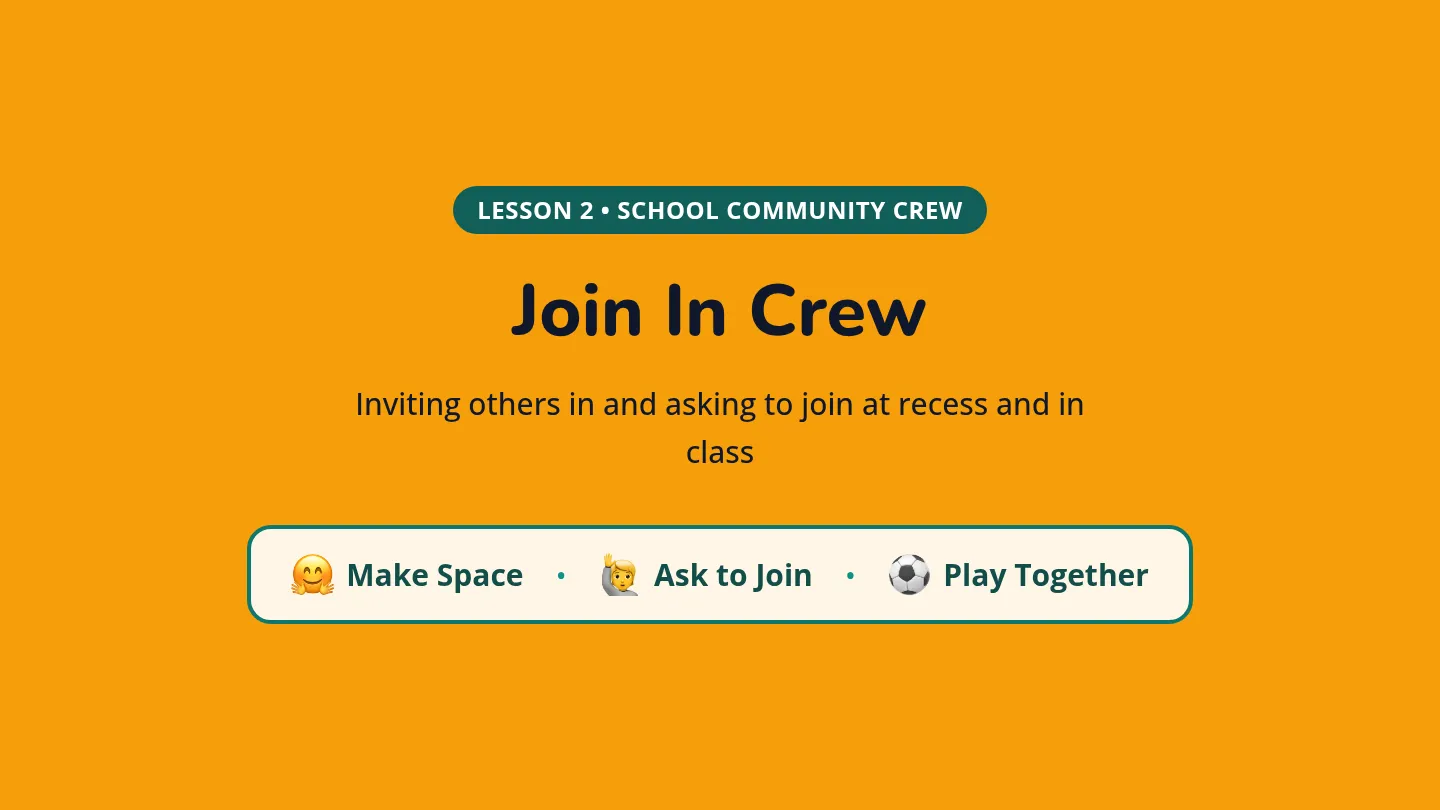
Join In Slides Lesson 2 • School Community Crew
Join In Crew
Inviting others in and asking to join at recess and in class
🤗 Make Space
•
🙋 Ask to Join
•
⚽ Play Together
Two Ways to Build Belonging
🫶
Invite Someone In
Notice when a classmate is standing alone or looking for a partner.
"Come join us!"
🙋♀️
Ask to Join In
Walk up calmly with a friendly face and use your joining words.
"Can I play too?"
Words That Invite Others
Open Circle!
⚽
"Do you want to play with us?"
Great for recess, tag, or soccer.
🪑
"You can sit right here next to me!"
Great for lunch tables and carpet time.
🎨
"Want to be in our group? It is your turn!"
Great for partner work and centers.
Words to Ask to Join
Brave & Polite!
1️⃣
"Excuse me, can I play too?"
Wait for a pause so your friends can hear you.
2️⃣
"May I work with your group?"
Use this when choosing a classroom table or center.
3️⃣
"Thank you for making room for me!"
Show appreciation when someone welcomes you in.
Role-Play Challenge
🏀
Scenario A: Recess
Two friends are playing a game. One classmate is watching nearby. Act out how to invite them in!
📚
Scenario B: Group Table
You arrive at a station and need a partner. Act out how to walk up and ask to join!
Join In Teacher Guide Lesson 2 • Teacher Guide
Join In Crew
Pacing
30 Minutes
Community Objective
Students will recognize when a peer is left out and practice inviting others in or asking to join games and group work.
Language Objective
Students will use polite invitation and request frames ("Do you want to play?" / "Can I join?" ) during structured role-play.
Lesson Flow & Facilitation
1. Notice & Connect (5 min) — Slides 1–2
Show Slide 2 and ask: "How does it feel to stand alone at recess?" Introduce the two roles: Inviter (open arms gesture) and Joiner (raised hand gesture).
2. Sentence Frame Echo (6 min) — Slides 3–4
Practice choral reading of Inviting Words and Asking Words. Highlight polite starters like "Excuse me" and "Thank you for making room."
3. Fishbowl Role-Play (7 min) — Slide 5
Invite 3 students to the front to act out Scenario A (Recess) and Scenario B (Group Table) while the class coaches them using the visible sentence frames.
4. Scenario Cards & Reflection (9 min) — Inclusion Scenario Cards
In triads, students draw a Scenario Card (Page 1), act out both inviting and joining, then complete the Reflection Sheet (Page 2) independently.
5. Closing Goal (3 min)
Have each student whisper one joining or inviting phrase they will try at recess or lunch today.
Emergent Bilingual Scaffolds & Differentiation
Entering / Emerging: Provide physical sentence strips or let students point to the phrase on the Scenario Card while using welcoming gestures (stepping back to open the circle).Developing / Expanding: Challenge students to add a reason or next step ("You can sit here because we have an extra chair!" ).Peer Grouping: Pair newcomer students with supportive bilingual or empathetic peers during triad role-play so everyone experiences a warm welcome. Inclusion Scenario Cards Inclusion Scenario Cards
Cut out these 4 cards and practice inviting & joining in your group!
✂️
Card 1 • Recess ⚽
The Soccer Circle
Two friends are passing a soccer ball. A classmate stands by the fence watching.
Try saying:
• "Do you want to play with us?"
• "Can I play too?"
Card 2 • Lunch 🍎
The Lunch Table
A new student walks into the cafeteria holding their lunch tray and looking for a seat.
Try saying:
• "You can sit right here next to me!"
• "Excuse me, is this seat open?"
Card 3 • Art Center 🎨
Sharing Markers
A group is drawing together at the art table. One student arrives late and needs a spot.
Try saying:
• "Come join our table! Here are markers."
• "May I work with your group?"
Card 4 • Reading Rug 📖
Partner Reading
The teacher says "Find a reading partner!" Everyone pairs up except one classmate.
Try saying:
• "Want to be in our group of three?"
• "Thank you for making room for me!"
Name: ____________________________________
Date: ________________________
Join In Practice Sheet
Choose welcoming words and plan how you will include others!
🤝
Part 1: Circle the Best Words
Read each school moment. Circle the words that help everyone belong.
1. You see a classmate standing alone at recess. You say:
A. "Do you want to play with us?"
B. "We already have enough people."
2. You want to join a group at the art table. You say:
A. "Move over, I want that chair."
B. "May I work with your group?"
Part 2: My Join In Plan
Draw a picture of you inviting a friend to play or sit with you.
Write the words you will say:
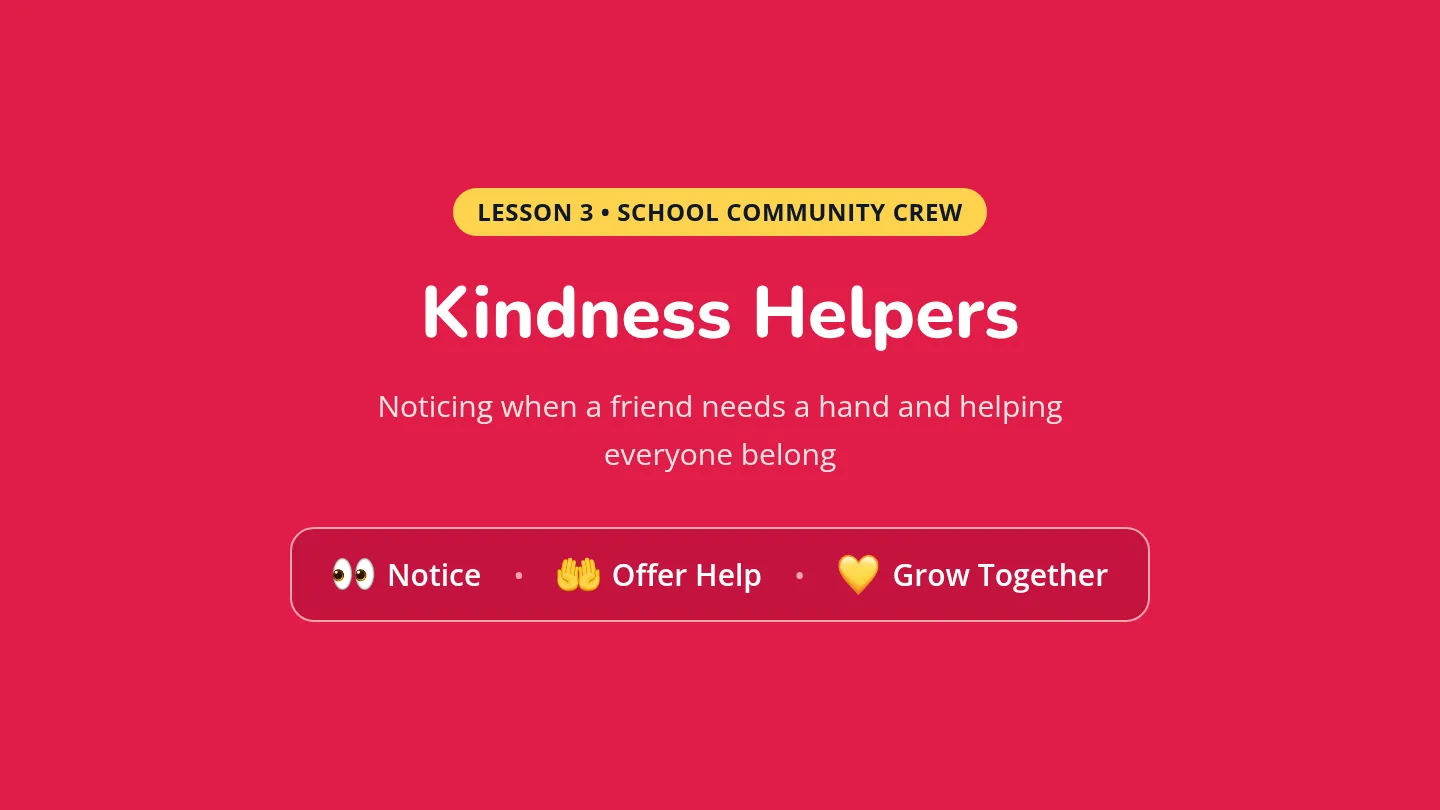
Kindness Helpers Slides Lesson 3 • School Community Crew
Kindness Helpers
Noticing when a friend needs a hand and helping everyone belong
👀 Notice
•
🤲 Offer Help
•
💛 Grow Together
Eyes That Notice
📚
Spilled Supplies
A classmate drops their crayons, folders, or books in the hallway.
🤔
Unsure What to Do
A friend looks confused about a page number or classroom routine.
💧
Having a Hard Day
Someone looks sad, quiet, or hurt on the playground.
Kindness Helper Words
Ask First!
🤲
"Do you need help?"
Ask kindly before grabbing someone's things.
👉
"I can show you how!"
Point gently or model the step together.
💛
"Are you okay? Want to walk with me?"
Stay beside a friend who feels upset or lonely.
Receiving Help & Saying Thanks
🙏
When You Want Help
"Yes, please! Thank you."
Everyone needs help sometimes. Accepting help builds friendship!
🌟
When You Can Do It Yourself
"No thank you, I got it!"
You can say no politely and still smile at your friend.
🏫
Our Community Promise
We are a School Community Crew! On your poster, draw and write one way you will help everyone belong.
"I promise to help our school belong by..."
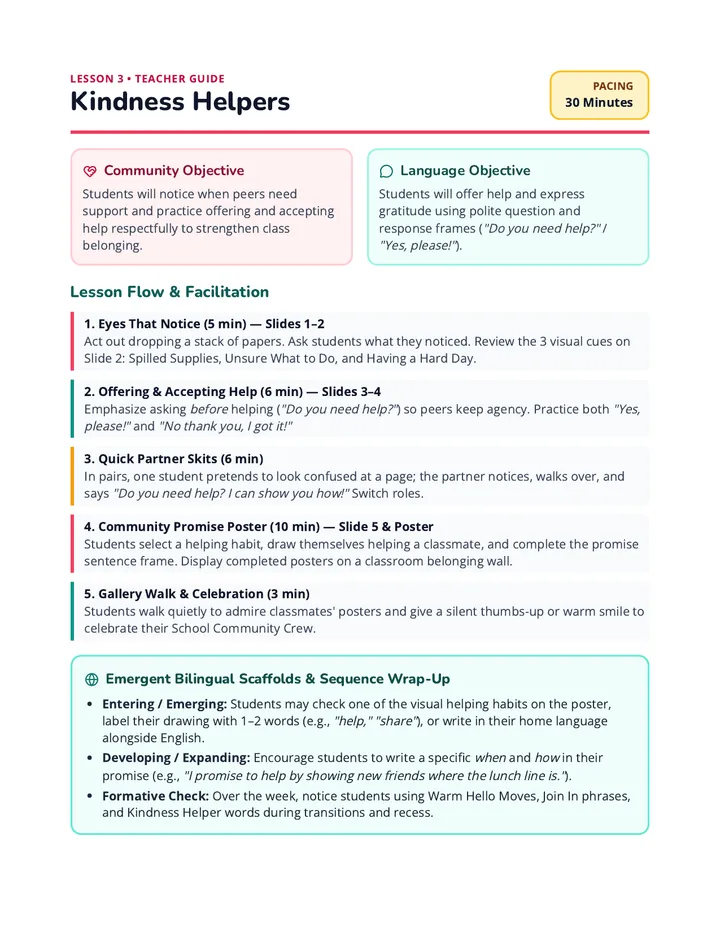
Kindness Helpers Teacher Guide Lesson 3 • Teacher Guide
Kindness Helpers
Pacing
30 Minutes
Community Objective
Students will notice when peers need support and practice offering and accepting help respectfully to strengthen class belonging.
Language Objective
Students will offer help and express gratitude using polite question and response frames ("Do you need help?" / "Yes, please!" ).
Lesson Flow & Facilitation
1. Eyes That Notice (5 min) — Slides 1–2
Act out dropping a stack of papers. Ask students what they noticed. Review the 3 visual cues on Slide 2: Spilled Supplies, Unsure What to Do, and Having a Hard Day.
2. Offering & Accepting Help (6 min) — Slides 3–4
Emphasize asking before helping ("Do you need help?" ) so peers keep agency. Practice both "Yes, please!" and "No thank you, I got it!"
3. Quick Partner Skits (6 min)
In pairs, one student pretends to look confused at a page; the partner notices, walks over, and says "Do you need help? I can show you how!" Switch roles.
4. Community Promise Poster (10 min) — Slide 5 & Poster
Students select a helping habit, draw themselves helping a classmate, and complete the promise sentence frame. Display completed posters on a classroom belonging wall.
5. Gallery Walk & Celebration (3 min)
Students walk quietly to admire classmates' posters and give a silent thumbs-up or warm smile to celebrate their School Community Crew.
Emergent Bilingual Scaffolds & Sequence Wrap-Up
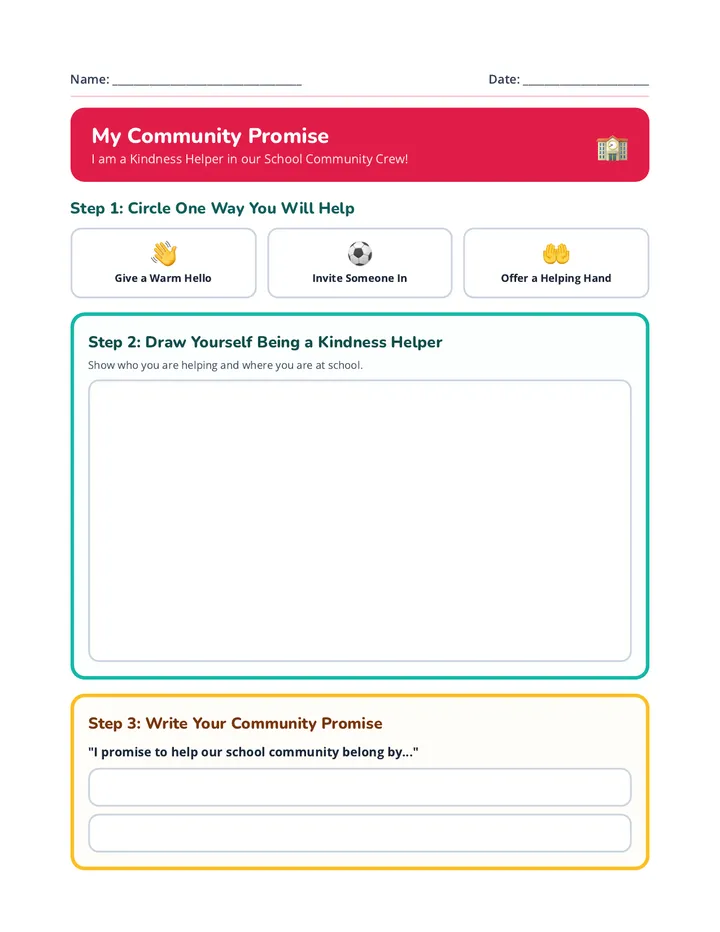
Entering / Emerging: Students may check one of the visual helping habits on the poster, label their drawing with 1–2 words (e.g., "help," "share" ), or write in their home language alongside English.Developing / Expanding: Encourage students to write a specific when and how in their promise (e.g., "I promise to help by showing new friends where the lunch line is." ).Formative Check: Over the week, notice students using Warm Hello Moves, Join In phrases, and Kindness Helper words during transitions and recess. Community Promise Poster Name: ____________________________________
Date: ________________________
My Community Promise
I am a Kindness Helper in our School Community Crew!
🏫
Step 1: Circle One Way You Will Help
👋
Give a Warm Hello
⚽
Invite Someone In
🤲
Offer a Helping Hand
Step 2: Draw Yourself Being a Kindness Helper
Show who you are helping and where you are at school.
Step 3: Write Your Community Promise
"I promise to help our school community belong by..."