Peer Radar Check In Sheet Friendship Signals • Week 1
Peer Radar Daily Log
Name:
Date:
Skill Focus
Social Radar: Tuning your eyes and thoughts toward what classmates are doing, sharing space respectfully, and noticing the group plan.
Mon Scan the Room
Battery: 🪫 Low 🔋 Steady ⚡ High
Turn on your radar. Notice two peers working or playing. What is their current focus or game?
Tue Personal Comfort Bubble
Space Check: Too Close Just Right 👍 Too Far
Where were you standing or sitting today where keeping a comfortable one-arm distance helped a peer feel relaxed?
Wed Reading Group Energy
Group Vibe: Quiet Focus Playful Busy/Noisy
What did your group plan call for today (independent work, partner chat, line up)? How did you match that rhythm?
Thu Face & Body Clues
Radar Level: Detecting Well 🎯 Needed Reminder
Look at a peer’s posture or facial expression. What clue hinted that they were happy, confused, or needed space?
Fri Weekly Radar Highlight
Week Complete!
When was a time this week your radar stopped a collision or helped you notice someone who was left out?
Radar Peer Spotlight
Name a classmate who demonstrated great space awareness or peer kindness:
Peer Radar Facilitator Guide Educator Coaching Guide • Week 1
Peer Radar Facilitation
Focus: Social Awareness
Core Concept
Social Radar
Actively noticing what people around us are doing, feeling, and needing without waiting for verbal instructions.
Target Skill
Shared Space Bubbles
Maintaining respectful physical proximity (arm's length) and adjusting movement inside classrooms and hallways.
Social Goal
The Group Plan
Recognizing whether the group is in quiet focus, transition, or active play, and synchronizing actions accordingly.
Daily 5-Minute Morning Meeting Scripts
Mon • Scanning: "Look around without speaking for 10 seconds. Point your mental antenna at a classmate. What does their body tell you about their task?"
Tue • Space Bubble: "Imagine your bubble expands when people are overwhelmed and shrinks when whispering secrets. What size bubble is helpful right now?"
Wed • Group Energy: "Is our room's energy like a gentle river or a rollercoaster? When our rhythm matches the room, everyone feels safer."
Thu • Nonverbal Clues: "Someone drops their pencil box. Before asking them, what does your radar predict they need? A helper or quiet space?"
Fri • Radar Victories: "Who felt seen or protected by a classmate this week? Let's name and celebrate real radar moments from our log."
Observable Look-Fors
✓ Navigates crowded spaces without accidental bumps or pushing.
✓ Pauses before interrupting peers who are focused on a task.
✓ Notices when a peer's posture signals distress or disengagement.
Neurodiversity-Affirming Tips
• Do not mandate direct eye contact; encourage ear-orienting or looking near peers.
• Validate students who need larger personal boundaries due to sensory processing.
• Use visual floor tape markers for students who struggle with spatial estimation.
End of Week Coaching Check
Collect student logs Friday afternoon. Note students needing targeted dyad practice during Week 2 initiations.
Module 1 of 8
Warm Welcomes Check In Sheet Friendship Signals • Week 2
Warm Welcomes Daily Log
Name:
Date:
Skill Focus
Initiating & Approaching: Sending friendly social signals, using peer names, and reading body cues before stepping into group play.
Mon The Silent Greeting
Morning Battery: 🪫 Low 🔋 Steady ⚡ High
Try a friendly silent signal today (a nod, quiet wave, or gentle smile). Who did you greet, and how did they respond?
Tue The Name Spark
Greeting Type: "Hey [Name]!" "Good Morning!"
Saying someone's name shows they are in your mind. Which peer did you address by name during arrival or passing period?
Wed Reading Group Entry Signals
Group Signal: 🟢 Open Circle 🟡 Closed / Focused
Before joining a group, notice their circle shape. Was the circle open with space for one more, or tight and busy?
Thu The 3-Step Slide-In
Step Done: 1. Observe 2. Stand Near 3. Connect
Practice sliding into a game: Watch for 30 seconds first, then make an interested comment ("Cool build!"). How did it go?
Fri Welcoming An Outside Peer
Week Complete!
How did you create an opening for someone else today? (e.g., sliding over on a bench, smiling, or waving them over)?
Welcoming Hero Spotlight
Name a classmate who made you feel included, greeted, or valued this week:
Warm Welcomes Facilitator Guide Educator Coaching Guide • Week 2
Warm Welcomes Facilitation
Focus: Social Initiation
Core Concept
Initiation Cues
Sending micro-invitations (waves, smiles, using names) that signal safety, warmth, and readiness to engage.
Target Skill
The 3-Step Slide-In
Transitioning from observing an ongoing game to parallel proximity, then asking a relevant entrance question.
Social Goal
Reading Group Openings
Differentiating open circles (green light) from closed, private, or intense collaborative clusters (yellow/red light).
Daily 5-Minute Morning Meeting Scripts
Mon • Silent Welcomes: "Words are only one way to say hello. Turn to your left and give a friendly nod or peace sign. Notice how quickly warmth spreads."
Tue • The Name Magic: "Hearing our own name is the sweetest sound. When you say 'Morning Alex' instead of 'Hey', Alex knows you see them specifically."
Wed • Open vs Closed Circles: "Let's demonstrate with 4 volunteers. Stand tight shoulder-to-shoulder (closed), now step back and angle outward (open). What signal is sent?"
Thu • The 3-Step Slide-In: "Don't burst in and change the game! Step 1: Watch. Step 2: Hover near. Step 3: Add a compliment or ask, 'Can I be the banker?'"
Fri • Making Space: "If you are already inside a fun group, your job is being a gatekeeper of kindness. How can you scooch over to welcome someone standing near?"
Observable Look-Fors
✓ Uses peer names naturally during morning greetings and transitions.
✓ Watches play before jumping in rather than disrupting existing rules.
✓ Physically shifts posture to include an approaching peer into the group.
Neurodiversity-Affirming Tips
• Provide scripted sentence stems or visual passes ('Can I join?') for non-speaking or shy moments.
• Normalize parallel play; sharing space with identical materials is a valid form of connection.
• Reframe 'not right now' as a game boundary rather than personal social rejection.
End of Week Coaching Check
Celebrate students who opened circles for others. Prepare students for back-and-forth verbal dialogue in Week 3.
Module 2 of 8
Conversation Bridges Check In Sheet Friendship Signals • Week 3
Conversation Bridges Daily Log
Name:
Date:
Skill Focus
Conversation Bridges: Tossing the conversational ball back and forth, asking curious questions, and building bridges across shared interests.
Mon The Conversation Catch
Talk Rhythm: Ball Hog Balanced Toss 🤝 Quiet Receiver
A good chat is like catch: toss, catch, pass back. Did you balance speaking and listening in your partner chat today?
Tue The "Tell Me More" Bridge
Question Word: "What...?" "How...?" "Why...?"
Ask a follow-up question that cannot be answered with just "yes" or "no". What did you ask a classmate today?
Wed The Shared Spark
Connection: Book/Movie Game/Sport Food/Hobby
Discover one thing you and a peer both enjoy or find interesting. What common bridge did you discover?
Thu Staying on the Train Track
Track Check: Stayed on Track 🚂 Smooth Pivot
When someone shares a story, add a comment about THEIR topic before changing to yours. What topic did you stick with?
Fri The 3-Turn Volley
Week Complete!
Celebrate a chat that lasted at least 3 turns each! Who was your conversation partner, and what was the highlight?
Conversation Partner Spotlight
A classmate who asked you a wonderful question or made conversation fun:
Conversation Bridges Facilitator Guide Educator Coaching Guide • Week 3
Conversation Bridges Facilitation
Focus: Conversational Exchange
Core Concept
The Talk Volley
Treating dialogue like a collaborative rally of catch rather than a monologue or interrogation.
Target Skill
Bridge Questions
Using open question stems ('What do you think about...', 'How did that happen?') to invite deeper responses.
Social Goal
Topic Tracking
Sustaining the current thread for at least 3 turns before introducing an unrelated personal interest.
Daily 5-Minute Morning Meeting Scripts
Mon • The Ball Game: "Hold an imaginary ball. When you talk, you hold it. If you keep talking for 2 minutes without asking a question, your partner gets tired of waiting."
Tue • Add a Comment First: "If Mia says 'I built a spaceship in Lego', don't immediately say 'I have a dog!' Say 'That sounds huge, how many bricks did it take?'"
Wed • Finding Common Sparks: "You don't need to love the same game. You can connect on feeling excited, building things, or mystery stories. Look for the emotion spark!"
Thu • Staying on the Train Track: "What happens when a train switches tracks with no warning? It derails! Conversations derail when we switch topics without a connecting bridge."
Fri • Celebrating Great Bridges: "Turn to a partner right now. Ask one curious question about their favorite recess game, listen to their answer, and pass the ball back."
Observable Look-Fors
✓ Allows peer to finish speaking before responding (no talking over).
✓ Asks at least one relevant follow-up question during casual chats.
✓ Shows interest in topics that are not their primary special interest.
Neurodiversity-Affirming Tips
• Support infodumping by teaching 'checking in' ('Do you want to hear more about this?').
• Provide physical conversation cubes or visual cards with prompt starters.
• Allow processing pauses; silence for 3-5 seconds often precedes thoughtful questions.
End of Week Coaching Check
Celebrate balanced conversation pairs. Next week in Lesson 4, we will learn how active listening powers deeper connection.
Module 3 of 8
Tuning In Check In Sheet Friendship Signals • Week 4
Tuning In Daily Log
Name:
Date:
Skill Focus
Attentive Listening: Tuning your ears, heart, and body posture toward the speaker so they feel valued, respected, and understood.
Mon The "I Hear You" Posture
Body Clue: Turned Toward Gentle Nod Still Hands
When a friend was speaking, how did your body show them you were tuned in rather than tuned out?
Tue Voice Volume Calibration
Volume Level: 1 (Whisper) 2 (Table Talk) 👍 3 (Stage/Recess)
Did you match your voice volume to your friend's comfort level and the classroom space today? Where did you practice?
Wed The Echo Check
Echo Used: "You felt..." "So you mean..."
Prove you tuned in: Repeat back one important detail or word a classmate shared with you before adding your thought.
Thu Managing Distractions
Distraction Managed: Pencil Fidget Screen/Book Side Chat
What was tempting to look at while a classmate spoke, and how did you pull your focus back to them?
Fri Feeling Heard Reflection
Week Complete!
Think of a moment someone tuned into you without looking away. How did that make you feel about your friendship?
Attentive Listener Spotlight
Name a classmate who made you feel genuinely heard and respected this week:
Tuning In Facilitator Guide Educator Coaching Guide • Week 4
Tuning In Facilitation
Focus: Active Attending
Core Concept
Attentive Resonance
Understanding that listening is an active social signal that communicates value, safety, and mutual respect.
Target Skill
The Echo Check
Paraphrasing or reflecting back key ideas before offering an opinion, verifying comprehension and empathy.
Social Goal
Volume Calibration
Modulating vocal volume and pitch to suit interpersonal proximity and ambient environmental conditions.
Daily 5-Minute Morning Meeting Scripts
Mon • The Visible Ear: "If you're looking at your shoes while someone talks, what might their brain predict? Let's practice orienting our upper body toward the speaker."
Tue • The 3 Voice Meters: "Level 1: Secret whisper. Level 2: Desk talk with your partner. Level 3: Outdoor playground rally. Let's practice slipping seamlessly into Level 2."
Wed • The Mirror Echo: "Before you respond, say 'So you're saying...' It gives your brain time to think and tells the other person they aren't talking to a wall."
Thu • The Mental Shield: "When another student walks past our circle, what do you do with your eyes? Freeze them on our speaker like a flashlight beam."
Fri • How Listening Feels: "Close your eyes. Remember a time when someone gave you 100% of their attention. What did that feel like in your chest? We can gift that every day."
Observable Look-Fors
✓ Nods or emits micro-affirmations ('Yeah', 'Uh-huh') during peer speech.
✓ Self-adjusts vocal volume when seated in close-quarters small groups.
✓ Accurately restates instructions or peer comments when prompted.
Neurodiversity-Affirming Tips
• Acknowledge that doodling or silent tactile fidgeting often enhances auditory processing.
• Distinguish between hearing impairment/auditory lag and deliberate inattention.
• Provide a 5-second thinking buffer before demanding restatements or answers.
End of Week Coaching Check
Halfway point! Foundational social awareness and conversational skills are now in place. Moving to cooperation in Week 5.
Module 4 of 8
Team Rhythm Check In Sheet Friendship Signals • Week 5
Team Rhythm Daily Log
Name:
Date:
Skill Focus
Cooperative Play: Sharing the steering wheel, bending like a willow tree (flexible thinking), and building win-win compromises.
Mon Sharing the Steering Wheel
Today's Role: Driver (Leading) Co-Pilot (Supporting) 👍
When playing or working in pairs, did you let your partner choose the materials or game direction today?
Tue The Flexible Bend
Thinking Style: Rigid / Locked Bending / Flexible 🎋
Things rarely go 100% as planned. How did your brain bend flexibly when a classmate suggested a different way to do something?
Wed The Win-Win Bridge
Solution: Took Turns Blended Ideas Flipped Coin
When you and a classmate disagreed on what to do, what compromise helped both of you feel satisfied?
Thu Sharing the Spotlight
Praise Given: "Great idea!" "Nice move!"
Give credit to a teammate! What specific contribution did your partner make that improved your shared project or game?
Fri Cooperation Milestone
Week Complete!
Reflect on a game or task you finished together this week that was more fun because of cooperation.
Team Player Spotlight
Name a classmate who shared control or compromised cheerfully this week:
Team Rhythm Facilitator Guide Educator Coaching Guide • Week 5
Team Rhythm Facilitation
Focus: Cooperation & Sharing Control
Core Concept
Co-Piloting
Understanding that games and projects require shared agency; friendships weaken when one person acts as sole director.
Target Skill
Cognitive Flexibility
Pivoting smoothly when unexpected rule changes or team preferences occur without freezing or retaliating.
Social Goal
Win-Win Compromise
Synthesizing two disparate ideas into a hybrid solution that preserves both participants' dignity and excitement.
Daily 5-Minute Morning Meeting Scripts
Mon • The Dual Steering Wheel: "What happens if two people in a car both yank the steering wheel opposite ways? The car crashes. Good teams take turns navigating."
Tue • Willow Tree Thinking: "In a strong storm, an oak tree with rigid wood snaps. A willow tree bends and survives. Is your brain bending like a willow today?"
Wed • The Hybrid Plan: "One wants tag, one wants hide-and-seek. How do you make 'Manhunt'? Combining ideas creates brand new games!"
Thu • Catching Your Partner Being Great: "True teammates pass the ball so someone else can score. When did a teammate make a move that helped your whole group shine?"
Fri • Celebration of Togetherness: "Working alone is fast, but working together goes further. Let's do a silent round of applause for every student who compromised this week."
Observable Look-Fors
✓ Willingly relinquishes primary role during collaborative games.
✓ Offers or accepts 'rock-paper-scissors' or timers to settle disputes.
✓ Celebrates peer wins without complaining or showing resentment.
Neurodiversity-Affirming Tips
• Support students struggling with rule-rigidity by establishing clear 'house rules' before play begins.
• Allow structured roles (e.g. materials manager, scorekeeper) to ease ambiguous social negotiation.
• Validate feelings of disappointment while coaching the behavioral response.
End of Week Coaching Check
Note students who struggled with compromise. Next week in Lesson 6, we explore reading other minds and perspectives.
Module 5 of 8
Perspective Detectives Check In Sheet Friendship Signals • Week 6
Perspective Detectives Daily Log
Name:
Date:
Skill Focus
Perspective Taking: Stepping into a peer's sneakers, discovering that different brains see things differently, and uncovering unspoken social clues.
Mon Two Brains, Two Views
Perspective: Identical Different View 🔍
Look at an event today (e.g. rain at recess, art project). Did you and a peer have opposite feelings about it?
Tue In Their Sneakers
Guessed Feeling: Proud Nervous Tired
Pick a classmate who was presenting or tackling hard work. What do you think they felt on the inside?
Wed Uncovering Hidden Rules
Zone: Hallway Cafeteria Library
What is an unwritten rule that isn't on a poster, but everyone expects you to follow to make others feel comfortable?
Thu Validating Without Agreeing
Validation Phrase: "I see your point" "That makes sense"
When someone liked something you didn't, how did you show respect without arguing that your taste is better?
Fri The Empathy Discovery
Week Complete!
How did thinking about someone else's perspective help prevent a misunderstanding or hurt feelings this week?
Perspective Detective Spotlight
A classmate who showed great empathy or understood your feelings:
Perspective Detectives Facilitator Guide Educator Coaching Guide • Week 6
Perspective Detectives Facilitation
Focus: Theory of Mind & Empathy
Core Concept
Separate Mental Files
Realizing that just because something feels obvious or fun to me does not mean another student experiences it the same way.
Target Skill
Reading Hidden Rules
Uncovering context-specific social expectations (e.g., library whispering vs stadium cheering) without explicit signage.
Social Goal
Validating Other Views
Acknowledging another person's preferences or feelings without arguing, mocking, or attempting to force consensus.
Daily 5-Minute Morning Meeting Scripts
Mon • The 6 and the 9: "Draw a numeral on the carpet. Stand on opposite sides. One sees a 6, one sees a 9. Who is lying? Neither! Both perspectives are true from their angle."
Tue • The Inside Story: "When a peer snaps or is quiet, their reaction might have nothing to do with you. What might have happened at home or on the bus before school?"
Wed • The Hidden Rules: "Nobody ever handed you a book on cafeteria rules. How did you figure out where to dump trays? By turning on your social detective eyes!"
Thu • Disagreeing Respectfully: "When someone says chocolate ice cream is gross, saying 'You're crazy!' damages trust. Say 'Vanilla is my favorite too.' Honor their taste!"
Fri • Detective Honors: "Who had their feelings understood by someone else this week before even having to explain it with words? Let's celebrate our empathy detectives."
Observable Look-Fors
✓ Accurately predicts how a peer will feel during a challenging event.
✓ Refrains from imposing personal game preferences as universal truths.
✓ Adjusts behavior when entering spaces with distinct implicit rules.
Neurodiversity-Affirming Tips
• Avoid assuming autistic students lack empathy; differentiate cognitive perspective-taking from deep affective empathy.
• Make implicit rules explicit using clear visual guides rather than relying on social osmosis.
• Do not force students to endorse views that contradict their personal sensory safety.
End of Week Coaching Check
With perspective taking solidified, students are equipped for Week 7's crucial work: handling glitches and social friction.
Module 6 of 8
Glitch Busters Check In Sheet Friendship Signals • Week 7
Glitch Busters Daily Log
Name:
Date:
Skill Focus
Size of the Problem: Telling small glitches apart from big emergencies, matching our reaction size, and using peaceful fix-it tools.
Mon Glitch vs Big Problem
Problem Scale: Small Glitch (1-2) Medium (3) Emergency (4-5)
A pencil snaps or someone cuts in line by accident. Was your challenge today a tiny glitch you can fix yourself?
Tue Matching Reaction Size
Match Check: Reaction Matched 👍 Reaction Too Big
When something annoying happened today, did your reaction stay small (calm voice, deep breath) to match the problem size?
Wed The 3-Second Reset
Reset Move: Deep Breath 🌬️ Drink Water Hand Clasp
Before words exploded out, what reset action helped calm your nervous system when someone frustrated you?
Thu Fix-It Strategy
Action Taken: Let it go "I-Statement" Asked Adult
How did you resolve a minor peer disagreement today using an 'I-Statement' or peaceful compromise?
Fri Glitch Buster Pride
Week Complete!
What is one moment this week you are proud of how cool, calm, and collected you stayed during peer friction?
Peacekeeper Spotlight
A classmate who handled a glitch with calm maturity or kindness:
Glitch Busters Facilitator Guide Educator Coaching Guide • Week 7
Glitch Busters Facilitation
Focus: Problem Solving & Self-Regulation
Core Concept
Glitch vs Emergency
Distinguishing everyday hiccups (loss of game, dropped item) from true safety hazards requiring immediate adult intervention.
Target Skill
Reaction Calibrating
Training students to align behavioral output with problem scale: small glitches deserve small, quiet responses.
Social Goal
The 3-Second Pause
Interrupting fight-or-flight reactivity through deliberate physiological resets before speaking or reacting.
Daily 5-Minute Morning Meeting Scripts
Mon • The 1 to 5 Thermometer: "Level 1: Broke your crayon. Level 5: Building fire. If we react to broken crayons like building fires, everyone's nervous system panics."
Tue • The Reaction Match: "When you don't get the swingset first, what does a Level 1 reaction look like? A quiet shrug, picking another game, or waiting your turn."
Wed • Box Breathing Drill: "Inhale 4 counts, hold 4, exhale 4, hold 4. That 16-second box cools down the brain's alarm bell before we say words we regret."
Thu • The 3 Peacekeeper Paths: "When someone annoys you: Path 1: Walk away. Path 2: Say calmly 'Please give me space'. Path 3: Ask a teacher. Which path is right today?"
Fri • De-escalation Champions: "Who caught themselves getting mad this week and successfully cooled their own engine down? That is true superpower strength."
Observable Look-Fors
✓ Accurately categorizes unexpected peer actions as small glitches.
✓ Attempts independent de-escalation before seeking teacher mediation.
✓ Uses calm conversational tone rather than screaming or physical pushing.
Neurodiversity-Affirming Tips
• Remember sensory pain (e.g. loud bell, fluorescent flicker) can turn small social glitches into real visceral crises.
• Provide access to a designated quiet corner or sensory break card without disciplinary stigma.
• Debrief incidents only AFTER full physiological down-regulation has occurred.
End of Week Coaching Check
Review log entries for recurring conflict triggers. Next week in Lesson 8: Final repairs, apologies, and lasting friendship celebrations!
Module 7 of 8
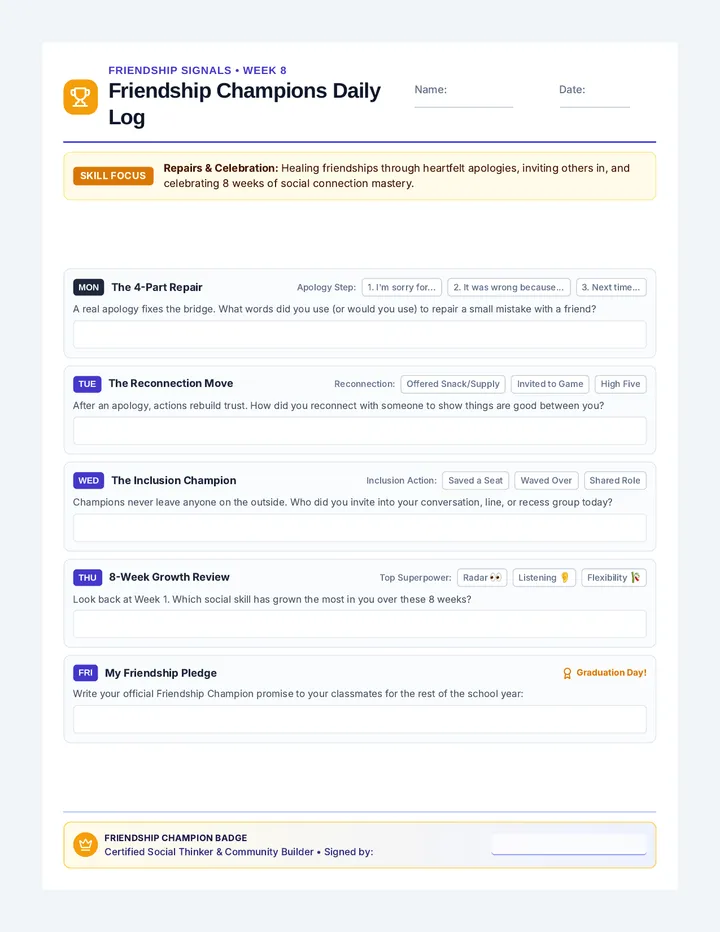
Friendship Champions Check In Sheet Friendship Signals • Week 8
Friendship Champions Daily Log
Name:
Date:
Skill Focus
Repairs & Celebration: Healing friendships through heartfelt apologies, inviting others in, and celebrating 8 weeks of social connection mastery.
Mon The 4-Part Repair
Apology Step: 1. I'm sorry for... 2. It was wrong because... 3. Next time...
A real apology fixes the bridge. What words did you use (or would you use) to repair a small mistake with a friend?
Tue The Reconnection Move
Reconnection: Offered Snack/Supply Invited to Game High Five
After an apology, actions rebuild trust. How did you reconnect with someone to show things are good between you?
Wed The Inclusion Champion
Inclusion Action: Saved a Seat Waved Over Shared Role
Champions never leave anyone on the outside. Who did you invite into your conversation, line, or recess group today?
Thu 8-Week Growth Review
Top Superpower: Radar 👀 Listening 👂 Flexibility 🎋
Look back at Week 1. Which social skill has grown the most in you over these 8 weeks?
Fri My Friendship Pledge
Graduation Day!
Write your official Friendship Champion promise to your classmates for the rest of the school year:
Friendship Champion Badge
Certified Social Thinker & Community Builder • Signed by:
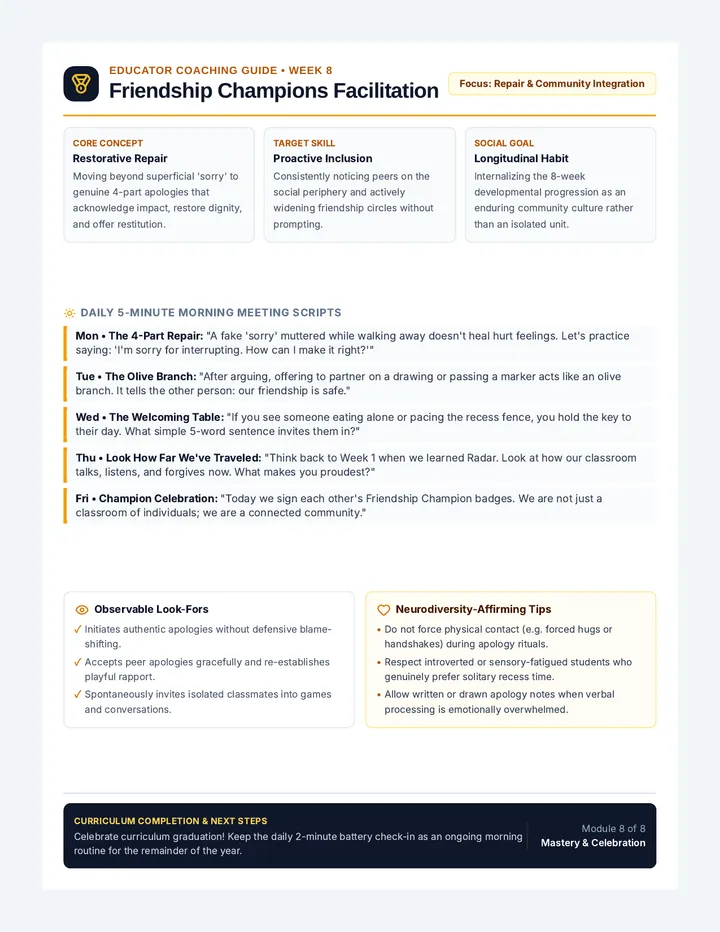
Friendship Champions Facilitator Guide Educator Coaching Guide • Week 8
Friendship Champions Facilitation
Focus: Repair & Community Integration
Core Concept
Restorative Repair
Moving beyond superficial 'sorry' to genuine 4-part apologies that acknowledge impact, restore dignity, and offer restitution.
Target Skill
Proactive Inclusion
Consistently noticing peers on the social periphery and actively widening friendship circles without prompting.
Social Goal
Longitudinal Habit
Internalizing the 8-week developmental progression as an enduring community culture rather than an isolated unit.
Daily 5-Minute Morning Meeting Scripts
Mon • The 4-Part Repair: "A fake 'sorry' muttered while walking away doesn't heal hurt feelings. Let's practice saying: 'I'm sorry for interrupting. How can I make it right?'"
Tue • The Olive Branch: "After arguing, offering to partner on a drawing or passing a marker acts like an olive branch. It tells the other person: our friendship is safe."
Wed • The Welcoming Table: "If you see someone eating alone or pacing the recess fence, you hold the key to their day. What simple 5-word sentence invites them in?"
Thu • Look How Far We've Traveled: "Think back to Week 1 when we learned Radar. Look at how our classroom talks, listens, and forgives now. What makes you proudest?"
Fri • Champion Celebration: "Today we sign each other's Friendship Champion badges. We are not just a classroom of individuals; we are a connected community."
Observable Look-Fors
✓ Initiates authentic apologies without defensive blame-shifting.
✓ Accepts peer apologies gracefully and re-establishes playful rapport.
✓ Spontaneously invites isolated classmates into games and conversations.
Neurodiversity-Affirming Tips
• Do not force physical contact (e.g. forced hugs or handshakes) during apology rituals.
• Respect introverted or sensory-fatigued students who genuinely prefer solitary recess time.
• Allow written or drawn apology notes when verbal processing is emotionally overwhelmed.
Curriculum Completion & Next Steps
Celebrate curriculum graduation! Keep the daily 2-minute battery check-in as an ongoing morning routine for the remainder of the year.
Module 8 of 8