Direction Detectives Worksheet Session 4 Listening Skills & Role Play
Direction Detectives
Name:
Date:
Target Skills: Listen actively, follow multi-step spoken directions, and practice real-life communication through role play.
1
Mission 1: The Detective Listening Protocol
3-Step Listening Challenge
Follow these three steps exactly in order as your teacher or partner reads them aloud:
A Step 1: Focus Anchor
Draw a circle around the detective badge and write the focus word "LISTEN" inside:
B Step 2: Key Rule Match
Write the missing word:"Eyes on speaker, body is ________."
C Step 3: Repeat Back
Write the confirmation phrase you say to show you heard:
2
Mission 2: Direction Role-Play Lab
Partner Practice
Pair up with a partner. Take turns being the Director and the Responder . Act out each scenario and record your responses below.
Scenario A: The Fast Instruction Clarifying Skill
Role: Your partner gives you 3 quick classroom directions (e.g., "Grab your blue binder, open page 14, and get a green pen" ). You missed the page number.
Your polite clarifying question:
Partner Check:
Calm Tone Made Eye Contact
Scenario B: Multi-Step Task Echo Confirmation Skill
Role: Your partner asks you to help clean up: "Put the colored pencils in the red bin, then stack the drawing paper by the window."
Your repeating-back response to confirm:
Partner Check:
Echoed Correctly Ready to Act
3
Mission 3: Detective Self-Reflection
When someone gives me directions, my best listening tool is:
Today's Listening & Role-Play Rating:
Still Practicing
Getting Better
Master Detective
Social Skills Quest • Session 4 Remember: Great listeners ask when they are unsure! Page 1 of 1
Calm Compass Worksheet Session 5 Emotional Regulation
Calm Compass
Name:
Date:
Target Skills: Identify how emotions feel in your body and practice proven calming tools to regain control.
1
Zone 1: Body Clues & Feelings Radar
Self-Awareness
Before we can calm down, we need to notice what our body is telling us. Match your feelings with body signals:
Angry / Frustrated
Clenched fists, hot face, racing pulse
Anxious / Worried
Butterflies in stomach, fast breathing
Sad / Tired
Heavy body, slumped posture, low energy
Calm & Ready
Relaxed shoulders, steady breath, focused
When big feelings start growing, where do you feel it first in your body? (Describe 2 physical clues):
2
Zone 2: Calming Strategy Toolkit Lab
Hands-On Practice
Test these calming strategies during class today. Rate how well each helps reset your nervous system:
Tool A: Box Breathing 4-4-4 Count
Inhale for 4s → Hold for 4s → Exhale for 4s → Rest for 4s. Repeat 3 times.
How did your body feel after trying it?
Tool B: Sensory Grounding Mind Reset
Name 3 things you see around you, 2 things you can touch, and 1 sound you hear right now.
Write 1 thing you saw & 1 sound you heard:
Tool C: Progressive Release Tension Drop
Squeeze shoulders up to ears tight for 3 seconds, then exhale and let them drop completely.
Did your muscles feel looser?
Tool D: Reset Self-Talk Mindset Tool
Replace "I can't do this" with "I can pause, breathe, and tackle this one part at a time."
Write your personal power phrase:
3
Zone 3: My Action Protocol
Complete your calming action plan statement:
1. When I feel upset, I will first:
2. My favorite calming strategy is:
Calm Meter Readiness:
Level 1
Level 2
Level 3
Level 4
Social Skills Quest • Session 5 Remember: Taking a pause is a sign of strength! Page 1 of 1
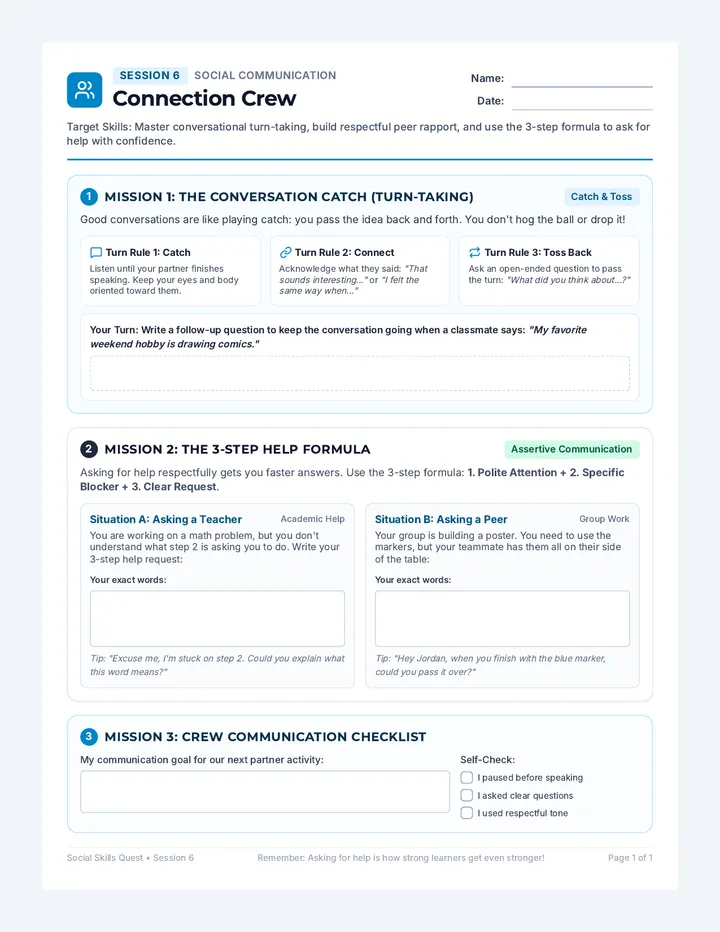
Connection Crew Worksheet Session 6 Social Communication
Connection Crew
Name:
Date:
Target Skills: Master conversational turn-taking, build respectful peer rapport, and use the 3-step formula to ask for help with confidence.
1
Mission 1: The Conversation Catch (Turn-Taking)
Catch & Toss
Good conversations are like playing catch: you pass the idea back and forth. You don't hog the ball or drop it!
Turn Rule 1: Catch
Listen until your partner finishes speaking. Keep your eyes and body oriented toward them.
Turn Rule 2: Connect
Acknowledge what they said: "That sounds interesting..." or "I felt the same way when..."
Turn Rule 3: Toss Back
Ask an open-ended question to pass the turn: "What did you think about...?"
Your Turn: Write a follow-up question to keep the conversation going when a classmate says: "My favorite weekend hobby is drawing comics."
2
Mission 2: The 3-Step Help Formula
Assertive Communication
Asking for help respectfully gets you faster answers. Use the 3-step formula: 1. Polite Attention + 2. Specific Blocker + 3. Clear Request .
Situation A: Asking a Teacher Academic Help
You are working on a math problem, but you don't understand what step 2 is asking you to do. Write your 3-step help request:
Your exact words:
Tip: "Excuse me, I'm stuck on step 2. Could you explain what this word means?"
Situation B: Asking a Peer Group Work
Your group is building a poster. You need to use the markers, but your teammate has them all on their side of the table:
Your exact words:
Tip: "Hey Jordan, when you finish with the blue marker, could you pass it over?"
3
Mission 3: Crew Communication Checklist
My communication goal for our next partner activity:
Self-Check:
I paused before speaking I asked clear questions I used respectful tone
Social Skills Quest • Session 6 Remember: Asking for help is how strong learners get even stronger! Page 1 of 1