Real World Launch Slides Capstone Transition Career & Life Readiness
Real World Launchpad
Practical skills for workplace success, smart money, time management, and owning your next chapter.
Career Preparation Life Skills
Grab a notebook for your checklist
Warm-Up Discussion
The Shift: School vs. Real World
In School
Clear syllabus & daily reminders
Grades measure effort & accuracy
Schedule is built for you
In the Real World
You track your own deadlines
Reliability & trust build your reputation
You manage time, money, & choices
Turn & Talk: What feels like the biggest jump between high school and your next step?
Career Prep 1
Workplace Expectations
Show Up Ready
On time means 10 minutes early. Communicate before a problem happens, not after.
Take Initiative
Don't wait to be told every step. Ask smart questions, take notes, and look for what's next.
Use Feedback
Correction is coaching, not a personal attack. Listen, adjust quickly, and follow through.
Key Takeaway: Technical skills get you hired; reliability and attitude keep you growing.
Career Prep 2
Applications & Professional Communication
Strong Applications
Tailor it: Match keywords from the job post.
Show impact: Use action verbs + results.
Proofread: Zero typos, clean formatting, professional email address.
Email & Message Formula
Subject: Clear & specific (e.g., Application: Junior Tech — Maya Lin ).
Body: Greeting, clear purpose, 2–3 concise sentences.
Close: Thank them + full name + contact info.
Discuss: Why does a 24-hour response time and a polite subject line set you apart?
Life Skills 1
Budgeting: Tell Your Money Where to Go
50%
Needs
Rent, groceries, utilities, transportation, health insurance, minimum debt payments.
30%
Wants
Dining out, subscriptions, hobbies, travel, upgrades, entertainment.
20%
Save & Future
Emergency fund (3–6 months), high-yield savings, retirement, paying extra on debt.
Watch Out For: Gross pay vs. take-home pay (taxes!), subscriptions, and impulse delivery fees.
Life Skills 2
Time Management & Responsibility
Own Your Calendar
Use one system: Put shifts, bills, appointments, and deadlines in one calendar.
Time block: Schedule deep work and rest before your week fills up.
Buffer time: Add 15–20 minutes for transit and unexpected delays.
Personal Responsibility
Own mistakes early: Apologize directly, share your fix, and move forward.
Protect your energy: Sleep, nutrition, and boundaries keep you consistent.
Follow through: Do what you said you would do, when you said you would.
Quick Check: What is one weekly habit that saves you the most stress?
Smart Choices
The 4-Step Decision Filter
1. Pause
Step back from impulse or pressure. What is the real goal?
2. Weigh
List 2–3 options. Compare cost, time, and 6-month impact.
3. Act
Pick the best option and commit to the first concrete step.
4. Review
Check the result. Keep what worked; adjust what didn't.
Scenario: A friend invites you on a $180 weekend trip, but rent is due next week. How do you decide?
Write Your Own Notes
Real-World Readiness Checklist
Career Prep
Show up 10 min early & communicate early
Take initiative & use feedback well
Tailor & proofread every application
Use clear subject lines & polite closings
Life Skills
Budget take-home pay (50 / 30 / 20)
Track shifts, bills & deadlines in 1 calendar
Own mistakes early & offer a fix
Use Pause → Weigh → Act → Review
In Your Notebook: Copy this checklist, check what you already do, and star 2 skills to build next.
Launch Plan
Your Next Steps Today
1
Write Your Checklist
Copy the Readiness Checklist into your notebook and star 2 skills to practice.
2
Tackle Scenarios
Work through the Adulting Scenarios Activity with a partner or small group.
3
Commit to 1 Action
Fill out your Next Steps Reflection with one real-world action for this week.
You don't have to know everything—you just need a system.
Readiness Skills Notes Sheet Capstone Transition
Readiness Skills Checklist Notes
Name: _________________________
Date: _______________
Check off each skill as we cover it (or if you already practice it) and jot a key note or example on the line.
Part 1: Career Preparation Checklist
Show up 10 min early & communicate early
Take initiative & ask smart questions
Use feedback as coaching, not criticism
Tailor resume & proofread applications
Write clear emails (Subject, Greeting, Close)
Part 2: Life Skills Checklist
50% Needs / 30% Wants / 20% Savings
Budget with take-home pay (after taxes)
Track shifts, bills & deadlines in 1 calendar
Build 15–20 min transit & task buffers
Own mistakes early & offer a fix
Part 3: 4-Step Decision Filter
1. Pause
2. Weigh
3. Act
4. Review
Part 4: My Next Steps Checklist
Check off your top 3 priorities & write your target date
Career Action:
By: ________
Money / Budget Action:
By: ________
Time / Habit Action:
By: ________
Adulting Scenarios Activity Career & Life Lab
Adulting Scenarios Activity
Name: _________________________
Date: _______________
Work with a partner or independently to solve each real-world scenario using the career and life-skill frameworks from today's lesson.
Scenario 1: Career Prep
The Unprofessional Email Fix
Draft to Fix:
"yo mr smith, sry i cant make the interview tmrw at 2 my ride bailed lol. can we do thursday or whenever works? thx - jordan"
Rewrite this as a professional email (include Subject, Greeting, Body, and Closing):
Subject:
Scenario 2: Workplace
The Missed Shift
You misread the weekly schedule and wake up 30 minutes after your shift started. Your supervisor has already texted asking where you are.
1. What do you say to your supervisor right now?
2. What system will you set up so this never happens again?
Continued on Page 2 →
Adulting Scenarios Activity — Page 2
Life Skills Practice
Scenario 3: Budgeting
The $2,400 Paycheck Challenge
Your monthly take-home pay is $2,400. Using the 50/30/20 rule, your targets are: Needs ($1,200), Wants ($720), Savings ($480). An unexpected $220 car repair just came up. Adjust your plan below so you still pay all Needs and keep saving.
Category
Original Plan
Adjusted Plan (After $220 Repair)
Needs (Rent, Food, Transit)
$1,200
Wants (Dining, Fun, Subs)
$720
Savings / Emergency Fund
$480
Explain the trade-off you chose:
Scenario 4: Decision-Making
The 2:00 PM Crunch
It is 1:45 PM. You have a 3:00 PM job interview (25 minutes away) and a 5:00 PM capstone deadline. A close friend texts asking for a 30-minute ride at 2:15 PM. Use the 4-Step Decision Filter to map your choice:
1. Pause (What is the real priority?):
2. Weigh (List 2 options & consequences):
3. Act (What will you text your friend?):
4. Review (How does this protect your goals?):
Partner Check: Compare your Scenario 3 & 4 choices with a partner and note one different idea they had.
Next Steps Reflection Exit Ticket & Action Plan
Next Steps Reflection
Name: _________________________
Date: _______________
1. Real-World Readiness Self-Check
Circle your current confidence level for each skill (1 = Just starting, 4 = Ready to launch).
Readiness Skill
1
2
3
4
Workplace Expectations & Reliability
1
2
3
4
Job Applications & Professional Communication
1
2
3
4
Budgeting (50/30/20 & Tracking Expenses)
1
2
3
4
Time Management & Personal Responsibility
1
2
3
4
Smart Decision-Making Under Pressure
1
2
3
4
2. Biggest Mindset Shift
What is one thing you realized today about transitioning from school to the real world?
3. Strength & Growth Area
Which skill above is your biggest strength, and which one do you want to build next?
4. My 7-Day Launch Commitment
Specific action I will complete in the next 7 days:
Target Date & Check-In Person:
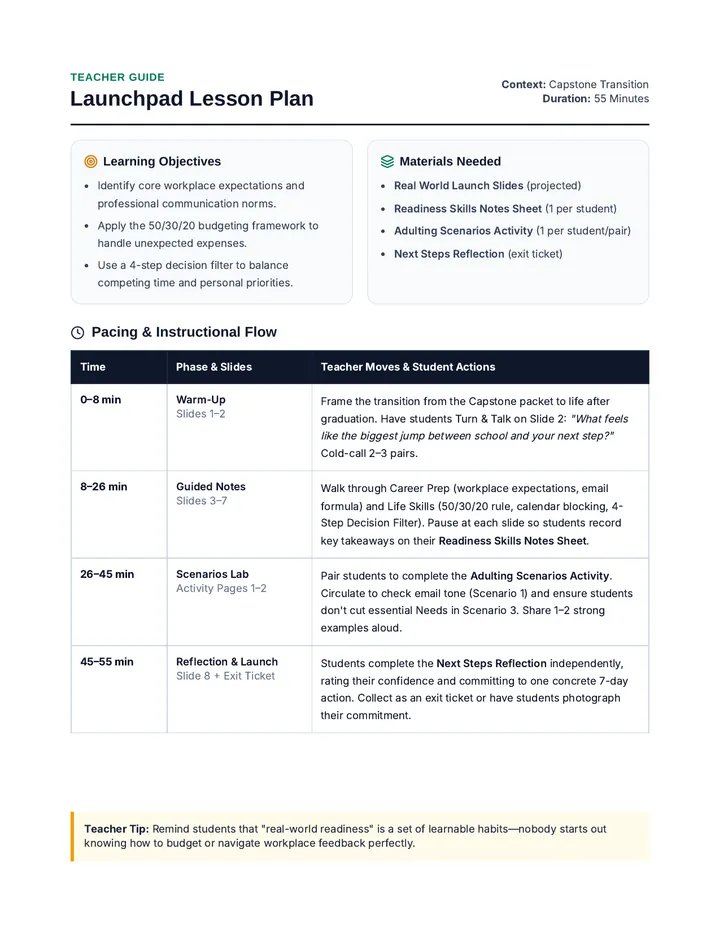
Launchpad Lesson Plan Teacher Guide
Launchpad Lesson Plan
Context: Capstone Transition
Duration: 55 Minutes
Learning Objectives
Identify core workplace expectations and professional communication norms.
Apply the 50/30/20 budgeting framework to handle unexpected expenses.
Use a 4-step decision filter to balance competing time and personal priorities.
Materials Needed
Real World Launch Slides (projected)
Readiness Skills Notes Sheet (1 per student)
Adulting Scenarios Activity (1 per student/pair)
Next Steps Reflection (exit ticket)
Pacing & Instructional Flow
Time
Phase & Slides
Teacher Moves & Student Actions
0–8 min
Warm-Up
Slides 1–2
Frame the transition from the Capstone packet to life after graduation. Have students Turn & Talk on Slide 2: "What feels like the biggest jump between school and your next step?" Cold-call 2–3 pairs.
8–26 min
Guided Notes
Slides 3–7
Walk through Career Prep (workplace expectations, email formula) and Life Skills (50/30/20 rule, calendar blocking, 4-Step Decision Filter). Pause at each slide so students record key takeaways on their Readiness Skills Notes Sheet.
26–45 min
Scenarios Lab
Activity Pages 1–2
Pair students to complete the Adulting Scenarios Activity. Circulate to check email tone (Scenario 1) and ensure students don't cut essential Needs in Scenario 3. Share 1–2 strong examples aloud.
45–55 min
Reflection & Launch
Slide 8 + Exit Ticket
Students complete the Next Steps Reflection independently, rating their confidence and committing to one concrete 7-day action. Collect as an exit ticket or have students photograph their commitment.
Teacher Tip: Remind students that "real-world readiness" is a set of learnable habits—nobody starts out knowing how to budget or navigate workplace feedback perfectly.
Launchpad Lesson Plan — Answer Key & Supports
Teacher Reference
Adulting Scenarios Activity — Look-Fors & Sample Answers
Scenario 1 (Email Rewrite):
Look for a clear subject line ("Rescheduling Interview — Jordan Rivera" ), formal greeting ("Dear Mr. Smith," ), polite apology without oversharing, specific availability ("Thursday between 1:00–4:00 PM" ), and full name closing.
Scenario 2 (Missed Shift):
Immediate accountability without excuses ("I'm sorry—I misread the schedule. I am leaving now and will be there by [time]." ) plus a concrete system (e.g., Sunday night calendar check, double alarms, screenshot schedule).
Scenario 3 ($2,400 Budget + $220 Repair):
Needs stay at $1,200. Students should pull the $220 from Wants ($720 → $500) to keep Savings intact at $480, or split between Wants ($720 → $580) and Savings ($480 → $400) while keeping Needs protected.
Scenario 4 (2:00 PM Crunch):
Priority is the 3:00 PM interview + 5:00 PM capstone. Students politely decline the 2:15 PM ride ("I have an interview at 3:00 and a deadline at 5:00—can't drive at 2:15, sorry!" ) and protect their transit buffer.
Differentiation
Scaffold: Provide sentence starters on the board for Scenario 1 ("Dear ___, I am writing to..." ).
Extension: Have students calculate their own real post-grad monthly budget using local rent/transit estimates.
Common Misconceptions
Gross vs. Net Pay: Students often budget using hourly wage × hours without subtracting ~15–22% for taxes.
Feedback = Failure: Emphasize that workplace correction is normal coaching, not a sign they are failing.
Real World Launchpad — Teacher Guide Follow up in 1 week to check students' 7-Day Launch Commitments!