Expectation Detective Slides Plan B Crew • Day 1
Expectation Detectives
What happens when the movie in our head does not match real life?
20-Minute Social Skills Mission • Grades 3–4
Imagine This...
All morning, you picture yourself playing kickball at recess with your friends.
Then the bell rings—and it starts pouring rain! Indoor recess!
Turn & Talk: How would your body feel in that moment?
What Is an Expectation?
An expectation is the picture in your mind of what you think will happen next.
What I Pictured
Sunny kickball game, running fast, cheering with friends.
What Happened
Rainy day inside, board games at desks, quieter room.
Your Mission Today
1
Read each school or home surprise on your worksheet.
2
Spot the difference between What Was Pictured and Reality .
3
Share one time reality surprised you this week!
Expectation Detective Teacher Guide Plan B Crew • Day 1 of 5
Expectation Detective Teacher Guide
Grades 3–4 • Social Skills
Total Time: 20 Minutes
Learning Objective
Students will define an expectation as a mental picture of what we think will happen and identify the gap between expectations and reality in everyday scenarios.
Prep & Materials
Expectation Detective Slides
Picture vs Reality Worksheet
Pencils
20-Minute Pacing & Facilitation
1. Hook: The Recess Mystery (Slides 1–2) 3 min
Read the rainy-day kickball scenario aloud. Ask students to Turn & Talk for 45 seconds about how their body would feel. Invite 2–3 volunteers to share (e.g., annoyed, bummed, restless).
2. Mini-Lesson: Picture vs. Reality (Slide 3) 5 min
Introduce the word expectation : "It is the movie or picture in your head before something happens." Emphasize that having expectations is normal—our brains love to guess what comes next! Trouble only starts when we forget that reality can look different from our picture.
3. Guided & Independent Practice (Slide 4 + Worksheet) 9 min
Hand out the Picture vs Reality Worksheet . Complete Scenario 1 together as a class so students see how to separate what was pictured from what actually happened. Have students complete Scenarios 2–3 and the personal reflection independently or with a partner.
4. Wrap-Up & Bridge to Day 2 3 min
Ask 2–3 students to share a surprise from their week. Preview Day 2: "Tomorrow we will talk about what to do with the big feelings that show up when reality surprises us!"
Differentiation
Support: Allow students to sketch their expectation and reality instead of writing full sentences.Extend: Ask early finishers to add a feeling word next to each scenario.
Worksheet Key Notes
1. Pictured: Taco Tuesday / Reality: Cheese sandwich.2. Pictured: Sitting with best friend / Reality: Assigned new seat.3. Pictured: Winning first round / Reality: Out early.
Picture vs Reality Worksheet Name: _____________________________
Date: _______________
Picture vs. Reality
Read each story. Write what the person pictured and what actually happened .
1 Maya walked into the cafeteria excited for Taco Tuesday. When she got to the counter, the menu had changed to cheese sandwiches.
What Maya Pictured:
What Actually Happened:
2 Leo thought he would sit next to his best friend on the bus. When he got on, the driver assigned him to a seat near the front.
What Leo Pictured:
What Actually Happened:
3 Sam practiced four-square all weekend and pictured winning every round. In the very first game, he got out on the second bounce.
What Sam Pictured:
What Actually Happened:
Your Turn: A Real-Life Surprise!
Think of one time this week when reality surprised you. Write or draw both sides below.
What I Pictured:
What Actually Happened:
Pause and Pivot Slides Plan B Crew • Day 2
Pause and Pivot
What can we do when plans change and big feelings show up?
20-Minute Social Skills Mission • Grades 3–4
When Expectations Crash...
It is okay to feel disappointed or frustrated! Our bodies give us clues first:
Hot Face
Cheeks feel warm or heart beats fast.
Tight Hands
Fists clench or shoulders scrunch up.
Urge to Snap
Wanting to yell, quit, or shut down.
Use the 3-Step Pivot
Step 1
Pause
Take one slow belly breath before you speak or act.
Step 2
Name It
Say in your head: "I feel bummed because my plan changed."
Step 3
Pivot
Turn toward what you can do next.
Let's Practice Together
You wanted the blue marker for your poster, but the bin only has green and orange left.
How can you Pause, Name It, and Pivot in 10 seconds?
Pause and Pivot Teacher Guide Plan B Crew • Day 2 of 5
Pause and Pivot Teacher Guide
Grades 3–4 • Social Skills
Total Time: 20 Minutes
Learning Objective
Students will identify physical body clues of disappointment or frustration and apply the 3-step Pause, Name It, Pivot strategy when plans change unexpectedly.
Prep & Materials
Pause and Pivot Slides
Pivot Plan Worksheet
Pencils
20-Minute Pacing & Facilitation
1. Hook: Body Clues Check-In (Slides 1–2) 4 min
Remind students of Day 1: "Yesterday we learned expectations are the pictures in our head. Today, what happens when that picture cracks?" Walk through the 3 body clues (hot face, tight hands, urge to snap) and ask students to give a quiet thumbs-up if they have felt one before.
2. Mini-Lesson: Pause, Name It, Pivot (Slides 3–4) 5 min
Teach the 3 steps with hand motions: Pause (hands up like a stop sign, 1 slow breath), Name It (point to heart/head), Pivot (turn shoulders slightly toward a new direction). Practice together with the Slide 4 marker scenario.
3. Student Practice: Pivot Plan Worksheet 8 min
Distribute the Pivot Plan Worksheet . Students check their personal body clues, then write a Name It sentence and a Pivot action for two relatable school scenarios. Circulate to coach students who write "do nothing" toward an actionable pivot.
4. Wrap-Up & Bridge to Day 3 3 min
Do one whole-class "Pause Breath" together. Preview Day 3: "Tomorrow we will train our brains to bend like noodles when we need a Plan B!"
Differentiation
Support: Provide the sentence frame: "I feel ___ because ___. Next I can ___."Extend: Have students role-play one scenario with a partner using a calm voice.
Worksheet Key Notes
Scenario 1 (Gym): Name: "I feel bummed we aren't playing dodgeball." Pivot: "Try the relay race and cheer for my team."Scenario 2 (Partner): Name: "I feel frustrated." Pivot: "Work with my new partner politely."
Pivot Plan Worksheet Name: _____________________________
Date: _______________
My Pivot Plan
Notice your body clues, name the feeling, and choose a calm Pivot!
Part 1: My Body Clues
Check the clues your body gives you when plans change unexpectedly:
Hot face
Tight fists
Fast heartbeat
Grumpy voice
Want to quit
Stomach knot
Scenario 1 You were excited to play dodgeball in gym, but the coach announces relay races instead.
Step 2 — Name It ("I feel ___ because ___"):
Step 3 — Pivot (What can you do next?):
Scenario 2 You expected to work with your friend on a science poster, but the teacher draws random partner sticks.
Step 2 — Name It ("I feel ___ because ___"):
Step 3 — Pivot (What can you do next?):
My Favorite Way to Pause (Circle one or write your own):
Belly Breath Count to 5 Shake Hands Out
Noodle Brain Slides Plan B Crew • Day 3
Noodle Brain Power
Training our brains to bend instead of breaking when Plan A is gone.
20-Minute Social Skills Mission • Grades 3–4
Two Ways to Think
Rock Brain
Stuck on one way only. Hard and stiff.
"If I can't go first, I'm not playing at all!"
Noodle Brain
Bends and stretches to find a Plan B.
"Going second still gives me a turn. Let's play!"
How to Build a Plan B
1
Keep the Goal
What did you really want? (Fun, learning, time with friends?)
2
Change the Path
Find another realistic way to reach that same goal.
Noodle Brain Challenge
The book you wanted from the library is already checked out!
Turn & Talk: What are two realistic Plan B ideas?
Noodle Brain Teacher Guide Plan B Crew • Day 3 of 5
Noodle Brain Teacher Guide
Grades 3–4 • Social Skills
Total Time: 20 Minutes
Learning Objective
Students will distinguish between rigid Rock Brain thinking and flexible Noodle Brain thinking, and generate realistic Plan B options when Plan A is unavailable.
Prep & Materials
Noodle Brain Slides
Plan B Builder Activity
Pencils
20-Minute Pacing & Facilitation
1. Hook: Rock vs. Noodle (Slides 1–2) 4 min
Ask students to freeze their arms stiff like a rock, then wiggle them like cooked spaghetti. Explain that brains can get stiff ("Rock Brain") or bendy ("Noodle Brain") when expectations aren't met.
2. Mini-Lesson: Keep the Goal, Change the Path (Slides 3–4) 5 min
Show students that a good Plan B keeps the real goal (e.g., having fun, reading a great story) while changing how we get there. Use Slide 4 (checked-out library book) for a 60-second Turn & Talk.
3. Partner Activity: Plan B Builder 8 min
Hand out the Plan B Builder Activity . Students first sort 4 thought bubbles into Rock Brain or Noodle Brain, then partner up to brainstorm two realistic Plan B ideas for 2 everyday Plan A roadblocks.
4. Wrap-Up & Bridge to Day 4 3 min
Invite 2–3 pairs to share their favorite Plan B. Preview Day 4: "Tomorrow we will look at expectations we have for other people —and why nobody is a mind reader!"
Differentiation
Support: Pair students strategically and let them talk out their Plan B before writing.Extend: Ask students to star the Plan B they would try first and explain why.
Activity Key Notes
Sort: Rock = "Everything is ruined!", "My way or nothing." Noodle = "I can try something new.", "Maybe next time."Plan B Ideas: Put book on hold / pick next in series; play a different swing / tag game.
Plan B Builder Activity Name: _____________________________
Date: _______________
Plan B Builder
Spot the Rock Brain thoughts, then flex your Noodle Brain to build Plan B!
Part 1: Rock Brain or Noodle Brain?
Circle R for Rock Brain or N for Noodle Brain next to each thought:
1. "If we can't play my game, recess is totally ruined!" R / N
2. "I wanted the red folder, but green works fine too." R / N
3. "I only ever sit in that exact spot. Nobody else can!" R / N
4. "My partner is absent, so I can join another group today." R / N
Roadblock 1 All the swings are full when you get outside for recess.
Plan B Idea #1:
Plan B Idea #2:
Roadblock 2 Your family planned a movie night, but the Wi-Fi goes out right before it starts.
Plan B Idea #1:
Plan B Idea #2:
Mind Reader Myth Slides Plan B Crew • Day 4
The Mind-Reader Myth
Why people cannot guess what we expect—and how to say it clearly.
20-Minute Social Skills Mission • Grades 3–4
What Happened Here?
You were hoping your friend would save you a seat at lunch. You never asked—and when you walked up, the table was full!
Did your friend know what you were picturing?
2 Questions to Check Expectations
1. Is It Fair?
Does this give everyone a fair turn, or am I expecting someone to be perfect?
2. Did I Say It?
Did I share my expectation kindly out loud, or keep it a secret?
Speak Up Kindly
"Hey, I was hoping we could ________. Does that work for you?"
Speaking up helps friends understand your picture—and gives them a chance to share theirs too!
Mind Reader Myth Teacher Guide Plan B Crew • Day 4 of 5
Mind Reader Myth Teacher Guide
Grades 3–4 • Social Skills
Total Time: 20 Minutes
Learning Objective
Students will evaluate whether expectations for others are fair and realistic, and practice using a polite script to share unspoken expectations out loud.
Prep & Materials
Mind Reader Myth Slides
Expectation Check Worksheet
Pencils
20-Minute Pacing & Facilitation
1. Hook: The Lunch Table Mystery (Slides 1–2) 3 min
Read Slide 2 aloud. Ask: "Why wasn't the seat saved? Was the friend being mean, or did they just not know?" Emphasize that nobody has mind-reading superpowers!
2. Mini-Lesson: Fair & Spoken Check (Slides 3–4) 5 min
Introduce the 2 questions: Is it fair? and Did I say it? Practice the Slide 4 script chorally: "Hey, I was hoping we could ___. Does that work for you?" Point out that asking kindly leaves room for the other person to say yes or offer a Plan B.
3. Guided & Partner Practice: Expectation Check Worksheet 9 min
Hand out the Expectation Check Worksheet . Students read 3 social expectations, decide if each is Fair or Unfair/Unrealistic, and rewrite 2 unspoken expectations into kind, clear requests.
4. Wrap-Up & Bridge to Day 5 3 min
Have 2 volunteers read their polite request aloud. Preview Day 5: "Tomorrow is our final mission—you will put all your skills together to earn your Plan B Pocket Card!"
Differentiation
Support: Let students rehearse their sentence out loud with a partner before writing it down.Extend: Ask students what they could say if a friend kindly says "No, I already promised someone else."
Worksheet Key Notes
Part 1: 1) Unfair (people make mistakes); 2) Fair (polite turns); 3) Unfair (friends can play with others too).Part 2: Accept any polite, clear request using "I was hoping..." or "Could we...?"
Expectation Check Worksheet Name: _____________________________
Date: _______________
Expectation Check
Check if each expectation is fair, then practice saying unspoken wishes out loud!
Part 1: Is This Expectation Fair?
Circle Fair or Unfair for each expectation:
1. "My teammate should never miss a catch in kickball." Fair / Unfair
2. "Everyone in our group should get a turn to share an idea." Fair / Unfair
3. "My best friend should only play with me at recess every day." Fair / Unfair
Part 2: Turn Secret Wishes into Kind Words
Use the frame: "Hey, I was hoping we could ________. Does that work for you?"
1. You want to be the timekeeper during your group's science experiment, but nobody knows.
2. You want to play tag with your neighbor after school today, but you haven't asked yet.
Part 3: Bonus Noodle-Brain Check
If your friend kindly says "No thanks, maybe tomorrow," what is one calm thing you can say back?
Toolkit Showdown Slides Plan B Crew • Day 5
My Plan B Toolkit
Putting all our expectation tools together for real-life surprises!
20-Minute Social Skills Mission • Grades 3–4
Your 4 Plan B Crew Tools
1. Spot the Picture
Notice what you pictured vs. reality.
2. Pause & Pivot
Breathe, name the feeling, turn forward.
3. Noodle Brain
Keep your goal, change the path.
4. Speak Up Kindly
Share fair expectations out loud.
Toolkit Showdown!
It is Friday Fun Time! You expected to build with LEGOs, but your teacher announces a class cleanup and quick reading circle instead.
Which Plan B Crew tool helps most here, and what would you do?
Your Final Mission
1. Pick your favorite Pause move and Noodle Brain reminder.
2. Fill out your Plan B Pocket Card to keep in your desk or folder.
3. Remember: Surprises happen, and you can handle them!
Toolkit Showdown Teacher Guide Plan B Crew • Day 5 of 5
Toolkit Showdown Teacher Guide
Grades 3–4 • Social Skills
Total Time: 20 Minutes
Learning Objective
Students will synthesize all four managing-expectations strategies—spotting the gap, Pause & Pivot, Noodle Brain flexibility, and speaking up kindly—by creating a personal Plan B Pocket Card.
Prep & Materials
Toolkit Showdown Slides
Plan B Pocket Card Activity
Scissors & Colored Pencils
20-Minute Pacing & Facilitation
1. Hook & Review: 4 Plan B Crew Tools (Slides 1–2) 4 min
Celebrate reaching Day 5! Quickly review the 4 tools together: 1) Spot the Picture, 2) Pause & Pivot, 3) Noodle Brain, 4) Speak Up Kindly. Ask students to hold up 1–4 fingers for the tool they used most this week.
2. Class Challenge: Toolkit Showdown (Slide 3) 5 min
Read the Friday Fun Time LEGO scenario. Have students Turn & Talk to pick a tool and explain their calm response. Highlight that multiple tools can work together (e.g., Pause first, then Noodle Brain!).
3. Capstone Activity: Plan B Pocket Card (Slide 4) 8 min
Hand out the Plan B Pocket Card Activity . Students complete the quick scenario check at the top, then personalize and cut out their foldable Plan B Pocket Card to keep in their desk, pencil box, or take-home folder.
4. Celebration & Crew Pledge 3 min
Invite 2–3 students to share their favorite self-talk phrase from their card. Close with a class chant: "Plans can change, and I can bend—Plan B Crew until the end!"
Differentiation
Support: Provide a word bank on the board (breathe, count, ask kindly, try something new ).Extend: Have students write a second Plan B reminder on the back of their folded card.
Informal Assessment
Check each student's top-section scenario response for a calm Pause step and a realistic Plan B action. Keep an extra stack of blank cards handy for future classroom transitions!
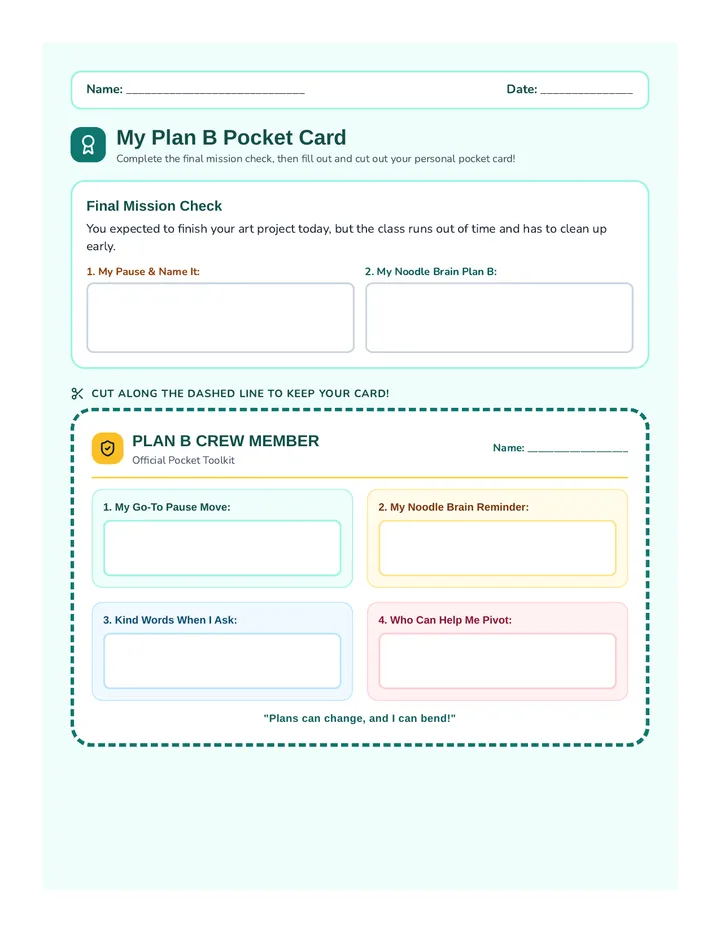
Plan B Pocket Card Activity Name: _____________________________
Date: _______________
My Plan B Pocket Card
Complete the final mission check, then fill out and cut out your personal pocket card!
Final Mission Check
You expected to finish your art project today, but the class runs out of time and has to clean up early.
1. My Pause & Name It:
2. My Noodle Brain Plan B:
Cut along the dashed line to keep your card!
PLAN B CREW MEMBER
Official Pocket Toolkit
Name: ___________________
1. My Go-To Pause Move:
2. My Noodle Brain Reminder:
3. Kind Words When I Ask:
4. Who Can Help Me Pivot:
"Plans can change, and I can bend!"