Heart to Heart Lesson PlanHeart to Heart Understanding Others through Empathy Maps Grades 3-5 Objective Students will develop deeper awareness of others' perspectives and emotions by creating visual "empathy maps" for characters in specific social scenarios. Time & Approach Duration: 40 minutes Approach: Active visualization & perspective-taking Materials Needed Inside Out Worksheet (Empathy Map) Life in Their Shoes Cards (Scenarios) Post-it notes & Markers Projector for Lesson Slides Lesson Flow 05 Introduction: The Heart of Empathy Begin with a brief discussion on what empathy means. Ask: "What does it mean to put yourself in someone else's shoes?" Share personal examples of feeling empathy for others. 05 Decoding Empathy Maps Introduce the four-quadrant tool. SAYS: Specific quotes or verbal reactions. THINKS: Internal thoughts they might not share aloud. DOES: Body language, actions, and physical choices. FEELS: The emotions driving the behavior (sad, excited, worried). 05 Scenario Assignment Distribute "Life in Their Shoes" cards to individuals or pairs. Briefly read through one card as a whole group to model initial thinking. 15 Creation Phase Students fill out the "Inside Out Worksheet". Encourage "deep diving"—what is the person thinking that they are afraid to say? How might their body look if they feel this way? 10 Closing: Reflection & Connection Share and reflect on the insights gained. Gallary walk: Let students see others' maps. Ask: "How can we apply this to a classmate tomorrow?"
Heart to Heart SlidesHeart to Heart Building Empathy Through Understanding What is Empathy? Empathy is the ability to understand and share the feelings of another person. "It's like looking at the world through someone else's glasses." The Empathy Map We use this tool to visualize what a person is experiencing across 4 different areas: 1. Says Words and spoken reactions. 2. Thinks Hidden thoughts and worries. 3. Does Actions and body language. 4. Feels Deep emotions and moods. Exterior vs. Interior The Outside What we SEE and HEAR. Says & Does The Inside What they are FEELING hidden away. Thinks & Feels Case Study "A new student is sitting alone at lunch. Their shoulders are hunched over and they are looking at their tray without eating." SAYS "Is this seat taken?" DOES Looks at the floor. FEELS Lonely or Shy. Your Turn! 1 Pick up your Life in Their Shoes card. 2 Discuss the scenario with your partner. 3 Fill out your Inside Out Worksheet. Remember: Try to think about thoughts they might be too embarrassed or nervous to say out loud! Final Thought "Empathy is seeing with the eyes of another, listening with the ears of another, and feeling with the heart of another." Heart to Heart
Inside Out WorksheetInside Out Empathy Mapping Tool Name: Date: My Scenario: SAYS What words or sounds do they make out loud? THINKS What are they thinking but NOT saying? DOES What is their body language or physical actions? FEELS What emotions are they experiencing inside? "Empathy is a muscle. The more you use it, the stronger it gets."
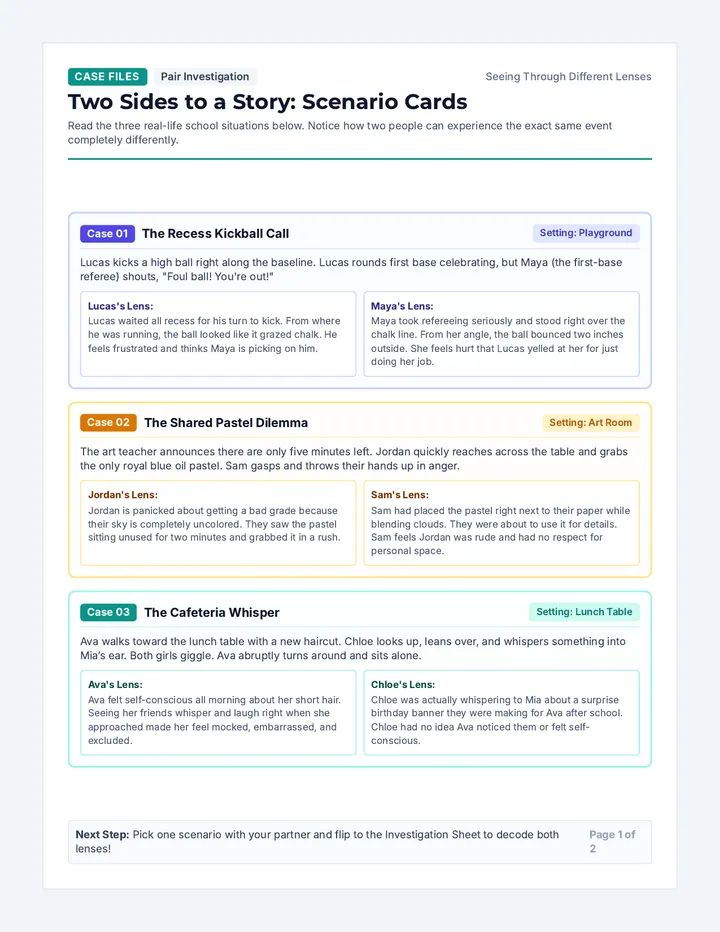
Life in Their Shoes CardsLife in Their Shoes Scenario Cards for Empathy Mapping Scenario 01 "A new student is feeling very nervous on their first day at school. They don't know where to sit at lunch and they are afraid of making a mistake." Scenario 02 "A classmate is visibly upset because they lost their favorite toy that they brought for show-and-tell. They have been looking for it all morning." Scenario 03 "A friend is incredibly excited about their birthday party this weekend. They keep talking about the cake and the games they have planned." Scenario 04 "A student is very worried about an upcoming math test. They didn't understand the homework last night and feel like they aren't prepared." Scenario 05 "A student realized they forgot their lunch at home. They are very hungry, but they don't want to tell anyone because they feel embarrassed." Scenario 06 "A student just won a trophy in a soccer game, but their best friend was on the other team and is very sad about losing the championship."