Warm Welcomes Slides Kind Connections • Lesson 1 Friendship Foundations
Warm Welcomes
How a simple greeting, open body language, and a kind smile open the door to lasting friendships.
Warm Faces
Friendly Words
Inviting Others In
The Greeting Blueprint
3 Keys to a Warm Welcome
1
Eyes & Smile
Look toward the person with a calm, gentle expression. Your face shows you are happy to see them.
Soft, direct gaze
2
Name & Hello
Use their name! Say "Good morning, Maya!" or "Hi, I'm Leo!" in a clear, audible voice.
Upbeat volume
3
Bridge Question
Build a bridge to a conversation: "How was your morning?" or "Want to check out the game?"
Invites reply
A great greeting makes someone feel noticed, respected, and welcomed.
Non-Verbal Signals
What Does Your Body Say?
Closed Door Signals
Can signal: "Not ready to talk"
Arms tightly crossed over chest
Staring down at floor or away
Turning shoulders completely away
Open Door Signals
Signals: "You are welcome here!"
Relaxed shoulders facing toward friends
Warm eye contact and gentle smile
Stepping aside slightly to make room
Friendship Rule: More than half of what we say comes from our posture, eyes, and hands!
Real-Life Practice
Try This Greeting in Action
Morning Arrival
A classmate walks in holding their backpack.
"Good morning, Alex! Great to see you today."
Sitting Alone
Someone is sitting by themselves at lunch or recess.
"Hey Sam! Do you want to join us for four-square?"
Meeting Someone New
A new student joins your work group.
"Hi! I'm Jordan. Welcome to our table!"
Asking to Join
Two peers are building with blocks.
"That castle looks awesome! Can I help build?"
Pick one line you feel confident trying during our quick roleplay!
Class Mission
The 3-Person Hello Quest
Practice your warm welcome right now before our worksheet!
1
Turn to a Neighbor
Make gentle eye contact and give your warmest, most genuine smile.
2
Say Their Name
Use a friendly greeting: "Good morning, [Name]! Great to see you."
3
Ask One Question
Listen attentively to their reply for 30 seconds without interrupting!
Ready? Stand up, find someone you haven't talked to yet today, and begin!
Greeting Mission Worksheet Greeting Mission Worksheet
Kind Connections • Lesson 1: Warm Welcomes
Name:
Date:
A warm welcome makes others feel included and safe. Complete the challenges below to master the 3 keys: friendly eye contact, a clear voice, and an inviting question!
1 Match the Greeting to the Situation
Write the letter (A, B, or C) in the box that best fits each situation:
1. A classmate arrives at school looking quiet and holding a heavy backpack.
[ ]
A: "Hi Jordan! Welcome to our science table!"
2. Someone is sitting alone on a playground bench during morning recess.
[ ]
B: "Good morning! So glad you're here today."
3. A new student is assigned to sit next to you for group project work.
[ ]
C: "Hey! Would you like to walk laps with us?"
2 Body Language Check: Open vs. Closed Doors
Check the box for each behavior that signals an "Open Door" (friendly & welcoming):
Making gentle eye contact
Crossing arms and looking down
Smiling with relaxed shoulders
Giving a small friendly wave
Turning completely away
Using a clear, warm voice tone
3 Craft Your Personal Welcome Script
Fill out the three parts below to create a greeting you will use today:
Step 1: Friendly Hello + Their Name
Step 2: Kind Statement (e.g., "Great to see you!", "I like your notebook!")
Step 3: Bridge Question (e.g., "How was your weekend?", "Want to sit together?")
Kind Connections Curriculum Page 1 of 2
The 5-Day Greeting Quest
Put Friendship Skills Into Action
Weekly Tracker
Your mission this week is to greet at least one peer every day using their name, a smile, and eye contact. Write their name and check off the greeting keys!
Day Person I Greeted Eye Contact Said Name Bridge Question Monday Tuesday Wednesday Thursday Friday
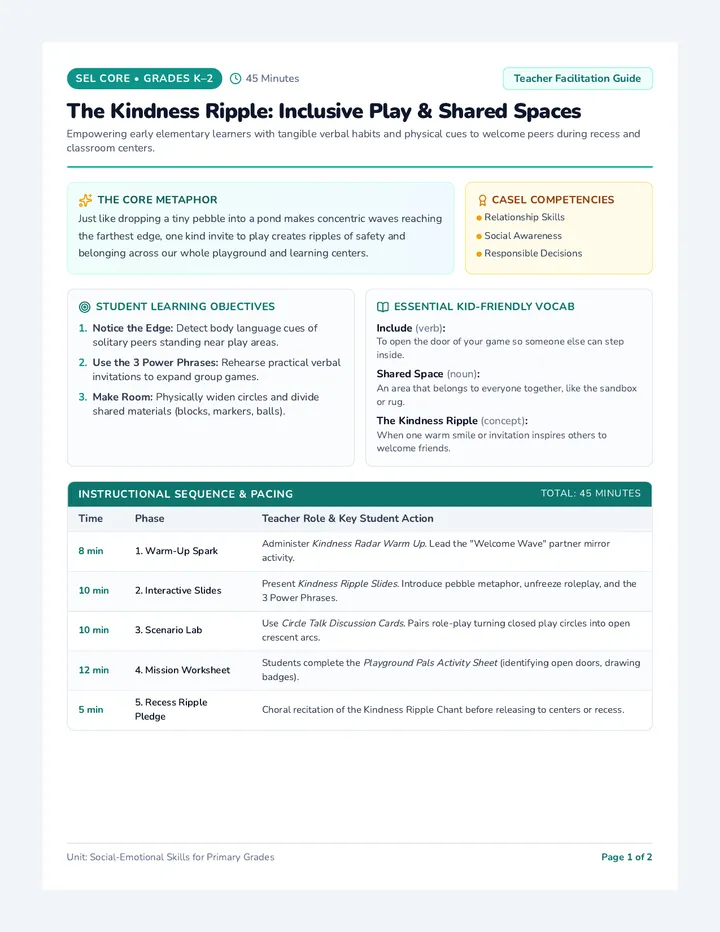
Warm Welcomes Facilitator Guide Warm Welcomes Facilitator Guide
Teacher Instructional Framework • Lesson 1 of 3
Duration: 40–45 Mins
Grades 1–4 SEL
Core Learning Objectives
• Identify the three vital parts of a greeting: friendly face, name/hello, and bridge question.
• Distinguish between open and closed body language cues in daily school environments.
• Demonstrate an inclusive greeting with at least two peers during guided practice.
Materials Needed
• Warm Welcomes Slide Deck
• Greeting Mission Worksheet
• Pencils & coloring markers
Pacing & Instructional Pathway
1. Hook & Spark (8 min)
Enter class with head down and arms folded; say nothing. Ask students: "How did that make you feel?" Repeat with open shoulders, broad smile, and: "Good morning class!" Compare reactions.
2. Interactive Slides (12 min)
Project Warm Welcomes Slides . Emphasize the 3 Greeting Keys and compare "Open Door" vs. "Closed Door" posture. Have students physically practice the posture switches at their desks.
3. Hello Quest (10 min)
Launch the 3-Person Hello Quest (Slide 5). Play upbeat music; when music pauses, students pair with the nearest peer and exchange their custom 3-step greeting.
4. Mission Worksheet (12 min)
Distribute Greeting Mission Worksheet . Complete Part 1 & 2 together or in pairs. Guide students in drafting their custom greeting and explain the 5-day tracker commitment.
Teacher Script Snippet
"Remember friends: greeting someone isn't just about good manners. It's an invitation that says, 'I see you, you matter, and you have a friend right here.'"
Neurodiversity & Shyness Tip
Direct eye contact can feel overwhelming for some learners. Validate alternatives: looking at forehead/nose, a gentle nod, an open-palm wave, or using a greeting visual card.
Quick Formative Observation Look-Fors
Emerging
Uses single-word greeting when prompted; eyes directed downward.
Developing
States peer's name and smiles, but misses bridge question or invitation.
Proficient
Smoothly combines warm body language, peer's name, and an open question.
Kind Connections Curriculum • Teacher Resource Single Page Reference
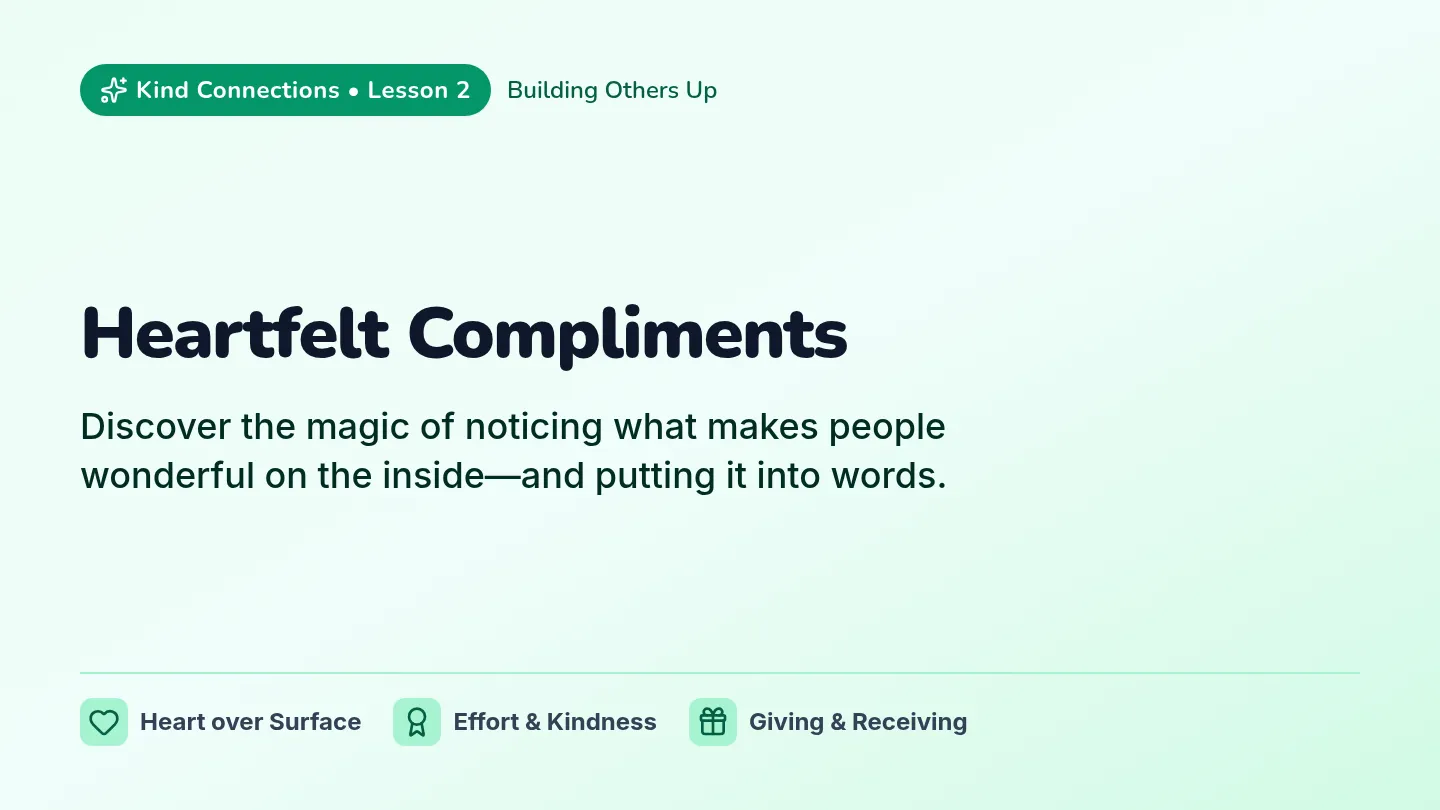
Compliment Crafter Slides Kind Connections • Lesson 2 Building Others Up
Heartfelt Compliments
Discover the magic of noticing what makes people wonderful on the inside—and putting it into words.
Heart over Surface
Effort & Kindness
Giving & Receiving
Digging Deeper
Outside vs. Inside Compliments
Outside Compliments
Focuses on things that change
"Cool sneakers!"
"I like your haircut."
"Nice backpack."
*Nice to hear, but doesn't tell people who they really are!
Inside Compliments
Focuses on character, effort & heart
"You never gave up on that math problem!"
"Thank you for sharing your colored markers."
"You always make people feel included."
*These build lasting self-esteem and deep trust!
Challenge today: Aim for 100% inside compliments!
The Secret Recipe
The 3-Part Compliment Formula
1
Name the Trait
Spot a specific positive action, talent, or personality strength.
"You are so patient..."
2
Add the Proof
Tell them what you saw them do. Concrete examples make it sincere.
"...when helping Leo with the rules."
3
Share the Impact
Share how their kindness made someone feel or helped the team.
"It made our whole table calm!"
Formula: [Trait] + [Specific Proof] + [Positive Impact]
Catching the Gift
How to Catch a Compliment
The Deflector Trap
Pushing the kind gift away
"Nah, it was super messy anyway."
"Anybody could have done that, it was easy."
Ignoring it or looking away awkwardly
The Gracious Catcher
Accepting it with warm appreciation
"Thank you so much! That means a lot to me."
"Thanks, I worked really hard on that!"
Smile, make eye contact, and say "Thank you!"
When someone gives you a compliment, say "Thank you!" like receiving a gift.
Lab Practice
The Compliment Delivery Lab
Pick one sentence stem and give a classmate an inside compliment:
Stem 1: Effort
"I really admire how hard you worked on..."
Stem 2: Kindness
Compliment Builder Worksheet Compliment Builder Worksheet
Kind Connections • Lesson 2: Heartfelt Compliments
Name:
Date:
An "Inside Compliment" shines a light on someone's character, kindness, or hard work. Use this guide to create words that build strong, lasting friendships!
1 Inside vs. Outside Compliments
Write "IN" for inside qualities (effort/kindness) or "OUT" for outside qualities (appearance/things):
1. "I love your glitter sneakers!"
2. "You were so patient with our group."
3. "You kept trying even when it was tough!"
4. "Nice brand new backpack!"
2 Build an Inside Compliment Using the 3 Steps
Choose a classmate and build a sincere, thoughtful compliment for them:
Recipient's Name:
Part 1: The Character Trait (e.g., helpful, courageous, creative, honest, persistent)
Part 2: The Proof / What You Saw (e.g., "when you helped me pick up my dropped books...")
Part 3: The Impact (e.g., "it made me feel so supported and happy.")
3 Receiving a Compliment: Best Response
A friend says: "You gave an amazing presentation today, Jordan!" What is the best response?
A: "Nah, it was terrible and I made so many dumb mistakes."
B: "Thank you so much! I practiced a lot and I'm glad you enjoyed it."
C: Shrug shoulders, roll eyes, and walk away without saying anything.
Kind Connections Curriculum Page 1 of 2
Compliment Gift Cards
Cut Out, Write, and Deliver Kindness
4 Cards to Share
Write a personalized inside compliment on each card below. Cut along the dashed lines and secretly or openly deliver them to four different classmates today!
Awesome Effort Award Kind Connections
To:
I noticed how hard you worked on:
You inspired me because:
From: ___________
Kind Heart Award Kind Connections
To:
Thank you for being so kind when you:
It made our classroom feel:
From: ___________
Great Teammate Award Kind Connections
To:
You are wonderful to work with because:
One thing you did to help was:
From: ___________
Sunshine Maker Award Kind Connections
To:
You made our day brighter when you:
I appreciate having you in class because:
From: ___________
Super Listeners Slides Kind Connections • Lesson 3 Active Listening Powers
Super Listeners
Being a wonderful friend isn't just about what you say—it's about how deeply you hear and value others.
Whole-Body Focus
Echo & Ask
Deep Friendship
Mind & Body
Whole-Body Listening
Ears Hearing
Tuned in to their words, voice tone, and feelings.
Eyes Looking
Gentle, caring gaze toward the person speaking.
Mouth Quiet
Waiting for them to finish before answering.
Heart Caring
Caring about what matters to your friend.
We listen with our whole body, not just our ears!
The Listening Formula
The "Echo & Ask" Technique
1
Echo the Feeling
Repeat back what you heard in your own words
This proves you were really listening and didn't miss their message.
"It sounds like you felt really proud when you finished that drawing!"
2
Ask with Curiosity
Ask an open question to learn more
Pass the ball back to them so they can share more of their experience.
"What are you going to draw next?" or "How did you pick those colors?"
Echoing and asking shows your friend that their ideas truly matter to you.
Conversation Habits
Roadblocks vs. Bridges
Listening Roadblocks
Stops the friendship flow
Interrupting before they finish
Fidgeting with items or looking away
Stealing the spotlight: "Oh, well MY dog is bigger!"
Listening Bridges
Deepens connection & trust
Nodding your head to show you're following
Waiting 2 seconds after they pause
Asking: "How did that make you feel?"
Be a bridge builder, not a roadblock builder!
Partner Mission
The Listening Detective Game
Test your super listening skills right now with a partner:
1
Partner A Shares
Share your favorite weekend memory or a game you love (45 seconds).
2
Partner B Echoes
Super Detective B mirrors back: "So you really loved when..."
3
Ask 1 Clue Question
Ask one curious question to learn one more detail before switching roles!
Listening Detective Worksheet Listening Detective Worksheet
Kind Connections • Lesson 3: Super Listeners
Name:
Date:
A Super Listener listens to understand, not just to reply. Solve the clues below, catch conversation roadblocks, and complete the partner listening investigation!
1 Whole-Body Listening Clues
Draw a line or match the body part to its listening superpower:
1. Ears A. Waiting calmly for peer to finish
2. Eyes B. Caring about what the person feels
3. Mouth C. Tuning in to words & vocal tone
4. Heart D. Looking gently toward speaker
2 Roadblock or Bridge?
Mark "B" for Bridge (helps connection) or "R" for Roadblock (stops conversation):
1. Nodding and saying, "Tell me more about what happened!"
2. Cutting in mid-sentence to share your own unrelated vacation story.
3. Putting down pencils/toys and turning shoulders toward your partner.
3 Partner Listening Case Log
Listen to your partner's 45-second story, then log your investigation findings:
Partner Detective's Name:
Step 1: Echo Sentence (Write what you heard: "You told me that...")
Step 2: Curiosity Question (Write your follow-up question to learn more)
Kind Connections Curriculum Page 1 of 2
Friendly Words Pocket Toolkit
Communication Power-Ups for Everyday Life
Pocket Reference
Keep these phrases handy in your desk, notebook, or pocket. Whenever you are in a tricky conversation or making a new friend, pick the right communication key!
Inviting & Joining In
When you want to play or welcome someone:
"That looks fun! Do you have room for one more?"
Compassion Check-In
When someone looks sad, tired, or left out:
"Are you okay? I'm here if you want to talk or sit together."
Kind Disagreement
When you have a different idea or opinion:
"I see your point! What if we tried a little bit of both?"
Friendly Repair
When you accidentally interrupted or slipped up:
"I'm sorry for interrupting you. Please finish your thought!"
Cheering a Win
When a classmate achieves something great:
"Way to go! You worked so hard for that and it paid off!"
Passing the Mic
When you've been talking and want to invite others:
"That was my experience, but I want to hear what you think!"