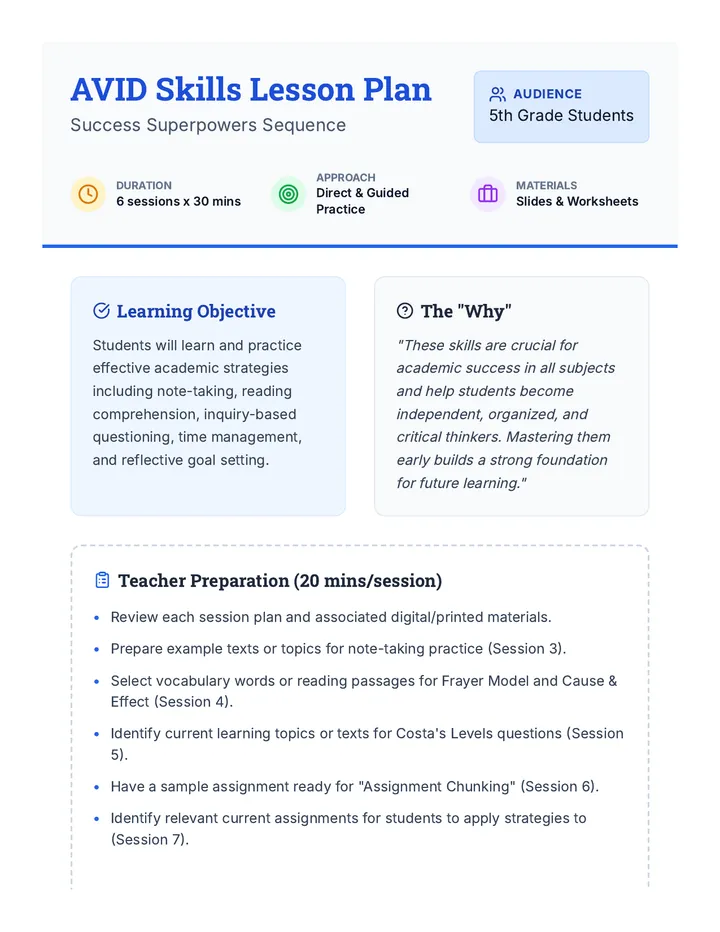
AVID Skills Lesson Plan AVID Skills Lesson Plan
Success Superpowers Sequence
Audience
5th Grade Students
Duration
6 sessions x 30 mins
Approach
Direct & Guided Practice
Materials
Slides & Worksheets
Learning Objective
Students will learn and practice effective academic strategies including note-taking, reading comprehension, inquiry-based questioning, time management, and reflective goal setting.
The "Why"
"These skills are crucial for academic success in all subjects and help students become independent, organized, and critical thinkers. Mastering them early builds a strong foundation for future learning."
Teacher Preparation (20 mins/session)
• Review each session plan and associated digital/printed materials.
• Prepare example texts or topics for note-taking practice (Session 3).
• Select vocabulary words or reading passages for Frayer Model and Cause & Effect (Session 4).
• Identify current learning topics or texts for Costa's Levels questions (Session 5).
• Have a sample assignment ready for "Assignment Chunking" (Session 6).
• Identify relevant current assignments for students to apply strategies to (Session 7).
• Prepare for a brief class discussion on January reflections and February goals (Session 8).
Session Breakdown
3
Strong Note-Taking (Week 2)
30 MINS
Check-in & Warm-Up (5 min): Ask students to share one thing they remember about why note-taking is important.
Skill Instruction (10 min): Introduce and explain 2-Column and 3-Column note-taking methods, providing clear examples. Use the Note-Taking & Comprehension Slide Deck .
Guided Practice (10 min): Distribute the Two and Three Column Notes Worksheet . Guide students through practicing both methods using a short, shared text. Circulate and support.
Reflection & Exit Ticket (5 min): Students complete the peer feedback section or share one takeaway about effective note-taking.
4
Reading for Understanding (Week 2)
30 MINS
Check-in & Warm-Up (5 min): Ask students what makes a text hard or easy to understand.
Skill Instruction (10 min): Introduce the Frayer Model and Cause & Effect organizer. Explain how they help break down information. Use the Note-Taking & Comprehension Slide Deck .
Guided Practice (10 min): Distribute the Frayer Model and Cause & Effect Worksheet . Guide students in using these tools with a selected passage or vocab word.
Reflection & Exit Ticket (5 min): Students complete the reflection question on the worksheet.
5
Asking Better Questions (Week 3)
30 MINS
Check-in & Warm-Up (5 min): Start with a quick riddle or intriguing question to get students thinking.
Skill Instruction (10 min): Introduce Costa's Levels of Thinking (Level 1, 2, 3). Explain each level with 5th grade examples. Use the Inquiry & Time Management Slide Deck .
Guided Practice (10 min): Distribute Costa's Levels of Inquiry Worksheet . Students generate questions for a given topic at each level. Facilitate small group discussions.
Reflection & Exit Ticket (5 min): Students share one type of question they find most challenging to create.
6
Time Management & Planning (Week 3)
30 MINS
Check-in & Warm-Up (5 min): Ask students how they keep track of their homework and activities.
Skill Instruction (10 min): Discuss weekly planning and how to break down big assignments (chunking). Use the Inquiry & Time Management Slide Deck .
Guided Practice (10 min): Distribute Time Management & Planning Worksheet . Students create a sample weekly study plan and chunk a hypothetical or real assignment.
Reflection & Exit Ticket (5 min): Students share one strategy they will try to use this week for planning.
7
Academic Application (Week 4)
30 MINS
Check-in & Warm-Up (5 min): Ask students to name an AVID strategy they've learned so far.
Skill Instruction (10 min): Review strategies covered. Emphasize choosing the right strategy for different assignments. Use the Application & Reflection Slide Deck .
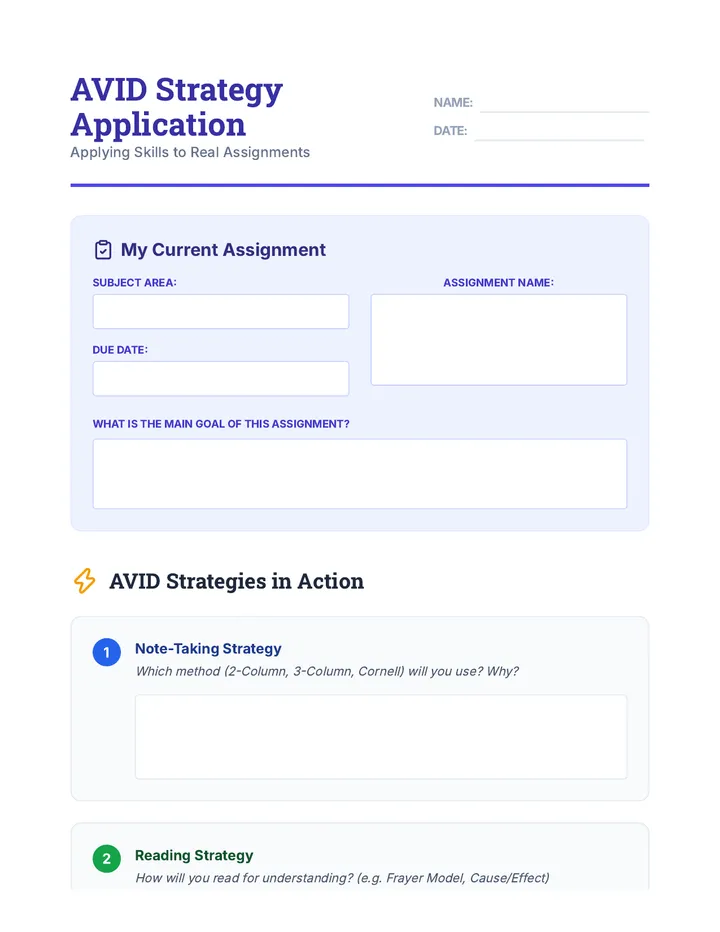
Guided Practice (10 min): Distribute AVID Strategy Application Worksheet . Students choose a real assignment and plan application of 2+ strategies.
Reflection & Exit Ticket (5 min): Students share which strategy they are most excited to use.
8
Reflection & Goal Reset (Week 4)
30 MINS
Check-in & Warm-Up (5 min): Ask students what their favorite part of January was.
Skill Instruction (10 min): Discuss importance of reflection and SMART goals. Review how to adjust for the future. Use the Application & Reflection Slide Deck .
Guided Practice (10 min): Distribute Reflection & Goal Setting Worksheet . Guide students through reflecting on January and setting 1-2 goals for February.
Reflection & Exit Ticket (5 min): Students share one goal they are excited about.
Note Taking and Comprehension Slides Notes: Your Brain's Best Friend!
Why are notes important?
Good notes help your brain learn and remember!
Teacher Notes: Welcome students and get them ready to think about why good notes are helpful. Ask them to share a time when notes saved them!
2-Column Notes: Main Idea & Details
How it works:
1. Left Column: Main Ideas or Questions
2. Right Column: Important Details or Answers
When to use it:
Perfect for lectures, reading textbooks, or organizing facts.
Main Idea
Details
Teacher Notes: Introduce 2-column notes. Explain that one side is for main ideas or questions, and the other is for details or answers. Give a simple example relevant to 5th grade.
3-Column Notes: Digging Deeper
The Three Pillars:
Column 1
Main Idea / Question
Column 2
Details / Answers
Column 3
Summary or Reflection
When to use it:
"When you want to not just write, but also THINK about what you're learning. Great for studying for tests!"
Teacher Notes: Introduce 3-column notes. Explain the addition of a summary/reflection column. Emphasize that this helps them think deeper about the information.
Are You REALLY Understanding?
Reading isn't just saying the words. It's about:
Knowing what words mean
Connecting ideas together
Understanding the "why" and "how"
Let's explore some tools to become super readers!
Teacher Notes: Transition to reading comprehension. Ask students how they know if they truly 'get' what they're reading.
Frayer Model: Vocab Unlocked!
For each tricky word:
1. Definition: What does it mean?
2. Characteristics: What are its features?
3. Examples: What are some instances?
4. Non-Examples: What is it NOT?
WORD
Definition
Characteristics
Examples
Non-Examples
Teacher Notes: Explain the Frayer Model. Show an example of a vocabulary word filled out. Stress that it's more than just a definition.
Cause & Effect: Why Things Happen
Every action has a reaction!
Cause
Inquiry and Time Management Slides Asking Better Questions!
Are all questions equal?
• Some questions find facts.
• Some questions make you think hard!
• Some questions help you solve problems!
Asking BETTER questions helps you learn more deeply.
Teacher Notes: Start with an intriguing question or a thought-provoking image to get students curious. Ask them what makes a question "good".
L1
Costa's Levels: Level 1 (Recall)
Just the Facts!
You can find the answer directly in the text, from memory, or from a simple observation.
Keywords
Who, What, When, Where, List, Define, Observe, Describe
Example
"What is the capital of France?"
Teacher Notes: Introduce Costa's Levels of Thinking. Explain Level 1 questions as "right there" answers.
L2
Costa's Levels: Level 2 (Process)
Thinking About the Facts!
You need to compare, contrast, explain, summarize, or analyze information.
Keywords
Compare, Contrast, Explain, Analyze, Infer, Summarize, Group
Example
"Compare and contrast two types of energy sources."
Teacher Notes: Explain Level 2 questions as "putting it together" questions. These require students to process information.
L3
Costa's Levels: Level 3 (Apply)
Beyond the Facts!
You need to predict, imagine, hypothesize, evaluate, create, or justify.
Keywords
Predict, Hypothesize, Evaluate, Judge, If...then, What if...?
Example
"What would happen if all the ice caps melted?"
Teacher Notes: Explain Level 3 questions as "going beyond" questions. These require deeper thought, prediction, or evaluation.
Mastering Your Time!
Do you ever feel like there isn't enough time?
Time management is a SUPERPOWER!
Teacher Notes: Transition to time management. Ask students what happens when they have a big project due.
Weekly Study Planning
Map out your week!
1 Write down everything: Classes, activities, chores.
2 Add study time: Be specific about subjects!
3 Include breaks: Important for your brain!
Why?
"You'll feel less stressed and get more done when you have a plan."
Teacher Notes: Discuss weekly study planning. Show a blank weekly schedule and explain how to fill it in with school, homework, and free time.
Application and Reflection Slides Using Your AVID Toolbox!
We've learned many amazing AVID strategies!
Note-Taking
2-Column, 3-Column
Reading
Frayer Model, Cause & Effect
Questioning
Costa's Levels (L1, L2, L3)
Planning
Weekly Schedules, Chunking
Now, how do we use them in real life?
Teacher Notes: Start by reminding students of the different AVID strategies they've learned.
AVID in Action: Real Assignments
Time to be a detective!
Look at your assignments from other classes.
Which AVID strategy would help you most?
Make a plan to use it today!
"These strategies are not just for this class—they're for ALL your classes!"
Teacher Notes: Emphasize that the goal is to APPLY these skills, not just learn about them. Give an example of a student using notes for a science report.
Looking Back, Moving Forward
What went well?
Celebrate your successes!
What was tough?
Understand where you can grow.
What did you learn?
About the subject AND yourself!
Reflection helps you get even better!
Teacher Notes: Transition to reflection. Ask students why it's important to look back at their learning.
Setting Goals: Your Future Success!
Goals help you focus and work towards something specific. They give you a target!
Think SMART Goals!
Specific (What exactly?)
Measurable (How will I know?)
Achievable (Can I do this?)
Relevant (Is it important?)
Time-bound (By when?)
Teacher Notes: Explain what a goal is and why setting goals is important. Introduce SMART goals in a kid-friendly way.
January Review: My Learning Wins!
Proud Moment
What was your biggest learning win?
Tough Challenge
What did you overcome this month?
AVID Skill
Which skill helped you the most?
Teacher Notes: Guide students through thinking about their January progress.
February Goals: What's Next?
Now, let's look ahead to February!
Master a Skill
What new AVID skill do you want to master?
Improve Daily
What is ONE thing you want to get better at?
Make your goals exciting!
Two and Three Column Notes Worksheet Two-Column Notes
AVID Critical Thinking • Question & Detail Strategy
Name:
Date:
Topic / Text:
Essential Question:
Tip: In the left column, record your main ideas or questions. In the right column, take detailed notes, examples, and evidence.
|
Main Ideas / Questions
|
Details / Explanations / Evidence
|
| --- | --- |
|
1 Main Idea or Question 1
|
Notes & Supporting Details
|
|
2 Main Idea or Question 2
|
Notes & Supporting Details
|
Summary
Synthesize in 2–3 complete sentences to answer your Essential Question.
Three-Column Notes
AVID Critical Thinking • Concept, Detail & Reflection Strategy
Name:
Date:
Topic / Text:
Essential Question:
Tip: Record key terms in Col 1, facts in Col 2, and personal reactions, connections, or visual sketches in Col 3.
|
1. Key Term / Idea
|
2. Details & Definitions
|
3. My Reflection
|
| --- | --- | --- |
| | | |
| | | |
| | | |
| | | |
| | | |
| | | |
Teacher Feedback
Teacher Initials / Date:
Strengths & Effective Strategies:
Next Steps & Growth Area:
Frayer Model and Cause and Effect Worksheet Reading for Understanding
Frayer Model & Cause/Effect Organizer
Name:
Date:
1
Frayer Model
WORD:
VOCAB WORD
Definition
Characteristics
Examples
Non-Examples
2
Cause & Effect Organizer
Main Event or Idea from Text:
CAUSE (Why?)
EFFECT (What happened?)
Reflection
How did using these organizers help you understand your reading better?
Costas Levels of Inquiry Worksheet Asking Better Questions
Costa's Levels of Inquiry Practice
Name:
Date:
Instructions: Using your current learning topic, practice asking questions at different levels of Costa's Levels of Thinking.
1
Level 1: Gathering Information
Questions that can be answered directly from the text or by recall.
Question 1
Answer
Question 2
Answer
2
Level 2: Processing Information
Questions that require comparing, contrasting, summarizing, or explaining.
Question 1
Answer
Question 2
Answer
3
Level 3: Applying Information
Questions that require predicting, hypothesizing, evaluating, or creating.
Question 1
Answer
Question 2
Answer
Inquiry Discussion Prep
Choose one of your Level 3 questions. How would you start a discussion with your classmates using this question?
Time Management and Planning Worksheet Time Management & Planning
Session 6 Practice Worksheet
Name:
Date:
1
Weekly Study Plan
Instructions: Fill in your usual activities, then add dedicated study times. Remember to include breaks!
Time Slot Mon Tue Wed Thu Fri Sat Sun MORNING AFTERNOON EVENING
2
Assignment Chunking
Assignment Name:
Due Date:
01
STEP 1
TARGET DATE
02
STEP 2
TARGET DATE
03
STEP 3
TARGET DATE
04
STEP 4 (OPTIONAL)
TARGET DATE
How does breaking down a big task make it feel more manageable? AVID Strategy Application Worksheet AVID Strategy Application
Applying Skills to Real Assignments
Name:
Date:
My Current Assignment
Subject Area:
Due Date:
Assignment Name:
What is the main goal of this assignment?
AVID Strategies in Action
1
Note-Taking Strategy
Which method (2-Column, 3-Column, Cornell) will you use? Why?
2
Reading Strategy
How will you read for understanding? (e.g. Frayer Model, Cause/Effect)
3
Questioning Strategy
What Level 2 or Level 3 questions (Costa's Levels) can you ask about the assignment?
4
Planning Strategy
How will you chunk this assignment? List at least 3 steps.
Step 1:
Step 2:
Step 3:
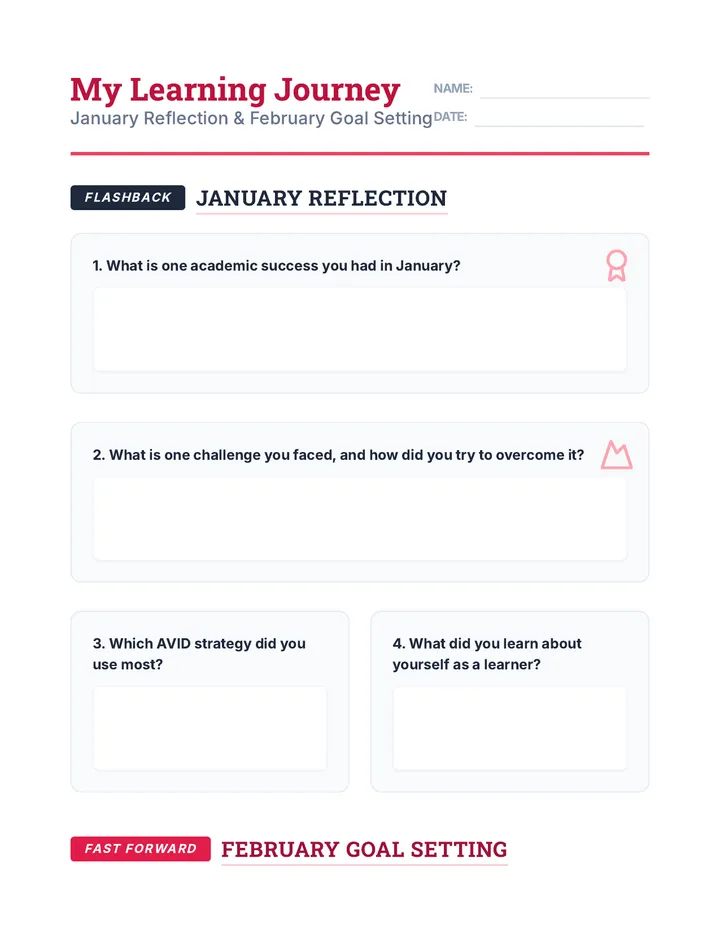
Final Thought: How will these help you succeed? January Reflection and February Goal Setting Worksheet My Learning Journey
January Reflection & February Goal Setting
Name:
Date:
Flashback
January Reflection
1. What is one academic success you had in January?
2. What is one challenge you faced, and how did you try to overcome it?
3. Which AVID strategy did you use most?
4. What did you learn about yourself as a learner?
Fast Forward
February Goal Setting
Remember to set SMART goals: Specific, Measurable, Achievable, Relevant, and Time-bound!
Goal #1
My Goal:
Steps to achieve it:
Success Marker:
(How will I know I reached it?)
Goal #2 (Optional)
My Goal:
Steps to achieve it:
Success Marker:
Final Challenge
What is one NEW AVID strategy you want to try or improve on in February?