Feeling Detectives Slides Emotion Explorers • Lesson 1
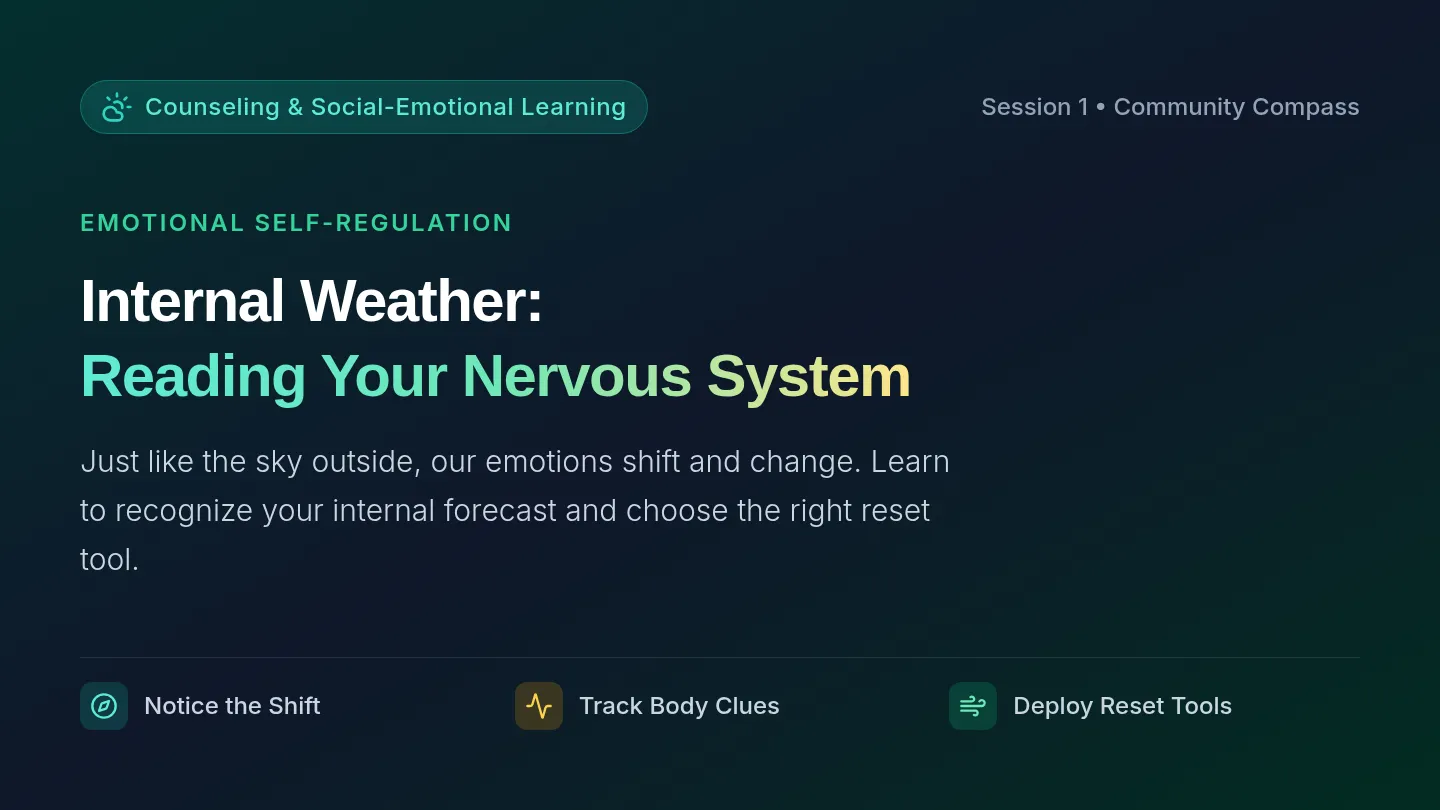
Social-Emotional Investigation
Feeling Detectives:
Cracking the Emotional Code
Uncover the hidden body clues and master precise words to describe what you feel inside.
Spot Body Clues
Expand Vocabulary
Name It to Tame It
Beyond "Fine" and "Mad"
Precision Gives Us Power
The Vague Trap
Saying "I feel bad" or "I'm just mad" leaves your brain foggy and others guessing how to support you.
"I don't know, everything is just annoying today..."
The Precise Detective
Pinpointing exact feelings like frustrated, overwhelmed, or excluded activates the problem-solving brain.
"I feel overwhelmed because I have three assignments due at once."
Key Principle: When you name the exact emotion, your nervous system begins to calm down.
Emotion Families
Upgrading Common Words
Joy Family
Base word: Happy
Content
Grateful
Exhilarated
Anger Family
Base word: Mad
Annoyed
Resentful
Infuriated
Fear Family
Base word: Scared
Apprehensive
Anxious
Terrified
Sad Family
Base word: Sad
Gloomy
Disheartened
Devastated
Look beyond the surface to find the most accurate label. Ask: Which specific word fits best?
Physical Clues
Your Body Speaks Before Words
Chest & Heart
Racing heartbeat, shallow breathing, tightness in the ribcage.
Often signals: Anxiety or Alarm
Stomach & Gut
Butterflies, knotted feeling, nausea, sudden heavy pit sensation.
Often signals: Nervousness or Guilt
Head & Muscles
Clenched jaw, tight shoulders, hot cheeks, balled-up fists.
Often signals: Frustration or Anger
Detective Strategy: Scan from head to toe when your mood shifts. What is your body doing?
Case Study 101
Analyze the Clues
Case: Maya's Presentation
"Maya is standing by her desk before her science presentation. Her hands are sweaty, her knees feel slightly shaky, and she feels a fluttery knot in her stomach."
Body Clues:
• Cold, clammy palms
Accurate Emotion Words:
• Apprehensive (mild)
Maya isn't "angry" or "sick" — her body is sending adrenaline clues for performance anxiety!
Detective Protocol
3-Step Routine
1
Pause & Scan
Stop for three seconds. Notice your breathing, muscles, jaw, and stomach.
"Where do I feel tension?"
2
Identify Family
Determine the general root: Is this Joy, Sadness, Anger, or Fear?
"Which big door opens?"
3
Select Precision
Replace the generic word with the exact descriptive emotion term.
"What is the exact match?"
Ready for practice on your Emotion Clue Tracker worksheet. Grab your detective pencil!
Emotion Clue Tracker Worksheet Emotion Explorers • Investigation File #1
Emotion Clue Tracker Worksheet
Field Detective
Name:
Date:
Class / Period:
1
Decoding Physical Signals
Our nervous system reacts before our conscious thoughts do. Connect each body signal with the emotion family it typically warns us about by drawing a line or writing the letter.
Physical Body Clue Emotion Family Specific Nuanced Word 1. Hot cheeks, jaw clenched tightly, fists curling Anger Family 2. Fluttery stomach knots, rapid breathing, dry mouth Fear / Worry
|
| 3. Slumped posture, heavy chest, watery eyes, low energy | Sadness Family |
|
| 4. Relaxed shoulders, warm chest, easy smile, steady rhythm | Joy / Calm |
|
2
Vocabulary Upgrade Bank
Replace basic, vague emotional words with high-precision vocabulary. Choose words from the word bank below and place them into the correct intensity ladders.
Word Bank: Infuriated Apprehensive Disheartened Exhilarated Irritated Panicked Content Gloom
Anger Upgrades
Mild:
Strong:
Fear Upgrades
Mild:
Strong:
Sadness Upgrades
Mild:
Strong:
Joy Upgrades
Mild:
Strong:
Emotion Explorers Sequence • Lesson 1 Page 1 of 2
Part 3 & 4
Case Files & Body Signal Journal
Investigation in Progress
3
Case Study Investigations
Read each scenario. Underline the physical cues mentioned, name the precise emotion, and explain what clues revealed it.
Case File Alpha: Jordan and the Group Project Evidence Item 1
"Jordan's group partners decided on a topic without asking him. Jordan felt his ears turn red, his teeth ground together, and his shoulders bunched up toward his neck."
Precise Emotion Label:
Key Body Clues Identified:
Case File Beta: Sam at the Tryouts Evidence Item 2
"Before walking onto the basketball court for evaluations, Sam felt a heavy drop in his stomach, his hands were trembling slightly, and he had to keep swallowing hard."
Precise Emotion Label:
Key Body Clues Identified:
Feeling Detectives Teacher Guide Teacher Resource • Lesson 1 Facilitation
Feeling Detectives Teacher Guide
Instructional Plan
Lesson Focus & Objectives
Students shift from vague emotional labels ("good", "mad", "bad") to precise vocabulary while connecting internal somatic markers (heart rate, gut sensations, muscle tension) with distinct emotional states.
Duration: 45-50 min
Grade Band: 4th-8th Grade
Materials: Slides & Tracker
Instructional Pacing & Agenda
Time Phase Key Teacher Actions & Discussion Prompts 00-08 min Hook & The Vague Trap Present Slide 2. Ask: "Why is answering 'I'm fine' unhelpful when you're actually burning up inside?" Emphasize that specificity triggers the rational prefrontal cortex. 08-20 min Families & Body Clues Review Slides 3-4. Guide students through a 60-second body scan. Model touching your chest/stomach when noticing adrenaline or butterflies. 20-35 min Guided Detective Practice Work through Case Study (Slide 5), then distribute the Emotion Clue Tracker Worksheet. Students complete Part 1 and Part 2 with peer partner checks. 35-45 min Case Files & Synthesis Students complete the Case Studies and Personal Inventory on Page 2. Lead a brief whip-around share on one physical clue discovered.
Common Student Misconceptions
Misconception: "Certain emotions are bad."
Reframing: All emotions are natural chemical data streams. Anger alerts us to boundaries or injustice; fear alerts us to safety needs. The emotion itself is never wrong—only harmful behavioral reactions are problematic.
Misconception: "Body cues mean I am sick."
Reframing: Students often visit the nurse with unexplained stomachaches or headaches before tests or social stress. Teach them that the gut and nervous system are directly wired together.
Emotion Explorers Sequence • Lesson 1 Facilitator Guide Page 1 of 2
Answer Key & Adaptation
Worksheet Key & Instructional Supports
Educator Reference
Emotion Clue Tracker Worksheet — Answer Key
Part 1: Body Clues & Nuanced Words
1. Anger Family → Annoyed, Resentful, Infuriated
2. Fear / Worry Family →
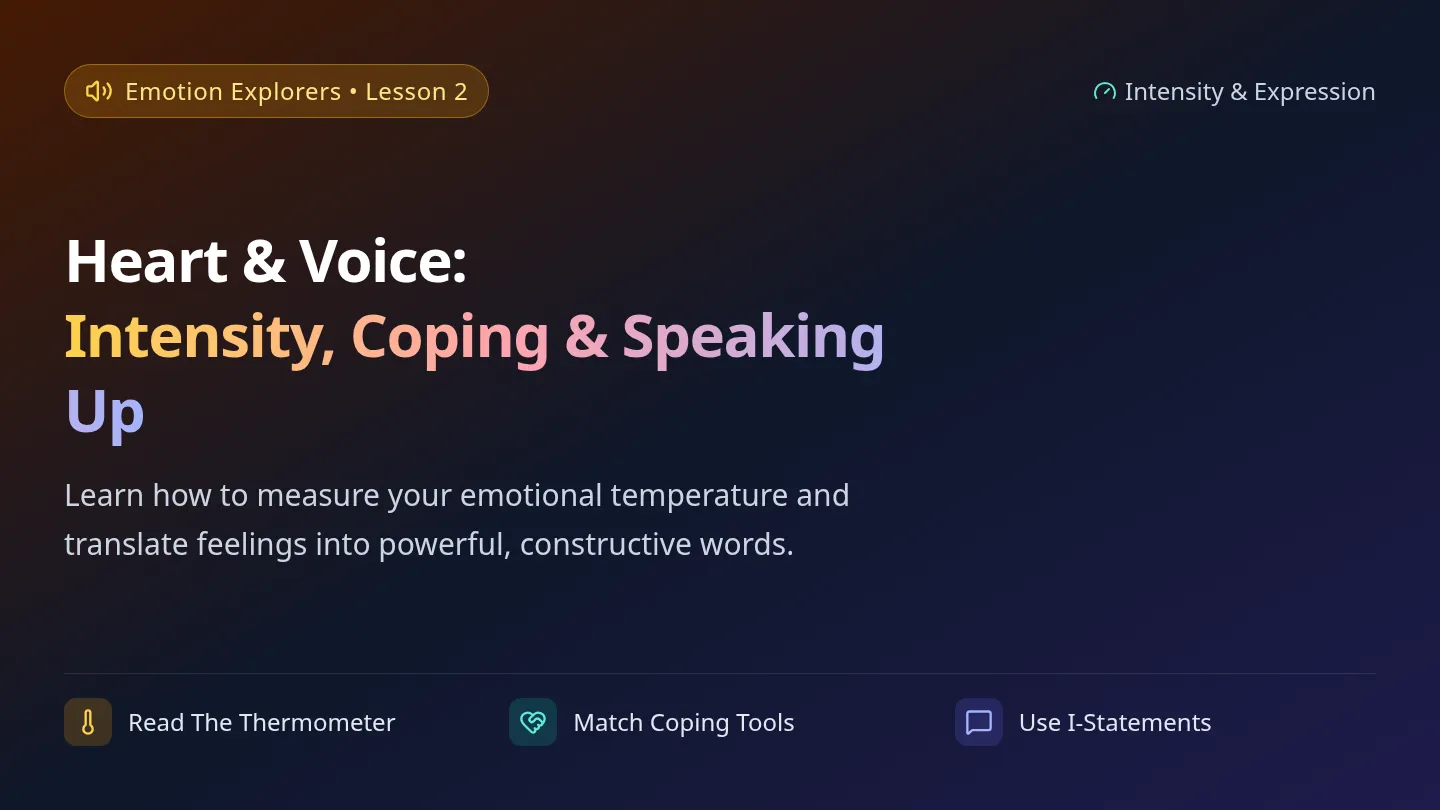
Emotion Intensity Slides Emotion Explorers • Lesson 2
Intensity & Expression
Heart & Voice:
Intensity, Coping & Speaking Up
Learn how to measure your emotional temperature and translate feelings into powerful, constructive words.
Read The Thermometer
Match Coping Tools
Use I-Statements
The Emotion Thermometer
Feelings Come in Different Volumes
Level 1 - 2
Mild Intensity
A gentle ripple. You notice it, but your brain is calm and you can easily think and learn.
Examples: Annoyed, curious, uneasy, content
Level 3 - 4
Moderate Intensity
A rising wave. Body clues get louder (fast pulse, tight muscles). Focus is challenged.
Examples: Frustrated, nervous, jealous, excited
Level 5
Strong / Extreme
An alarm sirens. The thinking brain shuts down; primal fight-or-flight takes control.
Examples: Infuriated, panicked, devastated
Goal: Catch your feelings at Level 2 or 3 before they spike to Level 5!
Right Size Strategies
Match the Tool to the Temperature
At Mild & Moderate (1-3)
Your thinking brain is active. You can problem-solve, reflect, and talk it through directly.
Take 3 deep belly breaths
Speak an I-Statement to the person
Write thoughts in a notebook
At High & Extreme (4-5)
Do not try to argue or solve problems now! Focus strictly on body safety and nervous system calming.
Ask for a 5-minute quiet reset break
Drink cold water or splash water on face
Reach out to a trusted adult immediately
Never try to resolve a major disagreement when anyone is at Level 5.
The Power of I-Statements
Expressing Feelings Without Blaming
The 4-Part Communication Blueprint
Step 1
"I feel..."
Name the precise emotion
Step 2
"When you..."
Describe the specific behavior
Step 3
"Because..."
Explain the real impact on you
Step 4
"I need..."
State a clear, realistic request
Contrast: "You always ruin everything!" vs. "I feel frustrated when you borrow my markers without asking because I need them for class."
Signal And Speak Activity Emotion Explorers • Investigation File #2
Signal And Speak Activity
Communication Lab
Name:
Date:
Class / Period:
1
Emotion Thermometer Calibration
Read each scenario. Rate the intensity on the 1 to 5 scale (1-2: Mild , 3-4: Moderate , 5: Strong ), and write a precise emotion label.
Scenario A: You studied hard for a math quiz, but when you receive your paper, you received a C- and don't understand where you made errors.
Intensity Level (1 - 5):
Precise Emotion Label (e.g. disheartened, baffled):
Scenario B: A classmate accidentally nudges your desk and knocks your pencil case onto the floor during silent reading.
Intensity Level (1 - 5):
Precise Emotion Label (e.g. slightly annoyed, startled):
Scenario C: Someone spreads an untrue rumor about your family on social media, and people are staring at you in the cafeteria.
Intensity Level (1 - 5):
Precise Emotion Label (e.g. humiliated, furious):
2
Right-Sized Coping Strategies
Connect the level of emotional intensity to the most effective coping response by matching the letter.
Intensity Levels:
[ A ] Mild (Level 1-2): Slight irritation or slight nerves.
[ B ] Moderate (Level 3-4): Noticeable frustration or worry.
[ C ] Strong (Level 5): Overwhelming fury or intense panic.
Proportional Response (Write A, B, or C):
Time-out reset, cold water, immediate trusted adult help
Shrug it off, self-talk, gentle posture reset
Box breathing, assertive I-Statement, short walking pause
Emotion Explorers Sequence • Lesson 2 Page 1 of 2
Part 3 & 4
I-Statements & Help-Seeking Scripts
Communication Mastery
3
Transforming Reactions into I-Statements
Blaming attacks ("You always...", "You're annoying!") make others defensive. Use the formula:
Unhelpful Reaction: "Stop talking over me! You never care about anyone else!"
Rewrite as a constructive, assertive I-Statement:
Unhelpful Reaction: (Saying nothing, slamming locker shut, glaring angrily at partner).
Rewrite as a constructive, assertive I-Statement:
Emotion Mastery Exit Ticket Emotion Explorers Sequence • Summative Assessment
Emotion Mastery Exit Ticket
Exit Ticket
Name:
Date:
Period:
1
Scenario Analysis: Vocabulary & Body Clues
"Taylor worked all weekend on an art project. On Monday morning, someone accidentally spilled paint across it in the hallway. Taylor felt a rush of heat in the face, tight clenched teeth, and rapid, shallow breathing."
A. Which two physical clues did Taylor show?
B. Most accurate emotion label:
Content
Infuriated
Gloomy
Apprehensive
2
Intensity Rating & Coping Choice
Where does Taylor's situation land on the thermometer?
Level 1 - 2: Mild (slight annoyance)
Level 3 - 4: Moderate (noticeable distress)
Level 5: Strong (intense distress / alarm)
What should Taylor do first before speaking?
3
Constructive I-Statement Script
After calming down, write the I-Statement Taylor can use with the student who spilled the paint.
4
Personal Takeaway
What is one specific feeling word or communication strategy from this sequence that you want to practice using in real life?
Emotion Explorers Sequence • Assessment & Exit Ticket Scoring Rubric: 4 Competencies Assessed