Clear Signals Lesson Plan Educator Guide Grade 8 Advisory / Tier 2 SEL
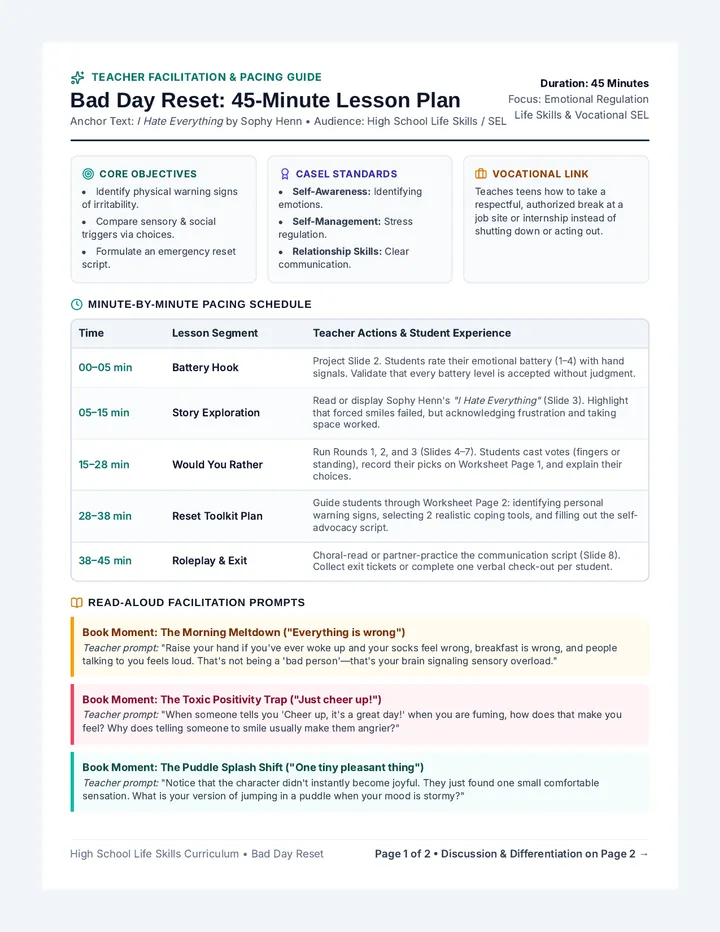
Clear Signals Lesson Plan
Empowering Anxious Students to Communicate Clarification Needs
Duration: 40–45 Mins
Setting: 1-on-1, Counselor, or Small Group
Focus: Low-Friction Help Seeking
Core Instructional Objectives
Identify physical and cognitive anxiety roadblocks to hand-raising in middle school.
Evaluate 4 distinct communication channels (discreet note, pre-arranged cue, email, whisper).
Construct and rehearse a 3-part clarification statement: [Where I am] + [Where I am stuck] + [Specific ask].
Anxiety Framing
Avoid forcing public speech. Treat asking for help as an executive communication skill, not a bravery test. Discreet channels build initial agency.
Materials: Slide Deck, "Signal Sender" Student Sheet, Post-it Notes, Cue Index Cards, Teacher Communication Agreement.
1 De-Stigmatize & Normalize the Freeze Response
7 Mins
Facilitator Script: "In 8th grade, raise-your-hand culture can feel like standing under a spotlight. When directions are fuzzy, your brain often freezes or worries: 'What if everyone else gets it?' In reality, over 65% of students feel lost at the same time."
Check for Understanding: Ask student to rate their internal hurdle: (1) Fear of looking silly, (2) Not knowing what words to use, or (3) Social spotlight effect.
2 Explore the 4 Communication Channels
10 Mins
Present alternatives to public hand-raising. Stress that adults in professional workplaces also choose written or scheduled communication:
A. Sticky Drop Leave note on podium/desk edge
B. Desk Signal Pre-arranged flip card or icon
C. Digital Ping 1-sentence LMS / email draft
D. Transition Whisper Ask during independent work
3 The 3-Part Clarification Formula
10 Mins
Saying "I don't get it" feels vague and leaves students vulnerable. Teach the structured formula that gives teachers exact context without requiring long explanations:
Part 1: "I read step 2..." + Part 2: "...but I'm unsure what format..." + Part 3: "...could you show one example?"
Clear Signals • Self-Advocacy Series Page 1 of 2
Instructional Rehearsal & Teacher Protocols
Phases 4 & 5, Practice Scenarios, and Classroom Accommodations
Part 2 of Facilitator Guide
4 Graduated Rehearsal (Low-to-Medium Stakes)
12 Mins
Work through these 3 realistic 8th-grade scenarios using the student's chosen communication channel:
Scenario A: The Muddled Rubric
Teacher explains a 4-paragraph history response verbally in 60 seconds; no slide is posted.
Target Script: "I heard paragraphs 1 and 2, but missed what goes in 3. Where is that posted?"
Scenario B: Partner Project Confusion
Teacher says 'find a partner and begin the lab,' but student does not know where to start or who to pair with.
Target Script: "Can you assign me a partner or let me work at station 4 independently?"
5 Action Agreement & Micro-Step Commitment
6 Mins
The student fills out the Action Plan in their worksheet, picking one specific class and one specific method (e.g., sticky note in 4th Period Science). Facilitator coordinates with that teacher so the response is seamless.
Classroom Teacher Best Practices (Dos & Don'ts)
DO:
Acknowledge notes with a brief nod or thumb-up.
Circulate near the student rather than calling them out.
Provide written or printed steps when oral directions are heavy.
Praise the action quietly: "Thanks for the note, that helped me clarify."
DON'T:
Never announce across room: "Jordan just asked me what to do!"
Don't force eye contact or demand full-sentence verbal retell.
Don't show visible annoyance at repeated clarification needs.
Never dismiss non-verbal notes with "Just ask out loud."
Accommodations & Variations:
For students with selective mutism, 504 plans, or acute panic symptoms, prep a 2-sided desk bookmark (Green = "Doing fine", Amber = "Need clarification on next step"). The teacher silently swaps the prompt for an example model without any verbal interrogation.
Clear Signals • Self-Advocacy Series Page 2 of 2
Clear Signals Slides Clear Signals
Self-Advocacy • Grade 8
How to Tell Teachers What You Need
Without the public spotlight, racing heart, or awkward silence.
100% Low-Stress • Discreet Methods • Instant Scripts
Fact Check
The "Freeze" Is Not Just You
The Spotlight Effect
It feels like 28 pairs of eyes are watching you, even though everyone is focused on themselves.
Physical Alarm
Pounding chest, blank mind, or dry mouth. Your nervous system is trying to protect you.
The Secret Truth
At least 5 other students in the room are just as lost and waiting for someone else to ask.
Rule #1: You never have to shout across the classroom to get what you need.
Choose Your Channel
4 Ways to Signal Without Raising Your Hand
1. The Sticky Drop
Stick a Post-it with your question on the corner of the teacher's podium or your desk when passing by.
2. The Desk Cue Card
A small colored index card flipped on your desk. Teacher sees the signal and walks over naturally.
3. The 1-Line Digital Ping
Send a private 1-line message through Google Classroom, Canvas, or school email right before or after class.
4. The Work-Time Whisper
Wait until music plays or independent work starts. Walk up quietly when the teacher is alone at their desk.
Which channel feels like a 2/10 on your stress meter instead of an 8/10?
Formula For Success
The 3-Part Clarification Formula
1
Anchor: Where You Are
"I have the first two questions answered..."
2
Friction: Where You're Stuck
"...but step 3 is confusing to me..."
3
Ask: What You Need
"...can you point out an example of what it looks like?"
Instead of saying "I don't get it" → You give them the exact puzzle piece you need.
Rehearsal Time
What Would You Do?
Scenario 1 Rapid Directions
The teacher talked fast, changed the due date, and said "Submit page 44 or 45." You're not sure which.
Low-Stress Move:
Write on a sticky note: "Quick check: page 44 or 45?" and place it on their desk.
Scenario 2 Unclear Rubric
The rubric says "Use strong evidence," but you aren't sure if that means 1 quote or 3 quotes.
Low-Stress Move:
Digital ping or side whisper:
Signal Sender Worksheet Student Activity Self-Advocacy Playbook
Clear Signals Series
Signal Sender Worksheet
Map your comfort zone and craft zero-stress questions for teachers
Name:
Date:
Period:
1 My Help-Seeking Stress Meter
Rate how stressful each method feels for you right now (1 = Low Stress / No Problem, 5 = High Panic / Freeze).
Hand Up Across Room
1 2 3 4 5
Sticky Note Drop
1 2 3 4 5
Flip Desk Cue Card
1 2 3 4 5
1-Line Email / LMS
1 2 3 4 5
1-on-1 Whisper at Desk
1 2 3 4 5
My #1 preferred low-stress channel:
2 Upgrading from "I Don't Get It" (The 3 Parts)
When you say "I don't get it," teachers don't know where to start. Use this formula so they can answer in 10 seconds:
1. Where You Are "I finished step 1..."
2. Where You're Stuck "...but step 2 says 'evaluate'..."
3. What You Need "...does that mean explain or list?"
Guided Practice: Complete the formula for a confusing Math or Science problem:
1. I was able to:
2. But I'm stuck on:
3. Could you clarify:
Emergency Sentence Starters (Circle your top 2 favorites)
"Could you repeat the due date and final format?"
"Can you show what a finished example looks like?"
"I got lost around step 3. Can I get a quick pointer?"
"Is this paragraph heading in the right direction?"
Signal Sender Worksheet • Clear Signals Page 1 of 2
Part 2: Real-Life Rehearsal & Personal Contract
Practice your draft questions and lock in your classroom agreement
Confidence Builder
Challenge A: The Fast-Paced Assignment English / Social Studies
Situation: The teacher gave 4 spoken instructions quickly before the bell. You don't know if the reading notes are due tomorrow or Friday, and you feel anxious interrupting.
Draft your quick note or email draft below:
Challenge B: Vague Project Expectations Science / STEM Lab
Situation: The teacher handed out a lab sheet and said "Get started with your data chart." You aren't sure how many trials you need to record.
Draft your sticky note or desk question below:
My Micro-Action Plan (Choose 1 Class for This Week)
1. Target Class & Teacher:
2. My Chosen Communication Method:
Self Advocacy Support Toolkit Reference & Tools Student Resource Kit
Clear Signals Series
Self-Advocacy Support Toolkit
Printable desk cues, pocket sentence scripts, and calm-down anchors
Pocket Script Cards (Cut out and keep in phone case, pencil bag, or binder)
Cut along dashed borders
Card 1 • Fast Pacing
"I missed the transition."
"Could you show me which problem we are on right now so I can jump back in?"
Card 2 • Unclear Rubric
"I need an example."
"Could you point out one model or sentence that meets this requirement?"
Card 3 • Partner Work
"Partner assignment help."
"Can you place me in a group or let me complete this assignment independently?"
Card 4 • Direction Check
"Quick gut-check."
"Does this first step match what you are looking for before I do the rest?"
Foldable Desk-Edge Signals (Place on desk corner during independent work)
Green: Flow State
I understand what to do and I'm working independently.
Amber: Quick Check
I'm still working, but please swing by when you walk past.
Red: Stuck / Need Step
I cannot move forward without a quick 30-second pointer.
The 30-Second Pre-Signal Reset
1. Box Inhale (4s) Breathe in deep through your nose. Let your shoulders drop down away from your ears.
2. Fact Anchor Remind yourself: "Asking a question is my job as a student, and answering it is their job."
3. Drop the Note Slide the note or cue card onto the desk without looking up. You've done your part.
Self-Advocacy Support Toolkit • Student Prompts Page 1 of 2
Classroom Communication Compact
Formal agreement between student, teacher, and counselor/case manager
Collaborative Plan
Step 1: The Mutual Agreement
Student Name:
Teacher Name & Subject:
Our Agreed Primary Method of Asking for Clarification:
Sticky Note Flip Desk Card LMS Message Quiet Desk Stop
Where the student will leave/show the signal:
How the teacher will respond discreetly (without calling on student across room):
Student Signature:
Teacher Signature:
Teacher Low-Anxiety Response Scripts
When Student Leaves a Note:
Don't read aloud. Walk past their desk during rounds, lean down quietly, and say: