Budget Mindset Lesson Packet
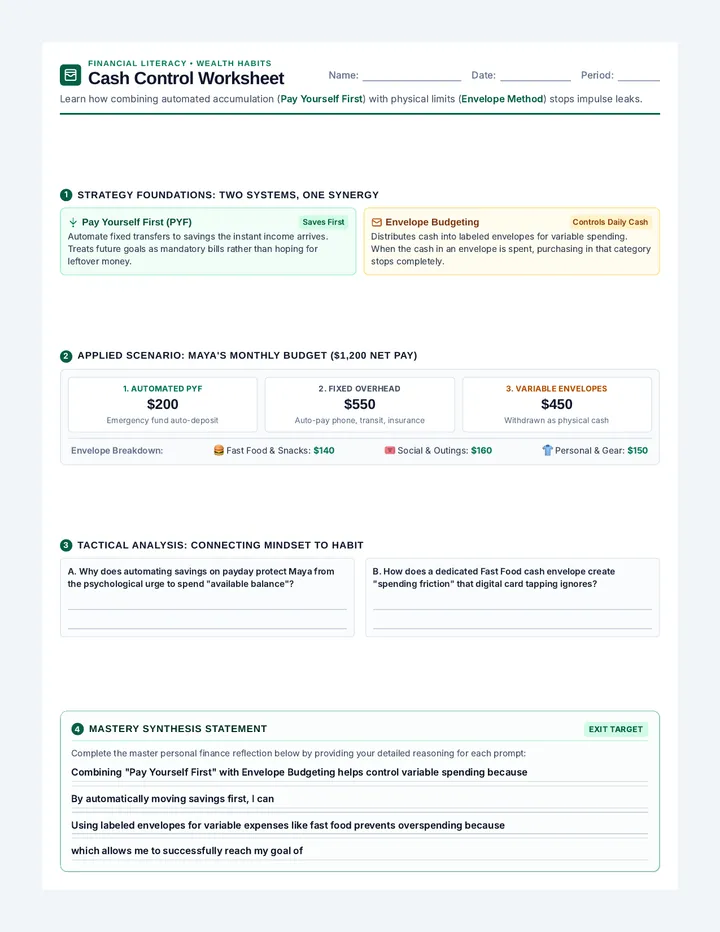
Behavioral Finance & Psychology Module 1 • Guided Student Workbook
THE BUDGET BREAKTHROUGH: AUTONOMY & PURPOSE
Student Name
Date / Period
Re-framing the "B-Word": Why Budgeting Is Freedom, Not a Prison
Most people assume a budget is about deprivation—someone wagging their finger telling you what you can't buy. In behavioral psychology, a budget is actually an autonomy engine: it gives you conscious permission to spend lavishly on what you truly care about by cutting out mindless leaks.
What is your honest initial gut reaction to the word "Budget"?
Stress / Guilt Boredom / Chores Control / Power
1. The Decisional Balance: Exploring Your Financial Ambivalence
Motivational Interviewing recognizes we all feel torn about money habits
OPTION A: Spending on Pure Impulse (Autopilot) Buying whatever feels good right in the moment
Immediate Perks (Why I do it now):
Hidden Costs (How it hurts me later):
OPTION B: Intentional Cash Allocation (Budgeting) Deciding where every dollar goes before you spend
Required Effort (What feels challenging):
Long-Term Payoff (What it unlocks for me):
2. The Readiness Rulers (Eliciting Your Internal Motivation)
Ruler A: On a scale of 1–10, how IMPORTANT is having total control over your money to you? 1 = Don't care • 10 = Essential
12345678910
Key Question: Why did you select that number and not a lower number (like a 1 or 2)? What makes it matter?
Ruler B: On a scale of 1–10, how CONFIDENT are you that you can stick to a simple money plan? 1 = Doubting • 10 = Fully capable
12345678910
Key Question: What is one specific strength, tool, or boundary that would bump your score up by 2 points?
Budget Breakthrough Workbook • Level Up Personal Finance Page 1 of 5
Phase 2: Values Alignment Developing Internal Discrepancy
VALUES VS. VENDORS: THE DISCREPANCY AUDIT
"Show me your bank statement, and I'll show you your priorities."
Motivational Interviewing Principle: Developing Discrepancy. Long-term behavioral change happens when we experience the contrast between what we say we value (freedom, adventure, peace of mind) and where our dollars actually vanish.
A. Select Your Top 3 Personal Core Values (Check 3 that matter most to your future)
Freedom & Independence
Adventure & Travel
Security & No Stress
Generosity & Community
Skills, Sports & Mastery
Creative Tech & Gear
Self-Reliance / No Debt
Fun & Social Hangouts
B. The Money Leak Reality Check: Does My Cash Match My Core Values?
Analyze three common everyday spending drains
| Spending Pattern |
Est. Monthly Drain |
Matches Values? |
What It Steals From Future Me |
| Daily Food & Drink Runs Convenience snacks, fast food, boba, soda runs ($5–$8/day) |
$60 – $120 |
Yes / No / Barely |
|
|
|
|
|
| Digital & Gaming Micro-Buys Loot boxes, battle passes, in-app cosmetics, forgotten trials |
$20 – $50 |
Yes / No / Barely |
|
|
| Impulse Social Compliance Buying overpriced items just because everyone in the group is | $40 – $90 | Yes / No / Barely |
|
C. Eliciting Change Talk: What Happens If You Align Your Cash?
1. Desire & Vision: If you reclaimed just $80/month from unconscious leaks, what major goal could you achieve in the next 6 months?
2. Internal Reason: Why is that future goal more exciting or satisfying than temporary convenience purchases?
Budget Breakthrough Workbook • Level Up Personal Finance Page 2 of 5
Phase 3: Active Coaching Lab Communication & Empathy
THE OARS INTERVIEW LAB: PEER MONEY DIALOGUE
"Listen to understand, not to lecture."
The Peer Coach Toolkit: The O.A.R.S. Method Rule: Never give unsolicited advice!
O Open Questions
Ask questions starting with "What" or "How" that can't be answered with a simple "yes" or "no".
A Affirmations
Acknowledge their honesty, courage, or smart decisions: "It takes guts to admit where cash leaks."
R Reflections
Mirror their feelings: "On one hand you enjoy treating friends, but on the other hand you hate feeling broke."
S Summarizing
Recap key points before asking: "So here is what you value most... what would be a smart first move?"
Live Peer Interview Activity (Pair Up: 7 Minutes Each, Then Switch)
Partner A interviews Partner B about a real spending challenge
Interviewer Question Bank (Choose 2 to ask your partner):
- "What is one spending habit you have that sometimes bugs you or makes you feel stressed?"
- "What are the good things about spending that money, and what are the not-so-good things?"
- "If you decided to change this habit next week, how would having a budget make things easier?"
My Partner's Name:
Their Spending Challenge:
1. Reflective Listening Record: What conflict or ambivalence did your partner express between their desires and their budget?
2. Change Talk Captured: Write down one phrase your partner said that showed they want to take control of their cash:
3. Affirmation Delivered: What genuine compliment or affirmation did you offer your partner regarding their financial awareness?
Debrief Reflection: How did it feel being interviewed without being told what to do or judged?
Budget Breakthrough Workbook • Level Up Personal Finance Page 3 of 5
Phase 4: Case Studies Cognitive Reframing & Solutions
TEEN MONEY DILEMMAS: BREAKING THE SPENDING CYCLE
Apply Motivational Interviewing to real-life friction
Case 1
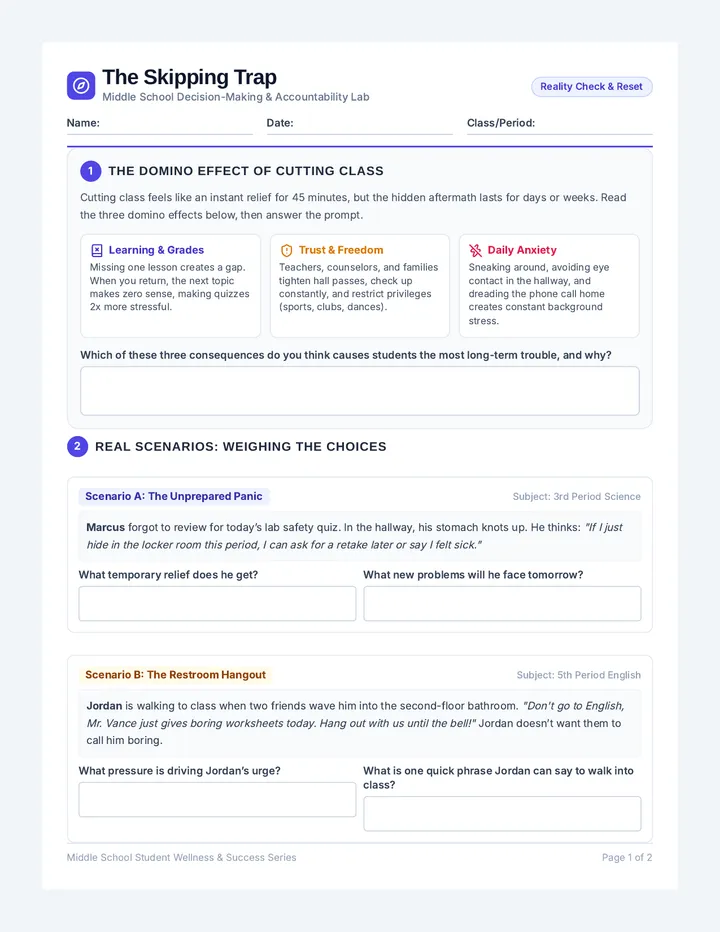
Marcus (16) & The Friday Night FOMO Spiral
Dilemma: Social Belonging vs. Big Car Goal
Marcus earns $140/week at a smoothie bar saving for his first car ($2,200 goal). Every Friday, his friends invite him to expensive sit-down dinners and bowling. He spends $45 each time because he hates saying "I can't afford that." After a month, his car savings has barely grown by $20.
Identify Marcus's Internal Ambivalence:
Write an Open MI Question to help Marcus reflect:
Case 2
Aaliyah (15) & The Late-Night Algorithmic Scroll
Dilemma: Stress Relief vs. Financial Peace
Whenever Aaliyah feels overwhelmed by school or bored in bed, she scrolls social shopping feeds. Targeted ads and 1-click Apple Pay make spending $15 on cheap clothes or beauty items feel harmless. By Sunday night, her bank account has $2.80 and she feels guilty and anxious.
What emotional trigger drives this behavior?
Draft an MI Reflection that validates her feelings:
Case 3
Jordan (16) & Paycheck Party Euphoria
Dilemma: Temporary High vs. Mid-Week Survival
Jordan refs weekend youth soccer and receives $160 cash every Saturday. Feeling wealthy, he treats his crew to drinks and buys new video game skins that afternoon. By Tuesday morning, he doesn't have $10 for lunch or gas and has to ask his parents for money.
How does a 50/30/20 budget fix this problem?
What automatic rule should Jordan implement Saturday?
Budget Breakthrough Workbook • Level Up Personal Finance Page 4 of 5
Phase 5: Implementation Commitment & Boundaries
MY FINANCIAL CHANGE PLAN & MONEY MANIFESTO
"Willpower is weak. Built-in systems are unbreakable."
1. My "If-Then" Trigger Armor (Pre-committing to Smart Choices)
Behavioral psychology proves pre-decisions protect your budget
Social Trigger: When friends invite me out and my "Fun & Hangouts" bucket is empty:
MY PRE-SET PLAN:
Emotional Trigger: When I feel bored, stressed, or tempted by online shopping ads:
MY PRE-SET PLAN:
Income Trigger: The exact moment cash lands in my hands or account (Payday):
MY PRE-SET PLAN:
2. My Personal Teen Money Manifesto
1. I am choosing to manage my cash intentionally because my #1 big-ticket goal is:
2. The biggest myth or lie I used to believe about budgeting was:
3. The single spending leak I am officially retiring starting this week is:
3. Final Synthesis & Blueprint Connection
How does using the Teen Cash Flow Planner shift you from "hoping you have money" to "commanding where it goes"?
Student Signature:
Instructor Verification:
Budget Breakthrough Workbook • Level Up Personal Finance Page 5 of 5
Teen Cash Flow Planner
Level Up Finances Ages 14–16 Personal Wealth Guide
TEEN CASH FLOW BLUEPRINT
Name
Month / Year
The Teen 50 / 30 / 20 Rule
How every dollar you get should be divided
50% Spend / Fun
Everyday & Hangouts
Fast food, gaming passes, cinema, clothes, outings with friends.
30% Target Goal
Big-Ticket Savings
First car fund, gaming PC, sneakers, driver's ed, concert ticket.
20% Future You
Emergency & Stash
Never touch fund, unexpected gear fixes, early starter investing.
1. Income Streams (Where Your Money Comes From)
Include allowance, yard work, pet sitting, odd jobs, birthday gifts
| Income Source / Hustle |
Expected ($) |
Actual Received ($) |
| Regular Allowance / Chores |
|
|
| Neighborhood Jobs (Mowing, snow, washing cars, dog walking) |
|
|
| Part-Time Work / Refereeing / Tutoring / Odd Hustles |
|
|
| Gifts / Selling Unused Gear (Games, clothes, cards) |
|
|
| TOTAL MONTHLY INCOME |
|
|
2. Planned Expenses & Monthly Allocations
Divide your income before you start spending
Fixed / Monthly Subscriptions Non-negotiable
Gaming (Game Pass / PS Plus / Steam)
Phone Plan / iCloud / Music
Gym / Sports / Club Dues
Other Fixed: ________________
Variable Fun & Lifestyle (50%) Under your control
Fast Food, Snacks & Drinks
Weekend Hangouts / Movies / Events
App Purchases / In-game items
Clothes & Style / Accessories
The 48-Hour Cheat Code
Want something over $30 that isn't essential? Wait exactly 48 hours. If you still crave it after two days, check your 50% category. In 80% of cases, the urge disappears and you keep your cash.
Page 1 of 2 • Level Up Personal Finance
EXECUTION & SAVINGS VAULT
Starting Wallet Balance:
3. Weekly Cash Flow Checkpoint
Check in every Sunday evening for 5 minutes
| Period |
Cash In ($) |
Cash Out ($) |
Saved This Week ($) |
| Week 1 (Days 1–7) |
|
|
|
| Week 2 (Days 8–14) |
|
|
|
| Week 3 (Days 15–21) |
|
|
|
| Week 4 (Days 22–End) |
|
|
|
| MONTHLY TOTALS |
|
|
|
4. Big Target Goal Smasher (Your 30% Bucket)
Car fund • Tech/PC • Sneakers • Trip
Target Item
Total Price ($)
Target Deadline
Monthly Deposit Needed
Milestone Progress Bar (Fill in as you save)
25% Saved
1/4
50% Saved
2/4
75% Saved
3/4
100% UNLOCKED
5. End-of-Month Level Up Debrief
Honest review: How did you manage your game?
Biggest Money Win This Month:
One Impulsive Buy I Could Have Skipped:
Next Month's Money Goal & Action Step:
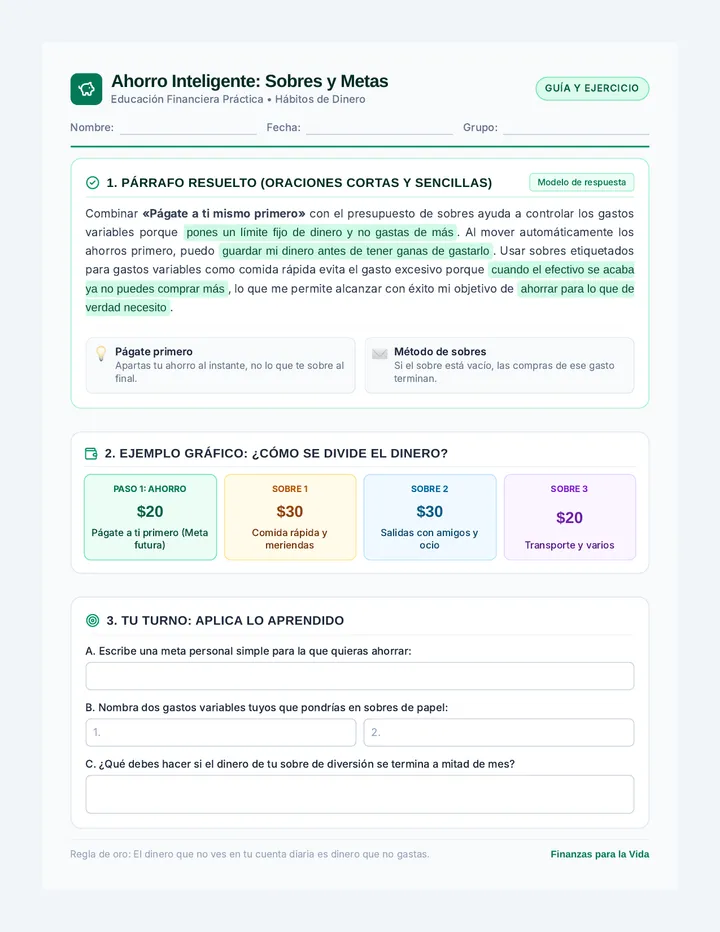
The Golden Teen Rule: Pay your future self first. The moment cash enters your hands or bank account, transfer the 30% and 20% savings before spending a single dime on entertainment.
Page 2 of 2 • Level Up Personal Finance