Bounce Back Lesson Plan Bounce-Back Blueprint
Resilience Training • Grade 9
45
Minutes
The "Why"
Building resilience and self-compassion equips students to recover from setbacks more quickly and develop a growth mindset, improving their academic and emotional well-being.
Prep & Timing
Time to Prep
5 Minutes
Instructions
Print or load the Emoji Pulse Warm-Up slide.
Queue up the Resilience Toolbox Slides .
Familiarize yourself with the Coach Voice Script .
Prepare chart paper for the 3-step Bounce-Back Plan.
Materials List
Resilience Toolbox Slides
Coach Voice Script
Resilience Relay Activity Guide
Emoji Pulse Warm-Up
Future Note to Self Handout
Lesson Objective
Students will co-create a personalized three-step Bounce-Back Plan after exploring resilience, self-compassion, and solution brainstorming through discussion and a relay activity.
Training Schedule
1
Warm-Up: Emoji Pulse
4 MIN
Display a screen of varied emojis representing emotions after a setback.
Ask students to silently select the emoji that matches how they feel when they receive a bad grade.
Tally the selections anonymously on the board to gauge the class’s emotional baseline.
2
Vocabulary Burst
6 MIN
Present key terms: resilience, recovery, perseverance, reflection .
Read definitions and invite volunteers to paraphrase.
Clarify misconceptions and answer quick questions.
3
Guided Discussion
12 MIN
Pose and facilitate:
What does "failure" mean to you? How long should we dwell?
What role does self-talk play in bouncing back?
Note insightful responses on the board using self-compassionate language.
4
Interactive Activity: Resilience Relay
18 MIN
Divide students into groups and use the Coach Voice Script for narration.
Read three challenge stages; students jot action steps for each.
Synthesize group ideas into a 3-step class Bounce-Back Plan on the board.
5
Closing: Future Note to Self
5 MIN
Distribute the Future Note to Self template.
Students write a brief message about applying their plan to the next setback.
Invite volunteers to share before collecting or allowing students to keep.
Resilience Toolbox Slides Resilience Toolbox
Resilience
The ability to adapt and recover quickly from difficulties or setbacks.
Training Module 01
Resilience Toolbox
Recovery
The process of regaining strength, confidence, or balance after a setback.
Training Module 02
Resilience Toolbox
Perseverance
Continued effort and determination, even when faced with obstacles or delays.
Training Module 03
Resilience Toolbox
Reflection
Thinking deeply about past experiences to learn and improve.
Training Module 04
The Core Blueprint
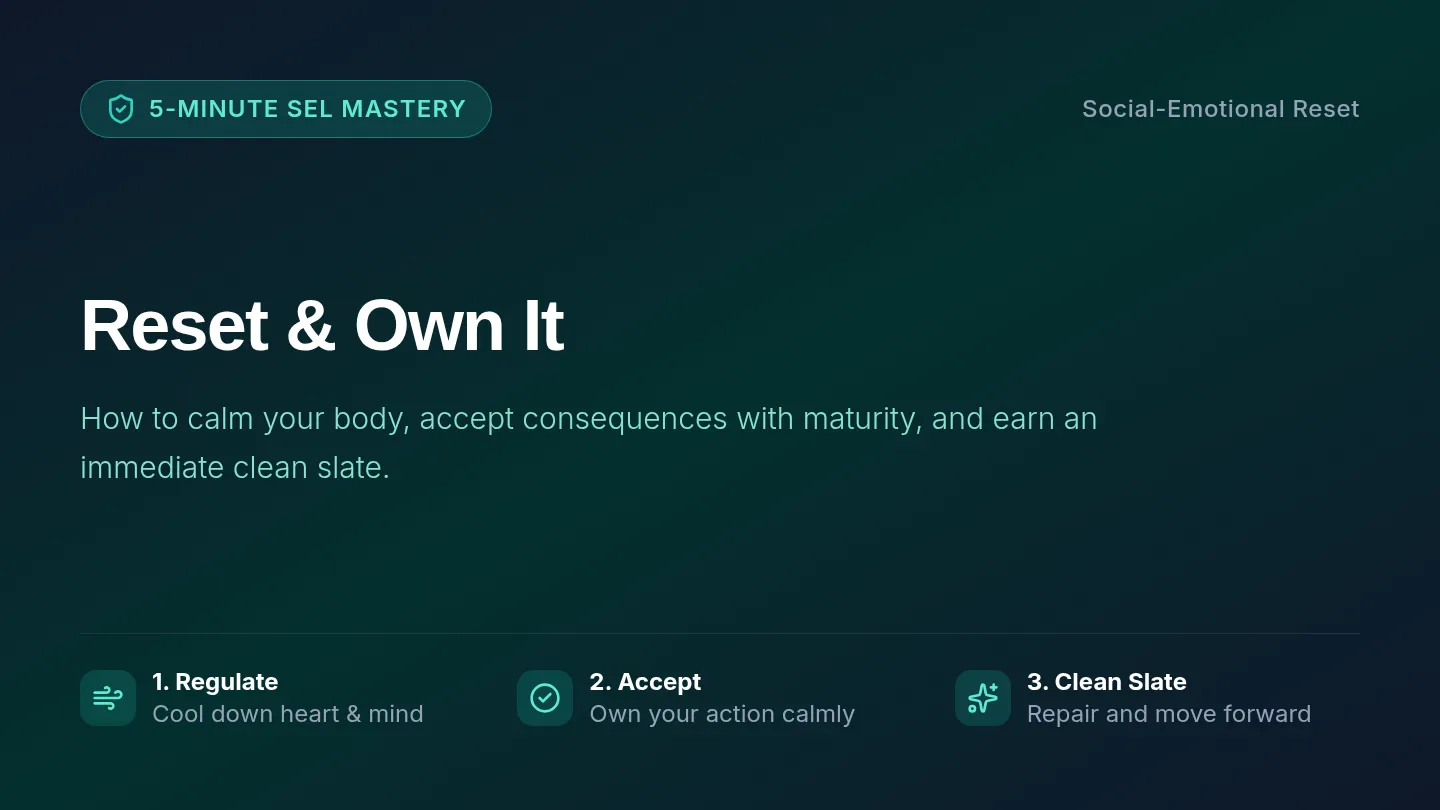
3-Step Bounce-Back Plan
01
Kind Self-Talk
Speak with compassion after a setback.
02
Root-Cause Check
Identify what went wrong and why.
03
Concrete Next Step
Choose one actionable move to start your comeback.
Coach Voice Script Official Script
Coach Voice Script
Resilience Relay Narration
Execution Note: Use an energetic, encouraging tone. Read the bold "Teacher says" sections verbatim. Pause where indicated to allow for student thinking and writing.
Introduction
Teacher says:
“Alright team, huddle up! Today, I’m your coach on the Bounce-Back Squad. We’re going to run a three-stage drill to practice bouncing back after a setback. At each stage, you’ll silently write down one action step. Got your pens ready? Let’s go!”
01
Stage One: The Unexpected Score
Teacher says:
“Imagine you just received your math quiz back, and it’s a 60%—way lower than you expected. Your heart pounds, your stomach twists, and you feel discouragement creeping in. Right now, I want you to practice self-compassion. In your group, quietly write one kind, supportive message you’d say to yourself in this moment. Keep it genuine and encouraging.”
“If you’re stuck, ask: ‘What advice would I give a friend in my shoes?’ Ready? Go!”
Pause for 45 Seconds
Quick Check: “Pens down! Who would like to share one compassionate thought? Great—let’s carry that energy forward.”
02
Stage Two: Investigating What Happened
Teacher says:
“Stage Two: Time to be detectives. You want to figure out why that quiz score fell short. What’s one concrete step you could take to uncover the root cause? Maybe reviewing a tricky problem, asking a peer to quiz you, or meeting with the teacher for feedback.”
“Need a prompt? Ask yourselves: ‘Which question confused me most, and how can I get clarity?’ Ready? Go!”
Pause for 45 Seconds
Quick Check: “Nice detective work! Who has an idea for pinpointing the problem? Thanks for sharing—excellent strategies!”
03
Stage Three: Planning Your Comeback
Teacher says:
“Final stage: It’s game time! You’ve shown yourself compassion and uncovered what went wrong. Now pick one immediate action to launch your comeback. Will you set up a new study schedule, join a peer study group, or schedule a review session with your teacher?”
“If you need inspiration, think: ‘What’s one thing I can do tomorrow to start rebuilding my confidence?’ Ready? Go!”
Pause for 45 Seconds
Wrap-Up
Teacher says:
“Awesome hustle, team! Pens down. Now, let’s collect the top ideas from each group and craft our bulletproof three-step Bounce-Back Plan on the board. Let’s build it together!”
Resilience Relay Activity Guide Interactive Activity
Resilience Relay
18 Minutes
Overview
A three-stage team-based drill where students practice key resilience skills: self-compassion, root-cause investigation, and action planning. Groups jot ideas on cards and share them to build a class-wide blueprint.
Materials Needed
Index cards (3 per student)
Pens or pencils
Timer/Stopwatch
Chart paper & Markers
Relay Procedure
1
Setup & Introduction (2 min)
Form teams of 4–5. Distribute 3 index cards to each student. Remind them to keep ideas concise and actionable. Launch the Coach Voice Script intro.
2
Stage One: Self-Compassion (4 min)
Read Stage One of the script. Students write a supportive message on card #1. After 60s, groups select one standout message for the "Compassion" column on the chart paper.
3
Stage Two: Investigate (4 min)
Read Stage Two of the script. Students write a root-cause diagnosis step on card #2. Groups select their best idea for the "Analysis" column on the chart paper.
4
Stage Three: Action Plan (4 min)
Read Stage Three of the script. Students write one immediate action step on card #3. Groups share their top step for the "Action" column on the chart paper.
5
Synthesis & Debrief (4 min)
Review the collected ideas. Highlight patterns in self-talk, diagnosis, and action. Co-create the class Bounce-Back Blueprint on the board based on these inputs.
Pro-Coach Tips
Pacing is Key Keep transitions brisk—use a timer for each writing burst to maintain the "relay" energy.Visual Organization Label your chart paper columns clearly: Compassion , Analysis , and Action .Promote Empathy Encourage respectful listening when groups share their self-compassion messages.Personalization Remind students that while the class plan is general, they should tailor the steps to their own lives. Emoji Pulse Warm Up Step 01: Warm-Up
The Emoji Pulse
"When you receive a lower grade than you expected on your Math test, which emoji best matches how you feel?"
😀 Determined
🙂 Optimistic
😐 Neutral
😟 Worried
😢 Upset
😡 Frustrated
How to play
1 Silent Choice: Think of the emoji that matches your feeling. Don't say it out loud yet!
2 Anonymous Tally: The teacher will call out each emoji. Raise your hand when yours is called.
3 The Result: We'll look at the board to see our class's collective "emotional baseline."
Future Note to Self Cool Down Name:
Date:
Bounce-Back
Personal Blueprint
Future Note to Self
You’ve co-created your three-step Bounce-Back Plan. Now it’s time to lock it in with a personal message. Write a brief note to yourself about how you will use each step when you face your next setback.
1
Step One: Kind Self-Talk
What is a kind, supportive phrase you will remember to tell yourself?
2
Step Two: Root-Cause Check
How will you investigate what went wrong in a constructive way?
3
Step Three: Concrete Next Step
What is the first concrete action you will typically take to start your comeback?
Verification of Resilience Intent
Signature of the Future You
Date
Lesson Facilitation Script Facilitation Guide
Lesson Script
Bounce-Back Blueprint Delivery
Full 45-Min Path
Introduction
1 MIN
Teacher says:
“Good morning, everyone! Today we’re going to build our very own Bounce-Back Blueprint—our personal game plan for recovering when things don’t go as planned. Over the next 45 minutes, you’ll define key resilience terms, share ideas, practice a quick team relay, and co-create a three-step plan you can use anytime you face a setback. Let’s get started!”
1. Warm-Up: Emoji Pulse
4 MIN
Display the Emoji Pulse Warm-Up slide.
Teacher says:
“First, I want you to think of a time you got a lower grade than you expected. Look at the emojis on the screen. When I call out your emoji, silently select it in your mind, then raise your hand so I can tally which feelings are most common. Ready? Here we go...”
[Tally: 😀 … 🙂 … 😐 … 😟 … 😢 … 😡]
“Thank you. This is our emotional baseline—everyone has different reactions, and that’s okay. We’ll use this information later when we talk about self-compassion.”
2. Vocabulary Burst
6 MIN
Advance to the Resilience Toolbox Slides.
Teacher says:
“Let’s build our Resilience Toolbox. I’ll read each term and its definition, then invite one volunteer to paraphrase in their own words.”
Resilience: [Read Slide 1] "Who can paraphrase what resilience means?"Recovery: [Read Slide 2] "What helps you feel better after something goes wrong?"Perseverance: [Read Slide 3] "Share a time you kept pushing through a tough situation."Reflection: [Read Slide 4] "Why is looking back on what happened important?"
3. Guided Discussion
12 MIN
Teacher says:
“Let’s talk more about setbacks and comebacks. I’ll pose a question, and I want you to think, then share. I’ll jot the best ideas on the board.”
Question 1
What does "failure" mean to you?
Question 2
How long should we dwell before moving on?
Question 3
What role does self-talk play in bouncing back?
Question 4
How can we turn a setback into a real comeback?
4. Resilience Relay
18 MIN
Transition to Coach Mode
Switch to the Coach Voice Script and have students form teams with their index cards. Follow the three stages (Compassion, Analysis, Action) as detailed in the Script and Activity Guide.