Lenny.com
Explore
Create
ActivitiesNewMathEnglish Language ArtsScience & EngineeringSocial StudiesGlobal LanguagesHealth & Physical EducationSpecial EducationCounseling & Life SkillsArts & CreativityESL
Lenny.com
Lenny.com
Explore
Create
ActivitiesNewMathEnglish Language ArtsScience & EngineeringSocial StudiesGlobal LanguagesHealth & Physical EducationSpecial EducationCounseling & Life SkillsArts & CreativityESL
Lenny.com
Counseling & Life SkillsSelf-AwarenessBasic Emotion RecognitionComplex Emotion IdentificationEmotional Nuance & Mixed FeelingsBuilding Positive Self-ImageRecognizing Strengths & Growth AreasAccurate Self-AssessmentPersonal Values IdentificationCultural & Individual Identity ExplorationValues-Based Decision MakingSelf-ManagementStop-and-Think StrategiesDelaying GratificationIndependent Impulse ManagementIdentifying Stress TriggersShort-Term Goal SettingSMART Goals DevelopmentGoal Monitoring & AdjustmentBuilding Perseverance & ResilienceInternal Motivation DevelopmentComprehensive Stress Reduction PlanningSocial AwarenessRecognizing Others' FeelingsDemonstrating EmpathyRespecting Individual DifferencesUnderstanding Cultural DiversityComplex Empathetic ResponsesMultiple Viewpoint ConsiderationMulti-Perspective AnalysisChallenging Stereotypes & BiasRelationship SkillsActive ListeningClear Verbal & Nonverbal CommunicationBuilding Positive FriendshipsWorking Cooperatively in GroupsCommunicating Personal BoundariesRespecting Others' BoundariesAssertive ExpressionPeaceful Problem-SolvingContributing to Team GoalsComplex Conflict NavigationMediation & NegotiationHealthy Romantic RelationshipsResponsible Decision-MakingDaily Problem IdentificationBrainstorming Multiple SolutionsEvaluating Pros & ConsRecognizing Risks & ConsequencesApplying Ethical FrameworksInformed Risk-Benefit DecisionsRoot Cause AnalysisMindfulnessMindful BreathingBody Scan MeditationDaily Mindfulness ApplicationDaily Self-Care RoutinesBalancing Life DemandsAdvocating for Wellness NeedsMental Health SupportUnderstanding Anxiety SymptomsWorry Management StrategiesProgressive Muscle RelaxationRecognizing Depression SignsBuilding Mood-Supporting RoutinesBehavioral Activation for MoodUnderstanding Grief StagesHealthy Grief CopingCreative Expression of LossBehavioral SupportDaily Check-In ProceduresDaily Goal Setting & ReviewRecognizing Escalation Warning SignsRequesting Breaks & SupportSelf-Calming During DistressUnderstanding Positive ReinforcementToken Economy ImplementationBehavior Chart TrackingAnalyzing Behavior PatternsIdentifying Antecedents & ConsequencesDetermining Behavior FunctionFunction-Based InterventionsIndividualized Behavior ContractsData-Driven Behavior AdjustmentTherapeutic ApproachesThoughts-Feelings-Behaviors ConnectionRecognizing Thinking PatternsChallenging Negative ThoughtsPositive Self-Talk PracticeThought Record TrackingAdvanced Cognitive RestructuringComprehensive CBT PlansBehavioral Activation TechniquesBuilding Positive ExperiencesExposure Hierarchies for AnxietyPresent-Moment AwarenessNon-Judgmental ObservationSelf-Soothing & DistractionComplex Emotion LabelingReducing Emotional Vulnerability (PLEASE)DEAR MAN CommunicationGIVE Skills for RelationshipsFAST Skills for Self-RespectRadical Acceptance PracticeCrisis Survival Skills (TIPP)Understanding Trauma EffectsTrauma Responses & TriggersIdentifying Trauma FeelingsGrounding TechniquesRegulation During Trauma DistressSafe Place VisualizationProcessing Through NarrativeDeveloping Trauma StoryPersonalized Safety PlanningGroup SupportTurn-Taking & SharingGroup Conversation SkillsSharing in Supportive EnvironmentLearning from Similar ChallengesBuilding Community & BelongingNavigating Peer RelationshipsGroup Skill PracticeGroup Mental Health EducationStress & Anxiety UnderstandingCrisis Support & SafetyKnowing When to Seek HelpIdentifying Mental Health CrisesGrounding During CrisisUsing Crisis HotlinesBuilding Support NetworksAccessing Mental Health ResourcesWarning Signs & Coping StrategiesDeveloping Personal Safety PlansUnderstanding Suicide Warning SignsGatekeeper Skills for PeersDigital LiteracySocial MediaTechnology BasicsProductivity ToolsInternet and Online ResearchWeb Design and PublishingDigital CitizenshipOnline Safety and PrivacyEmerging TechnologiesFinancial LiteracyMaking Financial DecisionsBanking and AccountsConsumer SkillsSaving and InvestingCredit and DebtEmployment and IncomeTaxesInsuranceMajor PurchasesEconomic ConceptsFinancial PlanningCollege & Post-Secondary PlanningCareer ExplorationUnderstanding Post-Secondary OptionsCollege Research & SelectionAdmission RequirementsCollege Application ProcessPersonal Statement WritingFAFSA CompletionScholarship Search & ApplicationsUnderstanding Student LoansContinuing Education PlanningInterview PreparationResearching EmployersCommon Interview QuestionsSTAR Method ResponsesProfessional Interview PresenceVirtual Interview SkillsInterview Follow-UpJob Search SkillsUnderstanding Job PostingsEffective Job Search StrategiesNetworking for OpportunitiesResume Writing BasicsAction Verbs & AchievementsTailoring Resumes to JobsCover Letter WritingProfessional ReferencesProfessional CommunicationBusiness Email EtiquettePhone & Voicemail ProfessionalismMeeting ParticipationPresentation SkillsProfessional Work EthicTime Management & ProductivityTeamwork & CollaborationAdaptability & FlexibilityProblem-Solving at WorkConstructive FeedbackWorkplace RightsUnderstanding Employment LawsPay & Benefits UnderstandingWorkplace SafetyAnti-Discrimination & Harassment

Building Positive Self-Image

Identifies personal strengths and develops positive self-talk strategies to foster confidence. Targets body image, self-acceptance, and the impact of internal narratives on mental well-being.

Lenny.com

Solutions

Lenny for EducatorsLenny for SchoolsLenny for Districts

Product

ExploreSign inCreateSupportAbout

Resources

Getting startedMTSS Acceleration Program

© 2026 Lenny Learning Inc.

TermsPrivacyAccessibility
LinkedInInstagramX
Lenny

Videos

Developing a Growth Mindset and the Power of Yet

Developing a Growth Mindset and the Power of Yet

This engaging music video introduces students to the concept of a "Growth Mindset" through a catchy, folk-pop style song. The video combines live-action footage of a singer-songwriter with diverse clips of people overcoming challenges, studying, playing sports, and exploring nature. The central narrative focuses on the power of changing one's internal dialogue—specifically shifting from saying "I can't" to "I can't yet." It emphasizes that intelligence and ability are not fixed traits but attributes that can be developed through hard work, focus, and practice. Key themes explored include the importance of perseverance, the value of making mistakes as learning opportunities, and the specific language students can use to reframe negative self-talk. The lyrics break down abstract psychological concepts into actionable steps, such as taking goals one step at a time and viewing challenges as opportunities to "train your brain." The video explicitly contrasts fixed mindset statements (e.g., "I don't understand, I must be dumb") with growth mindset alternatives (e.g., "I'm still learning"). For educators, this video serves as an excellent anchor for Social Emotional Learning (SEL) lessons centered on resilience and classroom culture. It provides a shared vocabulary ("The Power of Yet") that teachers can reference throughout the year when students face academic frustration. The song's bridge offers concrete examples of how to reframe thoughts, making it a practical tool for teaching cognitive reframing techniques suitable for elementary and middle school students.

Math Songs by NUMBEROCKMath Songs by NUMBEROCK

4mins

5 Signs You're An Independent Person

5 Signs You're An Independent Person

This animated video explores the concept of personal independence, breaking it down into five key behavioral indicators. It frames independence not just as living alone or paying bills, but as a holistic developmental milestone involving emotional maturity, financial responsibility, and resilience. The video uses the signature 'Psych2Go' character to guide viewers through relatable scenarios like fixing a leaky sink, grocery shopping, and dealing with criticism in the workplace. The content delves into themes of self-sufficiency, problem-solving, financial literacy, and emotional autonomy. It distinguishes between healthy independence (solving problems yourself but asking for help when needed) and isolation. It also emphasizes the importance of resilience when help isn't available and the maturity required to accept constructive criticism without letting others' opinions dictate one's self-worth. For educators, this video serves as an excellent resource for social-emotional learning (SEL) and life skills curriculums. It provides a structured way to discuss the transition from childhood dependence to adult autonomy. It can spark meaningful classroom discussions about what it really means to "grow up," how to handle failure, and the balance between self-reliance and community support.

Psych2GoPsych2Go

3mins 59s

3 Ways to Boost your Self Esteem

3 Ways to Boost your Self Esteem

This engaging animated video serves as a practical primer on understanding and improving self-esteem. Recognizing that many adolescent struggles—from peer pressure to assertiveness—stem from how we view ourselves, the video introduces a 6-week series dedicated to self-acceptance. It breaks down the abstract concept of self-esteem into manageble, actionable advice that connects mental wellness directly to physical health and happiness. The content focuses on three specific, manageable exercises to immediately lift one's mood and self-perception. First, it addresses the link between procrastination and negative self-talk, urging viewers to silence their inner critic by completing a nagging task. Second, it explores the scientifically proven benefits of gratitude. Finally, it presents the "crux" of self-esteem: learning to treat yourself with the same kindness and validation you would offer a best friend. For educators, this video is an excellent hook for Social Emotional Learning (SEL) units. It provides a non-threatening entry point for discussing mental health, negative self-talk, and resilience. The simple, whiteboard-animation style makes complex psychological concepts accessible for students from upper elementary through high school, offering them concrete tools they can use immediately inside and outside the classroom.

watchwellcastwatchwellcast

3mins 51s

RSA Short | Vivek Murthy on Loneliness and the Power of Connection

RSA Short | Vivek Murthy on Loneliness and the Power of Connection

This animated video features former U.S. Surgeon General Vivek Murthy explaining the biological and evolutionary roots of loneliness. He reframes loneliness not as a character flaw or a sign of being broken, but as a natural biological signal—like hunger or thirst—alerting us that we lack necessary social connection. The narrative explores how our ancestors relied on community for safety and survival, and how modern loneliness can create a negative feedback loop that damages self-esteem and makes reconnection difficult. The video delves into the insidious nature of chronic loneliness, illustrating how it often manifests in unexpected ways such as anger, irritability, or withdrawal rather than just sadness. Murthy argues that recognizing these alternative expressions of loneliness can help us respond to others with compassion instead of judgment. By understanding that loneliness is a common human experience, we can break the cycle of shame often associated with it. For educators, this resource provides a powerful tool for social-emotional learning (SEL). It offers a vocabulary for students to discuss feelings of isolation and provides actionable advice on how to help others: simply showing up and listening with full attention. The video's message emphasizes that listening validates another person's worth, making it an excellent starting point for lessons on empathy, active listening, community building, and mental health awareness.

The RSAThe RSA

3mins 49s

How to Be #Happier Today

How to Be #Happier Today

In this insightful video, Joshua Becker explores the concept of happiness not as a fleeting emotion, but as a deliberate, long-term state of joy and satisfaction. He challenges the common misconception that happiness is dependent on perfect external circumstances and instead frames it as a series of daily choices and disciplines. Becker outlines eight specific, actionable steps individuals can take immediately to cultivate a deeper sense of fulfillment, ranging from shifting one's mindset to practical lifestyle changes. The video delves into key themes such as the corrosive nature of comparison, the power of gratitude and generosity, and the fallacy of consumerism. Becker argues that modern society often confuses acquiring possessions with achieving happiness, leading to wasted resources and distraction. He emphasizes the importance of nurturing relationships, maintaining physical health, and looking beyond oneself to find meaning through serving others. For educators and parents, this video serves as an excellent tool for social-emotional learning (SEL). It provides a structured framework for discussing mental well-being, character development, and values. The content is practical and accessible, making it suitable for classroom discussions on mindfulness, consumer culture, and building healthy communities. It encourages students to take agency over their own happiness rather than waiting for external validation.

Joshua BeckerJoshua Becker

6mins 18s

Body Positivity or Body Obsession? Learning to See More & Be More | Lindsay Kite | TEDxSaltLakeCity

Body Positivity or Body Obsession? Learning to See More & Be More | Lindsay Kite | TEDxSaltLakeCity

In this compelling TEDx talk, Lindsay Kite, PhD, challenges the traditional narrative of body positivity. Rather than simply widening the definition of beauty to include more shapes and sizes, Kite argues for a more radical shift: moving away from defining women by their appearance entirely. She shares her personal journey from quitting competitive swimming as a teenager due to body shame to reclaiming her power as an adult, illustrating how we can transition from viewing our bodies as ornaments to be looked at, to instruments for our use. The video dives deep into the psychological concept of "self-objectification"—the habitual monitoring of one's body from an outsider's perspective—and explains how this mental energy drain negatively impacts physical and cognitive performance. Kite introduces the framework of "Body Image Resilience," outlining three distinct paths people take when facing body shame: sinking into harmful behaviors, hiding and fixing (the status quo), or rising with resilience to repurpose the pain into power. This resource is highly valuable for high school and collegiate health, psychology, and sociology classrooms. It moves beyond superficial "love yourself" messaging to provide concrete theoretical frameworks and actionable strategies for mental health. Teachers can use this video to spark critical discussions about media literacy, the difference between health and aesthetics, and practical coping mechanisms for anxiety and shame.

TEDx TalksTEDx Talks

16mins 48s

Materials

Uno Regulate Coping Cards

Uno Regulate Coping Cards

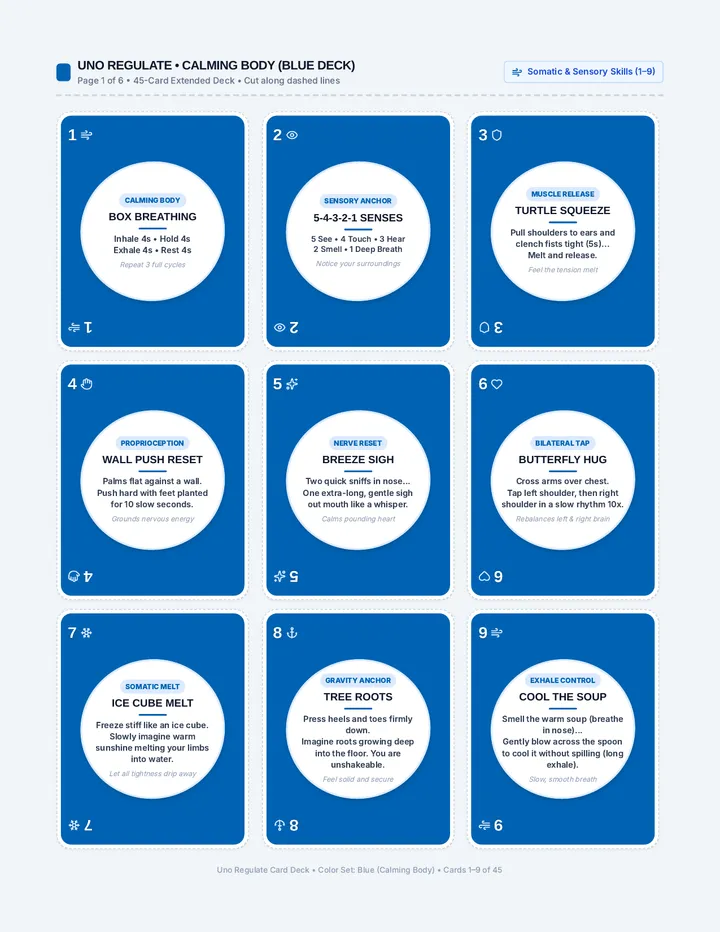
An expanded 6-page printable coping skills and self-regulation card deck styled after Uno, featuring 45 total cut-apart cards (complete 1–9 sets for all 4 color domains plus action and wild cards) and an in-depth gameplay and facilitation rulebook for classroom and small-group play.

RG

Rachel Garbutt

Connection Compass Worksheet

Connection Compass Worksheet

An ultra-accessible, low-reading-demand student counseling worksheet tailored for learners with disabilities, featuring visual icon-supported checkboxes, short direct prompts, large text, and flexible draw-or-write response areas.

JM

Jada Murray

Adulting Celebration Chart 2 Player Final Fix 2

Adulting Celebration Chart 2 Player Final Fix 2

The ultimate compact version of the Adulting Celebration Chart with ultra-reduced line spacing and minimal vertical gaps. It utilizes tiny icons, condensed font sizes, and tight leading to provide a high-density workplace tracking experience that fits multiple players and comprehensive metrics in a single printable view. It moves metric descriptions inline to save vertical space.

SM

Shelley Morgan

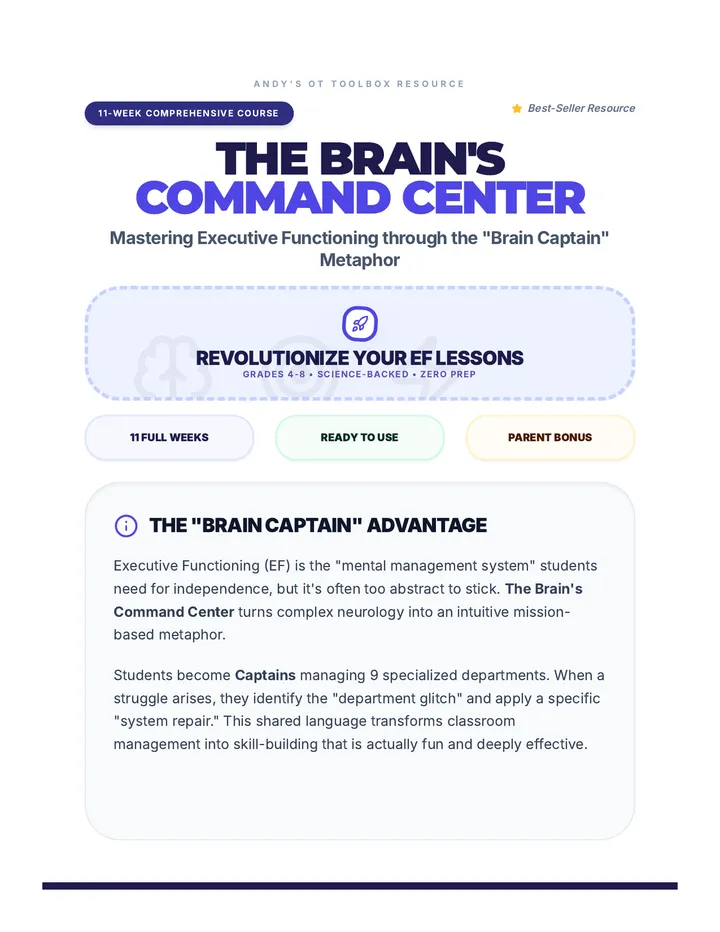
Command Center TpT Page

Command Center TpT Page

A 5-page Teachers Pay Teachers (TpT) product page for an 11-week Executive Functioning course, featuring a bold 'Command Center' theme, departmental skill highlights, parent guide mockups, and testimonials. Page 4 has been adjusted to ensure the 'missions' text is fully visible without cutoff.

AC

Andrew Casini

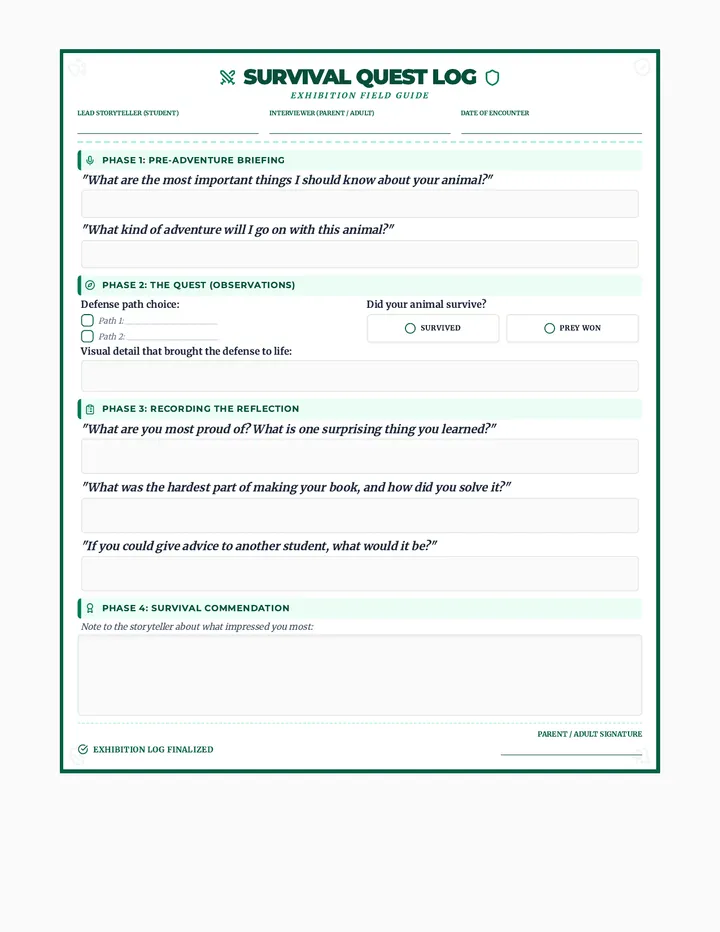
Survival Quest Final Log Form Trimmed

Survival Quest Final Log Form Trimmed

Final one-page Survival Quest parent feedback form. Optimized with a constrained 820px height and tightened vertical spacing to guarantee it fits on a single printed page while maintaining readable font sizes for the interview and reflection questions.

PM

Pam Muise

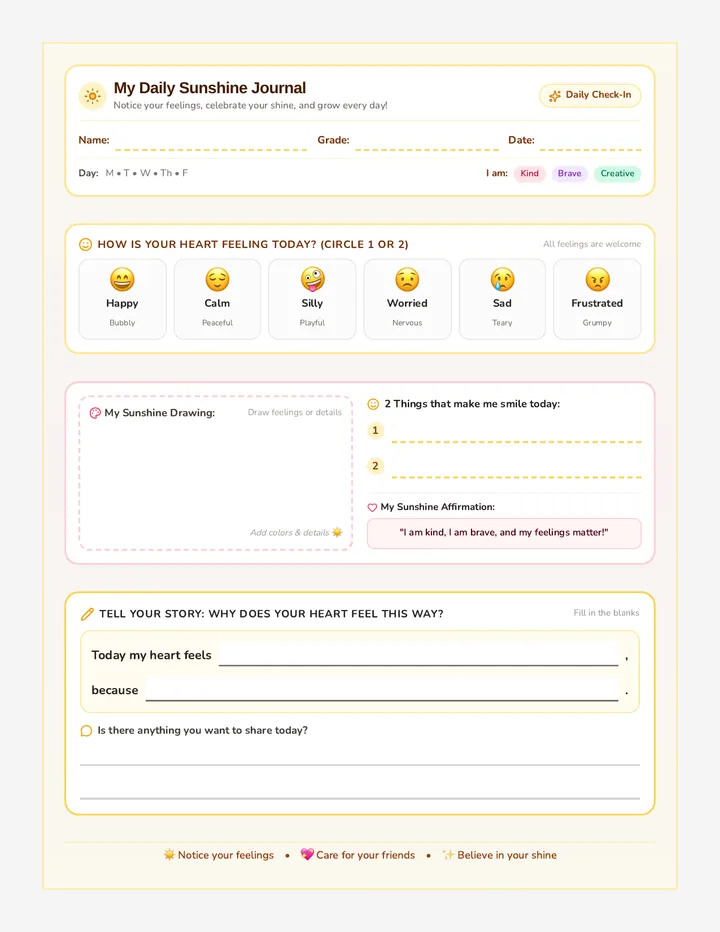
Sunshine Check In Journal

Sunshine Check In Journal

A single-page printable daily check-in journal worksheet for elementary students. It features a daily emotion selector, self-reflection drawing space, two smile spark lines, an enlarged fill-in-the-blank sentence starter, and space to share anything on their mind.

A

acrisafulli

Sequences

Orientation Key Points Visual v2

DBT Skills for Young Explorers

A comprehensive DBT skills training sequence for elementary schools, split into K-2 and 3-5 curricula. This program covers Mindfulness, Distress Tolerance, Emotion Regulation, and Interpersonal Effectiveness using age-appropriate activities and narratives.

MB

Megan Bjork

173
Freshness Slides (3) v2

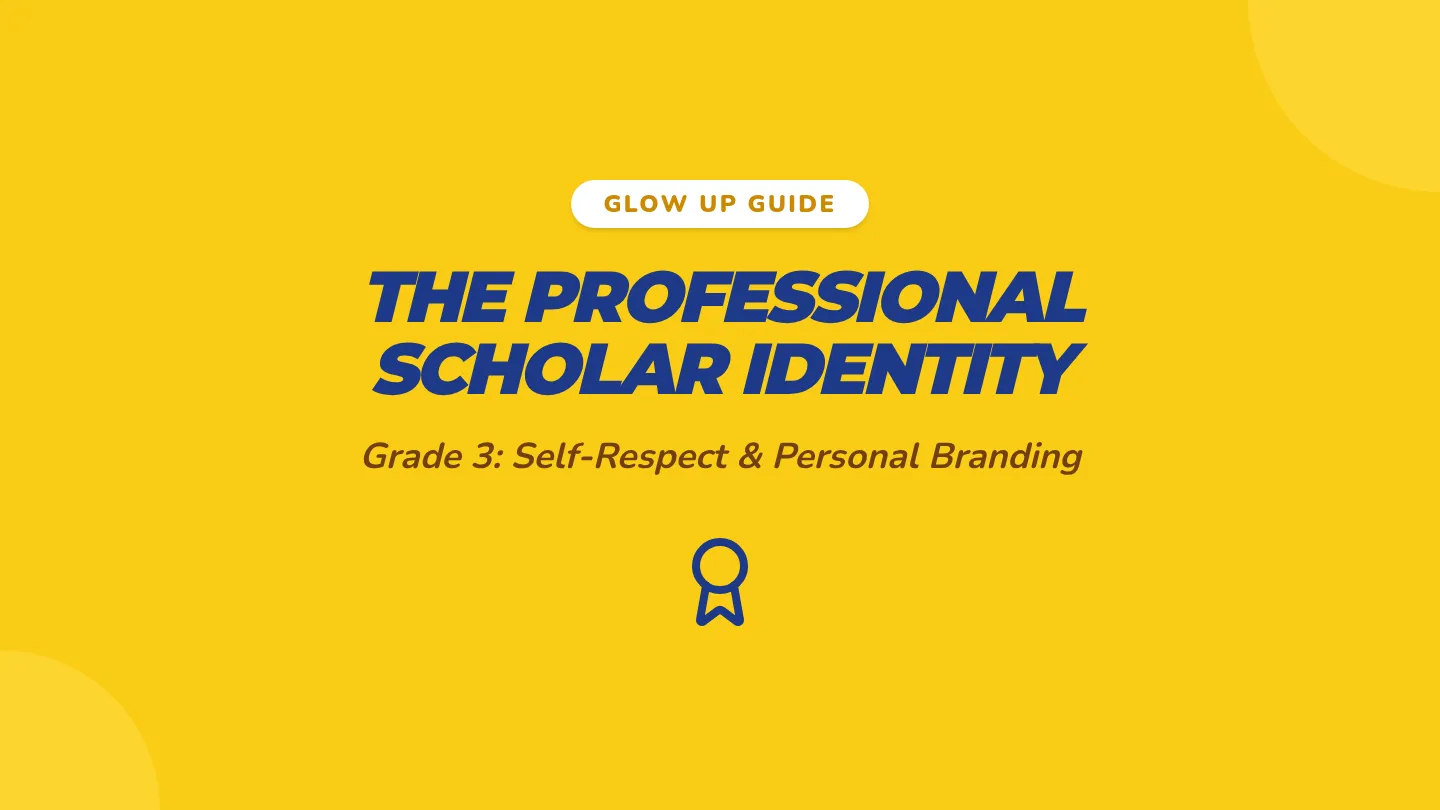
Glow Up Guide (K-4)

A comprehensive SEL-integrated hygiene curriculum for elementary scholars (K-4), focusing on self-awareness, social impact, and personal responsibility through the lens of a 'Glow Up'.

T

tkeya.void

86
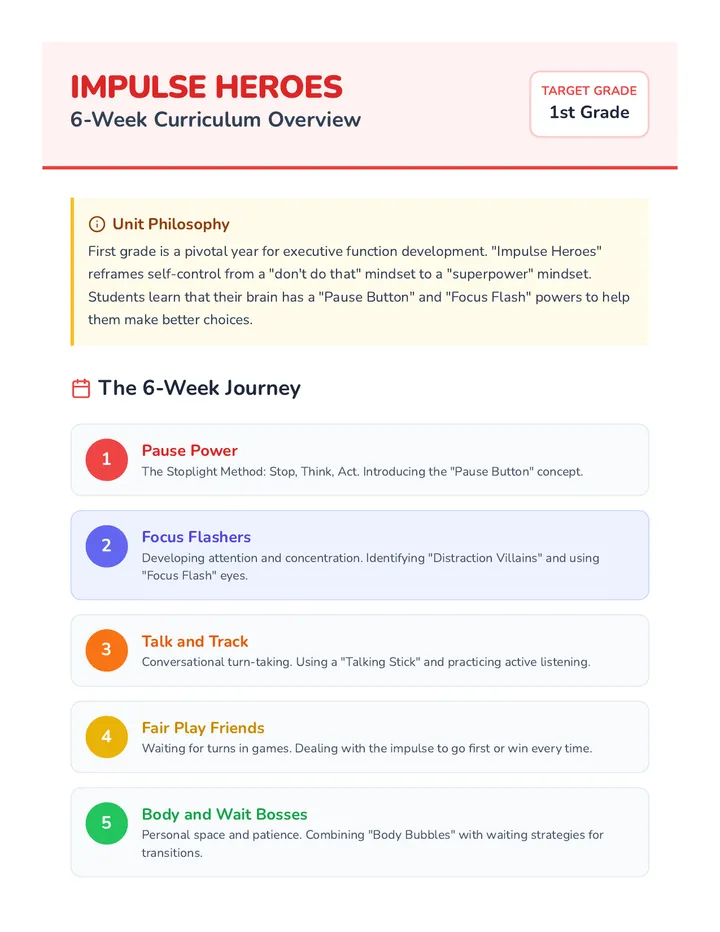
Impulse Heroes Teacher Guide

True North Identity Lab

A 6-week identity and self-esteem program for 5th graders titled 'True North: The Identity Lab.' Students explore their core values, strengths, mindset, and authentic selves through a scientific 'discovery' theme, preparing them for the social transitions of middle school.

BR

Beverly Rogers

41
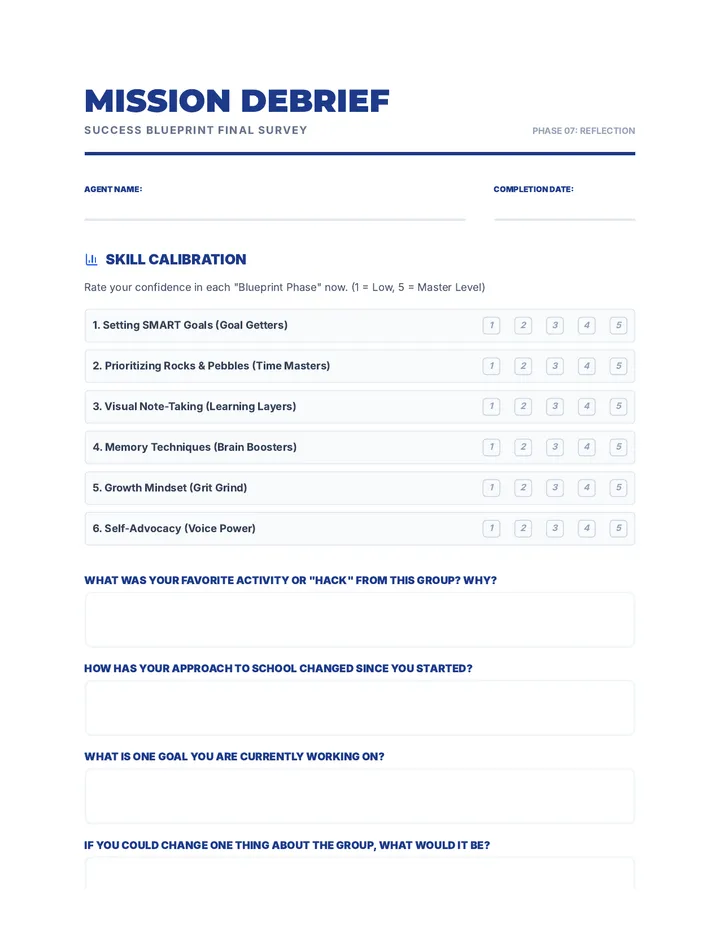
Success Blueprint Final Survey Document

Success Blueprint

A 6-session small group program designed for middle schoolers to build essential academic success habits through interactive games and hands-on activities. Topics include goal setting, time management, note-taking, study strategies, growth mindset, and self-advocacy.

AH

Amy Hill

33
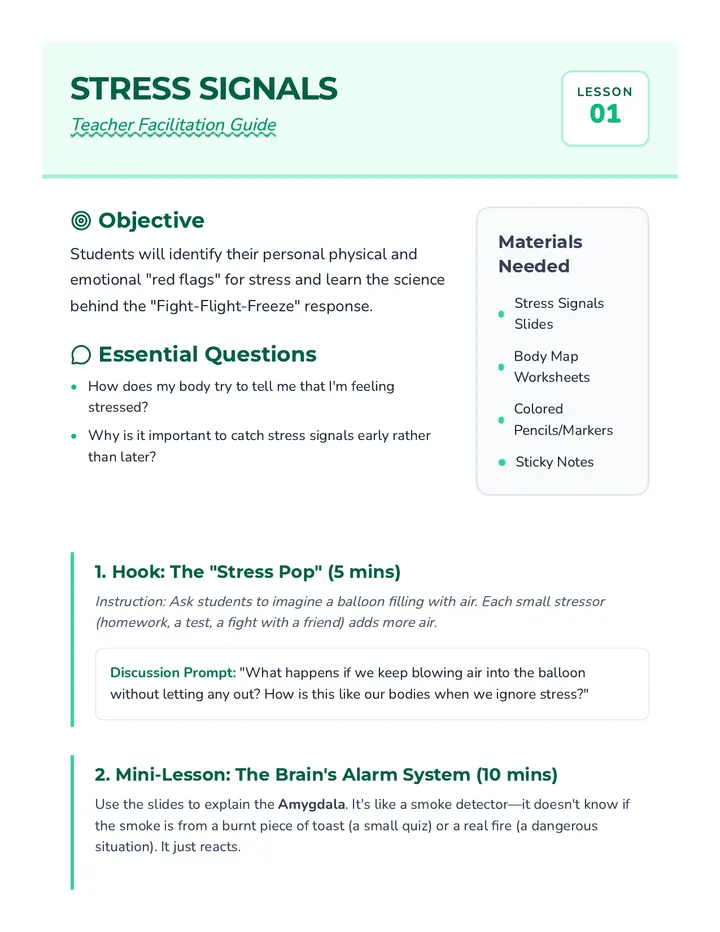
Stress Signals Teacher Guide

Mindful Masters

A 3-week comprehensive curriculum for middle schoolers focusing on identifying stress signals, developing healthy coping mechanisms, mastering positive self-talk, and building long-term resilience through interactive group activities and personal reflection.

KJ

Kayle Jordan

27
Body Scan Activity Sheet

Inner Strength Lab

A comprehensive 9-week social-emotional learning curriculum for 8th graders focusing on anxiety, self-esteem, and healthy relationships. Designed for two 2-hour sessions per week, with structured instruction on Day 1 and independent creative or research projects on Day 2.

D

dmartinez

37