Paper Trail Teacher Guide The Paper Trail
Lesson 1: Documenting Incidents • Teacher Guide
Duration 50 Min
Lesson Overview
Documentation is the foundation of any workplace rights claim. This lesson transitions students from emotional reactions to professional documentation. Students will learn how to record facts objectively to create a "paper trail" that HR or legal bodies can use to investigate harassment or discrimination.
Learning Objectives
Identify the five essential components of a workplace incident report.
Distinguish between objective facts and subjective opinions in documentation.
Draft a professional incident report based on a provided scenario.
Instructional Sequence
0-10m
The Memory Trap (Hook)
Show a quick 30-second chaotic video (or perform a pre-planned "interruption"). Immediately have students write down exactly what happened. Share answers to show how memories differ, emphasizing the need for immediate, written documentation.
10-25m
Direct Instruction: Anatomy of a Report
Use the Slide Deck to cover the 5 W's: Who, What, Where, When, and Witnesses. Discuss "Objective vs. Subjective" language (e.g., "He was mean" vs. "He used a raised voice and said [quote]").
25-40m
Workshop: Drafting the Trail
Students use the Incident Log Practice worksheet. Provide a written scenario (or video) of a workplace conflict. Students must extract the facts and draft a professional log entry.
40-50m
Closing & Reflection
Review the three most important rules of documentation: 1. Be prompt, 2. Be specific, 3. Keep a personal copy (off-site).
Pro-Tips
Quotes are Gold: Remind students to use quotation marks for direct speech. If they don't remember exactly, they should write "He said something to the effect of..."Safe Storage: Emphasize never keeping documentation exclusively on a work computer or in a work desk. It should be kept in a private personal journal or email.
Differentiation
Support: Provide a "word bank" of objective action verbs (e.g., interrupted, touched, gestured, stated).Extension: Have advanced students roleplay an HR interview where they must defend their documentation against a skeptical manager. Paper Trail Slides THE PAPER TRAIL
Mastering the Art of Workplace Documentation
Lesson 1: Documentation
The Memory Trap
Memory is unreliable under stress.
Emotions cloud facts.
Details fade after just 24 hours.
"He said / She said" is hard to prove.
Mantra for Today:
"If it isn't in writing,
The Anatomy of a Report
01
When
Date and exact time.
02
Who
People involved (and titles).
03
Where
Specific location.
04
What
The specific actions/words.
05
Witnesses
Who else saw/heard it?
The Documentation Rule
DON'T write:
"He was acting super aggressive and being really mean to me for no reason. I felt terrible."
Problem: Subjective/Emotional
DO write:
"At 2:15 PM, [Name] raised his voice and stated, 'You'll never get a promotion here.' He stood 12 inches from my face."
Strength: Objective/Verifiable
Where do I keep it?
Incident Log Worksheet Incident Documentation Log
Practice Workshop: Objective Reporting
Name:
Date:
Practice Scenario
"You are working a shift at 'The Burger Shack' on Tuesday afternoon. At 4:45 PM, your shift lead, Marcus, walks into the kitchen. He looks frustrated. He stops right in front of your coworker, Sarah, who is prepping fries. He points his finger in her face and shouts, 'You are useless! If you burn one more batch, you're out of here. I'm taking your Saturday shift away.' Sarah starts crying, and another coworker, Leo, watches from the grill. Marcus then slams the door and leaves."
Official Incident Entry
Date & Time of Incident
Location
Individuals Involved (Name & Role)
Description of Incident (Be Objective - Focus on Facts & Quotes)
Witnesses (Who else saw/heard this?)
Self-Check: Fact vs. Feeling
Review your "Description" above. Ensure you followed the professional standard.
Did you include direct quotes?
Yes
No
Did you remove emotional words like "mean" or "evil"?
Yes
No
Why is it important to use objective language instead of describing how you felt?
Reminder: Keep a copy of all incident logs in a secure, private location outside of the workplace.
HR Route Teacher Guide The HR Route
Lesson 2: Internal Reporting • Teacher Guide
Duration 50 Min
Lesson Overview
Many teen workers are unaware of what Human Resources (HR) actually does. This lesson demystifies the internal reporting process, explaining the "chain of command" and why understanding a company's hierarchy is vital for resolving issues internally before they escalate.
Learning Objectives
Define the role of Human Resources in a professional setting.
Map the reporting chain of command for different business sizes.
Determine the appropriate person to contact for various workplace issues.
Instructional Sequence
0-10m
Who's the Boss? (Hook)
Display logos of a large corporation (e.g., McDonald's) and a local mom-and-pop shop. Ask: "If a manager is harassing you at McDonald's, who do you tell? If it's at the local shop, who do you tell?" Highlight the difference in structures.
10-25m
Presentation: The HR Myth
Use the Slide Deck to discuss the dual role of HR: protecting the company AND enforcing policy. Explain that reporting to HR is a formal step that puts the company "on notice."
25-45m
Activity: Mapping the Routes
Students complete the Hierarchy Map Worksheet. They will compare a "Corporate Giant" hierarchy with a "Small Business" one and identify where a complaint goes in each scenario.
45-50m
The "Next Step" Preview
Summarize: Internal reporting is step one. But what if it fails? Tease the next lesson on retaliation and the EEOC.
The HR Reality Check
"Be honest with students: HR's job is to minimize risk for the company. However, minimizing risk often means stopping harassment. Students should view HR as a procedural necessity—you usually MUST report internally before you can take legal action externally."
Key Terms
Chain of Command: The hierarchy of reporting relationships.Policy: The written rules of the workplace.Grievance: A formal complaint. HR Route Slides THE HR ROUTE
Navigating the Internal Chain of Command
Lesson 2: Internal Reporting
What is Human Resources (HR)?
The Popular Idea
"The friendly office where you go for snacks, birthday cards, and to talk about your feelings."
The Reality
The department responsible for minimizing legal risk by ensuring the company follows labor laws and internal policies.
The Chain of Command
You (Employee)
Direct Supervisor
Manager / Owner
Human Resources
Pro Tip: If your direct supervisor IS the problem, skip them and go straight to HR or the next level up.
Why Report Internally?
Reporting puts the company "On Notice." They cannot claim they "didn't know" about the problem later.
It creates a formal record of your complaint.
Required by many courts before you can sue or file external charges.
Formal Notification
Where is HR?
The "Corporate Giant"
Has a dedicated HR department with multiple people. You can find their email in the employee portal.
Example
"Contact the regional HR advisor or use the anonymous tip line."
The "Mom & Pop Shop"
There is no "HR department." The owner or general manager handles all personnel issues.
Example
"Ask to speak privately with the owner outside of normal shift hours."
Hierarchy Map Worksheet Mapping the Chain of Command
Navigating Internal Reporting Routes
Employee Name:
Workplace ID:
Lesson 2 Workshop
Knowing who to tell is just as important as knowing what happened. Different companies have different reporting structures. Use this worksheet to map the "Internal Route" for a formal complaint.
Route A: The Corporate Giant (Large Franchise)
Regional HR Department
Store Manager
Hotline / Portal
Shift Lead
Scenario: Your Shift Lead is making inappropriate comments. Who do you report to first? Why?
Route B: The Mom & Pop Shop (Small Business)
In a small business (less than 15 people), there is often no HR department. The hierarchy is flat.
1
Owner / General Manager
2
You (The Employee)
The Dilemma:
What if the Owner is the one committing the harassment? Who do you report to internally?
Critical Decision Point
Why is it often a "rule" that you must tell the company about a problem before taking it to a lawyer or the government?
Notice Rule
Companies have a right to "fix" a problem, but only if they are officially aware it exists.
Retaliation Teacher Guide Retaliation Protections
Lesson 3: Whistleblower Rights • Teacher Guide
Duration 50 Min
Lesson Overview
Fear of losing a job or being mistreated is the #1 reason incidents go unreported. This lesson teaches students that retaliation is illegal . Students will learn to spot the subtle and overt signs of retaliation and understand the legal protections that act as a "shield" for whistleblowers.
Learning Objectives
Define retaliation in a workplace context.
Identify three common forms of illegal retaliation (firing, demotion, shift changes).
Explain the purpose of whistleblower protection laws.
Instructional Sequence
0-10m
The "Coincidence" Scenario (Hook)
Present a scenario: An employee reports harassment on Monday. On Tuesday, they are told their preferred Saturday morning shift is now a Friday night shift. Ask: "Is this a coincidence or a crime?"
10-25m
Presentation: The Shield
Use the Slide Deck to define Retaliation. Focus on the concept of "Adverse Action." Explain that it's illegal to punish an employee for participating in a protected activity (reporting).
25-45m
Workshop: Retaliation Detectives
Students work through the Retaliation Case Study Worksheet. They analyze three short stories and determine if retaliation occurred based on legal criteria.
45-50m
The "Power Balance" Check
Reiterate: Reporting is brave, but reporting with documentation (Lesson 1) is what makes the "Shield" work.
Legal Vocabulary
Adverse Action: Any action taken by an employer that would discourage a reasonable person from reporting.Protected Activity: The legal term for reporting harassment, participating in an investigation, or opposing discrimination.
Common Misconception
Students often think retaliation only means getting fired. Explain that subtle changes—like being excluded from meetings, receiving a sudden "poor" performance review, or having hours cut—are also forms of retaliation.
Retaliation Slides THE SHIELD
Whistleblower Protections & Retaliation Laws
Lesson 3: Protections
Why do 75% of victims NOT report?
Fear of Firing
"If I say something, I'll lose my paycheck."
Fear of Reputation
"I'll be seen as a 'snitch' or 'troublemaker'."
Fear of Worse
"They'll make my life miserable until I quit."
This is called RETALIATION.
Retaliation Defined
"Punishing an employee for engaging in protected activity by taking an adverse action."
Protected Activity
• Reporting harassment/discrimination
• Being a witness in an investigation
• Refusing to follow illegal orders
Adverse Action
• Firing or demoting you
• Cutting your hours/pay
• Threats or verbal abuse
Spotting the Crime
The "Overt" (Obvious)
The "Pink Slip"
You report your manager for inappropriate touching. Two hours later, you are told: "We're letting you go. It's just not working out."
CLEAR RETALIATION
The "Subtle" (Sneaky)
The "Cold Shoulder"
You report a coworker's racist jokes. Suddenly, you're left out of all team meetings and assigned to work alone in the basement every day.
STILL RETALIATION
You are Protected.
Whistleblower laws (like the Whistleblower Protection Act) make it federally illegal to retaliate.
"If the company retaliates, the penalty for them is often much larger than the original complaint."
— Legal Reality
Retaliation Case Study Worksheet Retaliation Detectives
Whistleblower Rights & Adverse Actions
Investigator:
Case File #:
L3-WPR
Legal Reference
"Retaliation occurs when an employer takes an Adverse Action against an employee for engaging in a Protected Activity ."
Case #001: The Friday Night Special
Overt?
"Alex reported their manager for making discriminatory jokes about their religion. The very next week, Alex—who has worked Saturday mornings for a year—is suddenly told they are required to work every Friday night and Saturday night shift, which Alex previously stated they could not work due to family obligations."
The Protected Activity (What did Alex do?)
The Adverse Action (What did the company do?)
Case #002: The "Surprise" Review
Subtle?
"Maya was a witness in an HR investigation regarding sexual harassment in her department. Three days after she gave her statement to HR, she received her first ever 'Unsatisfactory' performance review, claiming she 'lacks team spirit.' Her previous reviews were all 'Exceeds Expectations'."
The Protected Activity (What did Maya do?)
The Adverse Action (What did the company do?)
Verdict: The Proof Problem
In both cases above, the company will likely claim the changes were "unrelated" to the reports. Why is timing (how soon the action happens after the report) the most important piece of evidence for a retaliation claim?
EEOC Path Teacher Guide The EEOC Path
Lesson 4: External Reporting • Teacher Guide
Duration 50 Min
Lesson Overview
When an employer refuses to fix a problem or is the source of the problem, external action is required. This lesson introduces the Equal Employment Opportunity Commission (EEOC) . Students will learn how to navigate the federal reporting process, understand the timeline of a charge, and know their rights when a company fails to protect them.
Learning Objectives
Define the role of the EEOC in workplace protection.
Identify the three primary stages of an EEOC investigation.
Compare the differences between internal (HR) and external (EEOC) reporting.
Instructional Sequence
0-10m
The Intake Tour (Hook)
Open the EEOC Public Portal (demo via slides). Show the first few questions of the "Public Intake Questionnaire." This demystifies the government process and shows it's accessible to regular people.
10-25m
Presentation: Going Federal
Use the Slide Deck to explain the EEOC's power. Discuss the timeline: filing a charge, the investigation, and the "Right to Sue" letter.
25-45m
Activity: The EEOC Timeline
Students use the EEOC Filing Guide worksheet to map the steps of a federal complaint. They must identify what evidence (from Lesson 1) is needed at each stage.
45-50m
Unit Preview: The Rights Guide
Briefly introduce the final project for the next lesson. Remind students to keep their notes on documentation, HR, and the EEOC.
The 180-Day Rule
"Stress this important fact: In most states, you only have 180 days from the date of the incident to file a charge with the EEOC. If you wait too long, you lose your right to legal protection. This is why immediate documentation is key."
Common Question
"Does it cost money?" No. Filing a charge with the EEOC is free. They are a government agency meant to protect the public. Lawyers only come into play if you decide to sue after the EEOC investigation.
EEOC Slides THE EEOC PATH
Escalating to the Federal Level
Lesson 4: External Action
Why go External?
The company refuses to act on your report.
The owner is the one committing the harassment.
You have been fired in retaliation (Lesson 3).
The Escalation
"When the company fails to protect you, the government steps in."
Who is the EEOC?
Equal Employment
The right for every person to work without being judged by race, gender, religion, or disability.
Opportunity
Ensuring fair treatment in hiring, firing, pay, and promotions.
Commission
A federal agency with the power to investigate and sue companies that break the law.
The Deadline
180 DAYS
In most cases, you have exactly 6 months from the date of the incident to file a charge.
"If you miss the deadline, your legal right to file a charge is usually gone forever."
!
The EEOC Timeline
1
Intake Questionnaire & Interview
Determine if your case is covered by law.
2
Filing the Formal Charge
The company is officially notified and must respond.
3
Investigation / Mediation
EEOC looks for evidence or helps settle the dispute.
4
"Right to Sue" Letter
You receive permission to take the company to court.
EEOC Filing Guide Worksheet The EEOC Action Plan
Federal Filing & Reporting Checklist
Filer Name:
Date of Incident:
Step 1: The Evidence Box
Before you contact the EEOC, you must have your "Paper Trail" ready. Check off the items below you would need to provide.
Full names & titles of everyone involved
Names of coworkers who saw it (Witnesses)
Objective incident logs (Lesson 1)
Proof of internal reporting (Emails to HR)
Step 2: Mapping the Process
Number the following steps in the correct order (1 through 4).
EEOC Investigation
The agency interviews witnesses and reviews company records.
"Right to Sue" Letter
Permission is granted to take the case to private court if a settlement isn't reached.
Initial Interview & Questionnaire
A government official reviews your basic claim to see if it falls under their jurisdiction.
Formal Charge Filed
You sign an official document that makes the claim legal and permanent.
The Decision: HR vs. EEOC
Imagine you report a manager for harassment, and HR's response is: "He's been here 20 years, he's just like that. Try to avoid him." Why would you choose to go to the EEOC instead of just quitting your job?
The 180-Day Rule is in effect. Don't wait.
Rights Guide Project Slides THE TEEN WORKER'S GUIDE
Empowering Your Peers with Rights & Resources
Final Unit Project
The Challenge
Most teens start their first job with zero knowledge of their legal rights.
Your mission is to create a "Pocket Guide" or Digital Infographic that translates the complex laws we've learned into simple, actionable advice for a 15-year-old worker.
Design Goal
Clear.
What's in the Guide?
Section 1: Documentation
Explain the "5 W's" and how to keep a private log. Why is a paper trail better than memory?
Section 2: Reporting
Identify the Chain of Command. When do you go to HR? When do you go to the Owner?
Section 3: Protections
Define Retaliation. Let your peers know that getting fired for reporting is illegal .
Section 4: External Action
Introduce the EEOC. Include the 180-day deadline and the Public Portal link.
Rubric Highlights
Accuracy
All legal definitions and process steps are 100% correct.
Tone & Language
Written in a way that is easy for a teenager to understand (no complex jargon).
Visual Design
Organized with clear headings, icons, and a logical flow.
Protect Your Peers.
"Knowledge is the best defense."
Rights Guide Project Packet Rights Guide Project
Navigating Workplace Rights • Student Packet
Designer:
Deadline:
The Mission
Your goal is to create a "Teen Worker's Rights Guide." This resource should be something a friend starting their first job would actually read. It must consolidate everything we've learned about documentation, internal reporting, retaliation protections, and the EEOC into one clear, professional resource.
Required Sections
1. The Paper Trail (Lesson 1)
How to build a case before you ever say a word.
Define "Objective Documentation."
List the "5 W's" of a good report.
Include a tip on where to store your log (Lesson 1 Slide 5).
2. The Chain of Command (Lesson 2)
Navigating the internal routes of a business.
Identify who to tell at a large corporation vs. a small shop.
Explain what it means to put a company "On Notice."
3. The Retaliation Shield (Lesson 3)
Knowing your protections against "getting back at you."
Define "Retaliation" and "Adverse Action."
Give 3 examples of subtle retaliation (e.g., shift changes).
4. The Federal Route (Lesson 4)
Escalating to the government when internal routes fail.
Explain what the EEOC is and what they do.
State the 180-day filing deadline clearly.
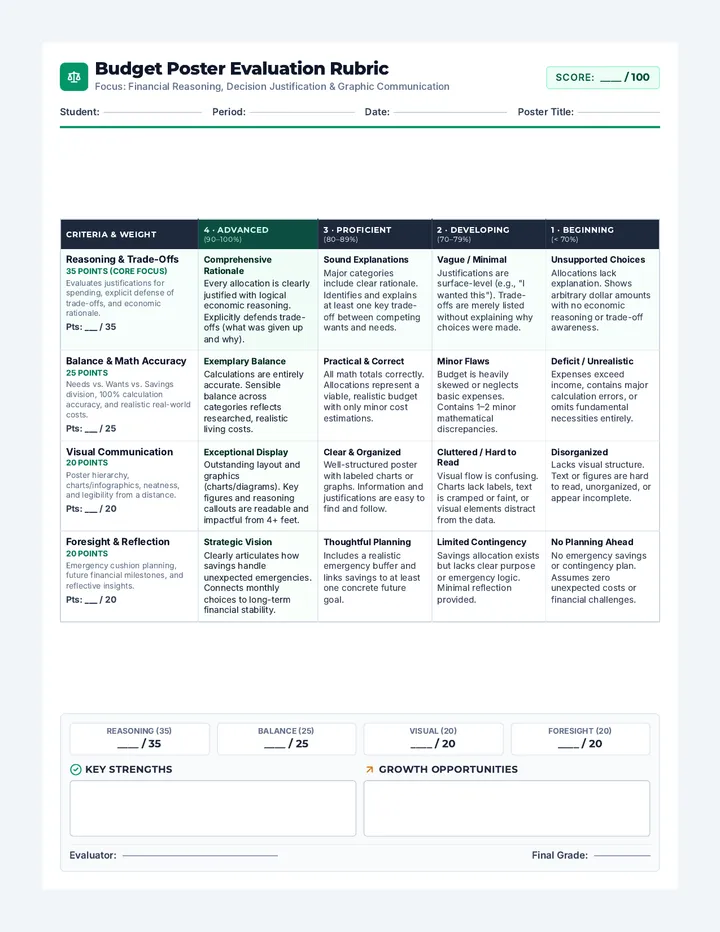
Project Rubric
Category Exceptional (10 pts) Developing (5 pts) Needs Revision (0 pts) Legal Accuracy All terms (EEOC, Retaliation, Adverse Action) are defined 100% correctly. Most terms are correct, but some definitions are vague or slightly off. Significant errors in legal definitions or process steps. Clarity & Tone Written in clear "Teen-to-Teen" language. Very easy to follow. Somewhat clear, but uses too much technical jargon or "textbook" language. Confusing or disorganized. Hard to follow. Completeness Includes all 4 required sections with multiple details for each. Missing one section or missing key details (like the 180-day rule). Missing multiple sections. Visual Impact Clean design. Uses icons/colors to highlight important warnings. Readable, but lacks visual organization or is too cluttered.