Problem Protocol Slides Wise Moves • Lesson 1
Decision Toolkit
Step-by-Step Problem Solving
The Problem Protocol
Mastering the mental shift from instant reaction to deliberate, high-impact solutions.
Target: Cool Cognition
5 Clear Action Steps
School & Social Scenarios
Cognitive Awareness
Reaction vs. Response
The 3-Second Rule
The Impulse Trap
Emotional, automatic, amygdala-driven reactions. Focusing entirely on immediate relief rather than consequence.
"I blurted it out without thinking and made things ten times worse."
The Strategic Pause
Intentional cognitive break. Engaging the prefrontal cortex to deconstruct facts, assess goals, and design choices.
"I took three deep breaths, stepped back, and examined my real options."
Key Insight: A 3-second pause shifts your brain from defensive reflex to executive control.
The Framework
The 5-Step Problem Protocol
01
Pause & Name
Define the root obstacle without assigning emotional blame.
What is really going on?
02
Map Facts
Separate verifiable facts from assumptions and rumors.
What is confirmed true?
03
Generate 3
Brainstorm at least three divergent, realistic pathways.
Never settle for just 1!
04
Test Impact
Evaluate outcomes for yourself and everyone involved.
Who is affected next?
05
Act & Check
Execute clearly and review: Did this fix the root problem?
Course-correct if needed.
Remember: The best decision is rarely the first thought that pops into your head.
Protocol In Action
Case Study: The Group Snag
Classroom Dilemma
The Situation
Your partner for a history presentation didn’t finish their designated slides. The presentation is due in 3 hours. Your initial impulse is to yell at them in the hallway or complain publicly on group chat.
Impulsive Move: Vent publicly → Broken friendship & project still incomplete.
Applying Protocol Steps
Step 1-2:
Fact: 4 slides are blank. Goal: Secure our team grade today calmly.
Step 3:
Options: (A) Quick split of remaining slides at lunch, (B) Speak with teacher proactively, (C) Deliver what is finished.
Step 4-5:
Best Call: Check in with partner directly at lunch first, then approach teacher together if emergency help is needed.
Notice how decomposing the challenge protects both the grade and the relationship.
Partner Drill
Turn & Talk: Spot Your Trigger
Prompt 1
Think of a time this week when an unexpected problem sparked an instant urge to react emotionally.
• Which step of the 5-Step Protocol would have made the biggest difference in that exact moment?
Prompt 2
Why do you think people default to only seeing one option when they feel stressed or overwhelmed?
• How can forcing yourself to find three choices change the outcome?
Next Activity: Open your Problem Solving Lab Worksheet and begin Phase 1: Guided Diagnostic.
Problem Solving Lab Worksheet Wise Moves Series • Module 01
Problem Solving Lab
The Problem Protocol
Name:
Date:
Class / Period:
The 5-Step Protocol Reference
1. PAUSE Name the obstacle calmly
2. MAP Facts vs. rumors
3. BRAINSTORM List 3 viable pathways
4. EVALUATE Forecast impacts
5. ACT Execute & review
1 Part 1: Guided Case Diagnostic
Read scenario & deconstruct
Scenario Prompt: Jordan is assigned to lead a four-person science lab presentation due Friday. Two group members have completed their research slides, but one teammate has not responded to messages, attended planning meetings, or shared any work. The presentation is worth 25% of the quarter grade. Jordan’s instinct is to confront the student angrily in front of friends at lunch.
Step 1: Define the Root Problem What is the factual challenge without emotional accusations?
Step 2: Fact vs. Assumption Filter List 2 known facts and 1 assumption Jordan might make:
Step 3: Generate Three Distinct Pathways
Option A (Direct / Peer)
Option B (Adult / Teacher Support)
Option C (Collaborative Pivot)
Wise Moves Curriculum • Problem Protocol Page 1 of 2
Wise Moves Series • Module 01
Personal Problem Blueprint
Application Lab
Task: Select an authentic school or social challenge you recently faced (or choose from the box below) and apply the complete 5-Step Protocol to formulate a deliberate plan.
Missed athletic commitment Misunderstanding over text Overbooked weekend schedule
Step 1 & 2: Problem Statement & Key Realities Be concise and objective
Step 3 & 4: Pathway Matrix (Evaluate Outcomes)
Pathway 1: Quick Fix / Avoidance What happens in the short term?
Consequence to relationships/goals:
Pathway 2: Proactive Resolution What concrete action is taken?
Consequence to relationships/goals:
Step 5: The Final Call & Reflection Loop
My chosen course of action:
How will I know this decision succeeded?
Self-Check: Protocol Readiness
Paused before answering
Identified verified facts
Evaluated long-term impacts
Wise Moves Curriculum • Problem Protocol Page 2 of 2
Risk Radar Slides Wise Moves • Lesson 2
Evaluation Lab
Weighing Options & Consequences
Risk Radar
Looking past instant temptation to forecast true costs, hidden risks, and long-term payoff.
Benefits vs. Risks
The 10/10/10 Rule
Decision Matrix
Time Horizons
The 10 / 10 / 10 Lens
Future-Pacing Tool
10 MIN
Immediate Reaction
How will you feel in the heat of the moment? Does this option just provide fast relief or instant gratification?
"Feels easy or exciting right now."
10 MOS
Mid-Term Ripple
Will this decision damage trust, grades, or opportunities down the road? What habits is it locking in?
"Where real consequences unfold."
10 YRS
Long-Term Identity
Does this choice align with the person you want to become, your values, and your core reputation?
"Shapes character and trajectory."
Golden Rule: Never trade what you want most for what you want in this exact moment.
Analytical Model
The Decision Matrix Framework
Balancing Value vs. Risk
Green Light Zone High Value • Low Risk
High upside, minimal downside. E.g., asking for help early or preparing ahead.
Action: Execute without hesitation.
Calculated Zone High Value • High Risk
Valuable opportunities requiring preparation and safety nets. E.g., tryouts or competitions.
Action: Prepare safeguards before leaping.
Neutral Zone Low Value • Low Risk
Minor everyday decisions. E.g., choosing notebook color or routine tasks.
Action: Decide quickly without overthinking.
Red Alert Zone Low Value • High Risk
Cheap temporary thrill with major fallout. E.g., cheating, skipping, or gossip.
Action: Full stop. Walk away immediately.
Core Check: Is the small temporary reward worth the absolute worst-case scenario?
Matrix In Practice
Case Study: The Sleep vs. Screen Trap
Realistic Scenario
The Dilemma
It is 11:30 PM on Thursday. You have a cumulative math final at 8:00 AM worth 30% of your semester grade. Your friends ping you to join a live online gaming tournament with a prize.
Option 1: Play until 2:30 AM.
Radar Evaluation
Option 1 Matrix:
Low Value (brief gaming fun) vs. Catastrophic Risk (failing grade, retaking course, parent trust lost).
Option 2 Matrix:
High Value (clear mind, high test score, stress-free Friday evening) vs. Zero Risk (game will be there Friday).
Clarity comes when you separate short-term FOMO from long-term peace of mind.
Takeaway Protocol
The 4 Pre-Flight Questions
1
Worst-Case Check
What is the absolute worst thing that could happen, and can I afford that price?
2
Trust Test
Would I make this exact choice if my family, coach, or mentor were watching?
3
Future Self Voice
Will my future self in 6 months thank me or resent me for this decision?
4
Reversibility Check
Is this a two-way door (easily undone) or a one-way door (permanent damage)?
Ready to Practice: Grab your Option Weighing Matrix Worksheet to score and evaluate candidate choices.
Option Weighing Matrix Worksheet Wise Moves Series • Module 02
Option Weighing Matrix
Consequence Mapping
Name:
Date:
Class / Period:
The 10 / 10 / 10 Analysis Rule Future-Pacing Filter
In 10 Minutes: Will I feel instant relief, thrill, guilt, or anxiety?
In 10 Months: Does this damage my reputation, grades, or health?
In 10 Years: Will I be proud of the character this choice built?
1 Part 1: Weighing Two Competing Paths
Evaluate benefits vs. hidden risks
Scenario Prompt: Taylor forgot to finish an English essay due tomorrow morning. A classmate texts: "Just use this online essay generator to rewrite an old paper—the teacher will never notice." Taylor considers two choices: (A) Use the generator to guarantee turning something in by 8:00 AM, or (B) Stay up to write an honest outline, email the teacher honestly before midnight, and submit what is ready.
Choice A: Use AI / Old Paper Generator
Choice B: Write Honest Outline & Email Teacher
Short-Term Benefit (Immediate):
Hidden Risk & Worst-Case Scenario:
10-Month Impact on Teacher Trust:
Short-Term Discomfort (Immediate):
Realistic Benefit & Safeguard:
10-Month Impact on Teacher Trust:
Wise Moves Curriculum • Risk Radar Page 1 of 2
Wise Moves Series • Module 02
Personal Decision Matrix
Scoring Laboratory
Instructions: Define a personal or school dilemma involving two competing options. Rate each option across the 4 key criteria using a 1–5 scale (1 = Poor/High Risk, 5 = Excellent/Low Risk). Add scores to determine the mathematically sound choice.
My Real-World Decision Question: Example: "Should I quit track to get a part-time job, or adjust my study routine?"
Weighted Evaluation Matrix (Scale: 1 = Worst • 5 = Best) Sum scores in bottom row
Evaluation Criteria
Option 1
Option 2
1. Protection of Relationships & Trust Does this keep trust with friends, teachers, and family intact?
|
| 2. Long-Term Value & Future Goals Will my future self be grateful 10 months from now? |
|
|
| 3. Manageable Stress & Realistic Effort Can I realistically follow through without overwhelming burn-out? |
|
|
| 4. Worst-Case Price Affordability Can I afford the absolute worst consequence if things go wrong? |
|
|
| Total Score (Sum of Rows 1–4): |
|
|
Final Verdict & Rationale
The winning choice:
Why this choice minimizes regret:
Wise Moves Curriculum • Risk Radar Page 2 of 2
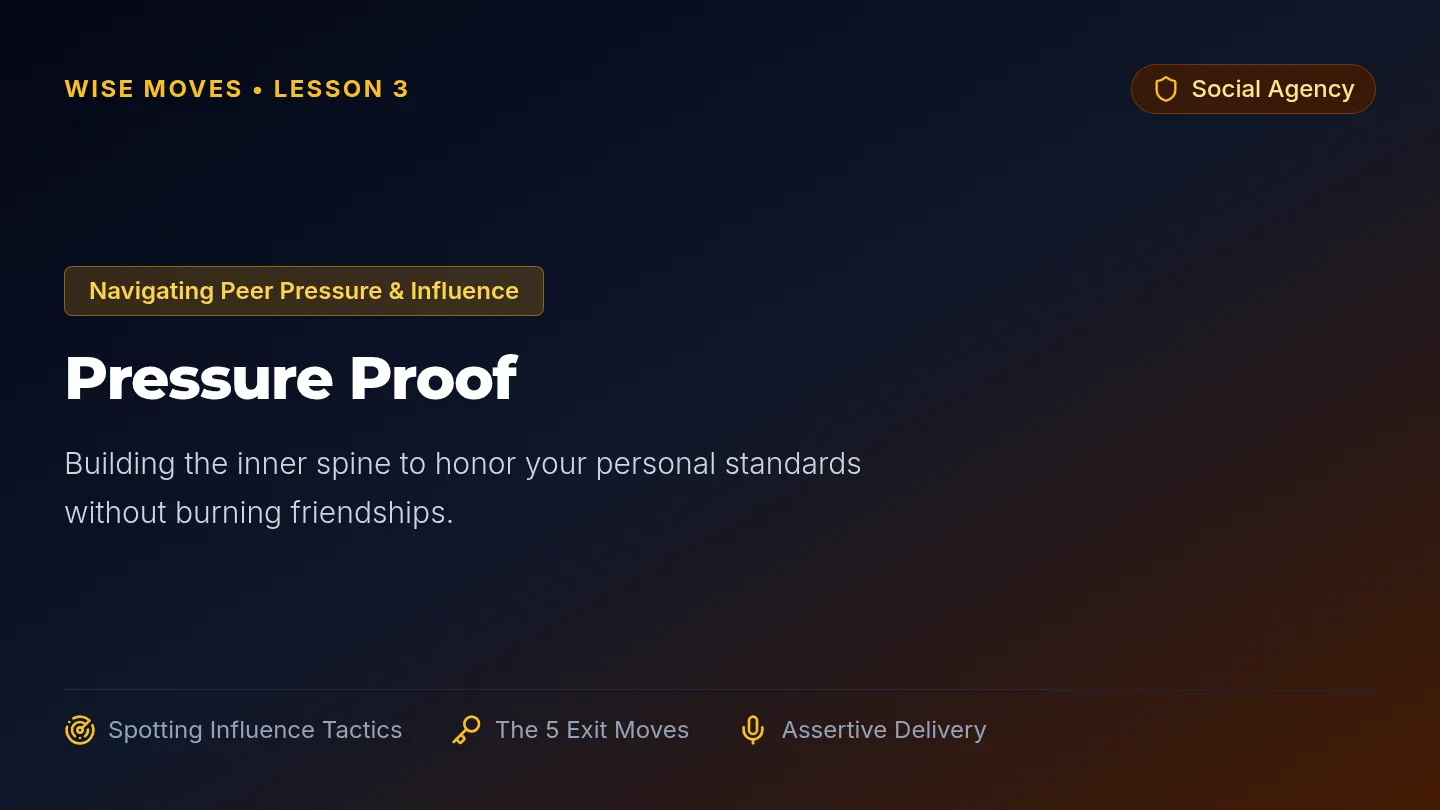
Pressure Proof Slides Wise Moves • Lesson 3
Social Agency
Navigating Peer Pressure & Influence
Pressure Proof
Building the inner spine to honor your personal standards without burning friendships.
Spotting Influence Tactics
The 5 Exit Moves
Assertive Delivery
Social Dynamics
The Pressure Spectrum
Direct vs. Subtle
Direct Pressure
Overt commands, dares, mocking, or explicit threats of social exclusion.
• "Don’t be boring, just do it!"
• "Everyone else already chipped in—are you in or out?"
Indirect Pressure
Unspoken norms, body language, fear of being left out, or feeling like you must match the room.
• Laughing at a mean joke because others laugh.
• Pretending to agree on social media to avoid conflict.
Insight: Subtle pressure is often harder to spot because nobody spoke a single threatening word.
Communication Tools
The 5 Exit Moves
Practical Refusal Scripts
01
Clear & Simple
No over-explaining or nervous apologies.
"No thanks, I'm good."
02
The Pivot
Redirect attention to a fun alternative.
"Nah, let's go grab pizza instead."
03
Own It
Use strong 'I' statements and values.
"I promised myself I’d pass this test."
04
The Delay
Buy immediate breathing room.
"I need to check my schedule first."
05
The Exit
Physically leave an escalating setting.
"Catch you guys later, I'm heading out."
Key Rule: You never owe anyone an elaborate defense for protecting your own boundaries.
Delivery & Demeanor
Tone Matters: The Assertive Sweet Spot
Delivery Check
Passive
Looking down, whispering, making excuses, or giving in reluctantly to avoid awkwardness.
Result: Signals you can be easily pushed or worn down over time.
Aggressive
Shouting, insulting, puffing up, or turning the disagreement into an all-out personal fight.
Result: Creates drama and defensiveness rather than resolution.
Assertive (Target)
Calm eye contact, steady posture, relaxed voice, and firm clarity without anger.
Result: Commands instant respect while de-escalating tension.
Body language speaks before you say a single word: shoulders back, chin level, voice calm.
Social Truth
The True Friend Test
Genuine Friends
Respect your "no" immediately without mocking, guilting, or testing your boundaries.
"They value you for who you are, not for compliance."
Conditional Friends
Only accept you when you go along with their agenda and punish you socially when you disagree.
"If a friendship requires breaking your standards, it isn't a friendship."
Handout Mission: Complete the Pressure Shield Action Handout with your roleplay partner.
Pressure Shield Action Handout Wise Moves Series • Module 03
Pressure Shield Action Plan
Refusal Strategies
Name:
Date:
Class / Period:
The 5 Exit Moves Cheat Sheet
1. SIMPLE NO "No thanks, I'm good."
2. THE PIVOT "Nah, let's grab food."
3. OWN IT "I don't mess with that."
4. THE DELAY "Let me check first."
5. THE EXIT "Heading out, catch ya."
1 Part 1: Social Pressure Tactics Decoder
Diagnose tactic & deploy Exit Move
Scenario A: The Group Chat Bait Tactic Type: Subtle / Crowd Consensus
"Everyone in our circle is kicking Marcus out of the weekend group chat and ghosting him. If you reply to him, you're looking like a traitor."
Which Exit Move fits best?
My assertive response script:
Scenario B: The Hallway Dare Tactic Type: Direct / Guilt-Trip
"Don’t be so uptight! Just pull the fire alarm prop down for five seconds for this video clip. We dare you—unless you’re scared of everything."
Which Exit Move fits best?
My assertive response script:
Wise Moves Curriculum • Pressure Proof Page 1 of 2
Wise Moves Series • Module 03
Partner Rehearsal & Standards
Simulation Lab
Protocol: Partner up. One person delivers realistic peer pressure; the other deploys an assertive Exit Move with calm eye contact and steady posture. Switch roles, then log your findings below.
Partner Drill 1: Rehearsal Log Partner Name: ______________
The Pressure Scenario Rehearsed:
Exit Move & Exact Words Used:
Peer Body Language Audit (Partner marks each):
Maintained steady eye contact
Calm, firm vocal tone
Relaxed, upright posture
My Personal Non-Negotiables Code When you decide your rules in advance, you don't have to scramble under pressure.
1. A line I will never cross, even if all my friends do it:
2. My most natural go-to Exit Move and default script:
3. One trusted friend or adult I can message if a situation turns toxic:
Wise Moves Curriculum • Pressure Proof Page 2 of 2