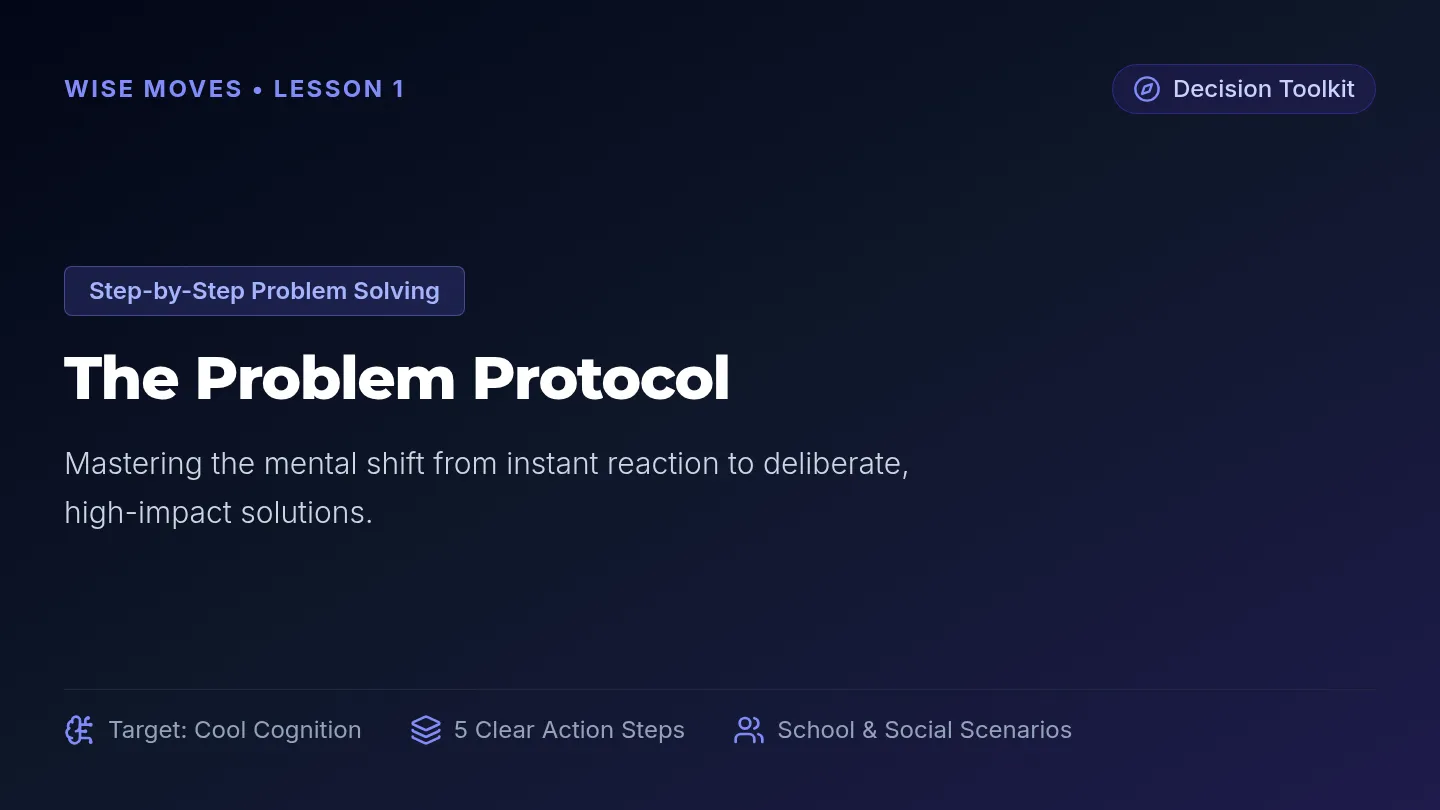
Emotion Reset Slides
Life Skills • Grade 9
Unit 5: Emotional Regulation
Managing Stress, Anger & Strong Emotions
Understanding what triggers you, keeping perspective, and mastering practical resets before reactions take over.
Spot Triggers
Center Your Body
Reframe Your Thoughts
Foundations Slide 2 of 12
What is an Emotional Trigger?
Trigger: A specific situation, person, place, or thing that provokes an immediate, intense emotional response.
Interpersonal
A sarcastic comment, feeling left out of a group chat, or being interrupted.
Pressures
Failing a quiz unexpectedly, rush before a deadline, or family expectations.
Physical State
Being exhausted, hungry, or over-caffeinated lowers your emotional fuse fast.
Key Truth: Triggers are unique to each person. What rolls off someone else might spark fury or panic in you.
Emotional Science Slide 3 of 12
The Magnification Trap
When Stress and Anger layer on top of another emotion (like disappointment or embarrassment), your brain inflates the reaction into an extreme outburst.
Why Reactions Go Nuclear
- Physical tension floods the nervous system
- Thinking narrows to "fight or flight" mode
- Substances or fatigue disable rational self-control
- Words are blurted that damage friendships and trust
Healthy Emotional Balance
- Emotional intensity matches the real situation
- Feeling is balanced with intentional thinking
- You pause to protect what actually matters long-term
- You own the feeling without becoming destructive
Discussion: Think of a time your reaction was ten times bigger than the event itself. What else was bothering you?
Core Insights Slide 4 of 12
Tips for Managing Emotions
Understanding your unique emotional landscape and what is at stake.
1
Triggers Vary by Person
Some triggers may be more challenging for others than for you.
2
You Are Emotionally Unique
You are unique in your emotions, how you feel them, and how you respond to them.
3
Management Brings Clarity
Learning to manage powerful emotions can help you think more clearly and make decisions that benefit you.
4
The Costs of Inaction
If you don’t learn how to manage your emotions, you may make decisions that hurt yourself or others, damage relationships, develop physical illnesses, and make you feel unhappy about life.
Self-awareness is the foundation of intentional self-control.
Core Insights Slide 5 of 12
Tips for Managing Emotions
Recognizing compounding hazards and defining a healthy emotional response.
5
Stress & Anger Magnify
When you experience stress and anger on top of another emotion, the original emotion is magnified and can feel more difficult to manage.
6
Substances Cloud Thinking
Alcohol and other drugs increase the odds that you won’t think clearly.
7
What a Healthy Response Looks Like
A healthy emotional response to a trigger generates the appropriate level of emotion for the situation, balances feeling with thinking, and results in decisions that help you work more effectively toward what is important for you.
Goal: Keep emotions aligned with reality so your choices protect your goals and relationships.
Technique 1: Body Reset Slide 6 of 12
The Centering Technique
Calm your nervous system before you try to solve the problem.
Step 1
Box Breathing
Inhale for 4 seconds, hold for 4 seconds, exhale slowly for 4 seconds, hold for 4 seconds.
Step 2
Physical Drop
Drop your shoulders away from your ears. Unclench your jaw, relax your hands, and loosen your stomach.
Step 3
Positive Ground
Visualize a grounded, quiet place or repeat one steadying sentence: "I am in control of my reaction."
Class Practice Drill: Feet flat on floor. Everyone take two deep box breaths together right now.
Why it works: Deep exhalations trigger the vagus nerve and downshift your biological alarm system.
Brain Tricks Slide 7 of 12
When Your Brain Plays Tricks
Under stress, your mind falls into predictable traps called Cognitive Distortions.
All-or-Nothing Thinking
"If I don't make varsity, my entire athletic career is completely over."
Catastrophizing
"I tripped during lunch; now everybody in 9th grade will mock me forever."
Mind Reading
"She didn't text back within 10 minutes, so she must secretly hate me."
Emotional Reasoning
"I feel overwhelmed and nervous, which means this test is definitely impossible."
Feelings are real, but feelings are NOT always facts!
Reframe Strategy 1 Slide 8 of 12
The Reality Check
Examine whether your reaction matches reality, not catastrophic assumptions.
Ask Yourself These 4 Hard Questions:
1
Am I using extreme words like "always", "never", or "ruined"?
2
What is realistically the absolute worst outcome that could actually happen?
3
Is there any positive angle, lesson, or opportunity hidden in this situation?
4
What is the most constructive, realistic resolution I can take today?
Example: "I bombed the chemistry quiz, my GPA is dead!" → "It was one 20-point quiz. I have three weeks to study and retake it."
Reality Check stops an emotional fire drill before you burn bridges.
Reframe Strategy 2 Slide 9 of 12
The Double Standard
Treat yourself with the exact same compassion and honesty you give your best friend.
How We Talk to Ourselves
"You messed up again. You are so useless. Everybody is laughing at you and you don't belong here."
Would you EVER say those cruel words out loud to someone you care about?
How We Talk to a Friend
"Hey, you had an off day. Everyone makes mistakes. You worked hard and you'll bounce back next time. I've got your back."
Now turn that exact script around and say it to yourself.
Rule of Thumb: If it's too cruel to say to your best friend, it is too cruel to say in your own head.
Self-talk dictates your emotional intensity. Harsh words guarantee high anger and anxiety.
Reframe Strategy 3 Slide 10 of 12
Past Experience
Your past holds hard proof that you know how to survive difficult moments.
The 4 Past Experience Questions:
1. Previous Trigger
Has a situation like this ever happened to me before?
2. Past Response
How did I handle it then? Did blowing up help or hurt?
3. The Outcome
How did it eventually resolve? Did life move forward?
4. Improved Action
What can I do right now to ensure a better result this time?
Example: "We lost before and it hurt, but working out and practicing together got us back on track."
Past Experience proves that intense discomfort is temporary—it always passes.
Visual Guide Slide 11 of 12
Quick Stress Relief Tips
Watch for practical physical and mental reset habits you can adopt right now.
Embedded media
As you watch: Notice how calming the physical body immediately creates space for rational thinking.
Your Game Plan Slide 12 of 12
The 3-Step Reset Protocol
When stress or anger hits today, run these three steps before you act:
1
Spot the Trigger
Name what happened and acknowledge the surge without acting instantly.
2
Center the Body
Take two slow box breaths. Drop your shoulders. Drop the immediate fight.
3
Reframe the Thought
Use Reality Check, Double Standard, or Past Experience to choose a smart response.
Now open your Student Worksheet and let's run our first Reframe Lab together!
LifeSkills Training • Unit 5 You are in control of your response.
Emotion Reset Worksheet
Life Skills • Unit 5
Emotion Reset Worksheet
Managing Stress, Anger, and Strong Reactions
Name:
Date: Period:
Trigger: A situation, person, place, or thing that provokes an immediate emotional response. When stress or anger gets layered on top of other feelings, small problems quickly feel like emergencies.
1
Part 1: Trigger Detective
Review the scenario below, then identify your own recent trigger. Notice the difference between the trigger and your emotional reaction.
| Situation / Trigger |
Emotions Felt |
First Impulse / Reaction |
| Model: Late to school, phone battery died, huge test today. |
Overwhelmed, frantic, irritable |
Snapping at a friend who asked for a pencil. |
| Your Example 1 (School or Social): |
|
|
|
|
|
|
| Your Example 2 (Home or Online): |
|
|
Reflection: Why do substances (alcohol, drugs, excessive caffeine) make emotional triggers worse rather than better?
2
Part 2: The Centering Drill (Body Reset)
The Centering Technique settles physical alarms (racing pulse, clenched jaw, tight chest) using deep breathing and positive imagery before you make any choice.
1. Box Breath Inhale 4s • Hold 4s • Exhale 4s • Hold 4s. Complete 2 cycles.
2. Muscle Release Drop shoulders, unclench teeth, release hands from tight fists.
3. Steadying Anchor Pick one calm thought: "I can stay in control right now."
Practice Check-In: As you completed the 2-minute centering exercise in class, what physical sensation changed in your body?
Unit 5 • Managing Stress & Anger Page 1 of 2
Cognitive Reframing
The Reframe Lab
Checking whether your thoughts match reality and choosing a better response.
Three Proven Strategies
Strategy 1
The Reality Check
Challenge drama words like "always", "never", and "ruined." Look for facts and real resolutions.
Scenario: You practiced hard for basketball tryouts, but your name wasn't on the first roster. Your automatic thought: "I'm terrible at everything. I'll never be good enough."
Reality Check Reframe: (What is realistically true? What is one constructive next step?)
Strategy 2
The Double Standard
Stop talking to yourself worse than you would ever talk to someone you love. Treat yourself like your best friend.
Scenario: You stumbled on words during an English presentation and some classmates chuckled. Your automatic thought: "I am such an idiot. Everybody thinks I'm a joke."
Double Standard Reframe: (What would you say if your closest friend was in this exact situation?)
Strategy 3
Past Experience
Remember: you have felt angry or stressed before and made it through. What worked in the past?
Scenario: You got into a heated text argument with a friend over plans on Friday night. You feel furious and want to send a spiteful message.
Past Experience Reframe: (Think of a time when cooling down worked better than reacting angrily. What can you do right now?)
My Reset Commitment: Next time I feel triggered, I will Pause & Breathe before saying or texting anything.
Unit 5 • Managing Stress & Anger Page 2 of 2
Emotion Reset Teacher Guide
Educator Facilitation Guide
Emotion Reset Teacher Guide
LifeSkills Training • Unit 5: Managing Stress, Anger & Strong Emotions (Grade 9)
50-Min Lesson
Key Learning Objectives
- Define emotional triggers and recognize physiological warning cues.
- Explain how stress and anger magnify baseline emotional responses.
- Execute the 4-4-4 centering breath to de-escalate physical tension.
- Apply three cognitive reframing tools (Reality Check, Double Standard, Past Experience) to high school scenarios.
Materials & Tech Setup
- Slides: Emotion Reset Slides (projector with audio).
- Handouts: 2-sided Emotion Reset Worksheet (1 per student).
- Supplies: Pens/pencils, sticky notes (for anonymous trigger share).
- Video: Ensure YouTube playback enabled for Slide 9.
Recommended Lesson Timeline (50 Minutes)
| Time |
Phase |
Teacher Facilitation & Key Focus |
| 00–08m |
Hook & Triggers |
Display Slides 1–2. Ask: "Why does teen emotion sometimes feel like a roller coaster?" Define trigger as situation/person/place/thing. |
| 08–18m |
The Volcano Effect |
Slides 3–4. Teach how stress + anger magnify minor issues. Lead students through the live 4-4-4 Box Breathing drill (2 full cycles). |
| 18–32m |
The Reframe Lab |
Slides 5–8. Introduce Cognitive Distortions. Model the 3 reframing tools. Students complete Worksheet Part 1 & Part 3 in pairs. |
| 32–42m |
Video & Discussion |
Slide 9. Play stress relief video clip. Facilitate debrief: "How do substances or raging blunts real problem-solving?" |
| 42–50m |
Action Pledge |
Slide 10. Students finalize worksheet commitment pledge and complete exit review. |
Core LifeSkills Discussion Prompts (Scripted)
Prompt A: On Disproportionate Reactions
"Have you ever had an intense reaction where the response was 10 times bigger than the event? What was really happening underneath?"
Prompt B: On Substances as 'Quick Fixes'
"Why do teens sometimes use substances to numb feelings? Does that solve the trigger or just create new disasters for tomorrow?"
LifeSkills Lesson 6 Facilitator Guide Page 1 of 2
Teacher Reference
Worksheet Exemplars & Guidance
Model Responses, Common Student Misconceptions, and Counselor Referrals
Answer Key
Model Student Answers (Worksheet Page 2)
1. Reality Check (Cut from basketball team):
Quality Response: "Saying 'I am terrible at everything' is an exaggeration. I didn't make the team today, but it doesn't mean I can never play. Realistic step: Ask the coach which two skills I should work on, join the city rec league, and try out again next season."
2. The Double Standard (Stumbling in speech):
Quality Response: "I'd tell my friend: 'You stumbled on one sentence, but the rest was great. Nobody cares or remembers by sixth period anyway—stop beating yourself up!' I need to say that to myself instead of calling myself an idiot."
3. Past Experience (Text argument with friend):
Quality Response: "Last time I fired off angry texts, we stayed mad for two weeks and I regretted what I typed. What works better: Put my phone across the room, go for a walk, and talk to them face-to-face tomorrow when we're both calm."
Common 9th Grade Pitfalls & Redirection Strategies
Myth: "Venting aggressively relieves anger."
Research shows screaming, punching pillows, or ranting actually rehearses and escalates neurological anger pathways. Deep breathing and cool-down pauses lower physiological arousal.
Myth: "Reframing is just toxic positivity."
Clarify that reframing is NOT pretending everything is happy. It is seeing the situation with accurate proportion and asking: "What can I realistically control right now?"
When to Refer to the School Counselor
While everyday frustration and stress are universal, watch for warning signs during private writing: persistent hopelessness ("nothing will ever get better"), signs of self-harm, severe withdrawal, or mentions of trauma at home. If a student reveals persistent overwhelming distress, quietly connect them with the counselor or support specialist after class.
LifeSkills Lesson 6 Facilitator Guide Page 2 of 2