Warning Signals Slides THE RESET PROTOCOL
SYSTEM: ONLINE
MISSION 01: HARDWARE SCAN
The Early Warning System
Learn how to catch anger and frustration in your body before your system overheats. Master your internal hardware.
6th Grade Small Group • Session 1 Intro
THE RESET PROTOCOL
GROUP ENCRYPTION
The Reset Rules
This group is our testing lab. To build a secure environment, we commit to three core parameters.
SECURITY RULE:
What is shared in the Reset Room stays in the Reset Room (except safety concerns!).
01
Real Feedback
We keep it honest but supportive. No judgment here.
02
Zero Interruptions
Every team member gets uninterrupted bandwidth to share.
03
Full Participation
We practice the codes together—no spectator mode.
Group Agreements
THE RESET PROTOCOL
BIOMETRIC DATA
The System Overload
Anger isn't just in your head—it's a high-priority physiological threat response. Millions of years ago, it helped humans survive sabertooth tigers!
Today, a difficult test or an annoying comment triggers that same emergency response. Your amygdala (brain's alarm system) hijacks your logical computer.
The Core Problem: You cannot think logically when your system is in full emergency mode.
The Stress Reflex
FIGHT MODE: Yelling, aggressive posturing, clenching jaw/fists. Ready to attack.
FLIGHT MODE: Escaping the room, tuning out, crossing arms, ignoring everyone. Ready to run.
FREEZE MODE: Staring blankly, feeling numb, head on desk, completely locked up.
Fight-Flight-Freeze Response
THE RESET PROTOCOL
DIAGNOSTIC TEST
Scanning Your Hardware
Before a system crashes, there are always physical error codes. What is your body's top indicator?
Heat Level
Hot ears, flushed cheeks, sweating, feeling warm all over.
Engine Speed
Heart racing, rapid/shallow breathing, heavy chest tightness.
Tension Points
Clenched fists, locked jaw, tense shoulders, pacing around.
Internal Static
Butterflies in stomach, headaches, dizzy, fuzzy head thinking.
Physical Warning Signs
THE RESET PROTOCOL
METER LEVEL
The Overheat Scale
Catching anger early is the key to preventing a system crash.
LVL 1
Cool
Calm, focus, normal performance. Standard operations.
LVL 2
Warm
Slight annoyance, tapping feet, sighing. minor warning.
LVL 3
Elevated
Frustrated, teeth grinding, clenching. Catch it now!
LVL 4
Critical
Yelling, throwing, heavy breathing. Logic shutting down.
LVL 5
Crash
Total overload, safety risk, completely locked out of choices.
Overheat Levels 1 to 5
THE RESET PROTOCOL
ACTIVE MISSION
IMMEDIATE ACTION REQUIRED
Hardware Blueprinting
It's time to open your lab worksheet. You will write down your custom triggers and map out exactly where the heat builds up in your body.
Goal:
Identify your personal Level 2 and 3 signals . If you can catch your anger at Level 2, you have a 90% higher chance of taking back control!
Your Lab Agenda:
Fill out your Personal Profile details
Circle your physical warning sensations
Color or shade your "Hardware Map"
Record what happens at Level 2, 3, and 4
Lesson 1 Lab Introduction
Body Scan Blueprint THE RESET PROTOCOL • MISSION 01
BODY SCAN BLUEPRINT
REF: HW-SCAN-01
Student Name:
Date:
Group Unit ID:
1. Core Temperature Scan
What physical signals does your body send when frustration starts? Check your top 3-4 primary codes :
Clenched Fists Racing Heart Hot Face / Ears Heavy Breathing Tense Shoulders Butterflies Locked Jaw Squeezing Head
2. System Triggers
What specific events or situations send your system toward overload?
Trigger 01 (Classroom):
Trigger 02 (Other Students):
3. Hardware Mapping Zone
Draw arrows or shade where tension and heat pool in your body. Put an "X" on your primary alert spot.
Tip: Red = heat. Blue = tension.
4. My Overheat Levels
Describe exactly what your brain and body are doing at each stage. What are the signals?
LEVEL 2: WARM
My early warnings (ex: foot tapping, feeling hot):
LEVEL 3: ELEVATED
Signs I am close to overload (ex: clenched jaw):
LEVEL 4: CRITICAL
What system crash looks like for me (ex: shouting):
THE RESET CURRICULUM COPYRIGHTED LAB DATA SHEET PAGE 1 OF 1
Cool Down Codes Slides THE RESET PROTOCOL
SESSION 02: ACTIVE
MISSION 02: COOL DOWN CODES
Calming the Central Processor
When your body warning signals flash, you need a safe input code to bypass the threat response. Let's learn the Cool Down Codes.
Coping Skills Small Group
THE RESET PROTOCOL
PHYSIOLOGY SCAN
Why Use a Code?
When the amygdala sounds the alarm, your breathing speeds up, and muscles tense to prepare for danger.
Cool Down Codes send a biological signal back to the brain: "We are safe." This shuts down the alarm immediately.
Brain vs. Body
The Alarm: High Heart Rate, Rapid Breaths, Shallow Air, Tension.
The Override: Deep Breathing, Muscle Release, Sensory Focus.
Biological Safety Loop
THE RESET PROTOCOL
CODE: 01-BOX-BREATH
SOMATIC REGULATION
Code 01: Box Breathing
A Navy SEAL technique to slow heart rates down instantly under high stress.
Four simple steps, four seconds each, forming a perfect calming loop.
1. INHALE 4S
2. HOLD 4S
3. EXHALE 4S
4. HOLD 4S
CALM CORE
Paced Respiratory Reset
THE RESET PROTOCOL
CODE: 02-TENSION-RELEASE
PMR METHOD
Code 02: Progressive Release
Anger traps electrical tension inside your muscle fibers. You don't even realize you are clenching!
By squeezing tightly and then releasing, we discharge that energy and force our muscles to turn soft.
1. Squeeze Tight (5s)
Squeeze your fists, pull shoulders up to your ears, grit your teeth.
2. Drop It (10s)
Let it completely loose. Feel your hands open, shoulders sink, jaw go limp.
Progressive Muscle Relaxation (PMR)
THE RESET PROTOCOL
CODE: 03-SENSORY-SCAN
Code 03: 5-4-3-2-1 Grounding
Distract an angry brain by focusing 100% on the surrounding room hardware. Take yourself out of your head.
5
SEE
Objects (ex: clock, desk, pencil)
4
TOUCH
Textures (ex: chair back, cold metal)
3
HEAR
Sounds (ex: hum of AC, chatter, birds)
2
Tactical Toolkit Worksheet THE RESET PROTOCOL • MISSION 02
TACTICAL TOOLKIT WORKSHEET
REF: TK-PRACTICE-02
Student Name:
Date:
Group Unit ID:
Code 01 Practice: Box Breathing
PACED BREATH
Practice box breathing as a group (Inhale 4s, Hold 4s, Exhale 4s, Hold 4s). After 3 complete rounds, rate how it felt in your body:
Amazing / Calmer A Little Better No Change / Hard
How did your chest or shoulders feel after breathing?
Code 02 Practice: Progressive Release
TENSION OVERRIDE
Tense your hands and shoulders like concrete for 5 seconds, then drop them loose for 10 seconds.
WHERE I SHIFTED FROM TENSE TO LOOSE:
My Hands My Shoulders My Jaw
PHYSICAL COMFORT SCORE (1 TO 5):
Loose (1)
Stiff (5)
Code 03 Practice: Sensory Grounding
SENSORY REBOOT
Scan the classroom right now. Fill out the grounding grid below to lock onto physical hardware in your environment:
5 See
Objects in sight: ______________________________________________________________
4 Touch
Textures around you: ___________________________________________________________
3 Hear
Sounds in the room: ___________________________________________________________
2 Feel / Smell
Subtle physical textures or scents: ______________________________________________
SYSTEM BYPASS CODE SELECTION
Which code felt the most calming and easiest to use in class? Commit to practicing this code!
Code 01: Box Breath Code 02: PMR Release Code 03: Grounding
THE RESET CURRICULUM COPYRIGHTED LAB DATA SHEET PAGE 1 OF 1
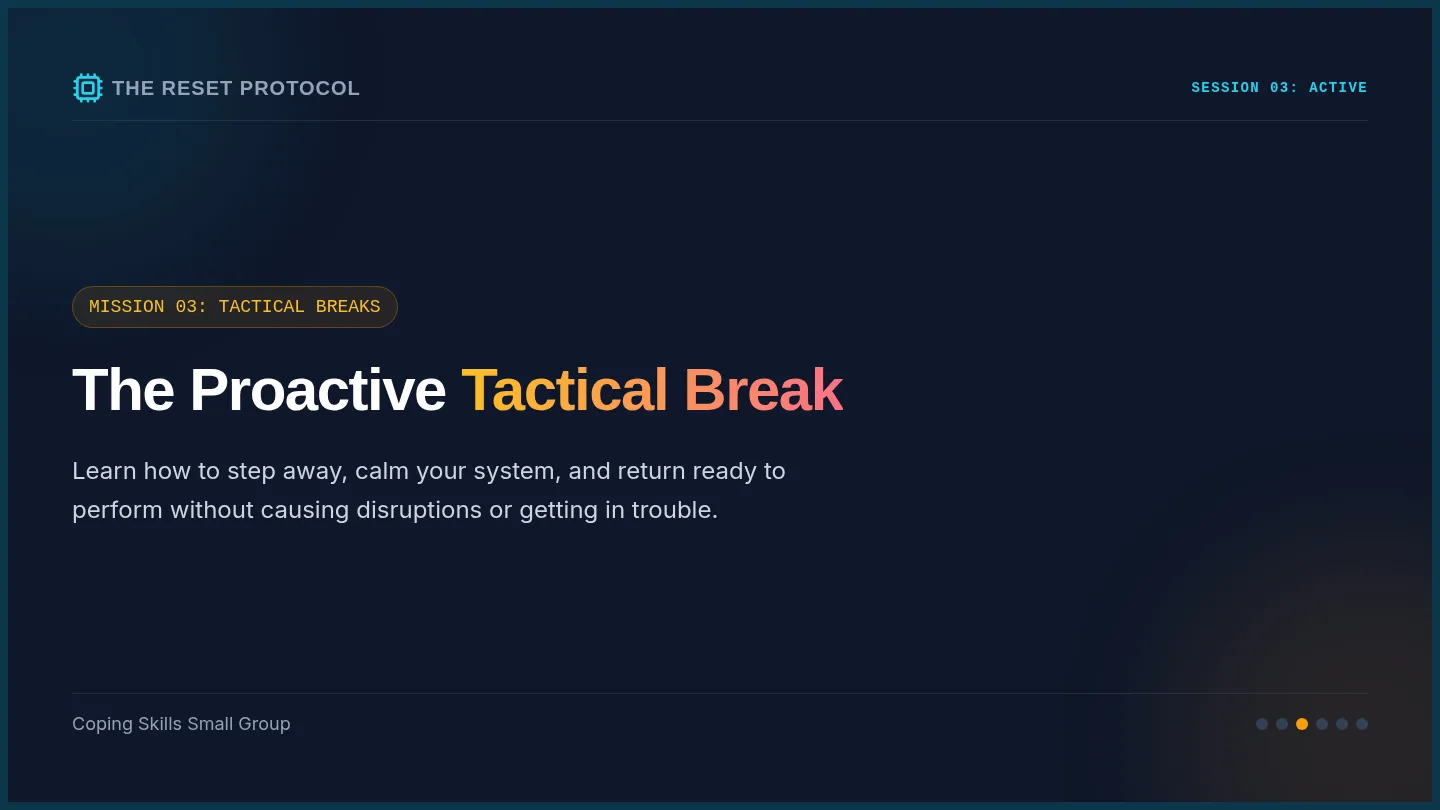
Tactical Breaks Slides THE RESET PROTOCOL
SESSION 03: ACTIVE
MISSION 03: TACTICAL BREAKS
The Proactive Tactical Break
Learn how to step away, calm your system, and return ready to perform without causing disruptions or getting in trouble.
Coping Skills Small Group
THE RESET PROTOCOL
STRATEGY ANALYSIS
Escape Mode vs. Tactical Reset
What is the difference between avoiding work and cooling down?
Avoidance (Escape)
Goal: Get out of doing classroom work entirely.
Action: Storming out, hiding, arguing, or wandering the halls.
Result: Disruption, missed learning, phone call home.
Proactive Reset (Break)
Goal: Calm physiological engine, then return.
Action: Structured 3-5 minute cool-down in a designated area.
Result: Standard operations resume, student remains in control.
Goal-Directed Resets
THE RESET PROTOCOL
SYSTEM REBOOT PROTOCOLS
The 3 Rules of the Reset Break
To ensure breaks are supported by teachers, we must stick strictly to these three standard protocol parameters.
1. Quick (3-5 min)
Set a physical timer or look at the clock. A reset takes exactly 3 to 5 minutes max.
2. Quiet (Zero Static)
No talking, no making noises, and no moving furniture. Smooth, silent operations only.
3. Purposeful (Reset)
You are there to use your Cool Down Codes (breathing, PMR, grounding), not to daydream.
Break Parameters
THE RESET PROTOCOL
TRANSMISSION ENCRYPTION
HOW TO ASK FOR A BREAK
The Break Request
Asking a teacher for a break can feel stressful. If you yell "I'm leaving!", it causes conflict.
Instead, use a silent visual break pass or a polite, low-voice script to get instant clearance.
Choose Your Method:
Visual Break Pass
Silently place your custom Break Pass card on the corner of your teacher's desk and walk quietly to the cool-down zone.
Low-Volume Script
Walk up during a pause and say: "My system is warm. I need to use my 3-minute Reset Break, then I'll be back to work."
Proactive Communication Scripts
THE RESET PROTOCOL
HARDWARE RESTORATION
Approved Break Operations
What physical sensory tasks are allowed during your 3-5 minute reset?
Break Blueprint Handout THE RESET PROTOCOL • MISSION 03
BREAK BLUEPRINT HANDOUT
REF: BRK-BLUEPRINT-03
Student Name:
Date:
Group Unit ID:
1. Low-Volume Request Script
Write down your custom verbal statement to use with teachers when requesting a 3-minute pause:
"Excuse me, Mr./Ms. ________________, my temperature is warm. I need to activate my 3-minute Reset Break, then I will return to work."
(Practice saying this in a whisper with your partner!)
2. Class Map & Rest Zones
Where is your safe cooling zone in your core classes?
MATH:
ENGLISH:
SCIENCE:
3. Approved Break Operations
Select 3 quiet sensory activities you can realistically perform during a classroom cool-down:
Drink cold water slowly Squeeze sensory ball 10 times Do 10 wall pushes/squeezes Complete 3 Box Breathing rounds Color a calming pattern silently
The Golden Parameters: Standard resets are 3-5 mins, completely quiet, and focused entirely on cooling your system.
4. Pocket-Sized Tactical Break Passes (Cut & Keep)
Decorate and cut out these passes. Keep them in your pocket, binder, or phone case. Silently place a pass on your teacher's desk to request a break.
THE RESET PROTOCOL
RESET PASS
TACTICAL BREAK AUTHORIZATION
Holder is authorized for a silent, self-regulated 3-minute reset cool-down.
Student Unit:
Counselor Auth:
THE RESET PROTOCOL
RESET PASS
TACTICAL BREAK AUTHORIZATION
Holder is authorized for a silent, self-regulated 3-minute reset cool-down.
Student Unit:
Counselor Auth:
THE RESET CURRICULUM COPYRIGHTED LAB DATA SHEET PAGE 1 OF 1
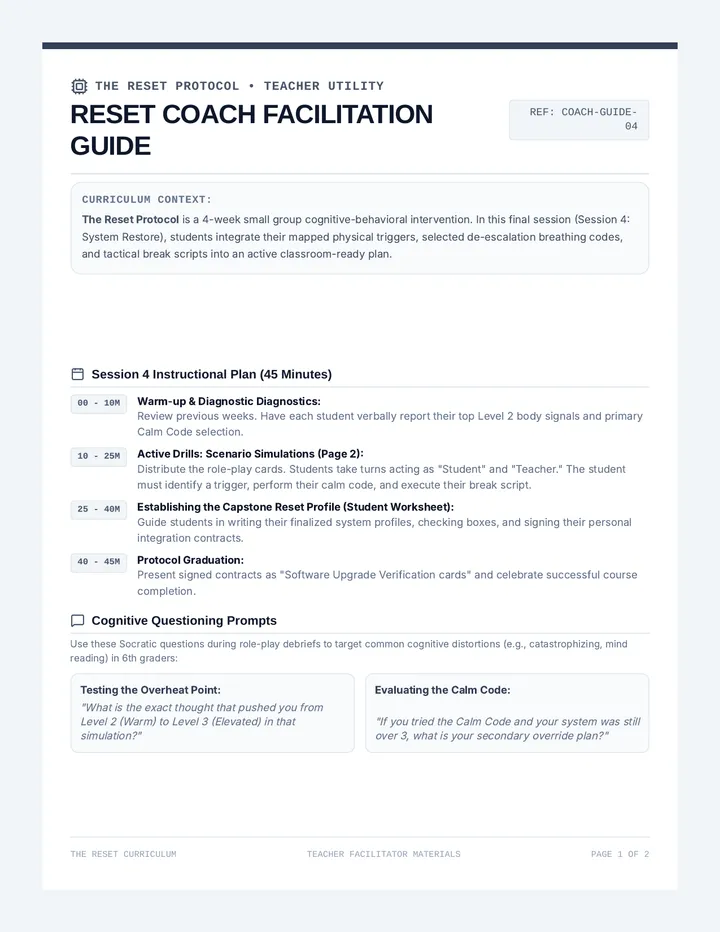
Reset Coach Teacher Guide THE RESET PROTOCOL • TEACHER UTILITY
RESET COACH FACILITATION GUIDE
REF: COACH-GUIDE-04
Curriculum Context:
The Reset Protocol is a 4-week small group cognitive-behavioral intervention. In this final session (Session 4: System Restore), students integrate their mapped physical triggers, selected de-escalation breathing codes, and tactical break scripts into an active classroom-ready plan.
Session 4 Instructional Plan (45 Minutes)
00 - 10M
Warm-up & Diagnostic Diagnostics:
Review previous weeks. Have each student verbally report their top Level 2 body signals and primary Calm Code selection.
10 - 25M
Active Drills: Scenario Simulations (Page 2):
Distribute the role-play cards. Students take turns acting as "Student" and "Teacher." The student must identify a trigger, perform their calm code, and execute their break script.
25 - 40M
Establishing the Capstone Reset Profile (Student Worksheet):
Guide students in writing their finalized system profiles, checking boxes, and signing their personal integration contracts.
40 - 45M
Protocol Graduation:
Present signed contracts as "Software Upgrade Verification cards" and celebrate successful course completion.
Cognitive Questioning Prompts
Use these Socratic questions during role-play debriefs to target common cognitive distortions (e.g., catastrophizing, mind reading) in 6th graders:
Testing the Overheat Point:
"What is the exact thought that pushed you from Level 2 (Warm) to Level 3 (Elevated) in that simulation?"
Evaluating the Calm Code:
"If you tried the Calm Code and your system was still over 3, what is your secondary override plan?"
THE RESET CURRICULUM TEACHER FACILITATOR MATERIALS PAGE 1 OF 2
THE RESET PROTOCOL • LAB DRILLS
SIMULATIONS & RUBRIC
REF: COACH-TOOLS-04
Active Simulation Cards (Cut & Distribute)
ACADEMIC
Card A: The Critical Grade
Your math test is handed back. You got a D- minus. Your classmate looks over and whispers "Ouch, tough luck."
Goal: Calm heart speed, ignore coworker's static.
PEER RELATIONS
Card B: The Closed Circle
You walk up to your usual lunch table. A classmate pulls their bag onto the empty chair and says, "Sorry, saving this."
Goal: Calm hot ears, use PMR release on fists.
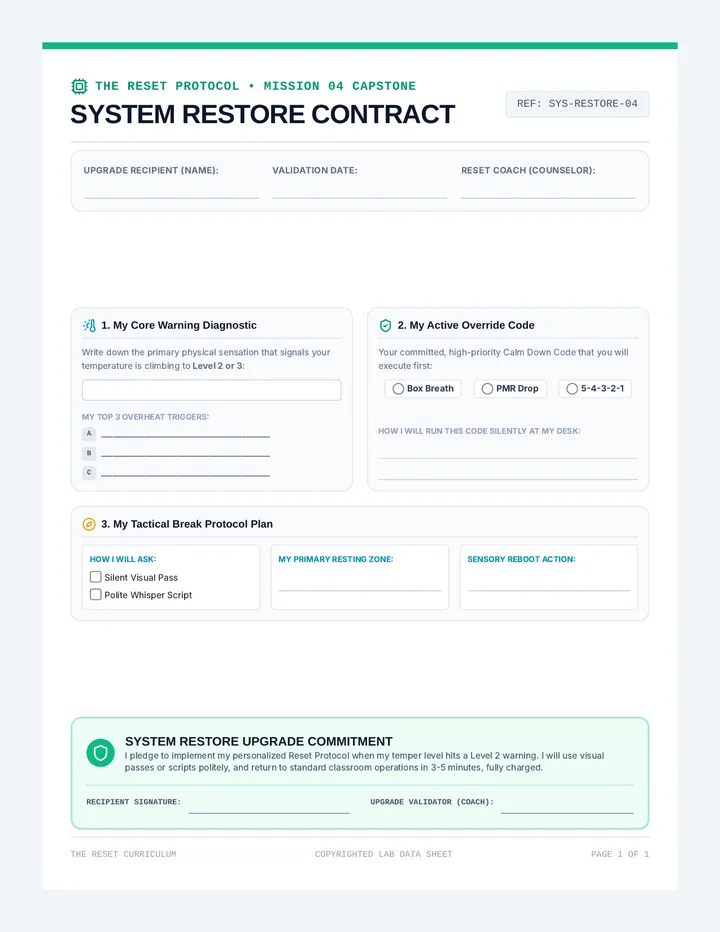
System Restore Worksheet THE RESET PROTOCOL • MISSION 04 CAPSTONE
SYSTEM RESTORE CONTRACT
REF: SYS-RESTORE-04
Upgrade Recipient (Name):
Validation Date:
Reset Coach (Counselor):
1. My Core Warning Diagnostic
Write down the primary physical sensation that signals your temperature is climbing to Level 2 or 3 :
My Top 3 Overheat Triggers:
A __________________________________________
B __________________________________________
C __________________________________________
2. My Active Override Code
Your committed, high-priority Calm Down Code that you will execute first:
Box Breath PMR Drop 5-4-3-2-1
How I will run this code silently at my desk:
3. My Tactical Break Protocol Plan
HOW I WILL ASK:
Silent Visual Pass
Polite Whisper Script
MY PRIMARY RESTING ZONE:
SENSORY REBOOT ACTION:
SYSTEM RESTORE UPGRADE COMMITMENT
I pledge to implement my personalized Reset Protocol when my temper level hits a Level 2 warning. I will use visual passes or scripts politely, and return to standard classroom operations in 3-5 minutes, fully charged.
Recipient Signature:
Upgrade Validator (Coach):
THE RESET CURRICULUM COPYRIGHTED LAB DATA SHEET PAGE 1 OF 1