Brotherhood Blueprint Curriculum Document
Project Charter Spec
System Design Manual // SEL-MS-01
BROTHERHOOD BLUEPRINT
CURRICULUM CHARTER, MANIFESTO, & SYSTEM SPECIFICATIONS
A high-fidelity, research-backed social-emotional learning curriculum designed specifically for middle school male-identifying cohorts. This system replaces outdated compliance-based behavior management with active, peer-accountable emotional architecture.
<table class="w-full text-left border border-slate-200 text-[10px] bg-slate-50/50"><tbody><tr class="border-b border-slate-200"><td class="p-2 font-bold text-slate-800 w-1/3">Target Demographic:</td><td class="p-2 text-slate-600">Middle School Boys (Grades 6-8)</td></tr><tr class="border-b border-slate-200"><td class="p-2 font-bold text-slate-800">Delivery Model:</td><td class="p-2 text-slate-600">Facilitated Circle / Active Lab</td></tr><tr><td class="p-2 font-bold text-slate-800">Unit Duration:</td><td class="p-2 text-slate-600">4 Weeks (4 Lessons + Showcase)</td></tr></tbody></table>
<table class="w-full text-left border border-slate-200 text-[10px] bg-slate-50/50"><tbody><tr class="border-b border-slate-200"><td class="p-2 font-bold text-slate-800 w-1/3">Core Focus:</td><td class="p-2 text-slate-600">Relational & Emotional Safety</td></tr><tr class="border-b border-slate-200"><td class="p-2 font-bold text-slate-800">Culmination:</td><td class="p-2 text-slate-600">Brotherhood Showcase / Mentoring</td></tr><tr><td class="p-2 font-bold text-slate-800">Compliance Code:</td><td class="p-2 text-slate-600">CASEL Alignment Domain 1-5</td></tr></tbody></table>
Executive Charter Statement
Traditional SEL curricula often fail middle school boys because they rely on passive worksheets, compliance checklists, or heavy didactic lecturing. These styles trigger boys to put up their "armor" (social performance, mockery, silent withdrawal) to protect themselves from feeling exposed in front of their peers.
The Brotherhood Blueprint shifts this paradigm. By turning social-emotional development into a technical, active drafting process—where emotional concepts are treated as "stress joints" and relationships are "load-bearing structures"—we bypass defensiveness and speak a language boys respect.
BROTHERHOOD-BLUEPRINT CURRICULUM CHARTER
COHORT: GRADES 6-8 PAGE 1 OF 11
Curriculum Manifesto
The Urgency of Relational Pedagogy
SHEET: MAN-02
Dismantling the Armored Culture
From early childhood, boys are socialized to equate masculinity with unshakeable stoicism and dominance. This creates a cultural "armor"—an invisible barrier that locks their true emotional states inside while displaying a performative exterior. At school, this armor shows up as constant roasting, defensive posturing, academic apathy, or sudden outbursts. If we simply instruct these boys to "be vulnerable," they will reject the instruction as an exposure risk. Instead, we must systematically deconstruct the armor by exploring how it is manufactured.
Peer Validation: The Currency of Change
Middle school is defined by a deep neurological focus on peer standing. Research in adolescent development shows that peer validation is the most powerful incentive for behavioral modification in boys. In the Brotherhood Blueprint, we do not position the educator as an all-knowing compliance officer. Instead, we use a peer-facilitated "Circle" structure. We turn the squad into a team of "architects" who are collectively responsible for checking each other's blueprint integrity. Peer feedback, co-signing documents, and communal codes shift the social currency from individual posturing to group loyalty.
The Paradigm Pivot
Traditional SEL says: "You need to learn how to express your feelings and act nice so you don't get suspended."
The Brotherhood Blueprint says: "We are building an unshakeable squad of leaders. We teach you how to master your own physiology, cut through media static, and construct a bulletproof Code of Honor. You aren't complying; you are designing a life of power and accountability."
BROTHERHOOD-BLUEPRINT CURRICULUM CHARTER
COHORT: GRADES 6-8 PAGE 2 OF 11
Research Foundation
The Scientific Urgency
SHEET: RES-03
1. Amygdala vs. Prefrontal Cortex Decoupling
During early adolescence (ages 11-14), the prefrontal cortex—responsible for impulse control, long-term risk assessment, and decision-making—is undergoing massive synaptic pruning and myelination. Meanwhile, the amygdala—the brain's emotional threat center—is highly reactive. For middle school boys, this mismatch often results in physical responses preceding analytical reasoning. When they perceive a threat (a peer laugh, a direct reprimand), they react immediately with aggression. Our physiological heat-mapping in Week 3 helps boys identify this "escalation engine" before the amygdala takes complete cognitive control.
2. Mirror Neurons & Social Pain Pathways
Neuroimaging studies demonstrate that social exclusion, isolation, or loss of peer standing activates the exact same physical pain pathways in the brain as a bone fracture. Middle school boys feel social anxiety as a physical assault. To avoid this pain, they adopt aggressive or completely detached personas. Our relational framework utilizes the concept of "The Crew" to leverage mirror neurons—designing activities where they physically mimic and validate each other's communications, transforming peer anxiety into peer safety.
Critical Research Benchmarks
- CASEL (2025): Systemic school outcomes indicate integrated SEL results in a 11-percentile point gain in academic success when centered on peer groups.
- Siegel, D. (Adolescent Brain Dynamics): The brain-remodeling of early teens requires relational feedback loops and high-sensory active learning, not lectures.
- Way, N. (Deep Secrets of Boys): Research proves middle school boys crave intimate, honest relationships, but systematically shut down when they hit the "armor culture" of high school.
BROTHERHOOD-BLUEPRINT CURRICULUM CHARTER
COHORT: GRADES 6-8 PAGE 3 OF 11
Pedagogical Framework
The Tactical Circle Method
SHEET: PED-04
The "What, So What, Now What" Scaffolding
Every single lesson in this curriculum follows an unyielding, high-fidelity instructional scaffold:
- THE WHAT (Hook/Setup): A heavy-hitting pop culture springboard (music track lyric, YouTube clip, movie scene) that frames the social-emotional challenge in low-risk terms.
- THE SO WHAT (Active Laboratory): An out-of-seat, highly physical experiment where students physically interact (manipulating props, standing on tape, moving in sync) to live the dynamic.
- THE NOW WHAT (Showcase Portfolio): Connecting the physical experiment directly to their written specs and sliding Plate pages into their Showcase Folder.
Active Experiment Rules
Middle school boys physically accumulate kinetic energy throughout the school day. Forcing them to sit and write about empathy backfires. Our activities require them to move, build, gesture, and speak. We capitalize on their natural competitive drives and convert them into collaborative, structural successes.
Facilitation Code: Act as "Lead Architect"
Never lecture. If you start a sentence with "You boys need to understand," you lose. Instead, start sentences with: "Let's inspect the blueprint of this scenario," or "Where is the stress cracking in this bridge?" Treat every conflict as a mechanical failure to be diagnosed and repaired rather than a personal character deficit.
BROTHERHOOD-BLUEPRINT CURRICULUM CHARTER
COHORT: GRADES 6-8 PAGE 4 OF 11
System Scope & Sequence
Curriculum Grid (Part I)
SHEET: GRID-05
| Lesson ID | Module / Title | Pop Culture Anchor | Active Lab Experiment | Portfolio spec |
|---|
| W1-L1 | Identity Unmasked (Identity) | Kendrick Lamar: "Father Time" (Vulnerability / Armor) | The Box Dilemma: Cardboard physical activity deconstructing media armor expectations. | Plate 01: The True Identity Spec |
| W2-L2 | The Crew (Relationships) | Fast & Furious / Social Media Feuds (Beef/Static) | Static Noise: Back-to-back communication barrier drawing experiment. | Plate 02: Support Network Scaffold |
Execution Parameters (Weeks 1 & 2)
The first half of the unit focusing heavily on self-concept and trust. Educators must establish absolute psychological safety, preventing student mockery of any "hidden core" revelations.
BROTHERHOOD-BLUEPRINT CURRICULUM CHARTER
COHORT: GRADES 6-8 PAGE 5 OF 11
System Scope & Sequence
Curriculum Grid (Part II)
SHEET: GRID-06
| Lesson ID | Module / Title | Pop Culture Anchor | Active Lab Experiment | Portfolio spec |
|---|
| W3-L3 | Under Pressure (Regulation) | Anime Fighting Clips / Sports Meltdowns | The Heat Map: Color-mapping anatomical stress signals on body charts. | Plate 03: The Engine Cool fire Plan |
| W4-L4 | Own the Code (Decision-Making) | Digital Footprint Drama / Callout Threads | The Consequence Draft: Physical board game tracking short & long-term fallout. | Plate 04: The Brotherhood Code of Honor |
| CULM | Brotherhood Showcase & Teach-Back | Media Reels / Community Walk | The Exhibition: Active presentation of portfolio plates & mentoring younger elementary cohorts. | FINAL SYSTEM COMPLETION CERT |
Execution Parameters (Weeks 3 & 4 + Culmination)
The second half of the unit shifts to personal accountability, emotional self-regulation under strain, and responsible choices. It culminates in the public declaration and peer co-signing of their Code of Honor.
BROTHERHOOD-BLUEPRINT CURRICULUM CHARTER
COHORT: GRADES 6-8 PAGE 6 OF 11
Unit Deep Dive Series
Week 1: Identity Unmasked
SHEET: DIVE-07
Theme & Pop-Culture Rationale
The transition into middle school forces boys to adopt an aggressive "armor" to guard against social exposure. In this lesson, we analyze Kendrick Lamar's track "Father Time" to explore generational narratives of silent suffering and emotional defenses. We use Adonis Creed's boxing legacy to illustrate physical shielding.
Step-by-Step Lab Execution
1. The Hook (10m): Play the first verse of "Father Time." Focus on his lines: "Guardin' my feelings, had to prevent it..." Ask: Where do we see this armor at our school? Who gets hurt when we wear it?
2. The Box Dilemma (20m): Lay physical cardboard boxes on the center floor. Have boys write "armor words" on the outside ("SAVAGE," "NO TEARS") and "hidden words" on the inside ("STRESS," "FEAR"). Then lead a synchronized physical step-out from the boxes.
3. Strength Alignment (15m): Direct boys to sit down with Plate 01, check their internal assets, and write down an "Internal Win Story"—a story of quiet character completely decoupled from external social clout.
Facilitator Watch-Outs
If a student writes a joke emotion on the inside of the box, do not reprimand them directly. Instead, ask the group: "Why does it feel safer to make a joke than to write something real?" Use the dynamic to prove the armor's power.
BROTHERHOOD-BLUEPRINT CURRICULUM CHARTER
COHORT: GRADES 6-8 PAGE 7 OF 11
Unit Deep Dive Series
Week 2: The Crew
SHEET: DIVE-08
Theme & Pop-Culture Rationale
Conflicts escalate rapidly in middle school because communication is filtered through digital screens, comment threads, and screenshots—creating immense "Static" in the line. We analyze viral social media "beefs" and Fast & Furious crew communication to contrast high-friction static with direct, structural "HD connection."
Step-by-Step Lab Execution
1. The Hook (10m): Discuss the anatomy of a comment war on a popular TikTok video. Map how a single misunderstood phrase leads to real-life cafeteria physical tension. Rationale: Boys realize the danger of "back-to-back" digital messages.
2. Static Noise Simulation (20m): Have student pairs stand back-to-back. Partner A must verbally coordinate drawing a blueprint geometric shape without gestures, under soft background room static. Midway, have them turn around, establish eye contact, and resolve the drawing.
3. The Conflict Scaffold (15m): Direct boys to complete Plate 02, utilizing the 3-part active "I-Statement" formula (Feeling, Trigger, Need) to script solutions to typical lunchroom roasting or group chat friction.
Facilitator Watch-Outs
During the back-to-back drawing task, pay close attention to pairs who begin blaming or shouting. Freeze the action and ask: "Is that static helping your blueprint build?" Guide them to adjust their vocal volume and coordinates.
BROTHERHOOD-BLUEPRINT CURRICULUM CHARTER
COHORT: GRADES 6-8 PAGE 8 OF 11
Unit Deep Dive Series
Week 3: Cool Fire (Regulation)
SHEET: DIVE-09
Theme & Pop-Culture Rationale
Middle school boys default to explosive anger because their physiological arousal triggers before conscious thought occurs. We analyze high-stakes fighting clips from anime (e.g., Naruto vs. Sasuke or My Hero Academia) or viral sports blowouts to dissect how high arousal causes tactical errors.
Step-by-Step Lab Execution
1. The Hook (10m): Play an explosive anime fight sequence or physical sports blowout. Direct students to watch the character's face, jaw, and breathing. Ask: When did they lose control? How did losing control lead to tactical failure?
2. The Body Heat Map (20m): Give boys red/orange colored pencils. Display an anatomical body blueprint. Have them physically color in their own personal "escalation heat zones" (tight jaw, sweating hands, racing heartbeat) representing where anger registers physically.
3. Engine Calibration (15m): Direct boys to complete Plate 03 by building a 3-step physical "Dial-Down plan" (e.g., box breathing, stepping 3 feet back, verbal reset code). This converts abstract self-regulation into a tactical spec.
Facilitator Watch-Outs
Ensure students understand that anger is not a mistake or a "bad feeling." Frame anger as raw engine heat: "Heat is great because it powers the car, but if the cooling system breaks down, the engine blows its head gasket."
BROTHERHOOD-BLUEPRINT CURRICULUM CHARTER
COHORT: GRADES 6-8 PAGE 9 OF 11
Unit Deep Dive Series
Week 4: Own the Code
SHEET: DIVE-10
Theme & Pop-Culture Rationale
Middle school boys evaluate risk poorly because their peer validation structures are hyper-active. We dissect a digital footprint "drama" where a social media posting or chat clip leads to massive long-term consequences. This anchors our core lesson on personal accountability and strategic decision-making.
Step-by-Step Lab Execution
1. The Hook (10m): Discuss a recent internet story where a content creator or famous gamer got "cancelled" or lost a sponsorship because of an unthinkingly aggressive chat leak. Rationale: Direct proof that digital choices carry permanent structural damage.
2. The Consequence Draft (20m): Play an interactive physical board game mapped on desks. Teams must navigate real scenarios (e.g., getting a leaked video, being dared to jump from a high ledge) and physically slide markers across short-term peer points vs. long-term structural points.
3. Code Construction (15m): Direct boys to complete Plate 04: The Brotherhood Code of Honor. Each student commits to 3 personal integrity specs (e.g., 'Will never share a screenshot of a homie without asking').
Facilitator Watch-Outs
When drafting codes of honor, prevent boys from writing generic, compliance rules ("Keep quiet in class"). Ensure they draft rules they physically control: "Keep my word when I tell a squad member I got them," or "Check in face-to-face if a text feels hostile."
BROTHERHOOD-BLUEPRINT CURRICULUM CHARTER
COHORT: GRADES 6-8 PAGE 10 OF 11
Culminating Action Track
Module 5: The Teach-Back Spec
SHEET: SHOW-11
Service Learning & Leadership Integration
Emotional courage becomes real when it is shared. Rather than ending the curriculum with a simple folders review, students must step into leadership. The Brotherhood Showcase includes a powerful Service Learning attribute: our middle school squad hosts a "Mentorship Circle" for incoming 4th or 5th-grade elementary boys.
The Mentorship Circle Event Sequence
- Introduction: Middle school leaders sit face-to-face with elementary boys, sharing their Plate 01: "The Tough Guy Box" and discussing how they stepped out.
- The I-Statement Scaffold Share: Leaders demonstrate a mock dispute on a playground, showing how they resolved it using active blueprint stress-joints, then assist the younger boys in practicing.
- The Portfolio Gifting: The middle school boys present a co-signed "Junior Blueprint Card" to the elementary students, inviting them into the support circle.
Final Completion Rationale
By acting as teachers and mentors, our middle school squad realizes that their learned SEL skills are not just behaviors to keep them out of suspension—they are real-life blueprints for leadership, power, and team solidarity. They leave the curriculum not as compliant subjects, but as the architects of their school culture.
BROTHERHOOD-BLUEPRINT CURRICULUM CHARTER
COHORT: GRADES 6-8 PAGE 11 OF 11
Identity Unmasked Worksheet
Student Name (Lead Architect):
Project Date:
Squad No:
Blueprints & Foundations // Lab Booklet 1
Identity Unmasked Workbook
W1_BOOKLET
The Showcase Portfolio Track
Welcome to the Brotherhood Blueprint. Over the next four weeks, you are drafting the architectural plans of your future self. This workbook forms Plate 01 of your Showcase Folder. You will exhibit these templates at our culminating Showcase event.
A
The Music Lab: Lyric Deconstruction
In Kendrick Lamar's track "Father Time," he raps about keeping his guards up to survive. Read his lyric reflection:
"I come from a generation of homeboys... Daddy issues made me competitive, more aggressive / Guardin' my feelings, had to prevent it..."
Your Turn: Write down a song title, movie, or social media video you've seen recently where a guy puts up an aggressive "armor" to protect his feelings, and explain why.
COHORT CORE: IDENTITY UNMASKED
WORKSHEET ID: W1_ACT_01 PAGE 1 OF 4
System Specification Section
Plate 01: The Armor Map
SHEET NO: 1-02
B
Mapping The Masculine "Tough Guy Box"
During our out-of-seat activity, we discussed the "Box" society builds for boys. Transfer those shared concepts onto your individual architectural specification below.
The Hidden Core
What are 3 things guys feel on the inside (stress, loneliness, self-doubt) but hide so they don't look weak?
The Armored Shell
What are 3 expectations society shouts at guys on YouTube, TikTok, or at school (don't cry, show aggression, win)?
Armored Shell Reflection
How much mental energy does it take to wear that armored shell every day at school? What does it prevent you from doing with your true crew?
COHORT CORE: IDENTITY UNMASKED
WORKSHEET ID: W1_ACT_01 PAGE 2 OF 4
System Specification Section
Plate 02: Character Assets
SHEET NO: 1-03
C
Selecting My True Assets
Real, structural strength is internal. Check 3-4 character strengths that represent your true internal core blueprint below.
LOYALTY INTEGRITY HUMILITY RESILIENCE EMPATHY CREATIVITY LEADERSHIP BRAVERY
The Internal Win Specification
An "internal win" is a time you chose to do the right thing or support a squad member, completely separate from sports, grades, or likes on TikTok. Write down your custom Win Spec:
Identity Unmasked Educator Plan
EDUCATOR BLUEPRINT SECTION
Lesson 1: Identity Unmasked
THEME FOCUS: MASULINITY, SELF-WORTH, & POP-CULTURE ARMORED MYTHS
SPEC NO: T-PLAN-01
DURATION: 45-50 MIN
FORMAT: IN-PERSON / CIRCLE
CULMINATION: PORTFOLIO TRACK
SQUAD LEVEL: GRADES 6-8
Instructional Objectives
- Deconstruct: Analyze societal expectations of "tough-guy armor" using hip-hop & film clips.
- Identify: Name and sort 3-5 core personal values and internal character strengths.
- Synthesize: Initiate the "Brotherhood Showcase" portfolio by framing their true internal blueprint.
Materials & Media Specs
- AV Setup (Music/YouTube Player)
- Identity Unmasked Student Handouts
- Cardboard boxes or large masking tape
Pop-Culture Springboards (Engagement Catalysts)
Track Spotlight: "Father Time" – Kendrick Lamar
Focus on Kendrick's lyrics deconstructing "tough-love" emotional shields ("real men don't cry") and the generational expectations placed on boys.
Film Scene: Creed (Adonis vs. His Legacy)
Focus on the clip of Adonis boxing his own shadow on screen, exploring how we put up aggressive physical shields to hide deep internal vulnerability.
1 Phase 1: The Launch – "Tuning the Radio" (10 Minutes)
The "What" Scaffold: Start the lesson with a high-energy music hook. Play a clean snippet of Kendrick Lamar's "Father Time" or a popular movie clip. Direct students to listen specifically to the references of hiding pain.
EDUCATOR VERBATIM SCRIPT:
"Fellas, welcome to the Brotherhood Circle. Turn down the background noise for a minute. That track we just heard by Kendrick Lamar talks about the mental walls we build. He says, 'Daddy issues made me competitive, more aggressive.' That's his armor. In sports, movies, and social media, we see guys on screen acting like they've got zero feelings—just tough, angry, or constantly flexin'. But we know on the inside, there's a whole blueprint they aren't showing. Today, we're cutting through the static to map who you actually are under that performance."
Relational Bridge:
Since this is Lesson 1, establish the circle's parameters: confidentiality, zero mockery, and true peer support.
Kinesthetic Transition:
Have all students stand up, stretch their arms, shake off the physical "armor," and move to the cardboard boxes.
BROTHERHOOD BLUEPRINT UNIT PLAN
COHORT: MIDDLE SCHOOL SEL PAGE 1 OF 4
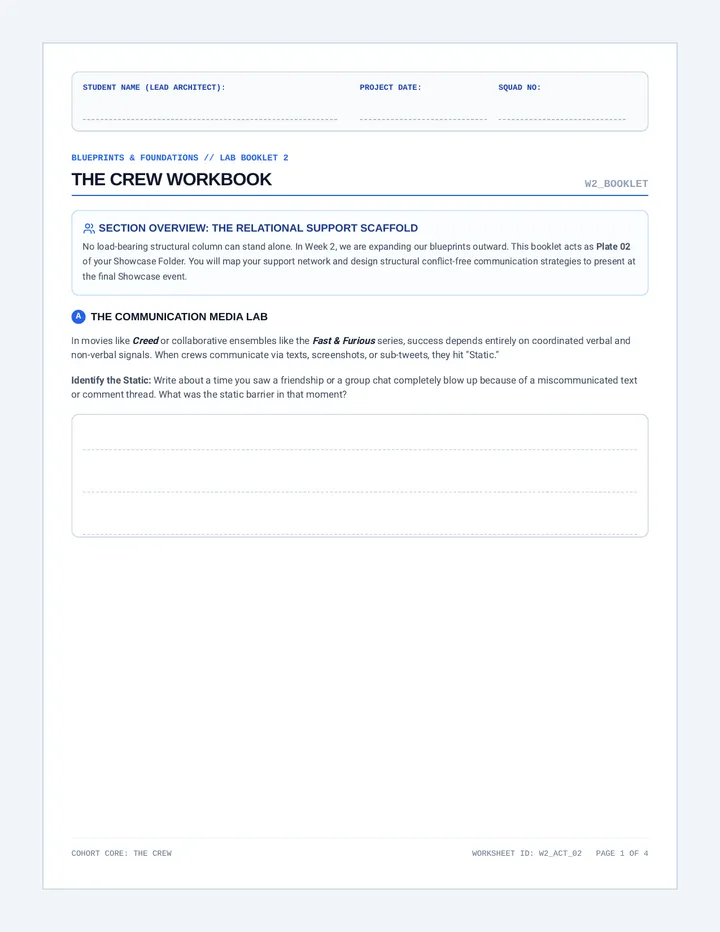
The Crew Worksheet
Student Name (Lead Architect):
Project Date:
Squad No:
Blueprints & Foundations // Lab Booklet 2
The Crew Workbook
W2_BOOKLET
Section Overview: The Relational Support Scaffold
No load-bearing structural column can stand alone. In Week 2, we are expanding our blueprints outward. This booklet acts as Plate 02 of your Showcase Folder. You will map your support network and design structural conflict-free communication strategies to present at the final Showcase event.
A
The Communication Media Lab
In movies like Creed or collaborative ensembles like the Fast & Furious series, success depends entirely on coordinated verbal and non-verbal signals. When crews communicate via texts, screenshots, or sub-tweets, they hit "Static."
Identify the Static: Write about a time you saw a friendship or a group chat completely blow up because of a miscommunicated text or comment thread. What was the static barrier in that moment?
COHORT CORE: THE CREW
WORKSHEET ID: W2_ACT_02 PAGE 1 OF 4
System Specification Section
Plate 01: Tuning the Frequency
SHEET NO: 2-02
B
Static Barriers vs. HD Connect Signals
During our back-to-back transmission activity, we felt how hard it is to listen and guide without eye contact. Contrast the two signal profiles below.
The Static Barriers
What are 3 things we do that shut down listening (e.g., looking at phones, interrupting, planning defensive comebacks)?
The HD Connect Signals
What are 3 active listening actions you can make to show your partner their signal is clear (mirroring, clarifying questions)?
Tuning My Personal Signal
Which of the Static Barriers do you personally catch yourself doing most often during school hallway conversations? How can you actively switch to HD?
COHORT CORE: THE CREW
WORKSHEET ID: W2_ACT_02 PAGE 2 OF 4
System Specification Section
Plate 02: Conflict Scaffold
SHEET NO: 2-03
C
The Three-Part Stress Joints
Bridges are built with expander joints to handle the thermal expansion stress. Apply our three-part conflict scaffold formula below to prevent structural failure during stress.
Stage 1: FEELING
"I feel [Emotion]..."
Stage 2: EVENT
"...when [Trigger]..."
Stage 3: NEED
"...because I need [Support]."
Scenario A: Your friend roasts you at lunch and the table laughs.