A modular social-emotional learning series designed for middle schoolers (grades 6-8). Integrates visual architectural blueprints to help students construct safety networks, master self-management systems, and navigate campus life.
How can you request a conversation using the "Signal" step?
What is a respectful way to advocate for your work?
Cut
Card 6 • Reflection Self-Awareness
Trust Superpowers
Everyone looks for different qualities in a trusted ally. Some people prefer someone who is extremely quiet and private, while others prefer someone who is action-oriented and will solve problems quickly.
Reflection Prompts
Which quality matters most to you in an adult? Why?
Who on campus matches that quality?
Cut
Card 7 • Scenario High Stress
The Classroom Escape
You are sitting in English class, and you suddenly feel a wave of intense panic. Your heart is racing, you feel like you might cry, and you need to get out of the room right away.
Reflection Prompts
What is the standard procedure to leave your room safely?
Which safe space on campus would you head to?
Cut
Card 8 • Challenge Design
Design the Super-Advocate
Imagine you could design the ultimate, perfect supportive school staff member from scratch. They have unlimited resources, absolute patience, and their own room.
Design Prompts
What does their office look/smell like? (Snacks? Music?)
What is the first thing they say to students who walk in?
CAMPUS SUPPORT SQUAD • DISCUSSION CARDS PAGE 2 OF 2
Attendance Deep Dive: Use their live portal data. Calculate missing assignments and map how many could be salvaged by simply attending two consecutive weeks.
Accountability Wave: Set up a morning "check-in" ritual where the student walks past your office and grabs a motivational cue card to start the day.
Small Group Circle
Habit Tag-Team: Have pairs review each other's "Reward Systems" in the workbook to ensure the rewards are practical and healthy.
Discussion Card Scenarios: Use the "Habit Builder Cards" to debate situational challenges like what to do when your phone is distracting you.
Group Contract: Create an advisory-wide "Consistency Pact" where students commit to a shared presence or prep target for the week.
Troubleshooting Obstacles
The "Perfect Day" Trap: Student writes unrealistic, hyper-demanding routine blueprints
Intervention: Address the tendency to over-schedule. Emphasize that "micro-habits" are the building blocks. Instruct them to cut their plan in half: if they planned to study for 2 hours daily, scale it back to "15 minutes of quiet reading immediately after school."
Chronic Absenteeism Resistance: Student sees no value in attending classes they dislike
Intervention: Frame attendance through a social and financial lens rather than grades. Share that high attendance maps directly to greater connection, while missing just two days a month drops core comprehension by 30%. Show how presence makes their own life less stressful.
Accountability Debrief Challenge
To leave the students with a sense of personal responsibility, execute this wrap-up reflection circle:
"We have constructed our Habit Blueprints. Look at your chosen reward. This week, you are the supervisor of your own structure. If you complete your habit for 3 consecutive days, you unlock your reward. Who is willing to share their reward to inspire others?"
HABIT BUILDER BLUEPRINT • GRADES 6-8 PAGE 2 OF 2
Reflection Prompts
How does persistent tardiness impact your daily class comfort?
What routine change keeps you on time while remaining friendly?
Cut
Card 6 • Reflection Incentives
Calibrating Rewards
A sustainable reward must be immediate, healthy, and easy to access. Setting a reward that is too slow or too expensive (like buying a premium digital game) breaks the routine-building loop.
Reflection Prompts
Brainstorm 3 healthy, instant rewards that cost zero dollars.
Why are immediate benefits more effective than distant rewards?
Cut
Card 7 • Scenario Logistics
The Missing Assignment
You stay up late to finish a history sheet. But when you sit down in class, you find your backpack is in absolute chaos. You can see scrap paper, snacks, and empty wrappers, but your history sheet is missing.
Reflection Prompts
Where did the "organizational routine" collapse here?
What simple evening habit loop would prevent backpack chaos?
Cut
Card 8 • Challenge Action
The Habit Stack Setup
Habit Stacking anchors a new desired action to an already bulletproof routine. Example formula: "Immediately after I brush my teeth at night (Anchor), I will plug my computer charger into the wall (New Habit)."
Action Task
Draft your own custom Habit Stack blueprint formula.
Present your Habit Stack to your partner/circle for feedback.
HABIT BUILDER BLUEPRINT • DISCUSSION CARDS PAGE 2 OF 2
Review Digital Logs: (With consent) Walk through a mock text/group-chat interface. Point out "boundary leaks" (e.g., gossiping, oversharing, screen-sharing) and construct exit scripts.
Bystander Check: If the student has struggled with passive compliance, review safe ways to exit or get adult support during high-risk peer pressure situations.
Small Group Circle
The Pressure Cooker: Pair students and hand them a "Boundary Card." One student plays the pressurer (with a mild, non-aggressive push), and the other practices the "Shield Script."
Whiteboard Heat-Map: Ask the group to rate common peer situations (e.g. sharing school work, leaving group chats) from 1 to 5 based on how hard they are.
Accountability Pledge: Establish a group norm that boundaries will be supported, not ridiculed. Have each student share one boundary they expect others to respect.
Troubleshooting Obstacles
The "Snitching" Label: Students fear that setting boundaries or seeking help is "uncool"
Intervention: Reframe the distinction between snitching (seeking to get someone in trouble for personal gain) vs. seeking support (protecting physical/emotional safety). Emphasize that "The Shield Script" is designed to be asserted directly to peers without involving an adult unless safety thresholds are breached.
Passive Compliance: Student nods along and doesn't want to roleplay the assert stage
Intervention: Don't force public compliance. In small groups, allow the student to start by scripting written text exits first (e.g., what to type in a text thread) before asking them to perform verbal roleplay. Focus on "low-friction" exits like the Pivot step.
The Respect Commitment Circle
Use this closing prompt to solidifying commitment back into general school spaces:
"We have mapped our personal social structures. This week, if you witness a classmate asserting a boundary—or if someone asserts one with you—your only task is to respect it with zero complaints or jokes. Let's make our campus a safer build for everyone. Who is ready to commit?"
BOUNDARY BUILDER • STRATEGY 3 PAGE 2 OF 2
Reflection Prompts
How can you assert how you expect your property to be treated?
Draft an assertive statement that does not escalate to a fight.
Cut
Card 6 • Reflection Digital Safety
The Password Request
In middle school, friends sometimes ask to share accounts or passwords to prove "loyalty" or trust. However, once login details are shared, digital safety boundaries completely dissolve.
Reflection Prompts
What is a healthy rule you can set regarding digital logins?
How does sharing passwords lead to potential relationship ruptures?
Cut
Card 7 • Scenario Compliance
The Class Cutters
You are heading to your English class when two of your friends block your path and whisper, "Don't go to English. Come hang behind the gym instead; everyone is skipping today anyway."
Reflection Prompts
How does skipping class disrupt your personal habit routine?
Draft a Shield Script to refuse their request smoothly.
Cut
Card 8 • Challenge Allyship
The Shield Ally
Standing alone is hard. If you see a friend struggling to say "no" to negative influences, stepping in to support them can immediately defuse peer pressure and validate their choices.
Action Task
Formulate a phrase you can say to stand with a friend setting boundaries.
Roleplay with a peer: How does standing together stop a pressurer?
BOUNDARY BUILDER • DISCUSSION CARDS PAGE 2 OF 2
Gratitude Action:
Small Group Circle
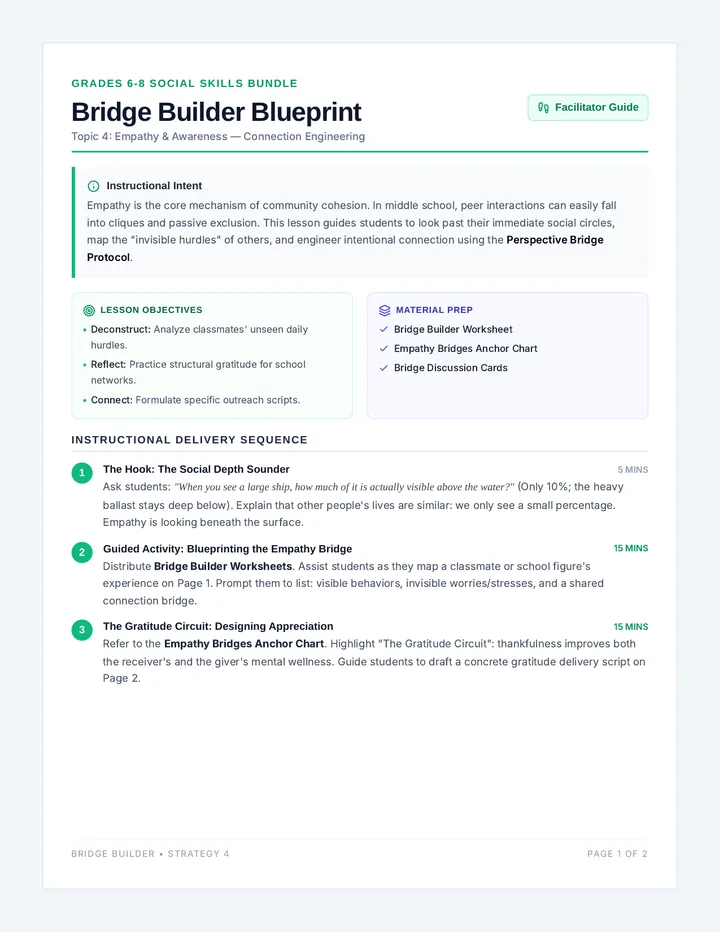
The Perspective Swap: Use the "Bridge Builder Cards." Have students read scenarios from another person's shoes and defend their choices.
Active Listening Drills: Students practice the "pillars" (listening for 1 minute without talking, then validating the emotional sentiment).
Troubleshooting Obstacles
The "Sarcastic Mask": Gratitude seen as "cheesy"
Intervention: Reframe gratitude tactically: "Scientific brain scans show that writing down gratitude rewires synapses to reduce anxiety. It is not about being sweet; it is a brain cheat code."
Deep Grudges: Student refuses empathy to a peer who hurt them
Intervention: Empathy is not forgiveness: "You do not need to accept their action. Empathy is just understanding their motives so you can stay in control and protect your own mood."
The Bridge Commitment Circle
Transition students back with a quiet, active challenge to build a community bridge:
"We have mapped our bridges today. This week, your challenge is to notice someone on campus who looks isolated. You do not need to solve their problem. Just offer a small token—hold the door open, share a snack, or offer a respectful wave. Who is ready to commit?"
BRIDGE BUILDER • STRATEGY 4 PAGE 2 OF 2
Reflection Prompts
Put yourself in their shoes: what is the immediate feeling?
What is 1 concrete act of allyship you can take to build a bridge?
Cut
Card 6 • Reflection Community
Diverse School Realities
Our campus hosts students from various cultures, backgrounds, and families. Embracing these different viewpoints and invisible experiences makes our school structure stronger and more creative.
Reflection Prompts
How does having diverse perspectives improve our classroom?
What is something unique you have learned from a peer's culture?
Cut
Card 7 • Scenario Friendship
The Snapping Friend
You ask your friend for help with a math sheet. They snap angrily at you: "Do it yourself, I have my own problems." You feel hurt, but later find out they just received bad news from their coordinator.
Reflection Prompts
How can you use "Wonder" to process their angry reaction?
Draft a text you could send later to show support neutrally.
Cut
Card 8 • Challenge Action
The Inclusion Blueprint
Leaving classmates out is a common way walls are constructed. Designing an "inclusion blueprint" means actively seeking out students who are sitting alone and engineering low-stress pathways to connect.
Action Task
Formulate a casual phrase to invite an isolated peer to join a group.
Practice with a partner: How does stepping in strengthen community?