Brain Boss Counselor Guide Session 1 of 6 Tier 2 Counseling (Grades K-2)
20-25 Minutes
Brain Control Center & The Brain Boss
Core Focus: Emotional awareness, self-monitoring, and introducing executive functioning through the "Brain Boss."
Session Goal
Identify 3 body signals when feelings get too fast or slow.
Key Metaphor
The Brain Boss steering the emotion control wheel.
Materials Needed
Session 1 Worksheet, crayons, mirror (optional).
1. Welcome & Engine Check-In (4 Mins)
Hook
Greet the student warmly. Explain: "Welcome to the Super Brain Squad! Everyone has an amazing boss inside their head who helps make choices and steer our feelings."
Counselor Prompt: "Right now, is your engine running too slow (sleepy), just right (ready), or too fast (buzzy)?"
2. Guided Exploration: Meet Your Brain Boss (6 Mins)
Core Concept
Introduce executive functioning simply: The Brain Boss helps us plan, pay attention, and calm stormy feelings so we can do our best learning.
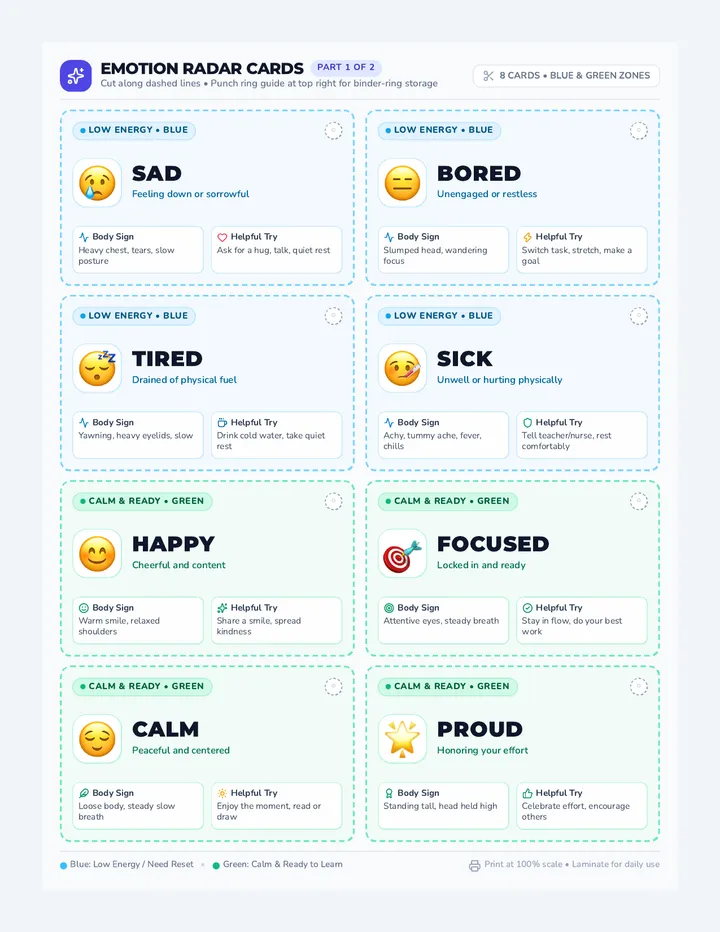
Blue Zone / Slow: Low energy, sad, or distracted body. (Needs gentle spark)Green Zone / Ready: Brain Boss is driving calmly and listening. (Ideal for learning)Red Zone / Fast: Body feels wiggly, hot, or explosive. (Needs cooling brake)
3. Guided Student Worksheet Activity (10 Mins)
Hands-on Practice
Hand out the Brain Boss Worksheet . Guide the student step by step:
Part A: The Control Dial
Help student circle their engine speed and draw their face in the control center screen.
Part B: Clue Detective
Connect body sensations (racing heart, heavy shoulders, clutched fists) to feelings.
4. Wrap-Up & Secret Squad Mission (4 Mins)
Transfer
Practice the "Brain Boss Pose" (two fingers tapping forehead gently, saying: "Brain Boss, guide my day!").
Classroom Transfer: Ask the student to notice one time before our next session when their Brain Boss helped them make a safe choice.
Counselor Coaching Notes
For younger Kindergarteners or students with emerging verbal skills, have them point to the pictures or act out physical signals (shrug shoulders, jump like a bouncy ball, or sit quietly). Emphasize that all feelings are okay, but our Brain Boss helps us choose what to do with them.
Brain Boss Worksheet Mission #1
My Brain Boss Control Panel
Name:
Date:
Meet your Brain Boss! Your Brain Boss helps you notice feelings and make awesome choices at school.
1
Check Your Engine Speed
Circle how your body feels right now:
Slow Engine Tired, sleepy, slow moving
Just Right Calm, focused, ready to learn
Fast Engine Wiggly, bouncy, buzzing
2
Draw Your Brain Boss
Draw a face or badge for the boss inside your brain who helps you make smart choices!
3
Body Clues Detective
Color or check the clues your body gives you when feelings grow big:
Heart beating fast (thump-thump)
Tight face or clenched jaw
Warm cheeks or hot forehead
Bouncy feet that want to run
Deep, calm breathing
Super Brain Squad Power Pledge
Practice saying this aloud with your counselor, then sign your name on the line:
"I notice my body. I listen to my clues. My Brain Boss helps me choose what to do!"
Squad Member Signature:
Body Brake Counselor Guide Session 2 of 6 Tier 2 Counseling (Grades K-2)
20-25 Minutes
The Body Brake Pedal & Impulse Pause
Core Focus: Response inhibition, somatic calming techniques, and pausing before blurting or acting impulsively.
Session Goal
Learn and practice the 3-step "Stop-Breathe-Choose" brake routine.
Key Metaphor
Stepping on the brake pedal before your car rolls down a hill.
Materials Needed
Session 2 Worksheet, pencil, pinwheel or feather (optional).
1. Squad Review & Red Light Game (5 Mins)
Warm-Up
Quickly review the Brain Boss from Session 1. Play 1 minute of seated "Freeze Dance" or "Red Light, Purple Light" to test physical impulse control.
Counselor Prompt: "Was it easy or tricky to freeze your body instantly? What part of your body wanted to keep moving?"
2. The 3-Step Brake Routine: Stop, Breathe, Choose (6 Mins)
Skill Instruction
Explain that fast engines need brakes so we don't crash into hurtful words or rushed mistakes:
1. STOP
Freeze feet flat on floor. Hands on lap.
2. BREATHE
Slow "Hot Cocoa" breath (smell cocoa, blow cool).
3. CHOOSE
Ask Brain Boss: "What is my safest move?"
3. Guided Student Worksheet Activity (10 Mins)
Hands-on Practice
Hand out the Body Brake Worksheet :
Brake Pedal Trace: Trace the brake shoe path with a finger, taking 3 deep belly breaths.Impulse Scenario Sorting: Read common early-grade moments (someone cuts in line, someone touches pencil, wanting to blurt out answer) and decide where to tap the brake.My Calming Reset Tool: Student identifies their favorite quick physical reset (squeeze hands, count to 5, stretch arms).
4. Physical Rehearsal & Takeaway (4 Mins)
Action Anchor
Have student gently stomp their foot on the floor like stepping on a car brake pedal: "Press the brake, take a breath, let my Brain Boss do the rest!"
Counselor Check: If the student blurts during the session, smile and gently point down to your shoe to cue the "brake pedal."
Developmental Adaptation Notes
Younger children often perceive impulse control as "being in trouble." Frame the brake pedal as a superpower: race cars have the strongest brakes in the world because they move so fast! Strong brakes keep fast minds safe.
Body Brake Worksheet Mission #2
My Body Brake Pedal
Name:
Date:
When your body engine wants to race ahead, tap your internal brake pedal: Stop, Breathe, and Choose!
1
Trace & Breathe: The Brake Track
Put your finger on START and follow the arrows:
1. STOP Freeze your hands & feet Start Here →
→
2. BREATHE Breathe in 1-2-3, blow out slow Fill Your Tummy
→
3. CHOOSE Brain Boss picks a safe action Ready to Roll!
2
Brake Detective: When should you press your brake?
Check the boxes where tapping your Body Brake Pedal saves the day:
Someone cuts in front of me in line
I want to push, but I can pause and ask for help.
I know the answer right away!
I want to shout it out, but I can raise my hand.
My drawing ripped by mistake
I feel angry, but I can take a deep breath first.
It's time to clean up recess games
I want to keep playing, but I stop when told.
3
Pick Your Reset Tool
Circle your favorite move when pressing the brake:
Hot Cocoa Belly Breaths (x3)
Squeeze fists tight, then let go
Silent backwards count: 5 - 4 - 3 - 2 - 1
4
Draw Your Calm Body
Draw yourself using your calm-down move at school:
Remember: A fast mind with a strong brake can do anything!
Squad Ready
First Steps Counselor Guide Session 3 of 6 Tier 2 Counseling (Grades K-2)
20-25 Minutes
Mission First Steps & Task Initiation
Core Focus: Task initiation, reducing task freeze or avoidance, and breaking big school tasks into bite-sized steps.
Session Goal
Break a daunting class task into 3 tiny doable steps & start within 1 min.
Key Metaphor
"Turning a Giant Mountain into 3 Small Stepping Stones."
Materials Needed
Session 3 Worksheet, writing pencil, 3 building blocks or counters.
1. Check-In & The "Stuck Monster" Story (4 Mins)
Engage
Check in on how the student's Body Brake worked this week. Then introduce the feeling of getting stuck: "Ever look at a big worksheet and your brain feels frozen like ice?"
Counselor Prompt: "When a job looks huge, what do you usually feel like doing? Staring, daydreaming, or avoiding it?"
2. The "3 Tiny Stones" Strategy & 3-2-1 Blastoff (6 Mins)
Instruction
Demonstrate with 3 blocks. We never have to do the whole mountain all at once. We only need the very first stone:
Stone 1: Get Ready
Put pencil in hand and write my name at the top.
Stone 2: Just One Item
Read or try question #1 only. Ignore the rest.
Stone 3: Keep The Roll
Celebrate the first win and roll to #2!
3. Guided Student Worksheet Practice (10 Mins)
Worksheet
Guide student through the First Steps Worksheet :
Stepping Stones Path: Trace the path from "Giant Job" to "Mission Accomplished!"Practice Breakdown: Take a common task (e.g., "Writing a sentence" or "Math page") and identify the microscopic step #1 (e.g., "Open the book", "Write my name").The 3-2-1 Launch: Student practices counting down backwards out loud and picking up the pencil without hesitation.
4. Squad Mission & Counselor Feedback (4 Mins)
Closure
Reinforce the motto: "I don't need to finish it all right now, I just need to start step one!"
Teacher Collaboration Tip: Share with the classroom teacher that student responds well to a "Start with Step 1" sticky note or timer countdown.
Executive Function Insight
Task initiation issues are rarely laziness—they usually stem from working memory overload or low dopamine activation. Making the first step laughably easy (e.g., just touching the pencil or writing one letter) breaks the freeze response.
First Steps Worksheet Mission #3
Mission First Steps
Name:
Date:
When a classroom job feels like a giant mountain, break it into 3 small stepping stones!
1
Turn the Mountain into Stepping Stones
How to tackle any big job:
Big Job! "Looks too hard!"
1
Tool Up Get pencil & paper
2
Do Just 1 Solve first problem
3
High Five! You're in motion!
2
Choose A Tricky Job & Break It Down!
What is one job at school that feels hard to start? Write or draw your 3 easy stones:
1
My Tiny First Move (Easy peasy):
2
My Next Little Bite:
3
My Celebration Reset (Check off & breathe):
3
3-2-1 Blastoff!
Color in each rocket circle as you count down to starting your work:
3
→
2
→
1
→
GO!
4
When I Feel Frozen:
Check the strategy you want to try:
Ask teacher: "Can you help me start?"
Set a 2-minute "speed challenge" timer
Write just my name, then pause
Squad Motto: "Big tasks fade when first steps are made!"
Action Ready
Sticky Notes Counselor Guide Session 4 of 6 Tier 2 Counseling (Grades K-2)
20-25 Minutes
Memory Sticky Notes & Multi-Step Directions
Core Focus: Working memory expansion, self-talk rehearsal, and holding 2-to-3 step directions in mind.
Session Goal
Repeat and follow 3-step classroom directions using visual anchors & whisper echoes.
Key Metaphor
"Posting bright sticky notes on your mental whiteboard."
Materials Needed
Session 4 Worksheet, real Post-it notes, colored markers.
1. Squad Review & The "Lost on the Way" Story (4 Mins)
Engage
Briefly check in on task starts. Then normalize forgetfulness: "Has your teacher ever said, 'Get your red folder, open to page 4, and sit quietly,' but on the way to your desk you forgot what to do?"
Counselor Prompt: "Working memory is like a little desk in your brain. If we put too many things on it, papers slide off!"
2. The 3 Memory Superpowers (6 Mins)
Skill Instruction
Introduce three tangible strategies that prevent thoughts from slipping away:
1. The Whisper Echo
Repeat the steps in a whisper: "Folder, page 4, sit."
2. Finger Counter
Hold up 1, 2, 3 fingers to hold each step in place.
3. Picture Anchor
Make a quick mental snapshot of doing the job.
3. Guided Worksheet & Memory Challenge Game (10 Mins)
Practice
Hand out the Sticky Notes Worksheet :
Memory Vault Practice: Counselor gives 3 silly instructions (e.g., "Tap your nose, spin pencil twice, give counselor a thumbs-up"). Student repeats before acting.Worksheet Sticky Note Cards: Student draws/doodles 3 icons on their mental sticky notes for their morning routine.Memory Shield: Identify classroom distractions that "erase" memory notes (loud noises, chatting friends, looking out window).
4. Wrap-Up & Sticky Anchor (4 Mins)
Transfer
Give the student an actual sticky note to put on their pencil box as a physical anchor for practicing their whisper echo.
Affirmation: "Hear it, whisper it, do it! My Brain Boss remembers!"
Working Memory Developmental Reality
Early elementary children typically have a working memory capacity of only 2 to 3 chunks of information. Subvocal rehearsal (repeating under one's breath) is an essential developmental milestone that transitions outward instructions into internal self-guidance.
Sticky Notes Worksheet Mission #4
My Memory Sticky Notes
Name:
Date:
Stick important directions in your brain! Use whisper echoes and mental pictures to remember every step.
1
Brain Whiteboard: Stick Your 3 Steps!
Draw a quick symbol or write a word in each note:
NOTE #1
First Thing To Do:
NOTE #2
Next Thing To Do:
NOTE #3
Last Thing To Do:
2
Memory Erasers: What makes you forget?
Circle the classroom distractions that try to wipe away your sticky notes:
Loud Noises
Friend Talking
Daydreaming
Fun Toys/Pens
3
3-Step Mission Challenge
Listen to counselor's directions, repeat them in a whisper, and check each star:
Challenge #1
2-Step Action
Challenge #2
3-Step Action
Challenge #3
Whisper Echo Champion
"Hear the steps, whisper three, now my brain remembers me!"
Memory Master
Backpack Detective Counselor Guide Session 5 of 6 Tier 2 Counseling (Grades K-2)
20-25 Minutes
Backpack Detective & Organization Habits
Core Focus: Material organization, desk management routines, and reducing stress caused by lost supplies.
Session Goal
Master the 3-Pile Sort (Stay at School, Go Home, Trash) for daily gear.
Key Metaphor
"Detective looking for clues to make learning faster and happier."
Materials Needed
Session 5 Worksheet, student's backpack or pencil box, clean bin.
1. Squad Review & "Where Did It Go?" Mystery (4 Mins)
Engage
Ask the student: "Have you ever had a missing pencil or crumpled paper turn into a morning panic?" Explain that being organized is like giving your Brain Boss clean glasses to see clearly.
Counselor Prompt: "When your desk or backpack is a messy jungle, how does your body feel? Rushed, frustrated, or sleepy?"
2. The 3-Pile Detective Sort System (6 Mins)
Strategy
Teach the student to sort items into 3 clear categories:
Pile 1: Keep at School
Pencils, eraser, workbooks, school folder in designated slot.
Pile 2: Pack for Home
Take-home folder, lunchbox, artwork to show family.
Pile 3: Recycle / Trash
Broken crayons, scrap scraps, old wrappers toss away.
3. Guided Worksheet & Real Gear Inspection (10 Mins)
Action
Open the Backpack Detective Worksheet . If available, have the student practice sorting their actual pencil pouch or backpack:
Item Sort Hunt: Classify common items into School, Home, or Bin using colored paths.Desk Top Zone Map: Learn the "Launch Pad" concept—where pencil and paper live so arms don't knock them down.Daily 60-Second Check: Practice the 1-minute end-of-day backpack sweep.
4. Wrap-Up & Detective Oath (4 Mins)
Closure
Award the "Detective Inspector" badge on their worksheet. Have the student state: "Everything has a place, and my desk has happy space!"
Home Connection: Encourage families to set up a specific "School Landing Spot" near the front door at home for the backpack.
Sensory & Environmental Support
Visual clutter directly strains working memory in young learners. A student who cannot find a pencil during whole-group instruction often misses the first 5 minutes of teacher explanation, leading to frustration and behavioral escalation.
Backpack Detective Worksheet Mission #5
Backpack Detective
Name:
Date:
Be a detective with your learning tools! When your desk and backpack are neat, finding things is a breeze.
1
The 3-Pile Sort: Where Does It Belong?
Draw a line from each item to its pile:
Pencil
Snack Core
Take-Home
Math Book
Torn Scrap
Family Art
1. STAY AT SCHOOL
Pencils, books, crayons
2. PACK FOR HOME
Folder, jacket, lunchbox
3. TRASH / RECYCLE
Scraps, crumbs, broken tips
2
Desk Launch Pad: Keep Space for Working!
Look at the desk map. Draw where your pencil pouch and paper go:
Tool Station (Top Corner)
MY OPEN WORK SPACE Only the current paper lives here!
Side Pocket (Safe Side)
3
Daily 60-Second Sweep
Check each item before you leave your seat:
Pencil back inside pencil pouch
Paper flat inside take-home folder
Backpack zipped all the way shut
Certified Organization Detective
I keep my space neat and ready to learn!
Detective Signature
"A clean space makes a clear mind. My Brain Boss loves finding what I need!"
Tidy Squad
Bend Dont Break Counselor Guide Session 6 of 6 Tier 2 Counseling (Grades K-2)
20-25 Minutes
Bend, Don't Break & Graduation Toolbelt
Core Focus: Cognitive flexibility, recovering from mistakes/schedule changes, and consolidating skills into a lasting toolkit.
Session Goal
Practice flexible thinking (Plan B) and assemble personal Brain Squad toolbelt.
Key Metaphor
"Being like a flexible palm tree in the wind, not a stiff dry twig."
Materials Needed
Session 6 Worksheet, colored pencils, pipe cleaner or rubber band.
1. Welcome & The Rubber Band Test (4 Mins)
Engage
Show a stiff dry twig and a flexible rubber band or pipe cleaner. Bend the twig (it snaps) and stretch the rubber band (it bounces back). Explain: "When things change at school—like rainy day recess or indoor specials—our brain can bend like a rubber band so we don't snap!"
Counselor Prompt: "When something doesn't go the way you expected, does your brain feel stiff or flexible?"
2. The "Plan B" Flex Strategy (6 Mins)
Skill Instruction
Teach the student the 2-step cognitive flexibility response:
Step 1: Notice the Change
Take 1 deep breath. Say: "It is okay. This is different, not ruined."
Step 2: Activate Plan B
Ask: "What is my next best choice right now?"
3. Guided Worksheet: The Super Toolbelt (10 Mins)
Synthesis
Open the Bend Don't Break Worksheet :
Rigid vs. Bendy Thinking: Contrast "I won't do it!" with "I can try Plan B."Squad Toolbelt Review: Check off all 5 previous tools (Brain Boss, Body Brake, First Steps, Sticky Notes, Clean Desk).Personal Super Badge: Student signs their counseling completion pledge.
4. Graduation Celebration & High Fives (4 Mins)
Celebration
Celebrate the student's 6 sessions of hard work! Highlight specific moments of self-regulation observed over the past weeks.
Next Steps: Check in with classroom teacher at 2-week follow-up to evaluate generalization of coping and executive functioning strategies.
Closing Clinical Considerations
Cognitive flexibility is often the hardest executive function skill for young children because it requires both emotional soothing and cognitive re-framing. Celebrate effort over perfection, and encourage the classroom teacher to give 2-minute transition warnings prior to unexpected routine changes.
Bend Dont Break Worksheet Mission #6
Bend, Don't Break Toolbelt
Name:
Date:
When plans change, bend like a super rubber band! Use your complete Super Brain Squad toolbelt.
1
Stiff Thinking vs. Bendy Thinking
Which way helps you bounce back?
Stiff Branch (Snaps!)
"My pencil broke! Everything is ruined! I'm not doing this work!"
Bendy Rubber Band (Bounces!)
"Oops, tip broke. I can pause, breathe, and sharpen it or grab another."
2
Plan B Detective Practice
Check the bendy choice when surprise changes happen:
Rain outside! Recess is in the classroom.
Pick a fun board game with a classmate
Cross arms and pout the entire recess
Someone else sat in your favorite circle spot.
Find another cozy spot and smile
Push them and yell that it's your spot
3
My Super Brain Squad Toolbelt
Check off all 6 powers you practiced in our counseling sessions:
1. Brain Boss Check-in
2. Body Brake Pedal
3. First Steps Launch
4. Sticky Notes Echo
5. Backpack Detective
6. Bendy Brain Plan B
Squad Graduate Award
Certified master of calm bodies, sharp focus, and flexible thinking!
Counselor & Student Signature: