Feeling Radar Teacher Guide WEEK 1 Social Superpowers • 3rd Grade
Pacing: 35 Minutes
Feeling Radar Teacher Guide
Core Skill: Identifying bodily emotion signals & applying calm-down resets
Learning Goals
• Name 3 body clues for rising frustration or anxiety.
• Map feelings onto Blue, Green, Yellow, and Red zones.
• Execute a 4-7-8 breathing reset independently.
Materials & Setup
• Feeling Radar Student Workbook page for each student.
• Chart paper with 4 Zones (Blue, Green, Yellow, Red).
• Pencils and colored pencils/markers.
Instructional Routine
1. Hook & Body Scan (8 Mins) Whole Group
Ask: "Has your stomach ever felt like butterflies before a test, or your fists clenched when a game was unfair?" Explain that our body sends early warning signals before our brain even names the emotion. Lead a 60-second head-to-toe body scan.
2. The 4 Feeling Zones & Modeling (10 Mins) Direct Instruction
Introduce the 4 Zones: Blue (tired/sad), Green (calm/focused), Yellow (frustrated/silly), and Red (out-of-control angry).
Teacher Script: "All zones are okay to feel! Our superpower isn't avoiding the Yellow or Red zones; it's noticing we are there and choosing our calming tool before acting."
3. Guided Practice: Calming Toolkit (10 Mins) Pairs & Workbook
Model two tangible strategies: (1) Square Breathing (in 4, hold 4, out 4, wait 4) and (2) 5-4-3-2-1 Sensory Grounding . Have students turn to a partner and role-play a scenario: "Someone took the marker you were reaching for." Students complete Part 1 & Part 2 of their workbook sheet.
4. Wrap-Up & Goal Setting (7 Mins) Closing Reflection
Students complete the "Weekly Superpower Commitment" box on their workbook. Choose 2-3 volunteers to share their favorite go-to reset.
Common Misconception
Students often believe anger itself is "bad" or "disobedient." Reinforce that anger is a normal biological emotion; harmful actions are what we regulate.
Differentiated Support
Provide visual emotion word banks for ELL/IEP students. Allow students to sketch body clues (e.g. thundercloud over head) instead of writing sentences.
Lesson 1 of 6 • Social Superpowers Curriculum Grade 3 SEL Standards Aligned
Feeling Radar Workbook Page Superpower 1 • Emotional Regulation
My Feeling Radar
Name:
Date:
Your body gives you clues before big emotions take over. Tune your radar to spot early signs!
Part 1: Where Do You Feel Big Feelings?
Check all the clues your body sends you
Warm / red cheeks
Racing heartbeat
Tight, clenched fists
Butterflies in tummy
Heavy shoulders / head
Shaky hands or legs
Part 2: The 4 Feeling Zones
Blue Zone
Low Energy
Tired • Sad • Bored
My reset tool:
Green Zone
Ready to Learn
Calm • Happy • Focused
How I stay here:
Yellow Zone
High Energy / Caution
Frustrated • Anxious • Silly
My reset tool:
Red Zone
Extreme Energy
Explosive • Furious • Panic
My reset tool:
Part 3: My Personal Calming Reset Action
Pick or write your top 2 calming strategies (e.g., Square Breathing, 5 Finger Breathing, Wall Push-Ups, Counting Backwards from 20):
1
2
Part 4: Weekly Radar Check-In Tracker
Color in the star each day you notice your zone!
Mon
★
Zone: _____
Tue
★
Zone: _____
Wed
★
Zone: _____
Thu
★
Zone: _____
Fri
★
Zone: _____
"I can notice my body clues and choose a reset tool before I react!" Week 1 Superpower Badge: Unlocked 🛡️
Focus Shield Teacher Guide WEEK 2 Social Superpowers • 3rd Grade
Pacing: 35 Minutes
Focus Shield Teacher Guide
Core Skill: Defeating distractions, sustaining attention & active listening in class
Learning Goals
• Distinguish between Outer distractions and Inner distractions.
• Practice 3 "Focus Shield" tools (Target Eyes, Self-Talk, Reset).
• Increase independent task focus stamina by 5-10 minutes.
Materials & Setup
• Focus Shield Student Workbook page per student.
• A small noisemaker or bell for attention practice.
• Classroom timer for the "3-Minute Focus Challenge".
Instructional Routine
1. Hook: Distraction Detectives (7 Mins) Whole Group
Begin reading a short passage while intentionally dropping a pencil, tapping a ruler, and gazing out the window. Ask: "What pulled my brain away from the work?" Define Outer Distractions (hallway noise, tapping, whispers) vs. Inner Distractions (daydreaming, hunger, thinking about recess).
2. Activating the "Focus Shield" (10 Mins) Direct Instruction
Teach students their mental "Focus Shield" has 3 armor plates:
1. Target Eyes: Look at the speaker or the text on the desk.
2. Coach Voice: Silent self-talk: "Back to work, I can do this."
3. Desk Cleanser: Keep only current tools on the workspace.
3. The 3-Minute Focus Challenge (10 Mins) Guided Practice
Set a timer for 3 minutes. Students independently work on Part 1 & 2 of their workbook page. The teacher provides mild environmental sounds (pencil dropping, walking past desks). At the beep, celebrate students who held their focus shield strong without turning around.
4. Debrief & Desk Audit (8 Mins) Closing Reflection
Have students do a 30-second "Desk Audit" (clearing unnecessary items). Guide completion of their personal "Distraction Blaster Plan" on the workbook sheet.
Teacher Coaching Tip
Use a discreet nonverbal gesture (like touching your eyebrow or tapping your desk) as a gentle focus reminder rather than publicly calling a student out.
Differentiated Support
Provide fidget strips or alternative seating for students with ADHD/sensory needs. Break the focus challenge into 1-minute intervals with quick thumb-checks.
Lesson 2 of 6 • Social Superpowers Curriculum Grade 3 SEL Standards Aligned
Focus Shield Workbook Page Superpower 2 • Focusing in Class
My Focus Shield
Name:
Date:
Classrooms are busy places! Build your invisible Focus Shield to block distractions and keep your brain in the game.
Part 1: Distraction Sorter
Write OUT for Outer Distraction (happening in the room) or IN for Inner Distraction (inside your mind/body):
Someone tapping a pencil nearby _____
Wondering what's for lunch today _____
A student walking down the hallway _____
Feeling tired and daydreaming _____
Part 2: Activate Your 3-Plate Focus Shield
Plate 1: Target Eyes
Where should my eyes look right now?
My eyes focus on:
Plate 2: Coach Voice
What do I tell myself when distracted?
"Brain, let's get back to..."
Plate 3: Clean Workspace
What is the 1 item I need on my desk?
Keep out only:
Part 3: When My Mind Wanders, My Quick Reset Is...
Choose your go-to quick reset when you catch your focus drifting away:
Take 1 slow breath
Roll shoulders back
Whisper: "Refocus now"
Part 4: 5-Day Focus Shield Daily Tracker
Rate your focus strength each day during work time!
Mon
🛡️
Strong / Growing
Tue
🛡️
Strong / Growing
Wed
🛡️
Strong / Growing
Thu
🛡️
Strong / Growing
Fri
🛡️
Strong / Growing
"I can shield my attention and bring my thoughts back to learning!" Week 2 Superpower Badge: Unlocked 🛡️
Clear Signals Teacher Guide WEEK 3 Social Superpowers • 3rd Grade
Pacing: 35 Minutes
Clear Signals Teacher Guide
Core Skill: Assertive "I-messages", whole-body listening & clarifying misunderstandings
Learning Goals
• Contrast Passive, Aggressive, and Assertive communication.
• Construct a 4-part "I-Message" to state personal boundaries.
• Practice the "Echo Back" active listening reflection technique.
Materials & Setup
• Clear Signals Student Workbook page per student.
• Anchor chart: "The I-Message Formula".
• Practice partner scenario cards (or board display).
Instructional Routine
1. Hook: Broken Signal Demonstration (7 Mins) Whole Group
Whisper a sentence with a mumble or contradictory facial expression (smiling while saying "I'm upset"). Ask: "Why was that confusing?" Explain that communication requires matching words, tone, and body posture. Introduce the radio analogy: sending a clear signal vs. static.
2. The 3 Styles & The I-Message Formula (10 Mins) Direct Instruction
Model three styles: Passive (mumbling, looking down), Aggressive (pointing, yelling "You always..."), and Assertive (calm eye contact, clear voice). Teach the 4-part formula:
"I feel [Emotion] when [Specific Action]. Next time, could we please [Solution]?"
3. Partner Echo & Practice Lab (10 Mins) Pairs & Workbook
Students pair up to practice "Echo Back" listening: Partner A shares a sentence; Partner B paraphrases: "So what I hear you saying is..." before responding. Students then complete Part 1 & 2 on their workbook sheet transforming blaming "You-messages" into clear "I-messages".
4. Wrap-Up & Shout-Outs (8 Mins) Closing Reflection
Invite two volunteer pairs to model an assertive conversation. Have the class identify what made their signals clear and kind. Students fill in the weekly pledge.
Common Stumbling Block
Students often use fake "I-messages" like: "I feel that you are annoying!" Remind students that after "I feel," must come an emotional feeling word, not an accusation.
Differentiated Support
Provide sentence frames on index cards for hesitant speakers. Allow students to practice with a puppet or teacher aide first to build confidence.
Lesson 3 of 6 • Social Superpowers Curriculum Grade 3 SEL Standards Aligned
Clear Signals Workbook Page Superpower 3 • Communication Skills
My Clear Signals
Name:
Date:
When we speak with clear words and listen with our whole body, we prevent misunderstandings and solve problems together.
Part 1: Identify the Signal Style
Write Passive (too quiet/hides feelings), Aggressive (mean/bossy), or Assertive (calm, clear & respectful):
"Give me that glue stick right now, it's mine or else!" ___________
(Looks at feet, says nothing, feels upset inside when someone cuts in line) ___________
"Excuse me, I wasn't finished with the book. Can I have it back for 5 minutes?" ___________
Part 2: The "I-Message" Signal Repair
Scenario: A classmate accidentally knocks over your pencil cup and doesn't notice. Fix the blaming message into a clear I-message!
Blaming You-Message: "You ruin everything! You did that on purpose!"
I feel...
(name the emotion)
When you...
(specific action)
Please...
(fair solution)
Part 3: My Whole-Body Active Listening Checklist
👀 Eyes on Speaker
Show them they have your full attention
🤐 Quiet Mouth
Wait until they finish without interrupting
🧠 Echo Back
"What I hear you saying is..."
Part 4: Weekly Communication Tracker
Check off when you used an I-message or good listening!
Mon
Clear Signal
Tue
Clear Signal
Wed
Clear Signal
Thu
Clear Signal
Fri
Clear Signal
"I use calm words to share my thoughts and listen with my heart and mind!" Week 3 Superpower Badge: Unlocked 🛡️
Friendship Sparks Teacher Guide WEEK 4 Social Superpowers • 3rd Grade
Pacing: 35 Minutes
Friendship Sparks Teacher Guide
Core Skill: Joining group play, cooperation, sharing & maintaining positive friendships
Learning Goals
• Execute the 3-Step Group Join-In formula at recess.
• Identify cooperative vs. "game-bossing" behaviors.
• Give genuine peer compliments and practice reciprocity.
Materials & Setup
• Friendship Sparks Student Workbook page per student.
• Chart: "The 3 Steps to Joining a Game".
• Playground scenario role-play cards.
Instructional Routine
1. Hook: The Loneliest Recess (7 Mins) Whole Group
Ask: "Have you ever stood by the basketball court or four-square line wanting to play, but felt nervous about asking?" Acknowledge that everyone feels that way sometimes. Today we learn the exact 3-step formula that makes joining in natural and welcoming.
2. The 3-Step Group Join-In (10 Mins) Direct Instruction
Step 1: Watch & Wait Observe what they are playing and notice the rules before walking up.
Step 2: Give a Spark Offer a kind compliment: "Great shot!" or "That looks fun!"
Step 3: Friendly Ask Ask clearly: "Can I join next round?" or "Do you need another player?"
Also teach the "If they say no" backup plan: "No problem, maybe next time!" and walk calmly to a new activity.
3. "Game Boss" vs. "Team Spark" Role-Play (10 Mins) Pairs & Workbook
Model two characters: "Bossy Bob" (demands to make all rules, pouts when losing) vs. "Flexible Fran" (takes turns, cheers on others). Students complete Part 1 & 2 on their workbook to evaluate friendship choices and practice writing a peer compliment.
4. Compliment Circle & Wrap-Up (8 Mins) Closing Community
Students turn to a classmate and deliver a genuine 3-word compliment (e.g., "You are creative," "You share kindly"). Students sign their Weekly Friendship Pledge.
Playground Observation Note
Notice which students frequently wander alone during recess. Pair them with designated "Recess Ambassadors" during the first few days of this unit.
Differentiated Support
Provide students who struggle with social anxiety a "Recess Script Pocket Card" containing the 3-Step formula to reference outdoors.
Lesson 4 of 6 • Social Superpowers Curriculum Grade 3 SEL Standards Aligned
Friendship Sparks Workbook Page Superpower 4 • Friendship Skills
My Friendship Sparks
Name:
Date:
Great friends aren't born by luck—they use superpowers like cooperation, taking turns, and inviting others to play!
Part 1: How to Join a Game at Recess
Step 1: Watch
Check the rules & game flow
"Notice if it's teams or line-based."
Step 2: Spark
Give a friendly cheer
"Nice kick!" or "Awesome drawing!"
Step 3: Ask
Ask with a smile
"Can I play next round?"
Part 2: Friend Magnet or Friend Pusher?
Write MAGNET (draws friends close) or PUSHER (pushes friends away):
Saying "Good game!" even if you lose _________
Demanding to change the rules mid-game _________
Inviting someone sitting alone to join _________
Bragging and teasing the other team _________
Part 3: Write a Secret Spark of Appreciation
Write a kind note to a classmate to brighten their day:
Dear:
I appreciate:
Because:
Part 4: 5-Day Friendship Kindness Tracker
Color in the heart each day you share, invite, or encourage!
Mon
♥
Kind Act
Tue
♥
Kind Act
Wed
♥
Kind Act
Thu
♥
Kind Act
Fri
♥
Kind Act
"I can share, cooperate, and include others so everyone feels welcome!" Week 4 Superpower Badge: Unlocked 🛡️
Peace Makers Teacher Guide WEEK 5 Social Superpowers • 3rd Grade
Pacing: 35 Minutes
Peace Makers Teacher Guide
Core Skill: Sizing problems, negotiating compromises & repairing peer relationships
Learning Goals
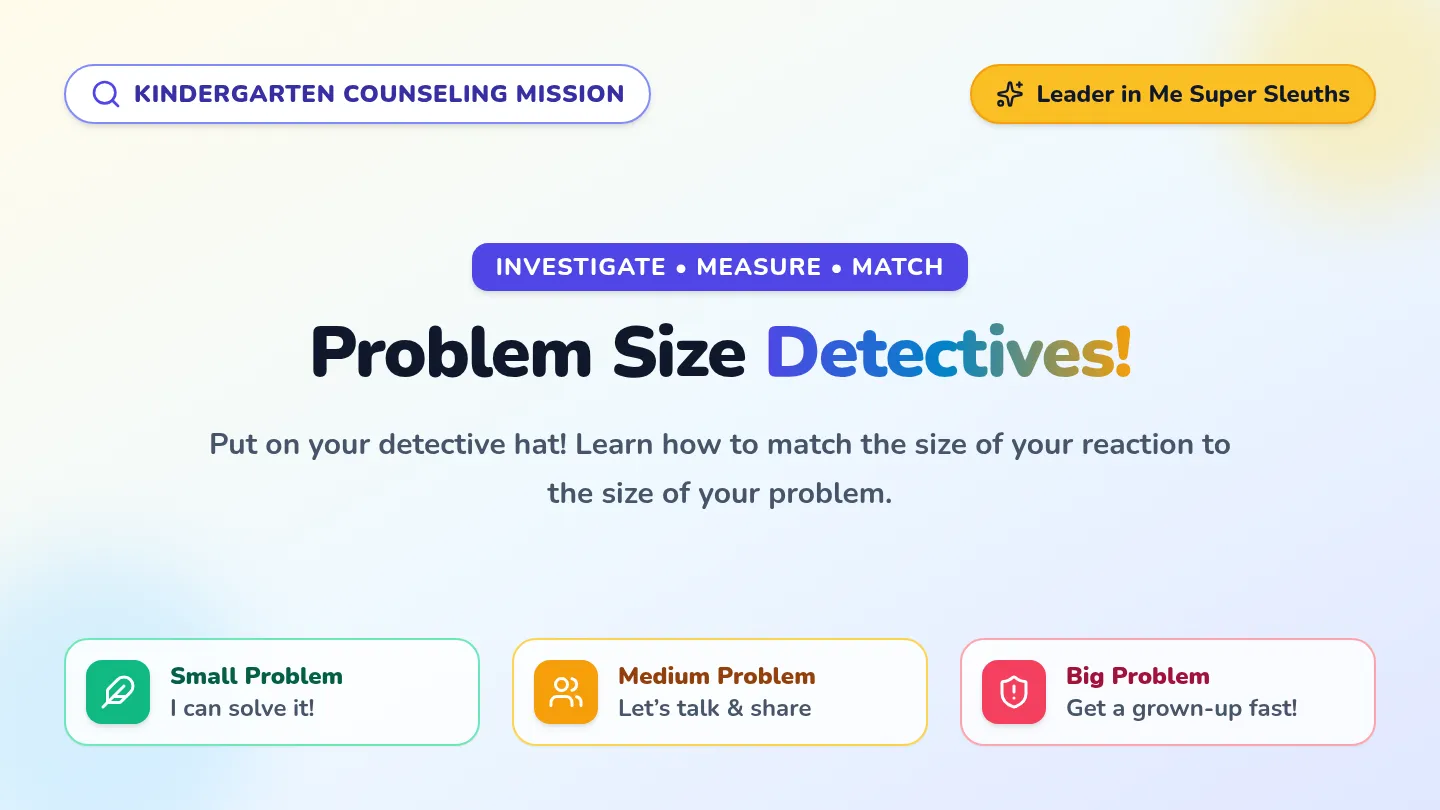
• Categorize conflicts into Small (kid-sized) vs. Big (adult-needed).
• Apply the 3 Win-Win negotiation tools (Take turns, Flip coin, Share).
• Deliver a sincere 4-part restorative apology.
Materials & Setup
• Peace Makers Student Workbook page per student.
• Chart: "Problem Size Thermometer" (Small vs Big).
• Role-play scenario task cards.
Instructional Routine
1. Hook: The Tattling vs. Reporting Puzzle (7 Mins) Whole Group
Present two situations: (A) "Someone took the blue crayon first" vs. (B) "Someone was pushed down on the blacktop." Clarify: Small Problems can be solved by students with calm words; Big Problems involve danger, repeated bullying, or injuries and require an adult immediately.
2. The Peace Bridge: 3 Win-Win Tools (10 Mins) Direct Instruction
Teach students that compromise means both people give a little so nobody loses completely:
1. Rock-Paper-Scissors: Quick, fair chance for minor choices.
2. Set a Timer: "You use it for 5 mins, then pass it to me."
3. Collaborative Combine: Blend both ideas into a new game.
3. The 4-Part Real Apology Practice (10 Mins) Pairs & Workbook
A forced "sorry" doesn't heal hurt feelings. Teach the 4-part formula:
1. "I'm sorry for..." • 2. "It was wrong because..." • 3. "Next time I will..." • 4. "How can I make it right?"
4. Debrief & Repair Contract (8 Mins) Closing Reflection
Students complete their workbook sheet and write out one personal apology script to practice relationship repair. Have students review their 5-day Peace Builder tracker.
The "Cool Down First" Rule
Never force students to resolve a conflict while still in the Red Zone. Allow 3-5 minutes of sensory reset before attempting the Peace Bridge.
Differentiated Support
Keep a laminated "Peace Wheel" on the classroom peace table so students can point to solutions (e.g. coin flip, timer, take a break) independently.
Lesson 5 of 6 • Social Superpowers Curriculum Grade 3 SEL Standards Aligned
Peace Makers Workbook Page Superpower 5 • Conflict Resolution
My Peace Makers
Name:
Date:
Disagreements happen to everyone! True peace makers know how to cool down, find a fair compromise, and heal hurt feelings.
Part 1: How Big Is the Problem?
Write KID (I can solve with calm words) or ADULT (danger/bullying, need adult help):
Two kids want the same soccer ball at recess _________
Someone gets pushed and scrapes their knee _________
A friend accidentally broke your green crayon _________
Someone is being repeatedly threatened or teased _________
Part 2: The 3 Win-Win Peace Tools
✂️ Quick Decision
Rock-Paper-Scissors or flip a coin for who goes first.
⏳ Take Turns
Set a 3-minute timer: you use it first, then hand it over.
🤝 Share / Team Up
Combine ideas so both friends get to contribute.
Part 3: Build a 4-Part Heartfelt Apology
Fill in the lines to complete an apology that actually heals hurt feelings:
1. I'm sorry for:
2. It was wrong because:
3. Next time I will:
4. Can I make it right by:
Part 4: 5-Day Peace Builder Tracker
Check off when you solved a problem peacefully!
Mon
🕊️
Peace Made
Tue
🕊️
Peace Made
Wed
🕊️
Peace Made
Thu
🕊️
Peace Made
Fri
🕊️
Peace Made
"I can stay calm, talk it out, and find a fair win-win solution!" Week 5 Superpower Badge: Unlocked 🛡️
Superpower Summit Teacher Guide WEEK 6 Social Superpowers • 3rd Grade
Pacing: 35 Minutes
Superpower Summit Teacher Guide
Core Skill: Culminating SEL synthesis, self-reflection & sustainable peer goal setting
Learning Goals
• Self-evaluate personal growth across all 5 skill areas.
• Write an encouraging peer endorsement recognizing a classmate's superpower.
• Create an ongoing "Maintenance Shield" for the remainder of 3rd grade.
Materials & Setup
• Superpower Summit Student Workbook page per student.
• Prior 5 completed workbook pages (student portfolios).
• Gold star stickers or colored pencils for summit badges.
Instructional Routine
1. Hook & Six-Week Highlight Reel (7 Mins) Whole Group
Briefly recap the journey: "In Week 1 we trained our Feeling Radar. In Week 2 we built our Focus Shield. In Week 3 we transmitted Clear Signals. In Week 4 we sparked New Friendships. And in Week 5 we built Peace Bridges!" Celebrate how much our classroom climate has transformed.
2. Portfolio Self-Audit & Radar Check (10 Mins) Independent Work
Students examine their 5 past weekly trackers. Guide them to complete the Superpower Growth Matrix on Part 1 of their sheet, rating themselves from 1 to 3 stars on each power: (1) Still Practicing, (2) Getting Stronger, (3) Super Mastered!
3. Peer Recognition & Superpower Awarding (10 Mins) Partner Activity
Students swap sheets with an assigned partner or neighbor to write in the Classmate Endorsement Crest : "I noticed your superpower when you..." Encourage specific observations (e.g., when you shared the basketball or took deep breaths during math).
4. Superpower Summit Ceremony & Pledge (8 Mins) Whole Group Celebration
Lead the classroom in the official Social Superpower Champion Pledge . Each student stands and signs their Graduation Certificate box on their workbook page.
Celebrating Growth Mindset
Emphasize that "1 star" isn't failure—it simply highlights where a student can focus their energy next. Celebrate honesty in self-assessment.
Differentiated Support
Help emerging writers scribe their peer endorsement or let them draw an icon representing their classmate's strongest superpower.
Lesson 6 of 6 • Social Superpowers Curriculum Grade 3 SEL Standards Aligned
Superpower Summit Workbook Page Superpower 6 • Final Summit & Reflection
My Superpower Summit
Name:
Date:
Congratulations on completing 6 weeks of social skills training! Look back at how much you've grown and set your future goals.
Part 1: My Superpowers Growth Check
Color: 1 Star = Practicing • 2 Stars = Good • 3 Stars = Mastered!
1. Feeling Radar (Self-Regulation) I notice my body clues and use calming reset tools.
★★★
2. Focus Shield (Classroom Attention) I ignore distractions and use positive self-talk to focus.
★★★
3. Clear Signals (Communication & Listening) I use "I-messages" and listen with my whole body.
★★★
4. Friendship Sparks (Peer Skills & Cooperation) I join games politely, share, and encourage my classmates.
★★★
5. Peace Makers (Conflict Resolution) I find win-win compromises and give genuine apologies.
★★★
Part 2: Peer Superpower Award
Have a classmate write one superpower they admire in you:
Classmate Reviewer:
I saw your superpower when:
Part 3: My Ongoing Social Goal
The one social superpower I will keep strengthening every single day is:
Because it helps my class community by: __________________________________________________
★
Official 3rd Grade Social Superpower Champion
This certifies that the student named above has completed 6 weeks of training in emotional regulation, focus, communication, friendship, and peace building.
Student Signature
Teacher Signature