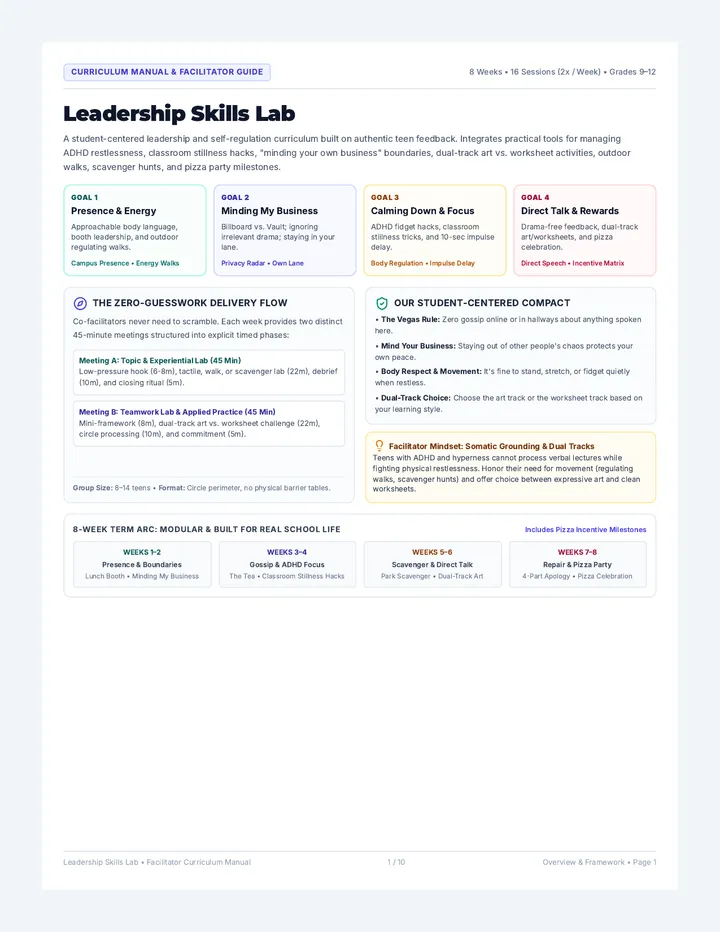
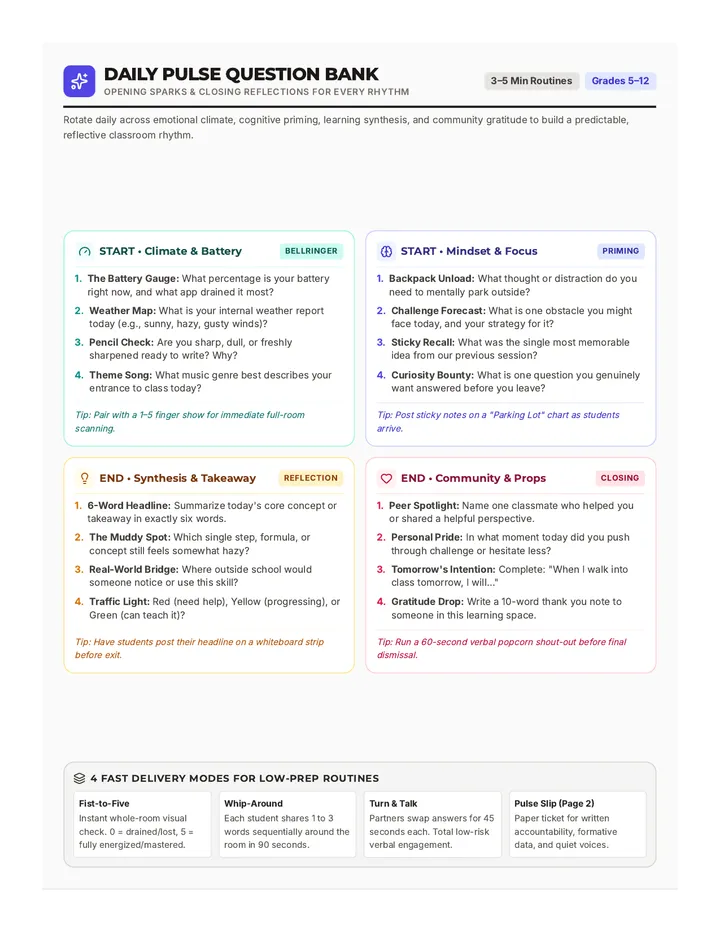
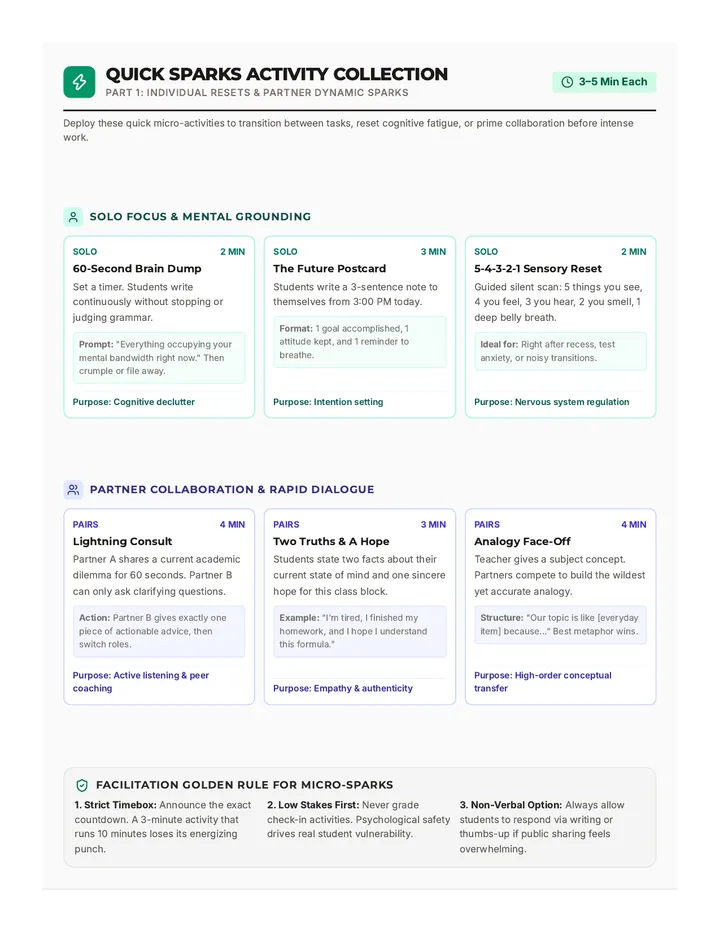
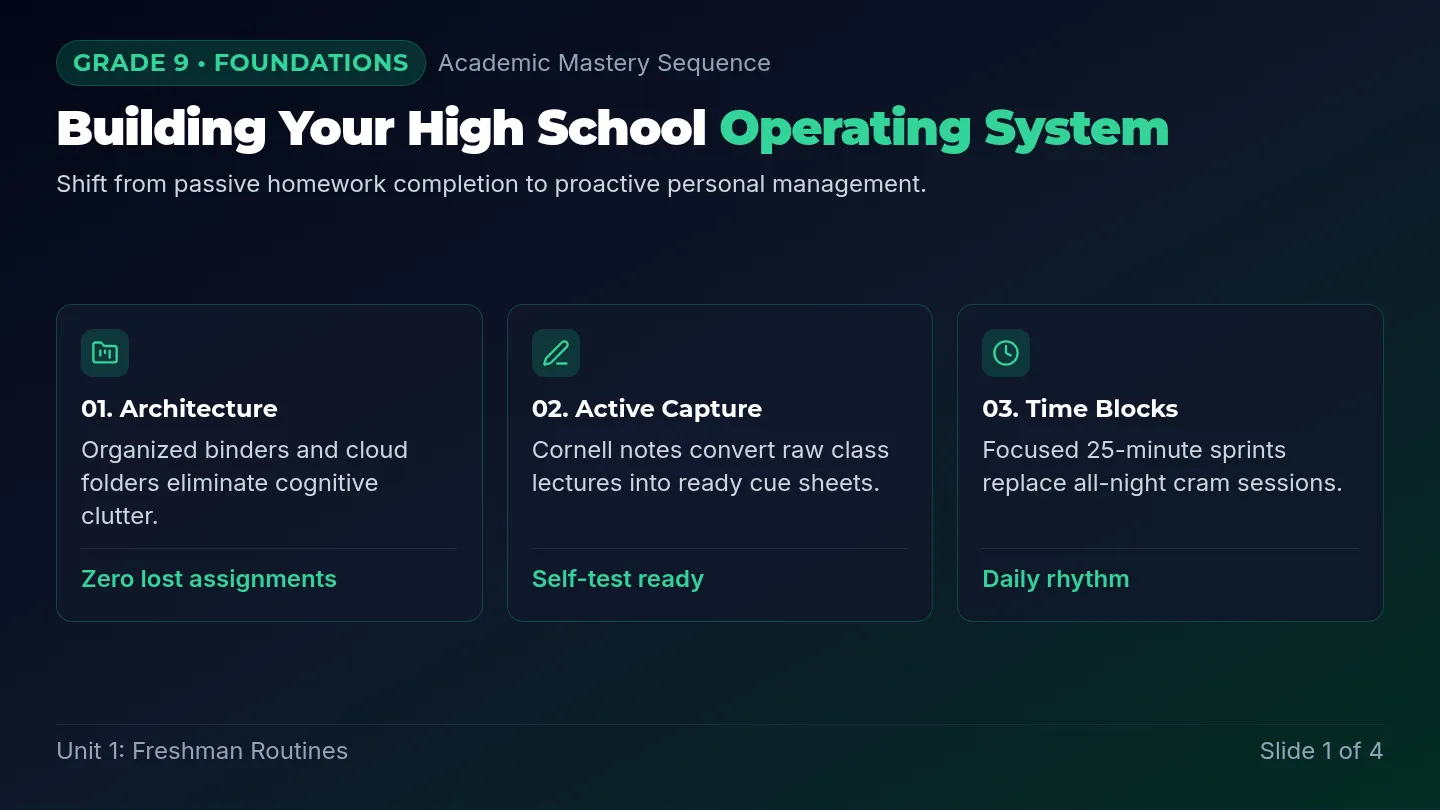
The Power of the Mix Slides Academic Support Lab
THE POWER OF
THE MIX
Blocked vs. Interleaved Practice: Why your brain needs "Good Trouble" to learn for life.
The Pitcher's Secret
Batting Practice
The coach throws 20 fastballs, then 20 curveballs, then 20 sliders.
"I know exactly what's coming. I look like a pro!"
The Real Game
Fastball? Curveball? Slider? You have no idea what's coming next.
"I have to recognize the pitch AND execute the hit."
Learning is just like batting practice. If you know what's coming, it's too easy.
Blocked Practice
A
A
A
➔
B
B
B
➔
C
C
C
The Illusion
It feels successful because you get into a rhythm.
The Trap
You stop thinking about why you're using a strategy.
The Result
Quick learning, but fast forgetting. Great for 1 day, bad for 1 month.
Interleaved Practice
A
B
C
➔
B
A
C
➔
C
B
A
Pattern Recognition
Forces you to look at a problem and ask: "Which tool do I need to solve this?"
Desirable Difficulty
It feels harder in the moment, but builds permanent, durable knowledge.
Your Turn: The Mix-Up Challenge
We're going to experience the difference. Half the class will do blocked practice, half will do interleaved.
What to watch for:
How long does each switch take?
Where does your brain feel "stuck"?
Which one feels "faster" but "fuzzier"?
Mix Up Challenge Worksheet The Mix-Up Challenge
Interleaved Practice Activity
Student Name & Date
Round 1: Blocked Practice (Set AAABBB)
Complete all problems in Topic 1, then all problems in Topic 2. Notice how you get into a "groove."
Topic 1: Percent Finding
Problem 1.1
What is 15% of 200?
Problem 1.2
What is 40% of 150?
Problem 1.3
What is 5% of 80?
Topic 2: Variable Solve
Problem 2.1
3x + 5 = 20. Solve for x.
Problem 2.2
5x - 10 = 40. Solve for x.
Problem 2.3
2x + 12 = 30. Solve for x.
Round 2: Interleaved Practice (Set ABCABC)
Now, the topics are mixed. You must identify the rule every single time. It will feel slower—that's the point!
Problem 3.1
What is 20% of 450?
Problem 3.2
4x + 4 = 20. Solve for x.
Problem 3.3 (NEW TOPIC)
Simplify: 2(a + 3) + 4
Problem 3.4
What is 12% of 50?
Problem 3.5
Simplify: 5(y - 2) + 10
Metacognitive Reflection
Which round felt like "more work"? Why is that "work" actually good for your long-term memory?
The Art of the Shuffle Slides Strategic Lab: Lesson 2
THE ART OF
THE SHUFFLE
How to categorize your subjects for high-speed interleaved practice.
Not All Mixes Are Equal
The Bad Mix
Mixing Biology flashcards with a Basketball workout.
Topics are too different. Your brain isn't learning to "discriminate" between options.
The Golden Mix
Mixing 3 different types of Physics equations.
Topics are similar but distinct. This forces you to spot the tiny differences!
The "Confusable" Rule
"Interleaving works best on things that look almost the same but aren't."
Math/Science
Formulas that use the same variables (like d or t ).
Languages
Words with the same root or similar endings.
History
Eras with similar causes or similar-sounding names.
How to Group Your Topics
1
Pick a Domain: Choose a subject you're currently studying.
2
Identify 3 Sub-topics: Things that "feel" similar.
3
The Interleave: Alternate 1 problem from each topic.
Pro Tip: The 15-Minute Rule
If you spend more than 15 minutes on one topic without switching, your brain is drifting back into Blocked Practice mode. Switch it up!
Interleave Map Worksheet Subject Audit & Interleave Map
Designing Your Personalized Review Set
Name: ____________________
Date: __________
1 Step 1: Current Academic Audit
List 3 subjects you are currently studying. For each subject, list 2 specific concepts or skills you've learned in the last 2 weeks.
Subject A
Subject B
Subject C
2 Step 2: Identifying "Confusable" Pairs
Look at your list above. Which topics are "cousins"—meaning they use similar rules or look alike but have key differences?
Topic X
Topic Y
Why do these confuse you?
3 Step 3: Build Your Shuffle Board
Plan a 30-minute study session by mixing 3 topics in an interleaved pattern (A-B-C-A-B-C).
A
B
C
A
B
C
My Topic A Is:
My Topic B Is:
My Topic C Is:
Confusable Pairs Teacher Guide Teacher Resource: Lesson 2
Confusable Pairs Reference
The "Confusables" Strategy
For students with executive functioning challenges, the hardest part of interleaving is knowing what to mix. This guide provides subject-specific examples for 10th-grade curriculum to help you guide students during their audit.
Mathematics (Geometry/Algebra II)
Topic A Topic B (The "Confusable") Area of a Triangle (1/2 bh) Area of a Parallelogram (bh) Solving for X in Linear Equations Solving for X in Inequalities (switching signs) Surface Area of a Cylinder Volume of a Cylinder
English / Literature
Topic A Topic B (The "Confusable") Metaphor (Direct comparison) Simile (Using "like" or "as") Active Voice Passive Voice Common Comma Splice Correct Semicolon Usage
Science (Biology/Chemistry)
Topic A Topic B (The "Confusable") Mitosis (Cell replication) Meiosis (Sexual cell division) Covalent Bonds Ionic Bonds Independent Variable Dependent Variable
Facilitation Prompts
"Which two formulas always make you pause and think, 'Wait, which one is this?'"
"If I showed you two problems side-by-side, what would be the 'clue' to tell them apart?"
"Do these topics use the same vocabulary but for different purposes?"
The Countdown Method Slides Planning Lab: Lesson 3
START AT THE
FINISH LINE
Retrograde Planning: The secret to never "cramming" again.
The Wall of "Now"
For many of us, time feels like it's only NOW or NOT NOW.
Standard Planning:
"I'll start studying today and see how far I get."
Result: Panicked Cramming
Now
The Void
Backward Design
Today
📅
Review Sessions
🔁
Final Exam
🏆
The Secret: We don't plan from today forward. We plan from the test date backward to ensure every topic fits into the schedule.
The 4-Review Guarantee
Review 1
48 hrs
Before the exam. High intensity, mixed topics.
Review 2
1 Week
Before the exam. Focus on "confusable" pairs.
Review 3
2 Weeks
Before the exam. Recall major concepts.
Review 4
1 Month
The "Deep Dive" session. Map out the curriculum.
This only works if you schedule it today.
Finish Line Planner Worksheet Finish Line Planner
Retrograde Study Scheduling
Student Name & Target Exam Date
Goal: The Final Countdown
Pick a cumulative exam coming up (Midterm, Final, or major unit test). We will build your schedule backward from this date.
Subject / Exam Name
Ex: 10th Grade Geometry Final
Target Date
The 4-Interval Map
1
Review 1: The 48-Hour Sprint
Intense mixing of all topics. Final recall check.
Scheduled Date: _________
2
Review 2: The Shuffle
Focus on "confusable" pairs identified in Lesson 2.
Scheduled Date: _________
3
Review 3: Conceptual Map
Summarize big ideas. Check for missing knowledge.
Scheduled Date: _________
4
Review 4: The Deep Dive
First pass at early material. Identify what was forgotten.
Scheduled Date: _________
Executive Function Shield
Scheduling is only half the battle. How will you make sure you actually show up to these sessions?
Digital Calendar Alerts (Phone)
Physical Calendar (on wall)
Study Buddy Commitment
In-Class Check-in with Teacher
Combatting Time Blindness Guide Teacher Resource: Lesson 3
Combatting Time Blindness
Understanding Time Blindness
Time blindness is a common executive functioning deficit where students struggle to perceive the passage of time or estimate how long future tasks will take. Retrograde planning isn't just a study tip—it's a prosthetic strategy for the brain.
Anchoring the Future
Students often view a test date 3 weeks away as "forever from now."
The Fix: Visual Proximity
Have students count the number of weekends or number of class periods left. Small, discrete units are easier to "feel" than days.
Task-Specific Weight
Students underestimate how long "Reviewing Unit 1" actually takes.
The Fix: Granular Breakdown
In Lesson 3, ensure students don't just write "Study." Force them to write "Shuffle Set: Triangle Area vs. Parallelogram Area (20 mins)."
The Interval Logic
1 Month Out
Identifies major "knowledge gaps" when there is still time to ask questions.
2 Weeks Out
The "Deep Recall" phase. Forces the brain to retrieve info from long-term storage.
1 Week Out
The "Discrimination" phase. High-intensity interleaved practice of similar topics.
48 Hours Out
Confidence build and high-speed mixed review (The "Pitch Recognition" phase).
Implementation Red Flags
Students setting the 1-Month Review date to "TBD" (To Be Determined).
Scheduling more than 2 high-intensity subjects in one afternoon.
Ignoring the "EF Shield" checklist on the student sheet.
Neural Circuit Training Slides Performance Lab: Lesson 4
BRAIN
CIRCUIT
High-Intensity Interval Training (HIIT) for your academic endurance.
The Academic HIIT
The Goal
To force your brain to switch contexts every 7 minutes.
This mimics the "Game Day" experience of a real final exam where you jump from topic to topic.
Rapid Recall Speed
Cognitive Flexibility
Focus Endurance
Rotation Rules
1. NO SETTLING
As soon as the timer goes off, you MOVE. Do not finish your last thought. Let the switch be jarring.
2. ACTIVE RECALL
Do not just "read" notes. You must solve, define, or explain. No passive review allowed.
3. LOG IT
Use your Rotation Log. Note down the exact moment your brain felt "fuzzy" or "slow" after a switch.
Station Overview
Station A: Math / Logic
Quick-fire formula application.
Station B: Science / Systems
Labeling cycles or identifying bonds.
Station C: Humanities / Vocab
Case studies and high-level definitions.
07:00
Minutes Per Station
Circuit Rotation Log Circuit Rotation Log
Interleaved Recall Session
Name & Rotation Order
Ex: B -> C -> A -> D
Rnd
Station / Topic
Recall Efficiency (0-10)
Switching Difficulty
1
Topic...
2
Topic...
3
Topic...
4
Topic...
The "Switching Cost" Reflection
Which switch was the most painful? (Ex: Math to English)
What did you do to "reset" your brain for the new topic?
Circuit Station Cards Teacher Guide Teacher Resource: Lesson 4
Circuit Station Cards
Setting Up the Circuit
Cut these cards out and place them at physical stations around the room. Each station should have 5-10 specific problems or tasks related to that subject area.
A
MATH & LOGIC
The "Pitch Recognition" Room
Prompt:
Include 3 types of equations (Linear, Quadratic, Inequalities). Students must solve one of each before repeating.
B
SCIENCE SYSTEMS
The "Structure" Room
Prompt:
Provide diagrams (Cell, Water Cycle, Atom). Students must label 5 key parts from memory without notes.
C
HUMANITIES
The "Analysis" Room
Prompt:
Give 3 short quotes or historical dates. Students must identify the speaker/era and provide 1 piece of context.
D
THE WILD CARD
The "Connection" Room
Prompt:
Provide 1 topic from each of the other stations. Students must find one similarity between all three.
Rotation Pacing
0:00 - 1:00
Transition & Prep. Clean slate.
1:00 - 6:00
Focus Work. Active Recall.
6:00 - 7:00
Log Entry. Reflect on "Fuzziness."
The Struggle is Learning Slides Mastery Lab: Lesson 5
THE STRUGGLE IS
THE LEARNING
Evaluating "Desirable Difficulty" and refining your path to mastery.
The Efficiency Paradox
The "Easy" Feeling
Reading notes, highlighting, and doing 50 of the same problem.
Feels like you're learning, but you're actually just becoming "fluent" in reading, not "fluent" in doing.
The "Hard" Feeling
Interleaving, active recall, and spacing your practice.
Feels like you're failing, but your brain is actually building permanent neural paths.
Your Study Audit
?
Did I have to stop and think during my review?
?
Am I confusing Topic A and Topic B less than last week?
?
Does my future self feel more prepared?
Optimize Your Machine
If it's too easy:
Add a 4th topic to the mix.
Increase the time between reviews.
Use harder "wild card" connections.
If it's too hard:
Drop down to 2 "confusable" topics.
Decrease the time between reviews.
Do a 5-minute "warm up" on 1 topic.
"There is no 'one size fits all' in your brain."
Study Strategy Audit Worksheet Study Strategy Audit
Metacognitive Refinement
Student Name
1 The Effort Audit
Think back to your Circuit Training (Lesson 4). Rate the difficulty of your session below.
Too Easy (Bored) Just Right (Struggle) Too Hard (Panic)
What was the specific moment you felt "Desirable Difficulty"?
2 Strategy Refinement
Based on your performance, how will you adjust your "Finish Line Planner" (from Lesson 3)?
Keep Doing:
What part of interleaving worked best for you?
Adjust:
What needs to change (pacing, topics, location)?
The Performance Contract
I, _________________________, commit to using Interleaved Practice for my next major exam. I understand that the struggle I feel while switching topics is my brain becoming stronger.
Student Signature
X _______________________
Today's Date
Strategy Refinement Rubric Teacher Guide Teacher Resource: Lesson 5
Strategy Refinement Rubric
Evaluating Metacognitive Growth
Use this rubric to evaluate the quality of a student's reflection in Lesson 5. Look for "Growth in Self-Awareness" rather than just a completed calendar.
Criteria Emerging Proficient Mastery Recognition of Difficulty Identifies that it was "hard" but cannot explain why. Connects the difficulty to context switching or recall. Embraces difficulty as a sign of learning; uses the term "Desirable Difficulty." Categorization Logic Mixes topics that are unrelated (Bad Mix). Mixes similar topics within the same domain. Targets "confusable" pairs that specifically challenge their weak areas. Retrograde Realism Calendar is incomplete or includes "cramming." Intervals are spaced reasonably (Days -> Weeks). Includes specific EF shields (alerts, timers) and realistic time blocks.
The "Overwhelmed" Student
They feel high anxiety during the Circuit. Switch to "Semi-Blocked" practice (AAAA -> BBBB) before moving to full Interleaving (A-B-A-B).
The "Over-Confident" Student
They think interleaving is "easy." Have them write out their own shuffle set for a peer. Teaching requires higher recall effort.