Identity Map Journal Identity Map Journal
Lesson 1: The Power of Me
NAME:
DATE:
Self-Reflection Mission
Knowing yourself is the first step to growing yourself. Use this journal to explore your values, strengths, and the unique qualities that make you who you are.
01 MY INNER CORE: VALUES
Values are the things you believe are most important in life. Circle 5 values that matter most to you:
Honesty
Kindness
Courage
Creativity
Respect
Adventure
Justice
Patience
Loyalty
Hard Work
Humor
Health
Why did you choose your top value?
02 STRENGTHS & GROWTH MINDSET
3 Things I am Great At:
1 Thing I am Still Learning:
Growth Mindset Flip
How can you change these fixed thoughts into growth thoughts?
"I'm just not good at this."
"This is too hard for me."
03 MY PERSONAL VALUES BILLBOARD
In the space below, draw or write a slogan that represents who you are and what you stand for.
Mindset Shift Slides Mindset Shift
Unlocking Your Brain's Superpower
Inner Compass Academy | Lesson 1
What is a Mindset?
A mindset is the collection of beliefs you have about yourself and your abilities.
"Your mindset determines how you handle challenges, mistakes, and learning something new."
Fixed Mindset
Believing your talents and intelligence are unchangeable.
Growth Mindset
Believing your abilities can improve with effort and practice.
The Power of "YET"
"I can't do this..."
"...YET!"
Adding one small word changes a dead end into a path forward.
Mindset Challenge
!
Scenario A
You worked hard on a project, but you got a lower grade than you expected.
Fixed: "I'm just bad at this subject."
Growth: ?
!
Scenario B
You're trying a new sport and you're the worst one on the team.
Fixed: "I should quit before I embarrass myself."
Growth: ?
Your Brain is a Muscle
Challenge
Difficult tasks create new neural pathways.
Effort
Repetition strengthens those connections.
Mistakes
Mistakes are the "heavy lifting" of learning.
Keep Growing!
Self-Discovery Quiz Self-Discovery Quiz
Lesson 1: Values & Mindset Assessment
NAME:
DATE:
SECTION 1: MINDSET CHECK
1. Which of the following is an example of a GROWTH mindset?
"I missed this question because I'm just not smart."
"I failed this time, but I can learn from my mistakes and try again."
"If I can't do it perfectly on the first try, I shouldn't do it at all."
2. What does the "Power of Yet" mean?
Waiting for someone else to do the work for you.
Believing you will never be able to accomplish a goal.
Understanding that you are in the process of learning, even if you haven't mastered it yet.
3. True or False: Your brain is like a muscle that can get stronger with effort.
TRUE
FALSE
SECTION 2: CORE VALUES MATCHING
Match the core value to its definition by writing the correct letter on the line.
1. Courage ____
2. Integrity ____
3. Empathy ____
4. Perseverance ____
A. Keeping going even when things are difficult.
B. Doing the right thing even when no one is looking.
C. Facing your fears or trying something new.
D. Understanding and sharing the feelings of others.
SECTION 3: APPLYING YOUR MINDSET
Scenario: You are working on a difficult math problem. You've tried three times and keep getting the wrong answer. Your friend says, "Just give up, you're not a math person anyway."
How would someone with a GROWTH mindset respond to this situation?
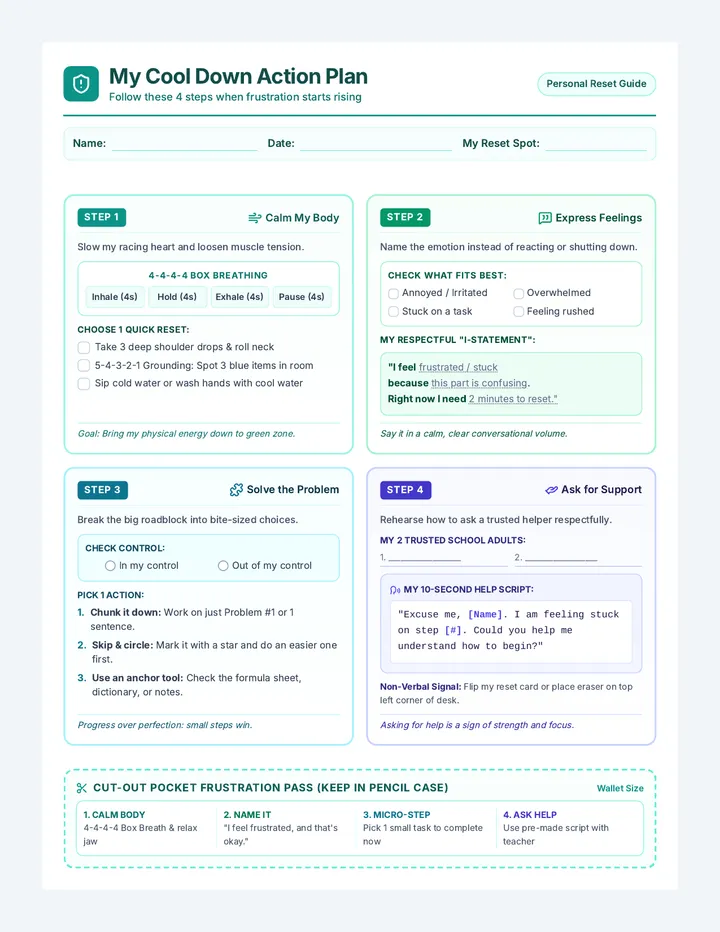
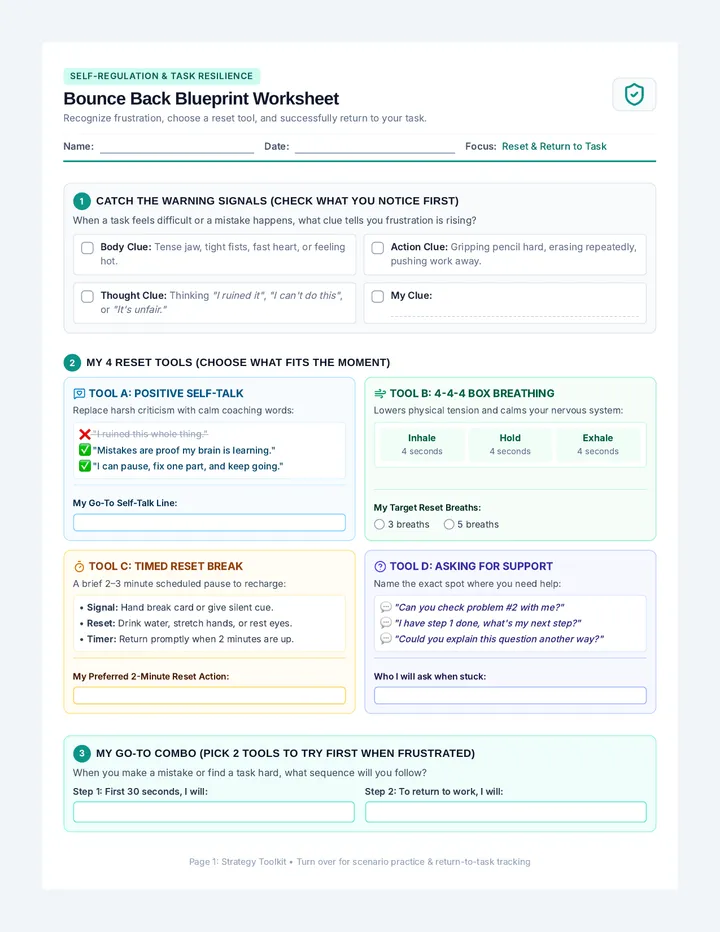
Cool Down Toolkit Slides Cool Down Toolkit
Strategies for Stress & Emotional Regulation
Inner Compass Academy | Lesson 2
Check Your Temp
Emotions are like a thermometer. To manage them, we first have to recognize where we are.
Red: Out of control (Angry, Panicked)Yellow: Losing grip (Frustrated, Worried)Green: Ready to learn (Calm, Focused)
Mindfulness in 60 Seconds
Box Breathing
1. Inhale (4 seconds)
5-4-3-2-1 Grounding
Name: 5 things you see, 4 you feel, 3 you hear, 2 you smell, 1 you taste.
THE REMOTE CONTROL RULE
PAUSE
REWIND
PLAY
PAUSE the situation before you react.
REWIND and think about the consequences.
PLAY out the best choice.
Is it a "Mountain" or a "Molehill"?
Not all stressors are the same. Match your reaction to the size of the problem.
Small Problems
Lost pencil, wrong lunch, small disagreement.
Big Problems
Safety issues, mean behavior, major loss.
Stress Buster Scenarios Stress Buster Scenarios
Lesson 2: Impulse Control & Self-Management
GROUP:
DATE:
ROLE-PLAY MISSION
In your small groups, read each scenario below. One person will act out the "Impulsive Reaction" (what we feel like doing), and another will act out the "Regulated Response" (using our Cool Down tools).
Scenario 1: The Accidental Bump
"You are walking in the hallway and someone bumps into you hard, knocking your books out of your hands. They don't say sorry and keep walking."
Impulsive Reaction:
Regulated Response:
Scenario 2: The Group Project
"Your group is working on a poster. You have a great idea, but one student keeps talking over you and ignoring your suggestions."
Impulsive Reaction:
Regulated Response:
Scenario 3: The Forgotten Homework
"You spent hours on your homework, but you realize you left it on your kitchen table. The teacher is about to collect it."
Impulsive Reaction:
Regulated Response:
Group Reflection
1. Which "Regulated Response" was the hardest to come up with? Why?
2. What physical signs does your body give you when you are in the "Yellow" or "Red" zone?
Self-Regulation Exam Quiz Self-Regulation Exam
Lesson 2: Stress & Self-Management Assessment
NAME:
DATE:
SECTION 1: CONCEPTS & DEFINITIONS
1. Which term describes the ability to control your behavior, emotions, and thoughts in the pursuit of long-term goals?
Self-Reflection
Self-Regulation
Social Awareness
2. What is the primary goal of "Grounding" techniques (like the 5-4-3-2-1 method)?
To help you remember facts for a test.
To bring your focus back to the present moment and calm the nervous system.
To improve your physical balance and coordination.
3. In the "Emotional Thermometer," being in the YELLOW zone typically means:
You are feeling calm, happy, and ready to learn.
You are totally out of control and may scream or cry.
You are starting to feel frustrated or anxious and need a tool to cool down.
SECTION 2: STRATEGY MATCHING
Match the tool to the specific situation where it would be most helpful.
1. Pause/Rewind/Play ____
2. Box Breathing ____
3. Mountain vs. Molehill ____
4. Mindfulness ____
A. You are feeling overwhelmed by a long list of tasks.
B. You are about to send a mean text because you're angry.
C. You are feeling a "racing heart" before a presentation.
D. You are eating lunch but realize you aren't tasting the food.
SECTION 3: PERSONAL APPLICATION
4. Describe one "Physical Signal" your body sends you when you are becoming stressed.
5. Why is it important to recognize a "Molehill" problem versus a "Mountain" problem?
Perspective Lens Slides Perspective Lens
Mastering Empathy & Respect for Diversity
Inner Compass Academy | Lesson 3
The Empathy Heart
Empathy is the ability to understand and share the feelings of another person.
"Sympathy is feeling for someone; Empathy is feeling WITH someone."
PUT ON THEIR GLASSES
The Same Fact, Different Views
The Event:
"It is raining on a Saturday morning."
Person A (Farmer)
"This is wonderful! My crops need this water to grow."
Joyful
Person B (Soccer Player)
"This is terrible! My championship game will be canceled."
Disappointed
Diversity is Strength
Diversity means all the ways we are different—including culture, race, ability, interests, and beliefs.
Listen to learn
Ask kindly
Include others
The Golden Rule
"Treat others the way YOU want to be treated."
Focuses on your own preferences.
The Platinum Rule
"Treat others the way THEY want to be treated."
The ultimate empathy goal!
The Unity Game Activity The Unity Game
Lesson 3: Cooperative Learning & Diversity
TEAM:
Game Mission
To win this game, your team must complete the "Unity Bridge." You don't compete against each other; you work together to find common ground while celebrating what makes each of you unique.
01 PHASE 1: THE COMMON GROUND HUNT
Talk with your team. Find 3 things that EVERY SINGLE person in your group has in common (besides the obvious like "we are students").
#1
#2
#3
02 PHASE 2: THE UNIQUE PIECE
Now, each person shares one thing about themselves that is DIFFERENT from everyone else in the group. Write your name and your unique trait.
Member 1 Name:
Member 2 Name:
Member 3 Name:
Member 4 Name:
03 PHASE 3: THE UNITY BRIDGE
Final Team Challenge:
"Imagine your group is building a community garden. You have different ideas about what to plant. Member A wants only flowers; Member B wants only vegetables. How do you respect BOTH preferences?"
Empathy Expert Quiz Assessment Empathy Expert Quiz
Lesson 3: Perspective & Diversity Assessment
NAME:
1. Which of the following is the best definition of PERSPECTIVE-TAKING?
Watching a movie from the front row.
Changing your mind because someone told you to.
Stepping outside of your own thoughts to see a situation through someone else's eyes.
2. How does the PLATINUM RULE differ from the Golden Rule?
The Platinum Rule is only for adults.
The Platinum Rule focuses on the other person's needs instead of your own.
There is no difference between the two.
3. Diversity refers to:
Only the race of a person.
The range of human differences including culture, ability, beliefs, and more.
A group of people who are exactly the same.
Match the Empathy Skill:
1. Asking a friend why they are sad ____
2. Inviting a new student to play ____
3. Thinking "How would I feel?" ____
A. Inclusivity
B. Active Listening
C. Perspective Taking
4. Imagine a student in your class has a physical disability that prevents them from playing a certain game at recess. How can you show respect for diversity in this situation?
Vision Quest Journal Vision Quest Journal
Lesson 4: Future Focused Growth
NAME:
LOOKING BACK
Think about everything we have learned. What is one SEL skill (empathy, regulation, growth mindset) that you have used this week?
Describe the situation...
SETTING A SMART GOAL
Specific
Measurable
Achievable
Relevant
Time-bound
My Goal:
3 Steps to get there:
Who can help me?
THE "FUTURE ME" MESSAGE
Write a 3-sentence note to your future self about why you are proud of the person you are becoming.
Dear Future Me...
The Roadmap Slides Goal Setting The Roadmap
Turning Dreams into Action Plans
Inner Compass Academy | Lesson 4
Why Set Goals?
1
Focus: They give your brain a destination.
2
Motivation: They give you a reason to keep trying.
3
Growth: They help you stretch your abilities.
Be SMART About It
S
Specific
M
Measurable
A
Achievable
R
Relevant
T
Time-bound
Example: "I want to get better at math" "I will practice multiplication for 15 minutes every Monday and Wednesday this month."
The "If-Then" Strategy
When you hit a roadblock, have a plan ready.
IF [Obstacle] happens...
THEN I will [Action].
Every Step Counts
You have the tools. You have the mindset. Now, take the first step towards the future you want to create.
The journey has just begun
SEL Mastery Exam Final SEL Mastery Exam
Comprehensive Final Assessment
NAME:
DATE:
SECTION 1: CORE KNOWLEDGE
1. Which mindset believes that effort is the path to mastery and that mistakes are part of learning?
Fixed Mindset
Growth Mindset
2. What is the most important first step when you feel yourself entering the "RED" zone on the emotional thermometer?
PAUSE before reacting.
Yell as loud as you can to let it out.
Run away as fast as possible.
3. In a SMART goal, what does the "A" stand for?
Amazing
Achievable (Possible to do)
Always
SECTION 2: REAL WORLD APPLICATION
4. EMPATHY & PERSPECTIVE-TAKING
"You love pizza, but your friend has a severe dairy allergy and gets upset when people bring pizza to their house. You think they are just being 'sensitive'."
How can you apply EMPATHY to see this situation differently?
5. SELF-MANAGEMENT & IMPULSE CONTROL
"Someone posts a comment online that you disagree with, and you feel a 'mountain' reaction building up. You want to type a mean reply immediately."
Outline a 3-step "PAUSE-REWIND-PLAY" plan for this situation:
Pause:
Rewind:
Play:
SECTION 3: PERSONAL REFLECTION
6. What is the most important thing you learned about yourself during this unit?