Strengths Compass Lesson Plan
SEL & Advisory Curriculum Grades 6–10 (Adaptable for 11–12)
Strengths Compass Lesson Plan
Navigating Personal Qualities, Talents, Learning Strengths, and Whole-Person Potential
55 Minutes
Tier 1 Core Instruction
Essential Questions
- What makes a strength beyond grades or sports?
- How do diverse strengths interact to form my unique identity?
Learning Objectives (SWBAT)
- Identify & categorize strengths in 4 core domains.
- Construct a personalized "Whole-Person Superpower Formula".
Standards & Competencies
CASEL Self-Awareness: Identifying personal, cultural, and linguistic assets; cultivating positive self-efficacy.
Required Materials: Strengths Compass 4-Quadrant Handouts, color sticky notes, markers, and index cards.
Solo, Pair & Whole-Class
Anchor Framework: The 4 Dimensions of Student Strength
Holistic Asset-Based Inventory
1. Personal Qualities Character
Internal traits, values, and emotional dispositions shown across life situations.
Key Examples: Grit/persistence, empathy, kindness, integrity, curiosity, resilience, humor, moral courage, patience, optimism.
2. Skills & Talents Execution
Learned or practiced proficiencies in artistic, academic, athletic, or life areas.
Key Examples: Digital editing, cooking, conflict mediation, visual sketching, athletic coordination, coding, storytelling, organization.
3. Learning Strengths Cognition
How an individual absorbs, processes, problem-solves, and collaborates in academic tasks.
Key Examples: Visual diagramming, asking clarifying questions, collaborative brainstorming, methodical step-by-step thinking, kinesthetic trial.
4. Whole-Person Synergy Integration
The compound effect when qualities, skills, and learning styles merge for impact.
Synergy Formula: Empathy (Quality) + Visual Sketching (Skill) + Reflective Processing (Learning) = Inspiring team graphic recorder.
Guiding Philosophy: Strengths are not static badges or innate genius. They are malleable, situational, and multi-faceted. Students must recognize that quiet traits like patience or analytical listening are just as valuable as extroverted or high-visibility achievements.
Strengths Compass Lesson Plan • Instructional Design Blueprint Page 1 of 3 • Core Framework
Facilitation Sequence
Lesson Agenda & Step-by-Step Delivery
Total Instructional Time: 55 Mins
01 • 7 MINS
Hook: The Strengths Iceberg
Whole Class • Provocation
Teacher Facilitation:
Draw a simple iceberg on the board. Label the top 10% "Visible Wins" (grades, athletic medals). Ask: "What silent strengths stay underwater that actually hold that tip up?"
Student Actions & Output:
Quick-pair share. Students call out underwater traits (perseverance, staying late to practice, reassuring a peer), which the teacher maps below the waterline.
02 • 10 MINS
Direct Inquiry: Unpacking the 4-Quadrant Compass
Interactive Modeling
Teacher Facilitation:
Distribute the 4-Quadrant Compass. Walk through each quadrant with contrasting personas (e.g., quiet student who spots errors through deep focus = powerful learning strength).
Student Actions & Output:
Students test each category by sorting 3 sample student micro-bios into the correct quadrant to build conceptual fluency before self-assessment.
03 • 18 MINS
Active Investigation: Strength Detective Lab
Solo Mining (8m) • Pair Affirmation (10m)
Phase A: Solo Asset Inventory (8 min)
Students write at least 2 authentic strengths into each quadrant on their compass. Circulate to prompt reluctant students with evidence-based cues.
Phase B: Peer Detective Validation (10 min)
Partners trade sheets. Partner spots and writes one "Hidden Strength Witnessed" on a sticky note with concrete evidence from class or campus life.
04 • 12 MINS
Synthesis: The Superpower Synergy Formula
Independent Application
Teacher Prompt:
Guide students to connect items from Quadrants 1, 2, and 3: "When I combine [Trait] with [Skill] and my [Learning Style], I can solve [Challenge]."
Student Deliverable:
Students write their Personal Synergy Statement and record one academic or social challenge where they will intentionally deploy it this week.
05 • 8 MINS
Closure & Formative Assessment: 3-2-1 Pledge Card
Individual Accountability
Students complete an Exit Ticket: 3 verified personal strengths across quadrants, 2 peer strengths noticed today, and 1 specific commitment for how they will apply a learning strength in their most challenging class.
Facilitator Coaching: Navigating Student Barriers
Barrier: "I don't have any strengths."
Reframe immediately: "Strengths aren't just trophies. Are you a loyal friend? Do you notice when someone is down? That is emotional intuition and character strength."
Barrier: "It feels like bragging."
Normalize self-awareness: "Knowing your strengths is like knowing the tools in your toolbox. It isn't showing off; it is knowing how you can contribute."
Strengths Compass Lesson Plan • Instructional Design Blueprint Page 2 of 3 • Facilitation Arc
Evaluation & Equity
Assessment, Differentiation & Extensions
Universal Design for Learning (UDL)
Formative Mastery Rubric
| Evaluative Criterion | Proficient / Target (3) | Developing (2) | Emerging / Needs Prompt (1) |
|---|
| Quadrant Breadth & Classification | Accurately identifies distinct items across all 4 quadrants with clear differentiation. | Identifies strengths in 2–3 quadrants; some overlap between skills and qualities. | Confines strengths to single domain (e.g., only sports or only academics). |
| Grounding in Concrete Evidence | Provides specific, real-world examples illustrating each trait in school or daily life. | Lists generic traits (e.g., "nice", "smart") with minimal situational context. | Requires teacher or peer coaching to articulate any concrete example. |
| Whole-Person Synergy & Action | Integrates trait + skill + learning style into a viable, actionable pledge for upcoming tasks. | Drafts a partial formula; plan for application is vague or disconnected. | Struggles to see connection between personal qualities and academic success. |
Tiered Differentiation Matrix (UDL)
Language & Scaffolds
- Provide 36-word Strength Bank sorted by color quadrant.
- Sentence frames: "One way I show [trait] in class is when I..."
- Bilingual glossaries for multilingual learners.
Neurodiversity & Anxiety
- Option to sketch or use icons instead of lengthy writing.
- Private affirmation cards if partner share causes social fatigue.
- Pacing checkpoints with teacher check-ins every 5 minutes.
Extensions & Leadership
- "User Manual for Me": Create a 1-page guide for group project partners.
- Analyze a literary or historical figure's 4 quadrants and failures/pivots.
- Serve as "Strength Ambassador" to lead group debriefs.
Cross-Curricular Extensions & Ongoing Integration
Language Arts (ELA):
Apply the 4-Quadrant Compass to analyze novel protagonists (e.g., Katniss Everdeen or Jonas) when examining character development.
STEM & Science Labs:
Assign lab roles (Data Analyst, Recorder, Spokesperson) based on complementary team learning and execution strengths.
Advisory & Goal-Setting:
Revisit the Compass quarterly to update skills acquired and track changes in academic confidence and personal goals.
Post-Lesson Teacher Reflection Prompts
• Did students lean heavily on athletic/academic tropes? Which quadrants required the most scaffolding?
• Did peer affirmations unearth hidden strengths that quiet students had previously concealed?
Strengths Compass Lesson Plan • Instructional Design Blueprint Page 3 of 3 • Assessment & Equity
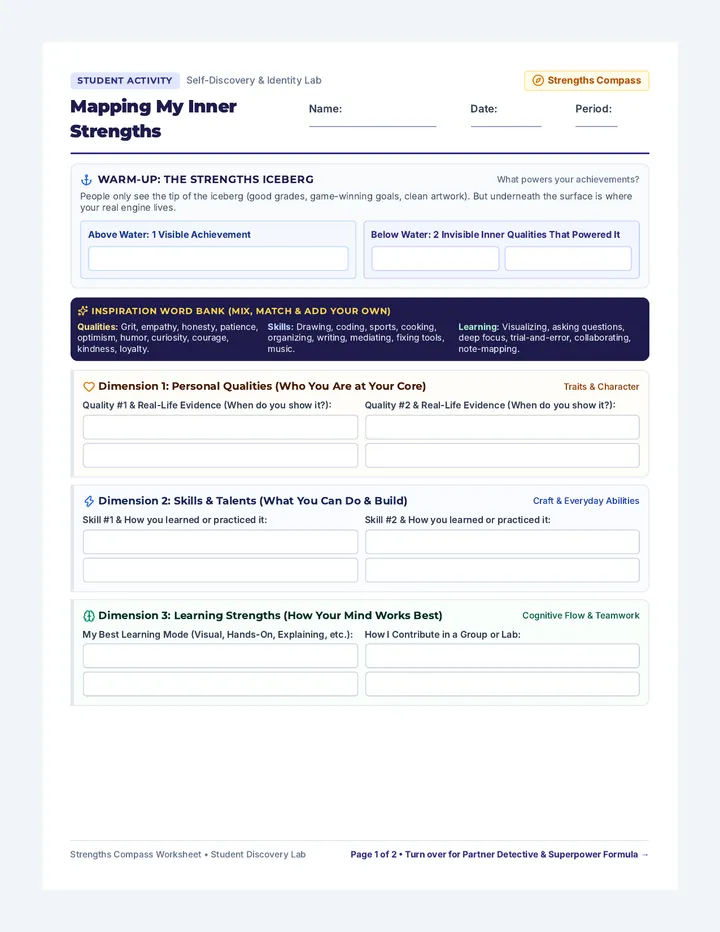
Strengths Compass Worksheet
Student Activity Self-Discovery & Identity Lab
Strengths Compass
Mapping My Inner Strengths
Name:
Date:
Period:
Warm-Up: The Strengths Iceberg
What powers your achievements?
People only see the tip of the iceberg (good grades, game-winning goals, clean artwork). But underneath the surface is where your real engine lives.
Above Water: 1 Visible Achievement
Below Water: 2 Invisible Inner Qualities That Powered It
Inspiration Word Bank (Mix, Match & Add Your Own)
Qualities: Grit, empathy, honesty, patience, optimism, humor, curiosity, courage, kindness, loyalty.
Skills: Drawing, coding, sports, cooking, organizing, writing, mediating, fixing tools, music.
Learning: Visualizing, asking questions, deep focus, trial-and-error, collaborating, note-mapping.
Dimension 1: Personal Qualities (Who You Are at Your Core) Traits & Character
Quality #1 & Real-Life Evidence (When do you show it?):
Quality #2 & Real-Life Evidence (When do you show it?):
Dimension 2: Skills & Talents (What You Can Do & Build) Craft & Everyday Abilities
Skill #1 & How you learned or practiced it:
Skill #2 & How you learned or practiced it:
Dimension 3: Learning Strengths (How Your Mind Works Best) Cognitive Flow & Teamwork
My Best Learning Mode (Visual, Hands-On, Explaining, etc.):
How I Contribute in a Group or Lab:
Strengths Compass Worksheet • Student Discovery Lab Page 1 of 2 • Turn over for Partner Detective & Superpower Formula →
Part 2
Connecting Strengths & Taking Action
Synergy Blueprint
Partner Detective Swap: A Strength Someone Else Sees in You
Peer Affirmation
Hand your paper to a partner. Partner writes one positive quality or talent they have seen you use in class or around school, with real evidence.
Detective Partner Name:
Strength I have witnessed in you:
Evidence (Where and when I saw you demonstrate this):
The Superpower Synergy Equation
Dimension 4: Synergy
A true superpower is not just one skill—it is what happens when you combine your character trait, practical ability, and how your mind works!
1 Personal Quality
1 Practical Skill
Learning Style
My Integrated Superpower Statement (In 1–2 complete sentences):