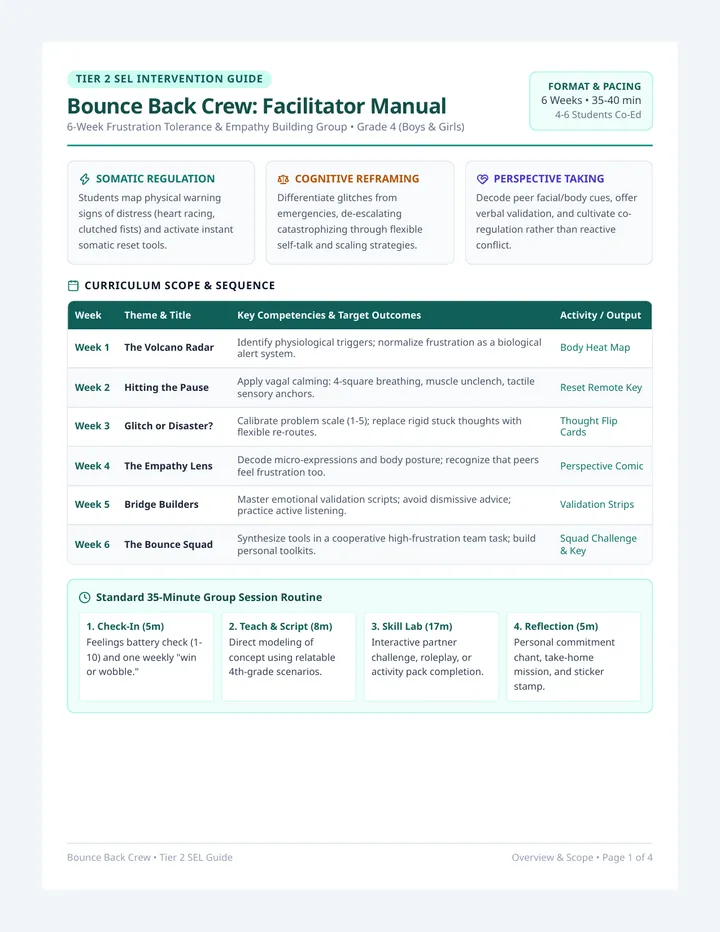
A targeted social-emotional learning lesson designed to help students recognize the signs of frustration early, regulate their body and emotions, break down problems into actionable steps, and confidently ask for adult support.
Part 5: Brain Reframing (Flip Frustrated Thoughts)
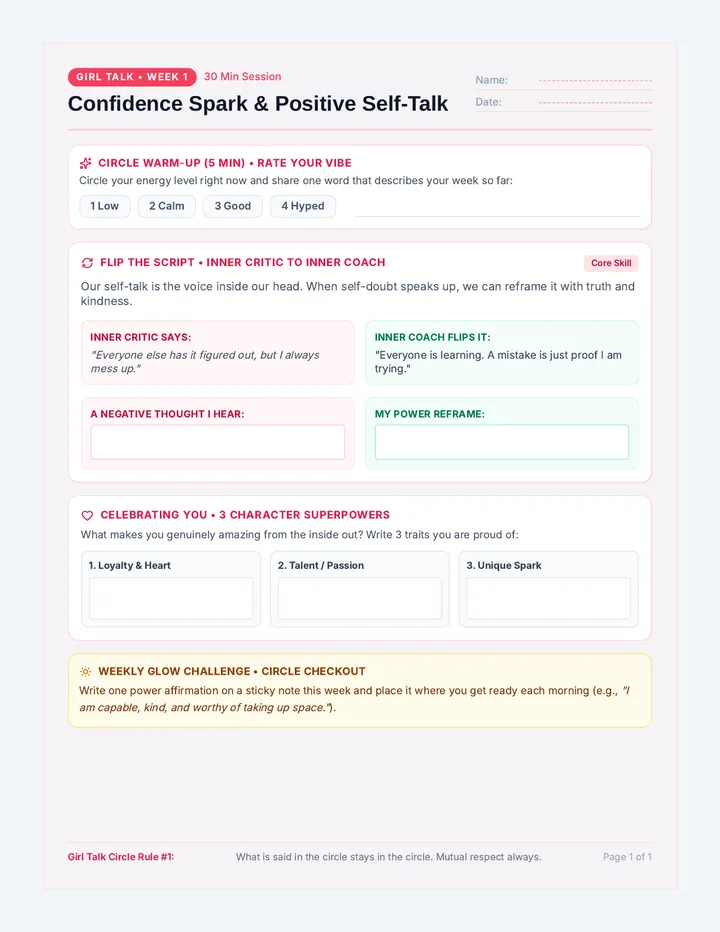
When frustration speaks, it exaggerates. Practice reframing negative self-talk:
Frustrated Thought: "I can't do this, it's impossible!"
Calm Reframe: "This is tricky, but I can do one small part first."
Frustrated Thought: "Everyone is faster than me!"
Calm Reframe: "Speed doesn't matter. Taking my time helps me learn."
Write your own personal calm reframe to use when you feel stuck:
Part 6: Rehearsing How to Ask for Support
Asking for help before you explode is a superpower. Fill in your personalized script:
Adult I will ask:
Best time / method to ask:
My Exact Help Sentence:
"Excuse me, _____________________. I am working on _____________________ and I feel stuck on _____________________. Could you please help me break down the next step?"
My Frustration Reset Commitment
I agree to try my breathing and action plan whenever my thermometer reaches Level 2 or 3.
Engage the student in realistic simulations. Have them consult their Cool Down Action Plan in real time.
Scenario A: The Timed Test Roadblock
"You are working on a multi-step writing prompt. The timer shows 10 minutes left. You made a mistake and erased a hole in your paper."
Target Response: Student pauses, takes 2 box breaths, drops pencil, whispers "This is hard, but I can write one sentence," and raises hand using the Help Script.
Scenario B: Partner Project Disagreement
"Your partner refuses your idea for the project poster and starts coloring without asking your opinion."
Target Response: Student checks body tension (unclenching fists), uses the I-statement: "I feel frustrated because I want to help decide the design. Let's ask the teacher how we can divide it."
5 Phase 5: Classroom Transfer & Teacher Partnership (5 Min)
Generalization
1. Reset Desk Mat Laminate the Action Plan and tape it securely to the student's desk or binder cover.
2. Subtle Signal Agree on a non-verbal cue with classroom teacher (e.g., student places green/yellow card on corner).
3. 3-Min Reset Window Student is allowed a 3-minute drink or sensory break before re-engaging with task chunk #1.
Counselor Progress Monitoring Rubric
Skill Indicator
Emerging (1)
Developing (2)
Proficient (3)
Body Cue Detection
Unaware until Level 5
Identifies cues with adult prompting
Self-identifies Level 2-3 cues independently
Regulation Practice
Refuses breathing/break
Attempts breath with coaching
Initiates box breath / sensory grounding
Help-Seeking Communication
Shuts down or acts out
Uses non-verbal cue or card
Delivers respectful verbal or written help script
Next Follow-Up Check-In:
Counselor Signature:
Never stay stuck in mud.
You don't need to finish the whole journey at once. You only need the next single step.
Pillar 4: Rehearsal Challenge
Step 4: Practice Your Help Request
The 10-Second Help Script
"Excuse me, [Teacher's Name]. I am feeling stuck on step 2. Could you please help me understand how to begin?"
Silent Alternative: Place your Cool Down Card on the desk corner.
Try It Now: Role-Play
Scenario: You've spent 5 minutes on a question. Your eraser just tore the paper, and your pencil lead snapped.
1. Take one deep box breath.
2. Say: "I feel frustrated, but I can handle this."
3. Deliver your help script to the counselor right now!
Asking for help when you're frustrated is what smart, strong leaders do.