Session One Lesson Plan Session 1 Lesson Plan
Topic: Recognizing Anxiety
30 Minutes
The Purpose
Understanding what anxiety feels like and having initial coping strategies empowers students with autism to attend school confidently and reduces avoidance behaviors.
Learning Objective
Students will define anxiety, identify related feelings, build group rapport, and get introduced to coping strategies to manage school-related anxiety.
Quick Info
Audience
Eighth graders with autism
Approach
Interactive discussion & hands-on activities
Materials
Chart Paper & Markers
Index Cards
Feelings Worksheet
Coping Tools Card
Prepare Materials (10 mins)
Print copies of Anxiety Feelings Worksheet for each student.
Prepare one large poster titled Anxiety Definition on chart paper.
Gather markers and a stack of index cards for the warm-up.
Review the Coping Tools Overview Card to familiarize yourself with each strategy.
Instructional Sequence
5m
Warm-Up Check-In
Distribute index cards; ask students to write one word describing how they feel about coming to school today.
Collect cards, read aloud anonymously, and group similar feelings on the chart paper poster.
5m
Define Anxiety
Introduce the term anxiety using the chart paper poster.
Ask students to share examples of times they’ve felt anxious at school.
Write key phrases and emotions around the definition.
7m
Feeling Matching Activity
Provide small scenario cards describing school situations.
In pairs, students match each scenario to feelings listed on their worksheet.
Share one scenario and feeling with the group.
8m
Worksheet Completion
Students complete the Anxiety Feelings Worksheet , identifying physical signs and thoughts.
Circulate and offer support as needed.
5m
Cool-Down & Introduce Tools
Distribute Coping Tools Overview Card .
Review one or two strategies (deep breathing, positive self-talk).
Students choose one tool to try before the next session.
Anxiety Feelings Worksheet Anxiety Feelings Worksheet
Session 1
Name
Date
1 List Three Feelings
Write three words that describe how you feel when you think about going to school.
2 Match Feelings to Scenarios
Your teacher will show you scenario cards. Write the feeling that best matches how you would feel.
Scenario 1
Scenario 2
Scenario 3
3 Physical Signs of Anxiety
What does your body feel like when you’re anxious at school? Write at least three signs.
4 Anxious Thoughts
What kinds of thoughts go through your mind when you feel anxious? Write at least three.
Use this worksheet to help you notice and name your feelings. We’ll use these notes when we learn coping strategies in future sessions!
Coping Tools Reference Card Coping Tools Toolkit
Quick Strategies to Manage Anxiety
Deep Breathing
Slow down your heart and calm your brain by controlling your breath.
1 Inhale slowly for 4 counts
2 Hold your breath for 2 counts
3 Exhale slowly for 6 counts
Self-Talk
Be your own coach. Replace scary thoughts with "I can" statements.
"I have handled this before."
"I am safe right now."
"One step at a time."
Grounding
Get out of your head and into the room by noticing things around you.
5 Things I See
4 Things I Feel
3 Things I Hear
2 Things I Smell
1 Thing I Taste
Squeeze & Release
Release physical tension by tightening then relaxing your muscles.
Squeeze your fists tight for 5 seconds... then drop them and feel the stress melt away.
"Coping tools are like muscles—the more you practice, the stronger they get!"
Feeling Matching Scenario Cards Feeling Matching Scenario Cards
Cut along the dotted lines. Use these for the Feeling Matching Activity in Session 1.
Scenario A
The teacher announces a surprise pop quiz on the chapter you just finished reading.
Scenario B
You have to stand at the front of the classroom and give a 2-minute presentation.
Scenario C
The lunchroom is extra loud today, and there are no empty seats at your usual table.
Scenario D
You realize you left your important homework assignment at home on the day it's due.
Scenario E
A group of students are laughing in the hallway and you're not sure if they're laughing at you.
Scenario F
The fire alarm suddenly goes off during a quiet reading time.
Teacher Tip
Encourage students to think about the physical signs and thoughts they wrote on their worksheet when discussing these scenarios. There are no wrong answers—different scenarios affect people in different ways!
Session One Facilitator Guide Facilitator Guide
Session 1: The Anxiety Wave
CONQUER SCHOOL ANXIETY
1
Warm-Up Check-In (5 min)
Instructions:
Give each student an index card and a marker.
Prompt: “Write one word on your card that describes how you feel about coming to school today.”Collect the cards, shuffle them, and read each word aloud anonymously.
Invite volunteers to place cards on the Anxiety Definition chart paper, grouping similar feelings.
Key Takeaway: “I notice many of us feel [e.g., nervous, tired]. That’s okay—today we’ll talk about anxiety and build tools to help.”
2
Group Discussion (5 min)
Guidelines
One person speaks at a time.
All feelings are valid—no "wrong" answers.
What’s shared here stays here (confidentiality).
Facilitator Note
If a student struggles to find words, offer prompts from the worksheet (physical signs, thoughts).
Check-In Prompt:
“What made you choose the word you wrote on your index card?”
Exploring Feelings:
“What does anxiety feel like in your body? Look at your worksheet—which physical sign happens most often?”
“What kinds of thoughts go through your mind when you feel that way? How do they make you feel overall?”
Real-Life Scenario:
“Think of a time at school when you felt anxious. Would anyone like to tell us briefly what happened? How did your body feel? What did you do next?”
3
Cool-Down & Exit Ticket (5 min)
Guided Deep Breathing (2 min)
Model the breathing exercise from the Coping Tools Card :
Inhale slowly for a count of 4.
Hold for 2.
Exhale for a count of 6.
Repeat together 3 times.
Exit Ticket: Tool & Plan (3 min)
Ask each student to choose one tool they want to try. Distribute an index card.
Sample Exit Ticket Format
Tool I will try: __________________________
When I will use it: ______________________
Preview Next Session
Practicing Mindfulness & Grounding Strategies
Mindfulness Practice Slides Mindful Moments
Session 2: Grounding & Breathing
Conquer School Anxiety
Session Check-In
Think back to your Exit Ticket from last session.
"Did you have a chance to try your coping tool this week?"
Discussion Prompts:
Grounding
The 5-4-3-2-1 Technique
5
Things You See
4
Things You Feel
3
Things You Hear
2
Things You Smell
1
Thing You Taste
Grounding brings your focus back to the present moment.
Box Breathing
INHALE (4s)
HOLD (4s)
EXHALE (4s)
HOLD (4s)
When to Use It?
CHALLENGE
IN CLASS
Before a test or when a teacher starts a long lecture.
HALLWAYS
Between classes when it's loud or crowded.
TRANSPORT
On the bus or during school drop-off.
Session Two Lesson Plan Session 2 Lesson Plan
Topic: Mindful Moments
30 Minutes
The Purpose
Practicing sensory grounding and rhythmic breathing helps students regulate their nervous system when feeling overwhelmed by school environments.
Learning Objective
Students will demonstrate 5-4-3-2-1 grounding and box breathing techniques and identify specific times to use them during the school day.
Materials Needed
Mindfulness Slides
Grounding Log Worksheet
Coping Cards (from Session 1)
Sequence of Activities
5m
Last Session Review
Share successes or challenges with trying last week's coping tool. Use the "Session Check-In" slide.
7m
The 5-4-3-2-1 Grounding Practice
Guide the group through the 5-4-3-2-1 technique using the items in the immediate room. Focus on sensory details (e.g., "The blue plastic of the chair", "The humming of the fan").
8m
Box Breathing Masterclass
Use the Box Breathing slide. Practice 4 rounds together. Have students try it with their eyes closed for the last two rounds if comfortable.
5m
Application Planning
Students identify three "Hot Spots" (anxious places) at school and write down which mindfulness tool they will use in each.
5m
Cool-Down: Quiet Minute
End with one minute of silence. Exit ticket: One word for how they feel after practicing the tools.
Neurodiversity Affirming Tip
Some students may find "eyes closed" uncomfortable or "feeling" certain textures overstimulating. Always offer alternatives like "soft gaze" or choosing a different sense if one feels overwhelming.
Grounding Log Worksheet My Grounding Log
Session 2: Stay in the Moment
Name
1. The 5-4-3-2-1 Practice
5
Things I See
4
Things I Feel
3
Things I Hear
2. My School "Hot Spots"
Where do you feel anxious? Which tool will you use there?
Place in School
Coping Tool I'll Use
Place in School
Coping Tool I'll Use
Keep this log in your folder to remind you: You have control.
Session Three Lesson Plan Session 3: Thought Bosses
Self-Talk
Key Concept
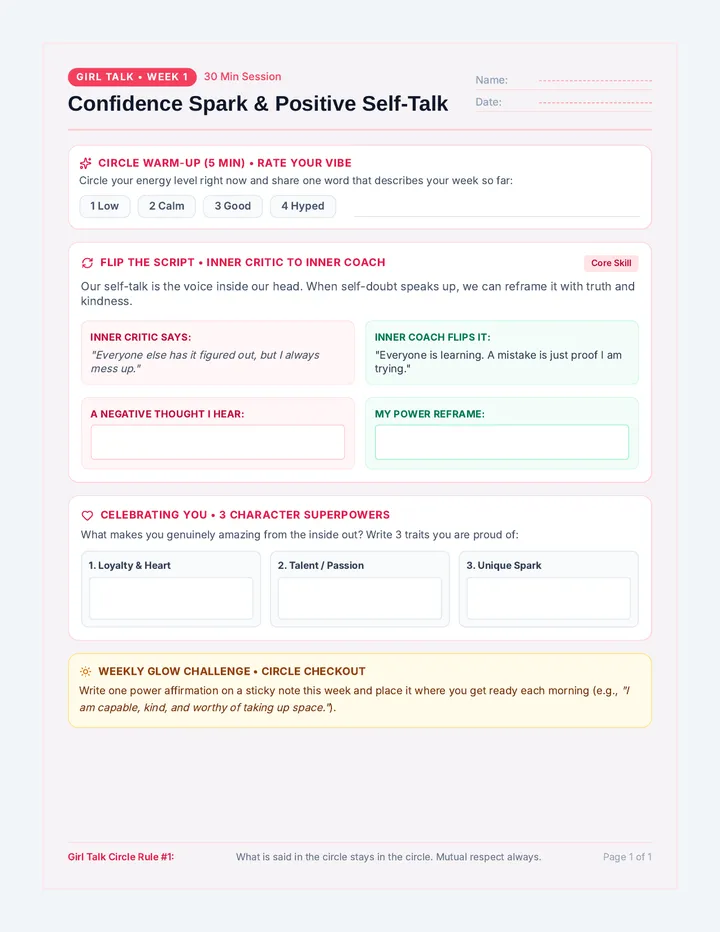
Anxiety often speaks in an "Inner Critic" voice (scary, loud, hopeless). We can train an "Inner Coach" to talk back with facts and kindness.
Objective
Students will reframe three common anxious school thoughts into "Inner Coach" statements.
Session Flow (30 min)
5m
Check-In: Practice one minute of box breathing. Review grounding "hot spots".
10m
The Two Voices: Explain Inner Critic vs. Inner Coach. Use examples: "I'll fail" vs. "I can try my best."
10m
Thought Reframing: Students complete the Inner Coach Training worksheet in pairs.
5m
Cool-Down: Share one "Coach" statement with the group. Give Success Sticker if used.
Materials: Inner Coach Worksheet, Pencils, Success Stickers
Inner Coach Worksheet Inner Coach Training
Be the boss of your thoughts!
The Inner Critic
Scary, Loud, Untrue
"Everyone is staring at me and thinks I'm weird."
"I'm going to fail this test and never graduate."
"I can't go to class today, it's too much."
The Inner Coach
Kind, Calm, Helpful
"I am focus on my work. Most people are focused on their own work too."
"I have prepared. I will do my best, and that's enough."
"I can take it one step at a time. I'll use my tools if it gets hard."
Practice Your Coaching
CRITIC THOUGHT: "I'll never understand this math problem."
COACH REFRAME: __________________________________________________
CRITIC THOUGHT: "I'm going to embarrass myself during the presentation."
COACH REFRAME: __________________________________________________
"Talk to yourself like you would talk to a friend."
Support Squad Map My Support Squad
Who can you turn to when things get tough?
The Support Map
Safe Places at School
Safe Adults & Peers
ME
Helpful Scripts
Practice saying these words to someone in your Support Squad.
To a Teacher
"I'm feeling a little overwhelmed. Can I use one of my tools for 2 minutes?"
To a Counselor
"I'm having some anxious thoughts about [topic]. Can we talk?"
"Asking for help is a superpower!"
Sensory Menu Worksheet My Sensory Menu
Small tools that make a big difference.
My Triggers
Check the things that make you feel anxious or overwhelmed:
Loud Hallways / Lunchroom
Bright Fluorescent Lights
People Touching My Desk
Strong Smells (like perfume)
Unexpected Schedule Changes
My Tools
Circle the tools you would like to try or use more often:
Headphones
Fidget Tool
Sunglasses
Deep Pressure
My Sensory Plan
When I feel overwhelmed by _______________, I will use my _______________ to help me stay calm.
Conqueror Success Plan #6
Conqueror's Plan
My Strategy for Success
My Top 3 Coping Tools
1. ___________
2. ___________
3. ___________
My Favorite "Inner Coach" Phrase
"________________________________________"
My School Support Squad
Signed By
I am a conqueror.