Paycheck Truths Reference Guide
Financial Literacy • Earning & Budgeting
Paycheck Truths Reference Guide
Understanding Gross vs. Net Pay, Deduction Realities, & Intentional Cash Flow
Resource Type
Model Exemplar & Key
Master Completed Reflection Statement
Standard Exemplar
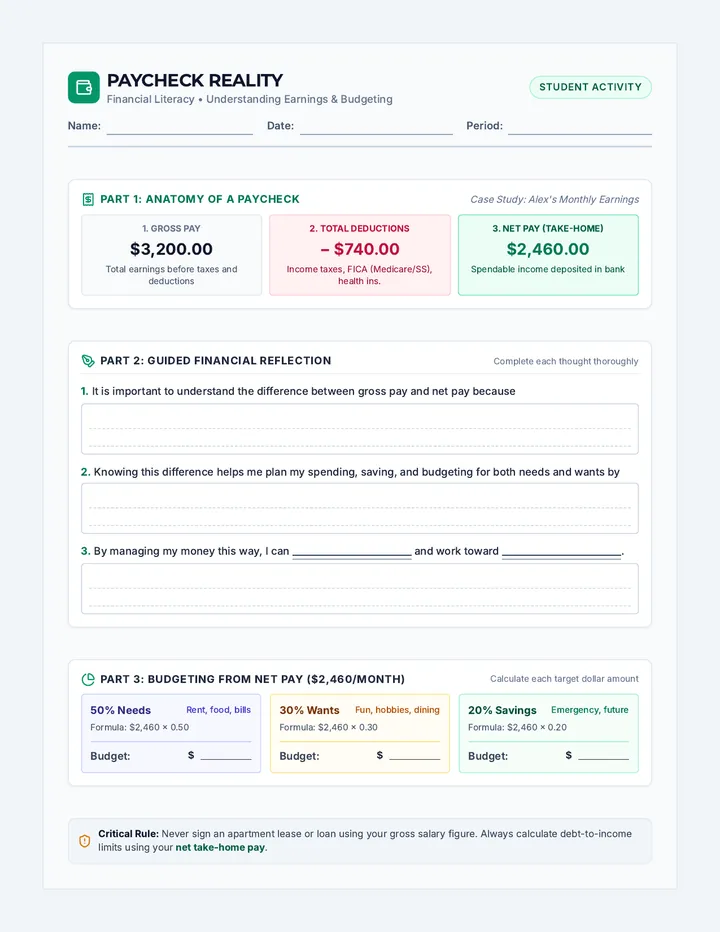
“It is important to understand the difference between gross pay and net pay because gross pay represents total earnings before deductions, while net pay is the actual take-home cash deposited into your account. Knowing this difference helps me plan my spending, saving, and budgeting for both needs and wants by basing my budget strictly on real take-home pay, funding essential needs first before allocating funds to savings and discretionary wants. By managing my money this way, I can avoid overdrafts, eliminate debt, and maintain a reliable emergency buffer and work toward long-term financial stability and major milestones like college, a car, or homeownership.”
Why Each Blank Matters: Financial Literacy Breakdown
1
Earning Reality (Gross vs. Net)
Gross pay is your contracted wage on paper. Net pay is the spendable amount remaining after mandatory payroll deductions (Federal/State taxes, FICA/Medicare) and voluntary benefits consume roughly 20% to 30%.
2
Needs vs. Wants Allocation
Budgeting against gross pay builds an immediate deficit. Net income gives the true baseline to fund 50% Needs (housing, food, transit), 30% Wants (hobbies, dining), and 20% Savings.
3
Daily Cash Flow Protection
When you align spending with spendable cash, you prevent overdraft penalties and eliminate reliance on high-interest credit cards or loans to cover the gap between paychecks.
4
Future Wealth & Goals
Consistent cash surpluses unlock long-term peace of mind: building a 3–6 month emergency fund, investing for compound returns, and funding major life milestones without debt.
Paystub Reality Check • Monthly Scenario ($15/hr × 80 hrs)
Formula: Gross − Deductions = Net
Gross Earnings
$1,200.00
80 hrs @ $15.00/hr
−
Deductions (22.5%)
-$270.00
Taxes & FICA (SS/Med)
=
Net Spendable
$930.00
Take-Home Cash
The Trap: Budgeting expenses around $1,200 creates an immediate $270 shortfall every single month!
Alternative Ways to Fill the Reflection (Targeted Models)
Model A: Student / First Job Focus
Practical
- Blank 1: “...taxes and deductions are taken out of gross pay, so take-home pay is smaller.”
- Blank 2: “...only budgeting what lands in my bank, making sure gas and essentials are paid first.”
- Blank 3: “...avoid overdrawing my checking account and build savings...”
- Blank 4: “...buying a reliable car and paying for college expenses.”
Model B: Wealth & Budgeting Focus
Advanced
- Blank 1: “...net pay is the true baseline of my disposable income after payroll withholdings.”
- Blank 2: “...applying the 50/30/20 rule to my net pay so fixed obligations never exceed available cash.”
- Blank 3: “...maintain positive cash flow and build an emergency safety net...”
- Blank 4: “...financial independence, real estate equity, and early retirement.”
Financial Literacy Core Concepts • Income, Payroll Deductions, & Budgeting
Ready for Classroom Instruction & Student Study