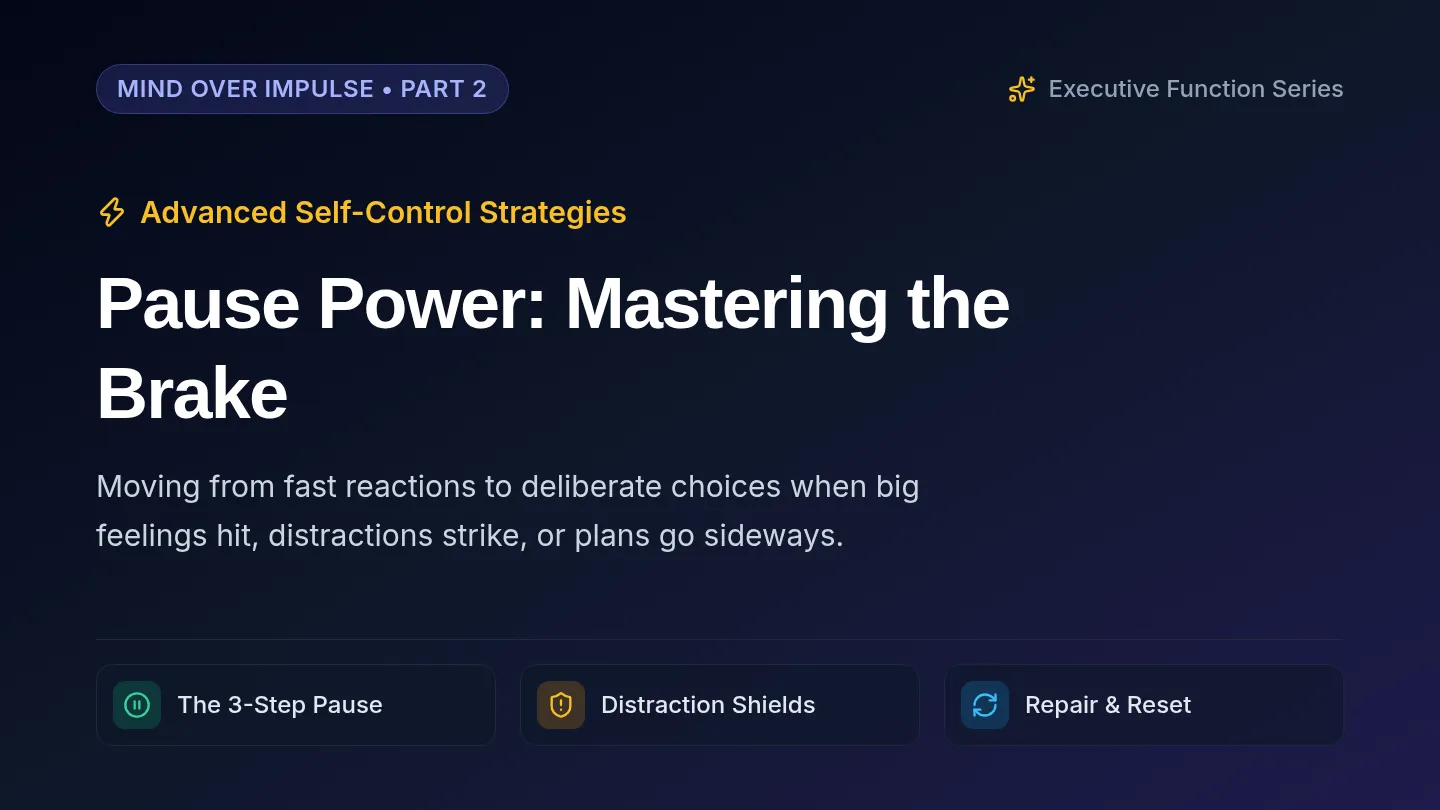
Campus Talk Slides Campus Communication Playbook
Core Life & Academic Skills
Words That Work
How to communicate with respect, ask for help like a pro, and navigate school situations with confidence.
Respectful Tone
Words that build trust
Asking for Help
Clear 4-step framework
Read the Room
Peers, staff & teachers
Foundational Concept
The 3 T's of Great Communication
Before you speak or write, tune into these three signals.
1. Tone
Your vocal pitch, volume, body language, and word warmth. It is how your message lands.
"Calm, steady, and clear beats loud or sarcastic."
2. Timing
Picking the right moment. Not mid-instruction, during emergency drills, or when someone is rushed.
"Wait for independent work time or after class."
3. Target
Knowing who you are talking to and choosing language appropriate for that audience.
"Casual for friends, professional for school adults."
Quick Check: Am I in the right mindset, at the right time, with the right words?
Skill 1 • Language Polish
Flip the Script: Tone Shifts
Small word changes turn complaints into constructive conversations.
Sounds Demanding
"You graded this wrong. Give me my points back."
Respectful Inquiry
"Could you help me understand question 4 so I can fix my mistakes?"
Sounds Dismissive
"That's a dumb idea. We're not doing that."
Collaborative Disagreement
"I see your point, but what if we combined it with this idea instead?"
Rule of Thumb: Replace accusations ("You did this") with curiosity ("Could we look at this together?").
Skill 2 • Self-Advocacy
The 4-Step Help Formula
Avoid saying "I don't get anything." Use this structure instead:
1
State Effort
Tell what you already tried first.
"I read step 2 and tried problem 3..."
2
Pinpoint Stuck
Name the exact roadblock.
"...but I got stuck finding the denominator."
3
Ask Question
Ask a specific question for clarity.
"Could you show how you set up step 1?"
4
Polite Close
Thank them for their time.
"Thank you, that makes a lot of sense!"
Why this works: Teachers and classmates can see your thinking and give exact, fast help.
Skill 3 • Situational Code-Switching
Audience Check: Who Are You Talking To?
Different campus settings call for different communication habits.
With Peers 🤝
Casual & Supportive
Friendly and relaxed, but requires active listening and respect in group work.
Key Tip: Avoid interrupting; value every idea.
With Teachers 📚
Professional & Direct
Use titles, raise hand, use clear emails, and state questions politely.
Key Tip: State context clearly and be patient.
With Staff 🏫
Courteous & Patient
Custodians, office staff, cafeteria teams, and bus drivers make our school day possible.
Key Tip: Use "please" and sincere gratitude.
Treat every person on campus with dignity — courtesy reflects your character.
Guided Practice
Class Challenge: What Would You Say?
Put the 3 T's and the 4-Step Help Formula into action!
The Situation:
You were absent yesterday with a cold. When you arrive at science class today, everyone is working in pairs on a lab packet that is due at the end of class. You have no handout and have no idea what the assignment is.
1. The Wrong Move:
Shouting across the room: "Nobody told me anything! Why didn't I get a paper?"
2. Your Turn:
How do you approach the teacher or partner respectfully using our 3 T's?
Turn and talk with your elbow partner for 60 seconds. Next: Scenario Decoder Worksheet
Scenario Decoder Worksheet Campus Communication Series
Scenario Decoder Worksheet
Skill: Respectful Phrasing & Help-Seeking
Part 1 • Foundations
Name: ______________________
Date: __________________
Period: ________________
1
The Tone Polish Lab: Rewrite Blunt Phrasing
Transform each blunt or accusatory statement into polite, respectful language using the 3 T's (Tone, Timing, Target).
Situation A • Peer Disagreement: Target: Classmate
Original: "Move over, you're taking up the entire desk and you're doing the poster wrong."
Your Respectful Rewrite:
Situation B • Questioning a Grade: Target: Classroom Teacher
Original: "You took off way too many points on problem 5. That's unfair."
Your Respectful Rewrite:
Situation C • Lunch Line Request: Target: Cafeteria Staff
Original: "Give me the cheese pizza instead, not that cold one."
Your Respectful Rewrite:
2
The 4-Step Help Request Blueprint
Scenario Prompt: You are working on a multi-step history project. You finished the timeline (Step 1), but you are stuck on how to cite two historical sources for Step 2. Instead of saying "I'm totally lost, help!" , construct your 4 steps below:
1. State Effort (What you did)
2. Pinpoint the Roadblock
3. Clear, Specific Question
4. Courteous Sign-Off
Words That Work • Student Practice Page 1 of 2
Campus Communication Series
Real Campus Dilemmas
Skill: Context & Audience Adaptation
Part 2 • Application
3
Situational Analysis & Scripting
Read each campus scenario. Determine the appropriate audience etiquette and script the exact words you would say.
Case 1 • Peer Dynamics in a Group Audience: Classmate
Situation: Your group has 15 minutes left on a science poster. Your partner is distracted on their phone and hasn't drawn their diagrams yet.
Your Script (Redirect focus calmly with a clear boundary):
Case 2 • Put on the Spot in Class Audience: Teacher
Situation: Your teacher calls on you to solve step 3 on the board. You were following along, but you aren't sure how to solve it and feel nervous.
Your Script (Respond with poise and request guidance instead of shutting down):
Case 3 • Front Office Request Audience: Front Office Staff
Situation: You need an emergency nurse pass, but the secretary is typing an urgent report while a phone is ringing.
Voice Reflection Activity Self-Awareness & Reflection
Voice Reflection Activity
Words That Work Series
Personal Growth Check
Name: ______________________
Date: __________________
Period: ________________
1
Personal Communication Audit
Rate your honest daily habits on a scale of 1 to 4: 1 = Rarely , 2 = Sometimes , 3 = Usually , 4 = Consistently .
Communication Habit
Your Rating
1. Tone Check: When I feel irritated or stressed, I pause before speaking so I don't sound sarcastic or aggressive.
1 2 3 4
2. Help-Seeking: When I'm confused by an assignment, I ask a specific question instead of giving up or staying silent.
1 2 3 4
3. Staff Courtesy: I greet cafeteria staff, custodians, and bus drivers with a friendly "please" and "thank you."
1 2 3 4
4. Peer Listening: In partner or group work, I listen to other people's ideas without interrupting or making fun of them.
1 2 3 4
2
My Words That Work Pledge
1. One communication habit from the audit above that I want to strengthen this month is:
2. When I am tempted to complain or talk back, I will pause and use this respectful phrase:
3
Deep-Dive Reflection Prompt
Prompt: Think of a real time at school (in class, hallway, cafeteria, or recess) when poor timing or a harsh tone caused a misunderstanding. How could using the 3 T's (Tone, Timing, Target) or the 4-Step Help Formula have created a completely different, positive outcome?
Words That Work Curriculum • Student Self-Reflection Exit Ticket / Reflection
Words That Work Teacher Guide Teacher Facilitation Guide
Words That Work Lesson Plan
Grades: 5–9 • SEL / Academic Success
Instructional Blueprint
Duration 45–55 Minutes
Focus Areas Tone, Help-Seeking, Audience
Materials Slides, Worksheet, Reflection
Core Learning Objectives
• Tone Mastery: Differentiate between accusatory demands and constructive, respectful phrasing.
• Structured Help-Seeking: Articulate academic roadblocks using the 4-step framework (effort → hurdle → query → gratitude).
• Audience Adaptation: Apply situational communication codes when speaking with classmates, teachers, and school staff.
Instructional Pacing & Routine
Time
Phase
Teacher & Student Actions
5-8 min
Warm-Up Hook
Present Slide 1 & 2. Ask: "Have you ever said something right, but in the wrong tone?" Quick poll.
15 min
Direct Instruction
Walk through Slides 3–5. Model tone shifts and practice the 4-step help formula choral response.
18 min
Guided & Partner Practice
Distribute Scenario Decoder Worksheet . Students pair up to roleplay and script dilemmas.
8-10 min
Audit & Reflection
Individual completion of Voice Reflection Activity . Collect as formative exit data.
Common Misconceptions & Coaching Tips
Misconception:
"Asking for help makes me look like I'm not smart."
Teacher Coaching:
Explain that high achievers ask specific questions early to save time and master material faster.
Misconception:
"Polite language feels fake or unnatural."
Teacher Coaching:
Frame polite phrasing as a "social tool" that unlocks cooperation and avoids unnecessary disciplinary drama.
Words That Work Teacher Resource Page 1 of 2
Teacher Facilitation Guide
Answer Key & Assessment Guide
Words That Work Series
Model Answers
Part 1 • Tone Polish Lab Model Responses
Situation A (Peer):
"Hey, could we shift our supplies so we both have room? Can I show you an idea for the poster layout?"
Situation B (Teacher Grade):
"When you have a quick moment, could you help me understand what I missed on question 5 so I can correct it?"
Situation C (Staff/Cafeteria):