Think Before You Speak Lesson Plan Think Before You Speak
Lesson Plan • Individual Tier 3
Duration 30 Min
Why This Matters
Learning to think before speaking helps students communicate more effectively, listen better, and build stronger relationships. It empowers them to participate thoughtfully and respectfully in class and social settings.
Objective
Students will learn and practice strategies to pause and consider their thoughts before speaking, reducing instances of blurting out and attention-seeking behavior.
Audience
5th Grade Student (Individual Session)
Preparation
Time: 10 Minutes
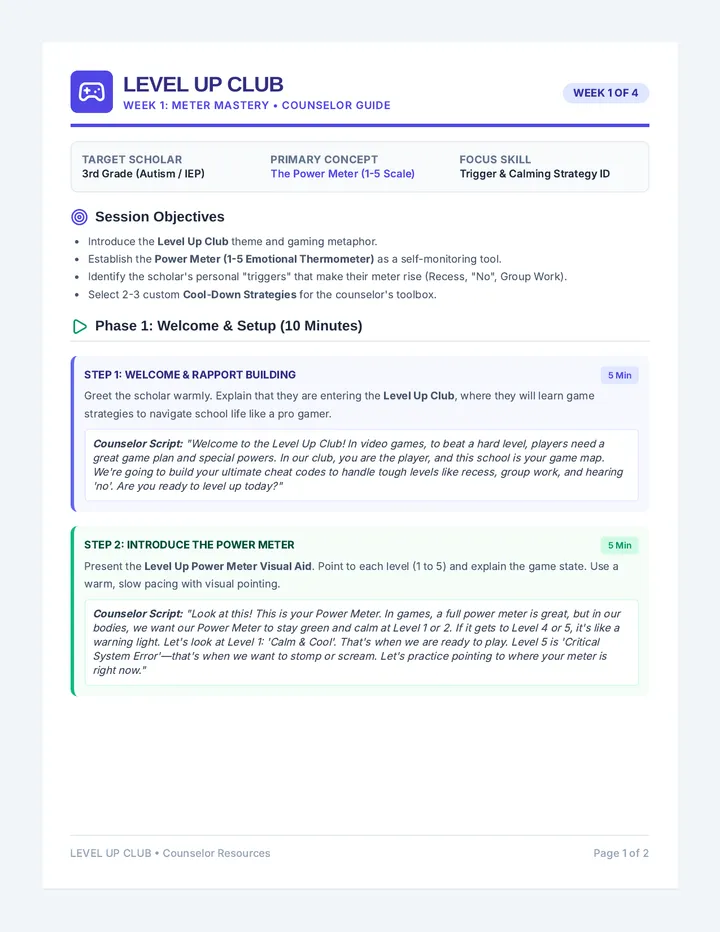
Review the Smart Choices Slide Deck to familiarize yourself with the content.
Read through the Teacher Script for Thoughtful Communication to prepare for guiding the student.
Print the Think-Pause-Act Role-Play Activity or prepare to display it digitally.
Instructional Steps
1
5m
Introduction: What's on Your Mind?
• Begin with a warm greeting and explain the purpose of the session, emphasizing skill-building for better communication.
• Use the first slide of the Smart Choices Slide Deck to introduce the topic.
• Ask the student: "Have you ever said something and immediately wished you hadn't? What happened?" (Use the Teacher Script for guidance).
2
7m
Understanding Blurting & Attention-Seeking
• Present slides explaining what blurting out and attention-seeking look like and why it can be challenging for both the student and others (refer to slides 2-4).
• Discuss the 'Why' behind these behaviors (excitement, wanting to share, seeking connection, feeling ignored). Ask the student if they recognize any of these reasons in themselves.
3
8m
Introducing 'Think-Pause-Act'
• Introduce the strategy using slides 5-7.
• Explain each step: Think (Is it true? Is it kind? Is it necessary? Is it relevant?), Pause (Take a breath, count to three), Act (Raise hand, wait for turn).
• Model the strategy with a simple example.
4
7m
Practice with Role-Play Activity
• Engage the student in the Role-Play Activity . Present scenarios where blurting or attention-seeking might occur.
• Guide the student through applying the steps in each scenario.
• Provide positive feedback and constructive suggestions.
5
3m
Wrap-Up & Next Steps
• Review the strategy and its benefits.
• Ask the student to identify one situation this week where they will try to use the strategy.
• Provide encouragement and conclude by thanking them for their participation.
Smart Choices Slide Deck Think Before You Speak
Smart Choices! 🧠
THINK
PAUSE
ACT
Teacher Notes: Welcome the student and explain that today's session is about learning strategies to communicate in a way that helps everyone feel heard and respected. Emphasize that these are skills they can learn and improve over time.
What's 'Blurting Out'?
It's when we speak without raising our hand or waiting for our turn.
Why does it happen?
1 So excited to share!
2 Think it's super important!
3 Just forget to wait.
What's 'Attention-Seeking'?
It's when we say or do things mainly to get others to look at us or talk to us.
Why does it happen?
Want to be heard!
Want to be part of the group!
Want to show off something cool!
Sometimes, it can interrupt others.
Why is it tricky?
How it impacts OTHERS:
Hard to hear everyone's ideas.
People feel interrupted.
Hard for the teacher to lead.
How it impacts YOU:
You might not finish your thought.
You might feel bad after blurting.
Strategy 1: THINK! 🤔
Before you speak, quickly ask yourself:
Is it true?
Is it kind?
Is it necessary?
Is it relevant?
Is it MY turn to speak?
Strategy 2: PAUSE! 🤫
Give yourself a quick moment before speaking:
Take a silent breath in and out.
Count to 3 in your head.
Make eye contact with the speaker.
This gives your brain time to catch up!
Strategy 3: ACT! ✨
Now that you've thought and paused, take action!
In Class
Gently raise your hand and wait to be called on.
In Conversation
Wait for a natural break in the talking.
Use a calm voice!
This shows respect for others AND your own amazing ideas!
Your Superpower! 🦸♂️
1
THINK!
Is it True, Kind, Necessary, Relevant?
Thoughtful Talk Script Teacher Script
Thoughtful Communication
Teacher Instructions:
This script is designed to be a flexible guide. Speak naturally and adapt the wording to match the student's personality and your relationship with them. Bold text represents suggested dialogue.
1
Introduction: What's on Your Mind? (5m)
"Hi [Student's Name]! Thanks for coming today. We're going to talk about something really important that can help you share your awesome ideas even better in class and with your friends."
"Today, we're going to learn some strategies for when we get super excited to share something, or when we really want to contribute to a conversation. We all feel that way sometimes, right? It's about building skills to make sure your voice is heard at the right time."
"Let's start with a question: Have you ever said something and immediately wished you hadn't? Maybe it popped out before you could stop it? What happened?"
Take notes on student's reflection above.
(Listen actively to the student's response. Validate their feelings and experiences.)
"That's a really common experience, and it's totally okay. We're here to learn ways to help with that."
2
Blurting & Attention-Seeking (7m)
(Refer to Smart Choices Slide Deck slides 2-4)
"Let's look at what 'blurting out' and 'attention-seeking' can look like." (Go through slides 2-4)
"Sometimes, when we blurt things out, it's because we're really excited, or we think our idea is super important right at that moment. Can you think of any times when you might feel that way, like you just HAVE to say something right away or you really want to be noticed?"
(Allow the student to reflect. Gently guide them to connect with the 'why' behind the behaviors.)
"It's really insightful to think about WHY we do these things. It's often not because we want to be disruptive, but because we have strong feelings or ideas we want to share. Understanding this 'why' is the first step!"
3
The 'Think-Pause-Act' Strategy (8m)
(Refer to Smart Choices Slide Deck slides 5-7)
"Now, let's learn a fantastic strategy that can help us. It's called 'Think-Pause-Act.' It's like having a superpower for thoughtful communication!"
"First, there's THINK. Before you open your mouth, just for a split second, ask yourself: 'Is it true? Is it kind? Is it necessary? Is it relevant?' And a big bonus question: 'Is it MY turn to speak?'"
Pause Power Activity Sheet Pause Power Activity
Role-Play Challenge
Student Name
Date
Your Superpower Mission:
Practice your 'Think-Pause-Act' superpower! For each situation, tell or show how you would use your steps to respond thoughtfully.
Scenario 1
The Exciting Discovery
Your teacher is explaining a new science experiment. Suddenly, you remember an amazing fact about the topic that you just HAVE to share.
Think
Pause
Act
Scenario 2
Wanting to Be Heard
You're working on a group project. One classmate is talking a lot. You have a great idea too, but it feels hard to jump into the conversation.
Think
Pause
Act
Scenario 3
The Funny Story
During quiet reading time, you suddenly remember a hilarious story from your weekend that you KNOW everyone would love to hear.
Think
Pause
Act
Scenario 4
Needing Attention
You're feeling left out at recess. Your friends are playing a game and you want to join. You start making silly noises to get their attention.
Think
Pause
Act
Scenario 5
Answering a Question Quickly
The teacher asks a question and you know the answer right away! You feel like the words are just going to burst out of you.
Think
Pause
Act