Basecamp Belonging Facilitator Guide Tier 2 Small Group Grades 4-5
Basecamp Belonging
Establishing Connection, Trust, and School Navigation
Resource Type
Facilitator Guide
Duration: 45 Minutes
Expedition Gear
• Basecamp Slides
• Adventure Maps (1/student)
• Connection Cards (1 set)
• Colored pencils & markers
Target Skills
Relationship Building Resource Navigation Identifying Support
Group Rules
Foster psychological safety: "What is shared in the cabin, stays in the cabin" (except safety concerns).
1 Expedition Objectives
Peer-to-Peer Bonds: Students will discover common experiences, traits, and interests to reduce isolation and foster campus belonging.
Identify Allies: Students will identify and map at least three trusted school adults to turn to in times of social or emotional distress.
Navigate Systems: Students will outline school-specific resources (counselor, nurse, library) and how to proactively seek support.
2 Expedition Hook: Campfire Check-In
10 Minutes Icebreaker Hook
Invite students to sit in a tight circle around a simulated "campfire" (use orange paper or a battery tea light in the center). This physical shift establishes a safe camp environment distinct from the classroom.
Facilitator Prompt:
"Welcome to our Basecamp! In a mountain climb, basecamp is a safe, warm shelter where climbers rest, plan, and bond before trekking. Today we start our journey of connection. Let's pass around the campfire spark (a safe prop). Introduce yourself and share one thing you love about school, or one thing you're hoping to discover today."
3 Stage 1: Mapping the Terrain
15 Minutes Activity: Adventure Map
Distribute the Adventure Map Worksheet . Guide students in completing the "My Basecamp Allies" and "Navigating Camp" sections. This visual mapping externalizes their network of support.
Ensure students think specifically about who is in each zone. Help prompt them for specific school departments or administrative staff if they draw a blank.
Guided Prompts
"Who is an adult at school who always smiles when they see you?"
"If you scraped your knee or felt sick, who do you look for?"
"Where is the quietest spot on campus when you feel overwhelmed?"
Tip: Encourage drawing or color-coding zones!
Basecamp Belonging Lesson Bundle Page 1 of 2
Basecamp Belonging Facilitator Guide
4 Stage 2: Connection Cards Challenge
15 Minutes Collaborative Play
Peer Connection
Cut out and distribute the Connection Cards . Place them face down in the center of the camp table. Students take turns rolling a die or picking a card from the deck.
Card Categories
Campfire Story (Orange): Personal narrative and light self-disclosure.Trail Guide (Green): Campus problem-solving & resource scenarios.Basecamp Bond (Blue): Low-stakes team action & sharing.
Active Listening Role
When a student shares, the companion on their left must summarize or repeat one detail they heard before taking their own turn. This builds explicit active listening skills.
5 Closing Circle: Reflections at the Peak
5 Minutes Formative Assessment
Gather around the campfire. Conclude with a quick, reflective question to transition them back to their academic classes with confidence and closure.
Debrief Reflection Prompts:
"What is one thing you learned about a companion today that you didn't know before?"
"Who is one trusted adult on your map you're committed to saying hello to tomorrow?"
Expedition Adaptations (Tier 2 Supports)
Shyer / Anxious
Allow students to write down answers or use a companion to read it for them. Offer drawing options for the Connection Cards.
Hyperactive / Impulsive
Use a tactile speaking object (like a foam rock or pinecone) to physically prompt waiting for a turn. Incorporate brief standing breaks.
Resistance to Adult List
If a student struggles to identify 3 adults, scaffold with generic school roles (e.g., "The librarian with the fun pins") to build a bridge.
Basecamp Belonging Lesson Bundle Page 2 of 2
Basecamp Belonging Slides Basecamp Expedition Grades 4-5 Small Group
Basecamp Belonging
Establishing Connection, Trust, and School Navigation
Every mountain climber needs a team, a safe basecamp, and a clear map. Today we build ours!
Sit in a circle around our "campfire"!
Slide 1 of 5
1 Campfire Check-In
10 Minutes
Campfire Safety Rules
Keep It Safe: What is shared in our basecamp stays in our basecamp.One Speaker: Hold the "campfire spark" to speak. Others listen.
Your Turn!
Pass the "campfire spark" object around the circle. Introduce yourself and share:
"One thing you love about school, OR one thing you hope we learn together today!"
Get ready to discover shared connections! Slide 2 of 5
2 Navigating Our Campsite
Map the School
Heart Headquarters
School counselor, social worker, or psychologist offices.
For big feelings or friendship help!
First Aid Station
School nurse or health clerk station in the office.
For physical scrapes, sickness, or rest.
Safe Havens
Library, student services lobby, or special classrooms.
For quiet time or calming down.
Which campus areas do you visit most? Slide 3 of 5
3 My Allies & Support
Web of Trust
What is an Ally?
An adult at school who listens, supports you, and helps you feel safe.
Map Your Camp Allies!
Open your Adventure Map Worksheet . Fill out your 3 Support Rings:
1
Immediate Cabin (Inner Ring): Teachers or staff you talk to daily.
2
Trail Helpers (Middle Ring): Counselors, office staff, or recess monitors.
3
Camp Protectors (Outer Ring): Principal, custodians, or nurse.
Who is an adult that always welcomes you? Slide 4 of 5
4 Connection Challenge
Play Time
How to Play
Roll a die or pick a card from the deck.
Answer the prompt or do the action with your team.
No rush! Enjoy the stories your companions share.
Challenge: Find 3 things you have in common with others!
Active Listening Role
Basecamp Belonging Adventure Map My Adventure Map
Map out your personal school support team and safe spots!
Student Worksheet
Explorer Name:
Expedition Date:
My Support Rings
Who are your school allies? Identify and write the names of adults you trust in each ring below.
Zone 3
Zone 2
Zone 1
Zone 1: The Cabin (Daily Teachers)
Zone 2: Trail Helpers (Counselors, Recess Staff)
Zone 3: Camp Protectors (Office, Nurse, Principal)
Campsite Navigation Guide
Fill out your physical and social support action plans.
Calm Zone:
Where is your quiet/calming spot on campus when you feel anxious or overwhelmed?
Friendship Ally:
If you have a big disagreement with a peer, what helper or location do you seek out first?
Connection Check:
What is one kind question or greeting you will try to ask another student tomorrow to make them feel welcome?
Explorer's Reflection:
Complete this final peak reflection: "I feel like I belong at school when..."
Basecamp Belonging Adventure Pack Page 1 of 1
Basecamp Belonging Connection Cards Basecamp Connection Cards
Cut along the dotted lines. Take turns drawing cards and sharing in your small group!
Group Activity
Explorer Rules: Cut out these cards. Place them face down. Pick one on your turn, answer the prompt, and let your group mates practice active listening!
Campfire Story
The Hike of Resilience
Tell your crew about a time something at school felt like climbing a steep mountain, but you kept going. Who helped you keep climbing?
Shared Story Prompt
Campfire Story
The Map of Joy
What is your absolute favorite thing to do at school during recess or free time? Who is usually with you during those happy times?
Shared Story Prompt
Trail Guide
The Lost Explorer
Scenario: You see a new student sitting completely alone at lunch, looking very nervous. What is one "trail guide" question you can ask them to welcome them?
School Navigation Scenario
Trail Guide
Stormy Weather
Scenario: You get a really low grade on a school quiz and feel like crying. Which Zone 1 or Zone 2 adult on your support map do you go visit first, and what do you say?
School Navigation Scenario
Basecamp Bond
The Team Slogan
Group Challenge: Work together with your teammates right now to create a 3-word "basecamp slogan" that makes everyone in the room feel included and supported.
Collaborative Action
Basecamp Bond
Campfire Echo
Action Challenge: Turn to the explorer on your left. Tell them one thing you notice they are great at, or one thing you've enjoyed learning about them today.
Collaborative Action
Basecamp Belonging Connection Set Page 1 of 1
Summit Success Facilitator Guide Tier 2 Small Group Grades 4-5
Summit Success
Responsibility, Attendance Awareness, and Goal Setting
Resource Type
Facilitator Guide
Duration: 45 Minutes
Expedition Gear
• Summit Success Slides
• Student Trail Logs
• Scenario Cards (1 set)
• Colored highlighters
Target Skills
Self-Management Attendance Habits Goal Mapping
Mindset Shift
Praise progress and effort: Frame attendance as staying connected to our climbing crew.
1 Expedition Objectives
Habit Architecture: Students will recognize the daily routines (evening & morning) that make attending school stress-free and successful.
Goal Setting: Students will establish a highly specific, realistic 5-day habit goal to improve academic focus or on-time attendance.
Problem Solving: Students will identify potential "trail blockages" (obstacles like oversleeping or missed school busses) and outline safety plans.
2 Expedition Warm-Up: The Gear Check
10 Minutes Habit Hook
Welcome students back to our Basecamp. Ask them how their past week went. Explain that to reach the mountain peak (success), climbers must double-check their backpacks and gear.
Facilitator Prompt:
"Welcome back, climbers! If you went on a real hike, what would happen if you forgot to pack water, or forgot to lace your boots? You'd struggle, right? Coming to school on time and packed is our daily 'Gear Check.' When we are here, we have everything we need to succeed. When we miss school, our climbing crew misses a vital partner!"
3 Stage 1: Planning the Expedition Route
15 Minutes Activity: Student Trail Log
Distribute the Summit Success Trail Log . Guide students through creating their "Morning & Evening Routine Checklist" and setting their "Peak Habit Goal" for the upcoming week.
Encourage students to set small, manageable goals (e.g., packing their backpack before going to bed, or waking up 10 minutes earlier) rather than overly broad academic promises.
Habit Scaffold
"What is the hardest part of your morning routine?"
"Where can you place your backpack at night so you don't forget it?"
"How does getting enough sleep help you stay focused at school?"
Tip: Let students choose a peer accountability partner!
Summit Seekers Series: Session 2 Page 1 of 2
Summit Success Facilitator Guide
Summit Success Slides Summit Expedition Grades 4-5 Small Group
Summit Success
Responsibility, Routines, and Reaching Your Goals
Setting up your morning and evening habits to climb strong, stay on track, and conquer the school week!
Sit with your climbing crew and get ready to map your route!
Slide 1 of 5
1 Expedition Gear Check
10 Minutes
The Attendance Backpack
Showing Up Matters: When you are here, your pack has the skills, support, and lessons of the day!Missing Days: Missing school is like leaving behind your water or boots. The climb gets much harder!
Climbing Check-In
Pass the "campfire spark" and share with your group:
"What is one positive habit or routine that helps you wake up, get packed, and make it to school on time?"
A successful morning starts the night before! Slide 2 of 5
2 The Daily Trail: Habits & Routines
Setup for Success
Night Camp Prep
Pack your bag, lay out your outfit, charge your devices, and sleep 9-11 hours!
Saves you 15 minutes in the morning!
Sunrise March
Wake up to your first alarm, eat a healthy breakfast, double-check your lunch, and head out the door!
Keeps your morning calm and on-time!
Which routine do you need to practice most? Slide 3 of 5
3 Trail Obstacles & Hazards
Problem Solving
Be Prepared!
In any climb, you will meet rocks or storms. Having a plan ahead of time keeps you moving forward!
Clear the Trail Blockages!
Draw a card from the Summit Success Scenario Cards pile and work as a crew:
1
Read the morning routine or homework obstacle card.
2
Expedition partners: Pitch two simple, realistic safety habits that solve this challenge!
How do your daily habits affect your whole climbing crew? Slide 4 of 5
4 Reaching the Summit Goal
Weekly Focus
Your Trail Log Goal
Pick one small, powerful habit you can work on every school day this week. Write it in your Trail Log!
"Lay my school clothes out before going to bed."
"Set a backup alarm and wake up on time."
"Put my completed homework into my folder immediately."
The 5-Day Summit Run
Summit Success Trail Log My Summit Trail Log
Plan your daily routines and check off your steps to reach the peak!
Student Worksheet
Explorer Name:
Expedition Date:
Planning My Expedition Routines
A strong climber checks their gear twice! Check off your standard routines and write one custom habit in the blank spaces.
Sunset Camp (Night Before)
Pack backpack and place it by the door. Lay out clothes and shoes for tomorrow. Set electronic alarms (or ask an adult helper).
Sunrise March (Morning Of)
Wake up immediately when the first alarm rings. Eat a fuel-filled breakfast to power my brain. Double-check my homework folder and devices.
My Peak Habit Goal:
Write one specific, realistic routine habit you will practice every day this week to climb successfully.
The 5-Day Summit Run
Every day you successfully practice your Peak Goal habit, sign off on that day's camp flag to climb higher!
Camp 1 Day 1
✓
Camp 2 Day 2
✓
Camp 3 Day 3
✓
Camp 4 Day 4
✓
Summit! Day 5
★
Expedition Companion Accountability Statement:
"I will check in with my hiking companion, ________________________, on Day 5 to support each other and celebrate our Summit victories!"
Summit Seekers Series: Session 2 Trail Log Page 1 of 1
Summit Success Scenario Cards Summit Success Scenario Cards
Cut along the dotted lines. Pitch practical solutions to clear these daily trail blockages!
Group Activity
Expedition Crew Rule: Draw a card on your turn. Identify the self-management problem. Then, let your group mates act as the crew to propose two realistic daily routines that clear the obstacle!
The Slip-Up
The Midnight Gamer
Scenario: Leo gets caught up playing an online game until midnight on a Sunday. On Monday morning, he oversleeps his alarm, misses his bus, and arrives to school late.
Evening Routine Solution
The Slip-Up
The Missing Homework
Scenario: Maya finishes her reading assignment but leaves it on the kitchen table. In her morning rush, she runs out the door, forgetting it, and has to spend recess in study club.
Packing Routine Solution
Heavy Weather
The Rainy Day Avoidance
Scenario: It's a dark, cold, pouring Tuesday morning. Sam feels tired and decides to fake a stomach ache so his dad lets him stay home, even though he's not actually sick.
Attendance Motivation Solution
Heavy Weather
The Math Avalanche
Scenario: Alisha missed two days of math class while out sick. Now she feels so behind and confused she wants to skip school again tomorrow to avoid the upcoming quiz.
Support Map Solution
Climber's Crew
The Off-Trail Distraction
Scenario: During independent study time, your table-mate whisper-prompts you to play paper-football, even though you have a science project due by the end of the class period.
Responsibility Solution
Climber's Crew
The Ride Slip-Up
Scenario: Caleb's carpool driver has engine trouble and has to cancel. Caleb doesn't know what to do and starts crying because he's afraid he'll get in trouble for being late.
Emergency Back-up Solution
Summit Seekers Series: Session 2 Obstacles Set Page 1 of 1
Crew Compass Facilitator Guide Tier 2 Small Group Grades 4-5
Crew Compass
Respect, Peer Dynamics, and Positive Decision-Making
Resource Type
Facilitator Guide
Duration: 45 Minutes
Expedition Gear
• Crew Compass Slides
• Student Decision Maps
• Boundary Cards (1 set)
• A length of thick yarn/rope
Target Skills
Refusing Pressure Respectful Boundaries Assertiveness
Group Safety
Supportive boundaries: Give students space to try out boundary-setting scripts in low-stakes peer play.
1 Expedition Objectives
Navigating Peer Winds: Students will learn to distinguish between positive peer influence (encouragement) and negative peer pressure (influence that causes stress or boundary violations).
The Crew Compass Method: Students will learn and practice a 3-step internal decision-making strategy (Pause, Orient, Step) to evaluate social requests.
Boundary Assertiveness: Students will practice direct, polite, and firm verbal boundaries (the "Climber's Anchor" technique).
2 Expedition Hook: The Safety Rope
10 Minutes Trust Warm-up
Have group members stand in a circle and hold onto a single loop of thick yarn or rope. Explain that during a dangerous climb, members are tied together to protect one another.
Facilitator Prompt:
"Hold onto this climbing line, explorers. If one climber trips, the rest of the crew holds the line steady. That is positive influence—we keep each other safe. But what happens if someone pulls too hard or tries to drag the crew off path? The whole rope snaps. Respect means we keep our safety line strong by making positive decisions and respecting each other's boundaries!"
3 Stage 1: Reading the Decision Compass
15 Minutes Activity: Decision Map
Distribute the Crew Compass Decision Map . Walk students through the 3 directions of the Decision Compass: Pause (Check feelings), Orient (Evaluate safety & values), and Step (Act firmly).
Encourage students to color-code their compass directions and think of a real school scenario (e.g. cheating on a quiz or gossiping) where these compass checkpoints keep them safe.
Compass Prompts
"Pause: Does your stomach tighten or head hurt when you're asked to do this?"
"Orient: Would you be proud to tell your Zone 1 parents/teachers about this?"
"Step: What are the exact firm words you can use to walk away?"
Crew Compass Slides Crew Compass Expedition Grades 4-5 Small Group
Crew Compass
Respect, Boundaries, and Navigating Peer Dynamics
A climbing crew must respect each other to survive. Learn how to stand firm, say "No" when needed, and support your partners!
Stand in a circle and hold onto our trust safety line!
Slide 1 of 5
1 Our Crew Safety Rope
10 Minutes
Tied Together for Safety
Positive Influence: Supporting each other, pointing out hazard paths, and keeping partners safe.Negative Influence (Pressure): Pushing, pulling too hard, or dragging partners to do things that feel unsafe.
Respect Discussion
Pass the "campfire spark" and share with your group:
"What is one way a friend at school has shown respect to you? How did it make you feel?"
Respect is the anchor that holds our safety line! Slide 2 of 5
2 The 3-Step Decision Compass
Internal Navigation
1. Pause
Slow down! Listen to your gut or body signals (tight stomach, fast heartbeat, or nervous feelings).
Stop and evaluate the path!
2. Orient
Ask yourself: "Is this choice safe? Is it kind? Would I be proud to tell my trusted adult map supports?"
Check your climbing rules!
3. Step
Act firmly! Use polite but direct boundary scripts to walk away or suggest a safer, positive path.
Walk forward with confidence!
Use your compass whenever the social winds start to blow! Slide 3 of 5
3 Boundary Anchor Scripts
Standing Firm
My Boundary Shield
Saying "No" is not mean. It is holding your boundary line to protect your safety and your goals!
Try Out These Anchor Scripts!
When someone pushes you, deploy one of these powerful shield strategies:
Option 1
Refusal + Reason: "No, I don't want to get a citation or get in trouble."
Option 2
Refusal + Redirect: "I'm not going to cheat. Let's study for 5 minutes instead."
Practice your anchor scripts with direct eye-contact! Slide 4 of 5
4 Boundary Card Challenge
Interactive Play
Gameplay Route
Pick a card from the Boundary Cards Pile .
Read the peer-pressure scenario to your climbing crew.
Crew Compass Decision Map My Crew Decision Map
Use your internal compass to navigate tricky peer pressure and stand strong!
Student Worksheet
Explorer Name:
Expedition Date:
Setting My Compass Directions
When peer pressure blows you off-course, write down your personalized responses for each of the three compass directions below.
1. PAUSE (Feelings)
What physical warning signs does your body show when you feel pushed to do something wrong?
2. ORIENT (Values)
Write one positive question you can ask yourself to check if an action is safe or respectful.
3. STEP (Action)
What physical movement (like walking away or turning around) can help you stand firm?
My Personal Anchor Scripts
Write out the exact words you are comfortable saying when practicing your boundary shield during our group card play.
A Polite Refusal + Reason Script:
Example: "No, I'm going to follow the school rules."
B Direct Refusal + Redirect Script:
Example: "No way. Let's head over to play kickball instead!"
Explorer Integrity Commitment:
By signing below, you promise to keep your crew compass aligned with positive choices and to act as a supportive Safety Anchor for your classmates.
My Signature:
My Safety Anchor Partner Signature:
Summit Seekers Series: Session 3 Decision Map Page 1 of 1
Crew Compass Boundary Cards Crew Compass Boundary Cards
Cut along the dotted lines. Use your Anchor Scripts to practice standing up to negative peer winds!
Group Activity
Boundary Defense Rule: Draw a card, read the peer-pressure challenge, and practice standing tall. Have a crew partner act as your Safety Anchor standing right beside you to support your choice!
The Wind Gust
The Test Peak
Pressure Scenario: Your friend didn't study for the spelling test and whispers: "Psst, show me your answers! If you're really my climbing partner, you'll let me copy."
Direct Academic Refusal
The Wind Gust
The Forbidden Trail
Pressure Scenario: A handball flies over the tall campus boundary fence. A classmate tells you: "Hurry, climb over the fence and grab it before the recess duty monitor turns around!"
School Safety Refusal
Subtle Shifts
The Quiet Campfire
Pressure Scenario: A quiet classmate wants to sit with your lunch group. A peer whispers: "Don't let him sit here. Tell him all our camp chairs are full."
Exclusion Resistance
Subtle Shifts
The Copycat Hike
Pressure Scenario: A popular kid in your class starts laughing at another classmate's hand-me-down sweater and turns to you, expecting you to join in and make a mean joke too.
Kindness & Respect Check
Crew Safety
The Digital Avalanche
Pressure Scenario: A teammate takes an embarrassing picture of a classmate during lunch and texts it to you, telling you: "Forward this to your bus contacts. It's so funny!"
Online Boundary Defense
Crew Safety
The Steeper Slope
Pressure Scenario: Your friend tries to pressure you to skip your after-school study group to hang out. They argue: "Study group is for babies. Who cares about homework?"
Responsibility Defense
Summit Seekers Series: Session 3 Boundaries Set Page 1 of 1
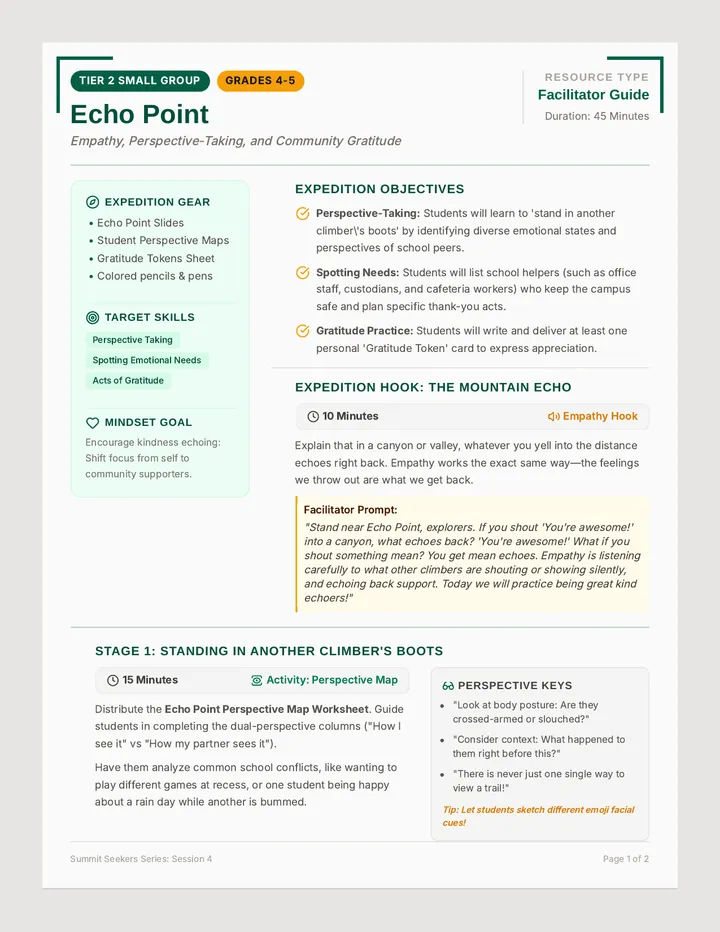
Echo Point Facilitator Guide Tier 2 Small Group Grades 4-5
Echo Point
Empathy, Perspective-Taking, and Community Gratitude
Resource Type
Facilitator Guide
Duration: 45 Minutes
Expedition Gear
• Echo Point Slides
• Student Perspective Maps
• Gratitude Tokens Sheet
• Colored pencils & pens
Target Skills
Perspective Taking Spotting Emotional Needs Acts of Gratitude
Mindset Goal
Encourage kindness echoing: Shift focus from self to community supporters.
1 Expedition Objectives
Perspective-Taking: Students will learn to 'stand in another climber\'s boots' by identifying diverse emotional states and perspectives of school peers.
Spotting Needs: Students will list school helpers (such as office staff, custodians, and cafeteria workers) who keep the campus safe and plan specific thank-you acts.
Gratitude Practice: Students will write and deliver at least one personal 'Gratitude Token' card to express appreciation.
2 Expedition Hook: The Mountain Echo
10 Minutes Empathy Hook
Explain that in a canyon or valley, whatever you yell into the distance echoes right back. Empathy works the exact same way—the feelings we throw out are what we get back.
Facilitator Prompt:
"Stand near Echo Point, explorers. If you shout 'You're awesome!' into a canyon, what echoes back? 'You're awesome!' What if you shout something mean? You get mean echoes. Empathy is listening carefully to what other climbers are shouting or showing silently, and echoing back support. Today we will practice being great kind echoers!"
3 Stage 1: Standing in Another Climber's Boots
15 Minutes Activity: Perspective Map
Distribute the Echo Point Perspective Map Worksheet . Guide students in completing the dual-perspective columns ("How I see it" vs "How my partner sees it").
Have them analyze common school conflicts, like wanting to play different games at recess, or one student being happy about a rain day while another is bummed.
Perspective Keys
"Look at body posture: Are they crossed-armed or slouched?"
"Consider context: What happened to them right before this?"
"There is never just one single way to view a trail!"
Tip: Let students sketch different emoji facial cues!
Summit Seekers Series: Session 4 Page 1 of 2
Echo Point Facilitator Guide
Echo Point Slides Echo Point Expedition Grades 4-5 Small Group
Echo Point
Empathy, Perspectives, and Community Gratitude
Every sound we yell into a canyon bounces back to us. What kind of words and actions do we want our school community to echo today?
Sit close to our campfire and prepare for our empathy hike!
Slide 1 of 5
1 The Canyon Echo Metaphor
10 Minutes
What We Throw Out Returns
The Kindness Echo: When we throw out support, kindness, or gratitude, it circles back to make us feel connected.The Angry Echo: When we throw out exclusion or disrespect, it returns as a cold and lonely school climate.
Your Kind Echo
Pass the "campfire spark" and share with your group:
"What is one encouraging or kind thing a peer could say to you when you are having a difficult day?"
Empathy is listening to the subtle voices of other climbers! Slide 2 of 5
2 Lookout Point: Dual Perspectives
Lookout Point
My Trail Lens
How I feel, what I expect, and how I see the school situation. (e.g. "I want to play kickball right now!")
Our immediate, natural reflex!
Partner's Trail Lens
How they feel, how their day went, and why they might view it differently. (e.g. "They got hurt playing kickball yesterday.")
Taking time to stand in their boots!
Open your Perspective Map worksheet to zoom in on different views! Slide 3 of 5
3 Spotting Invisible Needs
Silent Signs
Spot the Signs
Climbers don't always say when they are tired. Empathy means we keep our eyes open to spot silent cues!
Lookout Checks
How do you know when a partner needs an empathy echo? Check these cues:
1
Silent / Isolated: Sitting alone, head down on desk, or ignoring friends.
2
Frustrated / Fast: Tense shoulders, slamming books, or breathing heavily.
When you see these signs, what small kind action can you take? Slide 4 of 5
4 The Gratitude Token Challenge
Act of Thanks
Writing Your Card
Pick one crucial school helper (custodian, librarian, nurse, or clerk). Fill out an Echo Point Gratitude Token :
Say exactly what helper action they do.
Explain how their action makes you feel safe.
Echo Point Perspective Map My Echo Point Perspective Map
Stand at Lookout Point, see situations from other viewpoints, and plan acts of thanks!
Student Worksheet
Explorer Name:
Expedition Date:
The Lookout Lens (Perspective Check)
Imagine a classmate wants to sit with your group, but a peer tells them there are no spots left. Put on your binocular lenses to analyze both viewpoints:
My Lens (Immediate View)
How might you feel initially? (e.g. Wanting to avoid group drama or keep sitting with just your closest friends?)
Classmate's Lens (Empathy View)
How might the quiet classmate feel standing there? What silent cues or body signs might they show?
Spotting Silent Support Needs
A real climber notices when a companion is struggling. Outline your action steps for these situations:
A student gets a bad test score & slinks down:
What quiet, comforting words can you echo or slide to their desk?
A teammate is left out of Recess team picking:
What simple, welcoming redirect action can you take immediately?
My Gratitude Echo Planner:
Plan a thank-you token for a school supporter (e.g. custodian, office staff, librarian, or nurse). Write down who they are and draft your direct, specific message of praise:
I am thanking (Name/Role):
My draft thank-you message (specific praise + how it makes me feel safe):
Summit Seekers Series: Session 4 Perspective Map Page 1 of 1
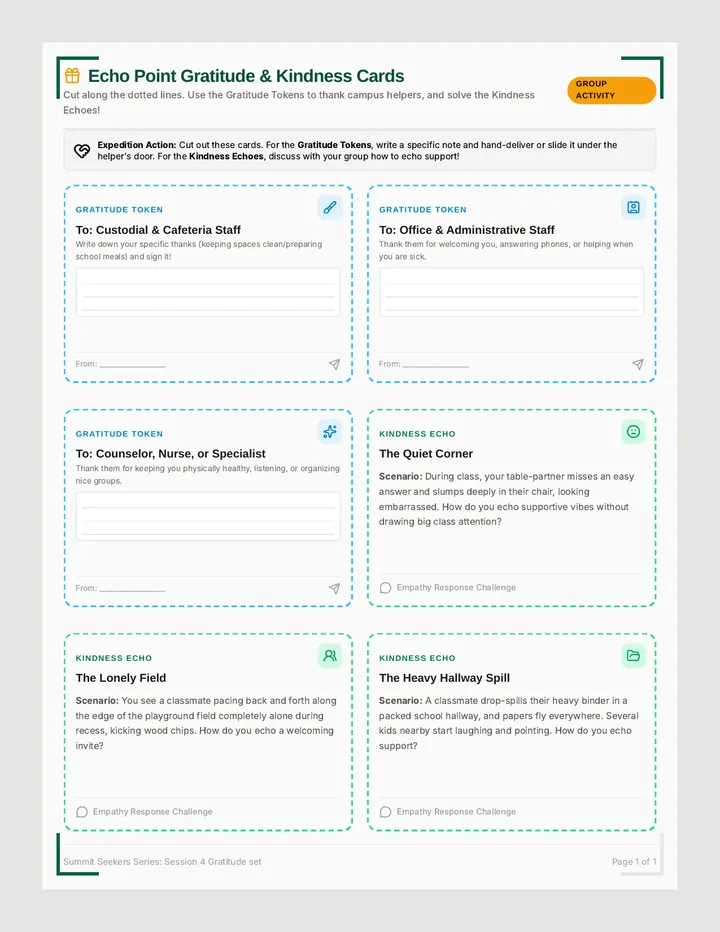
Echo Point Gratitude Cards Echo Point Gratitude & Kindness Cards
Cut along the dotted lines. Use the Gratitude Tokens to thank campus helpers, and solve the Kindness Echoes!
Group Activity
Expedition Action: Cut out these cards. For the Gratitude Tokens , write a specific note and hand-deliver or slide it under the helper's door. For the Kindness Echoes , discuss with your group how to echo support!
Gratitude Token
To: Custodial & Cafeteria Staff
Write down your specific thanks (keeping spaces clean/preparing school meals) and sign it!
From: __________________
Gratitude Token
To: Office & Administrative Staff
Thank them for welcoming you, answering phones, or helping when you are sick.
From: __________________
Gratitude Token
To: Counselor, Nurse, or Specialist
Thank them for keeping you physically healthy, listening, or organizing nice groups.
From: __________________
Kindness Echo
The Quiet Corner
Scenario: During class, your table-partner misses an easy answer and slumps deeply in their chair, looking embarrassed. How do you echo supportive vibes without drawing big class attention?
Empathy Response Challenge
Kindness Echo
The Lonely Field
Scenario: You see a classmate pacing back and forth along the edge of the playground field completely alone during recess, kicking wood chips. How do you echo a welcoming invite?
Empathy Response Challenge
Kindness Echo
The Heavy Hallway Spill
Scenario: A classmate drop-spills their heavy binder in a packed school hallway, and papers fly everywhere. Several kids nearby start laughing and pointing. How do you echo support?
Empathy Response Challenge
Summit Seekers Series: Session 4 Gratitude set Page 1 of 1