Tuning In Facilitator Guide Signal Masters • Session 1
Tuning In
Facilitator Guide
SESSION MISSION
Introduce students to the Signal Masters theme. Teach students to distinguish between the Signal (the primary message) and Static (distractions). Help them identify and categorize static into External (environment-based) and Internal (thought-based) groups.
Materials Needed: Chart paper, markers, whiteboard, Student Mission Logs, pencils.
Duration: 35-40 Minutes
1
The Setup & Hook: Radio Static Challenge 10 Mins
Welcome the group. Explain that active listening is like tuning a radio. Play or mimic a brief static noise, then speak clearly. Ask: "What was the difference between the noise and my voice?"
"In this room, we are tuning into a high-powered frequency. The message we want to hear is the Signal . Everything else that blocks our frequency is Static . Our goal is to become Signal Masters!"
2
Core Game: Signal & Static Relay 15 Mins
Designate one student as the "Signal Sender" (stands in the center, reads simple words from a mission list) and another as the "Receiver" (stands at the back). All other students are "Static Generators" who make soft whispering noises, rustle paper, or point to distractions.
Round 1 (Heavy Static)
Generators are active. The Receiver tries to write down the message exactly as sent.
Round 2 (Filtered Signal)
Generators are silenced. Point out how easy the message was to receive without noise.
3
Defining the Static (Internal vs. External) 10 Mins
Gather at the whiteboard. Draw two giant satellite dishes: one labeled "External Static" (things we hear, see, or touch around us) and one labeled "Internal Static" (thoughts, worries, daydreaming, or a rumbling tummy). Ask the group to brainstorm examples from the game and school life.
4
Mission Log Debrief & Check-Out 5 Mins
Distribute the Tuning In Mission Log . Have students classify distractions and write down one listening goal for this week. Praise their focus!
FACILITATOR TIPS
Keep the static game fun but structured so it doesn't get chaotic.
Emphasize that Internal Static is natural and happens to everyone—the trick is recognizing it.
GROUP GOAL CHECK
By the end of this session, every student should be able to clearly identify the difference between a listener "hearing" noise and an active listener "extracting" the signal.
Tuning In Student Log Signal Masters • Student Mission Log
Mission 01: Tuning In
Level 1 Recruits
Name:
Date:
Agent Briefing
To master active listening, you must learn to identify Static . Static is any distraction that blocks the important Signal (the message!). Let's categorize the static we experience at school!
Task 1: Static Sort
Read each distraction in the box below. Write it under the correct category on the satellite maps.
Hallway Laughter
Tired/Sleepy Eyes
A Pencil Dropping
Thinking About recess
Worrying About a Test
Whispering Next to Me
EXTERNAL STATIC (Outside the Body)
INTERNAL STATIC (Inside the Head)
Task 2: My Personal Static Radar
Which type of static is the hardest for you to block? Give an example of a school scenario where you experienced it.
Task 3: Weekly Signal Goal
Write down one goal for active listening in class this week.
SIGNAL MASTERS • RECRUIT STAGE 1
External Shield Facilitator Guide Signal Masters • Session 2
The External Shield
Facilitator Guide
SESSION MISSION
Empower students with strategies to block out External Static (noises, sights, movements in the school environment). Introduce the External Shield system: three physical maneuvers that block visual/auditory noise and channel focus back onto the primary signal.
Materials Needed: 1-2 noisemakers (bubble wrap/bell), colorful poster board, Student Mission Logs, timers.
Duration: 35-40 Minutes
1
The Setup: Activating the Shields 10 Mins
Review the concepts of "Signal" vs. "Static" from Session 1. Ask: "What external static did you notice in your classroom this week?" Introduce the External Shield —the body's super-defense system. Teach three core shields:
Laser Vision
Eyes locked to the speaker, filtering peripheral movements.
Headset Align
Turn chin towards speaker to catch direct sound waves.
The Anchor
Hands flat, feet anchored. Grounding the body to resist turning.
2
Activity: Shield Simulator Challenge 15 Mins
Students practice deploying their shields in an environment with high external noise.
How it works: Facilitator acts as the Signal , speaking in a calm voice about a wacky science topic (e.g., "The Giant Sloth of the Amazon").
The Static: Pick 2 student "Static Creators" to try to distract the listeners by walking around, waving posters, whispering, or tapping objects.
The Mission: Listeners must engage all three shields (Laser Vision, Headset, Anchor) and write down 3 key facts mentioned. Swap roles so everyone tries.
3
Mission Log Debrief & Goal Setting 10 Mins
Distribute the External Shield Student Mission Log . Have students self-assess how they maintained their shields during the Simulator and write down a weekly shield tactic for their toughest class.
COACHING TIPS
Help students realize that 'Laser Vision' doesn't mean a blank stare; it's active focus.
For students with high hyperactivity, emphasize that 'The Anchor' gives their body a safe, stable job to do.
REAL-WORLD SHIELD TRIP
Encourage students to pick one classroom lesson this week where they will explicitly tell their teacher: "I am activating my External Shields today!" as a fun cue.
External Shield Student Log Signal Masters • Student Mission Log
Mission 02: External Shield
Level 2 Guards
Name:
Date:
Agent Briefing
To defend your active listening from External Static , you must deploy your three physical maneuvers. Let's make sure your systems are calibrated!
Task 1: Calibrate the Shields
Match each Shield Maneuver to its correct body posture by drawing a line.
Laser Vision
Headset Position
The Anchor
Locking eyes directly on the speaker to filter out side movements.
Keeping hands flat and feet planted solid to resist turning around.
Turning your head and ears directly toward the source of sound.
Task 2: Simulator Reflection
How did it feel when the Static Creators tried to distract you? Which shield was your strongest?
Task 3: Classroom Deployment Plan
Pick one classroom or subject where the external static is the loudest. How will you use your shields there?
My Loudest Classroom:
The Shield I Will Deploy Most:
How will this help your listening?
SIGNAL MASTERS • RECRUIT STAGE 2
Taming the Brainstorm Facilitator Guide Signal Masters • Session 3
Taming the Brainstorm
Facilitator Guide
SESSION MISSION
Equip students to defend against Internal Static (daydreams, personal worries, off-topic ideas, and body restlessness). Introduce cognitive clearing maneuvers: Thought Parking (visually archiving an off-topic thought to look at later) and Three-Breath Clearing (mindfully resetting sensory focus).
Materials Needed: Sticky notes (small pads for each student), whiteboard, Student Mission Logs, pencils.
Duration: 35-40 Minutes
1
The Setup: When the Static is Inside 10 Mins
Welcome the group. Ask: "Have you ever sat in a completely quiet room, but still couldn't listen because your brain was shouting ideas?" Explain that this is Internal Static (the brainstorm). Introduce two mental clearing tricks:
Thought Parking
Jot down any off-topic thought on a sticky note ("park" it) so you can safely ignore it now and check it later.
Three-Breath Clearing
Take three slow, deep belly breaths. On each exhale, imagine blowing away one distracting thought to clear space.
2
Activity: The Story Detective Challenge 15 Mins
Give each student 2 sticky notes. Read a short, detail-heavy, slightly ridiculous story (e.g., about a detective koala who only eats blue raspberries and travels in a yellow submarine).
The Mission: Students must listen to capture 4 highly specific facts.
The Rule: If their mind wanders to an unrelated topic (e.g., "what's for lunch?"), they must instantly scribble it on their sticky note, "park" it on their desk, do a quick single-breath inhale, and refocus on the story.
Debrief: Ask students to count how many thoughts they had to "park." Celebrate parking thoughts as a sign of strong brain control!
3
Mission Log Debrief & Reflection 10 Mins
Distribute the Taming the Brainstorm Student Mission Log . Have students list common thoughts that clutter their brain and practice drawing their own mental "Parking Lot."
MINDFULNESS NOTE
Remind students that minds naturally wander. The goal isn't to never have off-topic thoughts, but to notice them quickly and put them in their place (the Parking Lot) so they don't hijack our listening.
PHYSICAL AIDS
If a student has heavy internal static, let them keep a designated "Parking Lot Pad" on their actual classroom desk to write down questions/thoughts they can ask the teacher at the end of lessons.
Taming the Brainstorm Student Log Signal Masters • Student Mission Log
Mission 03: Taming the Brainstorm
Level 3 Cleared
Name:
Date:
Agent Briefing
Sometimes static comes from inside our own heads! Daydreams, weekend plans, and worries are all Internal Static . Let's practice parking those thoughts to keep our listening screens clear!
Task 1: My Distraction Storm
What are 3 specific thoughts that wander into your mind most often when you are trying to listen?
Storm Thought #1
Storm Thought #2
Storm Thought #3
Task 2: My Thought Parking Lot
Practice "parking" your distractions. Write one distracting topic in each parking space below. This lets your brain know: "I will check on you later, but right now I am listening!"
SPACE 01
SPACE 02
SPACE 03
SPACE 04
Task 3: Three-Breath Reset Tally
Use the Three-Breath Reset strategy whenever you feel a brain storm coming. Describe how your brain feels after taking three deep, slow belly breaths.
SIGNAL MASTERS • RECRUIT STAGE 3
Whole Body Radar Facilitator Guide Signal Masters • Session 4
Whole Body Radar
Facilitator Guide
SESSION MISSION
Teach students that their entire body acts as an antenna or Whole Body Radar to catch incoming signals. Introduce the 4 Radar Zones (Scanner, Receiver, Stand, Silencer) to connect physical alignment and quietness with mental readiness to learn.
Materials Needed: Chart paper, masking tape (for a mock "radar grid" on the floor), Student Mission Logs, pencils.
Duration: 35-40 Minutes
1
The Setup: The "Broken Radar" Trick 10 Mins
Roleplay a quick scene: Have a student tell you about their weekend while you look at your watch, spin in your chair, and fiddle with a pencil. Stop and ask: "How did my body show that my radar was broken?" Introduce the 4 Radar Zones :
Scanner
Eyes on the speaker to catch the visual signal.
Receiver
Torso/heart turned forward, pointing the antenna.
Stand
Feet and bottom quiet, grounding the radar dish.
Silencer
Mouth and hands resting, turning off outgoing noise.
2
Activity: Radar Lockdown Relay 15 Mins
Students practice maintaining physical "radar alignment" under challenging, fast-paced conditions.
Setup: Have students sit in chairs positioned slightly off-center from each other around the room.
The Play: Whisper a complex command to the first student (e.g., "The blue monkey swam under three wooden bridges"). Each student must pass the message down the line.
The Catch: A student can only pass the message if the next student's Whole Body Radar is completely locked on them (torso turned, eyes locked, hands quiet). If they see a "broken radar", they must wait in silence until the person corrects their alignment.
3
Mission Log Debrief & Reflection 10 Mins
Distribute the Whole Body Radar Student Mission Log . Have students self-assess their physical radar readiness and identify which radar zone requires the most focus.
REINFORCEMENT TIP
Avoid framing Whole Body Listening as a compliance tool. Instead, focus on the scientific metaphor: "We are aligning our body's receivers to make listening easier and faster for our own brains."
DIVERSITY NOTE
Remind students that some bodies listen differently. If eye contact is difficult, point out that pointing their "Headset" (ears) towards the speaker is a powerful alternative radar adjustment!
Whole Body Radar Student Log Signal Masters • Student Mission Log
Mission 04: Whole Body Radar
Level 4 Radar Technicians
Name:
Date:
Agent Briefing
To capture every signal from your teacher and classmates, your entire body must work together as a powerful, steady Radar Dish . Let's run a full diagnostic test of your physical radar zones!
Task 1: Pre-Listening Radar Diagnostic Check
Read each zone's calibration below. Check the boxes to confirm your radar receivers are working!
Zone 1: The Scanner (Eyes) My eyes are pointing towards the speaker. I'm ignoring background movements.
Zone 2: The Receiver (Torso) My shoulders and chest are turned toward the person speaking to lock onto the signal.
Zone 3: The Stand (Feet/Bottom) My legs and bottom are steady in my seat. I am keeping my base solid and calm.
Zone 4: The Silencer (Mouth/Hands) My mouth is quiet, and my hands are rested and relaxed in my lap or on my desk.
Task 2: My Most Challenging Zone
Which of the 4 Radar Zones is the hardest for you to keep locked on? What trick can you use to keep it still or focused? (e.g., crossing your ankles, holding a small worry stone, looking at the speaker's eyebrows instead of eyes).
Task 3: Social Connection
How does it make your classmates or teacher feel when they see your Whole Body Radar pointed straight at them when they speak?
SIGNAL MASTERS • RECRUIT STAGE 4
Signal Check Facilitator Guide Signal Masters • Session 5
The Signal Check
Facilitator Guide
SESSION MISSION
Transition students from passive listening postures to active verbal verification. Introduce The Signal Check : the verbal active listening process where students use The Echo Check (paraphrasing) and The Focus Beam (clarifying questions) to verify accurate signal reception.
Materials Needed: Mission Request Cards, whiteboards, Student Mission Logs, pencils.
Duration: 35-40 Minutes
1
The Setup: The Fuzzy Transmission 10 Mins
Welcome students. Mumble a highly specific instruction quickly: "...pndjgh... take out the purple notebook and turn to page... um... twelve and color a small star..." Ask: "What happens when a signal is fuzzy? How can you repair it?" Introduce two verbal adjustments:
The Echo Check (Paraphrase)
Repeating back the key message in your own words. "So you are saying that..."
The Focus Beam (Clarify)
Asking a specific question to clear up fuzzy parts. "I missed the part about..."
2
Activity: Transmission Repair Team 15 Mins
Students work in pairs as communication engineers to fix scrambled instructions.
Setup: Pair students up. Partner A is the Broadcaster ; Partner B is the Engineer .
Broadcaster's job: Read a crazy mission instruction (e.g., "Build a block tower that is exactly 4 blocks high, with a green block in the middle, but do not touch the yellow ones.")
Engineer's job: Deploy active posture, listen carefully, and use The Echo Check or The Focus Beam to verify before sketching the request on their whiteboard. Swap roles.
3
Mission Log Debrief & Check-Out 10 Mins
Distribute the Signal Check Student Mission Log . Have students write down the exact verbal frames for Echo Checking and Focus Beaming, and practice applying them to classroom scenarios.
VERBAL SCAFFOLDING
Some fourth graders find paraphrasing very challenging. Scaffold them by giving them sentence starters: "So, what I need to do is..." or "It sounds like you want me to..."
PRACTICE GOAL
Have students try to use an Echo Check with their regular classroom teacher at least once this week when receiving directions for an assignment or classwork task.
Signal Check Student Log Signal Masters • Student Mission Log
Mission 05: The Signal Check
Level 5 Signal Repairmen
Name:
Date:
Agent Briefing
Active listening isn't just sitting still—it means verifying you got the message! Use The Echo Check to repeat the message in your own words, and The Focus Beam to clarify fuzzy details!
Task 1: Identify the Verbal Check
Read each active listening phrase. Is it an Echo Check (E) (paraphrasing) or a Focus Beam (F) (clarifying)? Write E or F in the circle.
"So, what I hear you saying is we should line up at the classroom door?"
"I'm confused about step three. Can you show me that part again?"
"In other words, you want me to hand out the rulers to each desk?"
"Which math page did you say we need to complete for homework?"
Task 2: Write an Echo Check
The Teacher Says: "Before we go to lunch, I need everyone to put their notebooks in their desks, place their chairs on top of their tables, and line up quietly without talking."
Your Echo Check response: ("So, you want us to...")
Task 3: Shoot a Focus Beam
Your Partner Says: "Grab that thing from the cubby and bring it to the back table so we can work." (Wait, what thing? Which cubby?)
Your Focus Beam response: ("Can you tell me...")
SIGNAL MASTERS • RECRUIT STAGE 5
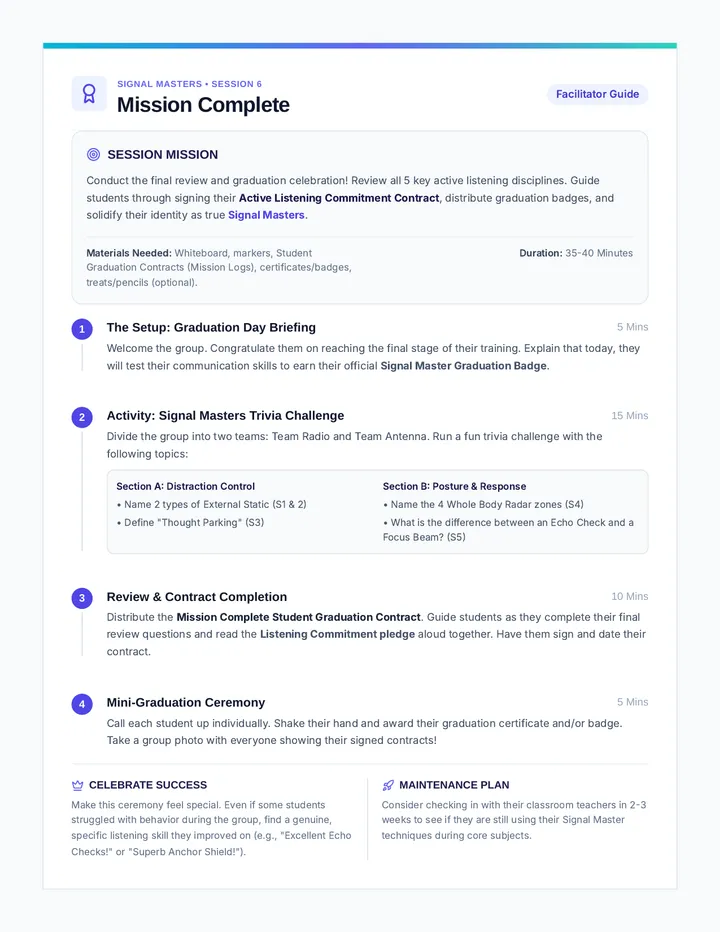
Mission Complete Facilitator Guide Signal Masters • Session 6
Mission Complete
Facilitator Guide
SESSION MISSION
Conduct the final review and graduation celebration! Review all 5 key active listening disciplines. Guide students through signing their Active Listening Commitment Contract , distribute graduation badges, and solidify their identity as true Signal Masters .
Materials Needed: Whiteboard, markers, Student Graduation Contracts (Mission Logs), certificates/badges, treats/pencils (optional).
Duration: 35-40 Minutes
1
The Setup: Graduation Day Briefing 5 Mins
Welcome the group. Congratulate them on reaching the final stage of their training. Explain that today, they will test their communication skills to earn their official Signal Master Graduation Badge .
2
Activity: Signal Masters Trivia Challenge 15 Mins
Divide the group into two teams: Team Radio and Team Antenna. Run a fun trivia challenge with the following topics:
Section A: Distraction Control
• Name 2 types of External Static (S1 & 2)
• Define "Thought Parking" (S3)
Section B: Posture & Response
• Name the 4 Whole Body Radar zones (S4)
• What is the difference between an Echo Check and a Focus Beam? (S5)
3
Review & Contract Completion 10 Mins
Distribute the Mission Complete Student Graduation Contract . Guide students as they complete their final review questions and read the Listening Commitment pledge aloud together. Have them sign and date their contract.
4
Mini-Graduation Ceremony 5 Mins
Call each student up individually. Shake their hand and award their graduation certificate and/or badge. Take a group photo with everyone showing their signed contracts!
CELEBRATE SUCCESS
Make this ceremony feel special. Even if some students struggled with behavior during the group, find a genuine, specific listening skill they improved on (e.g., "Excellent Echo Checks!" or "Superb Anchor Shield!").
MAINTENANCE PLAN
Consider checking in with their classroom teachers in 2-3 weeks to see if they are still using their Signal Master techniques during core subjects.
Mission Complete Student Log Signal Masters • Graduation Day
Mission Complete!
Signal Masters Graduate
Name:
Date:
Task 1: The Signal Master Review
Match each active listening core tool to its description by writing the correct number in the box.
External Shield
Thought Parking
Whole Body Radar
Echo Check
Repeating back the message in your own words.
Jotting down distracting thoughts to clear head space.
Physical postures that block external visual and noise static.
Aligning your eyes, torso, and base to listen actively.
Task 2: My Listening Superpower
Which strategy helped you focus the best over the past six weeks? How has your classroom listening improved?
Official Oath
The Signal Master Commitment
I pledge to listen with purpose
"I, , hereby commit to being a certified Signal Master . From this day forward, I promise to deploy my External Shields to block noisy static, use Thought Parking to clear my mind storms, point my Whole Body Radar directly at speakers, and perform Signal Checks to repair fuzzy transmissions."
Graduate Signature:
Group Coach Signature:
SIGNAL MASTERS • RECRUIT STAGE 6 COMPLETE