Sunk Cost Bell Ringer Worksheet
Bell Ringer #3 Behavioral Economics & Personal Finance
Cognitive Biases & Financial Choices
Checking for Understanding
30 Points • Due in 5–7 Mins
Student Name: _________________
Date: _________
Period: ____
Score: ____ / 30
Learning Target: Analyze how cognitive biases (e.g., Sunk Cost Fallacy) distort financial rationality, leading to irrational spending and poor budget decisions.
Part 1: Quick Check (10 Pts) Select the best answer
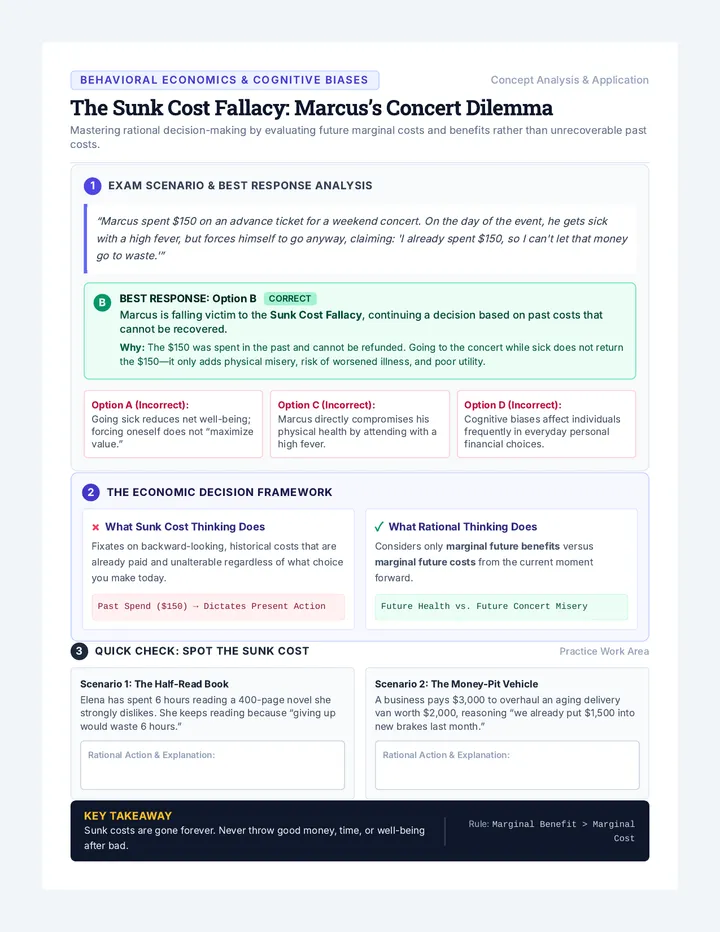
Scenario: Marcus spent $150 on an advance ticket for a weekend concert. On the day of the event, he gets sick with a high fever, but forces himself to go anyway because he says, "I already spent $150, so I can't let that money go to waste." Which statement BEST explains what is influencing Marcus's decision?
A Marcus is making a rational decision by maximizing the value of his ticket purchase
B Marcus is falling victim to the Sunk Cost Fallacy, continuing a decision based on past costs that cannot be recovered
C Marcus is properly evaluating his current physical health and long-term wellbeing
D Cognitive biases only apply to large corporate investments, not personal event tickets
Part 2: Workplace Application & Class Comment Drop (20 Pts) Level 3+ Criteria Required
Workplace Scenario: You are a peer financial mentor assisting a classmate with their budget. Your classmate bought an expensive gym membership three months ago for $80/month ($240 spent), but hasn't gone once because the location is inconvenient. When you suggest canceling it to save money, they reply: "No way! I've already spent $240 on it, so canceling now means I wasted all that money."
Prompt: How can cognitive biases, such as the Sunk Cost Fallacy, cause people to make irrational financial decisions? Why is it important to recognize this bias when managing money? Provide one specific piece of advice for this classmate.
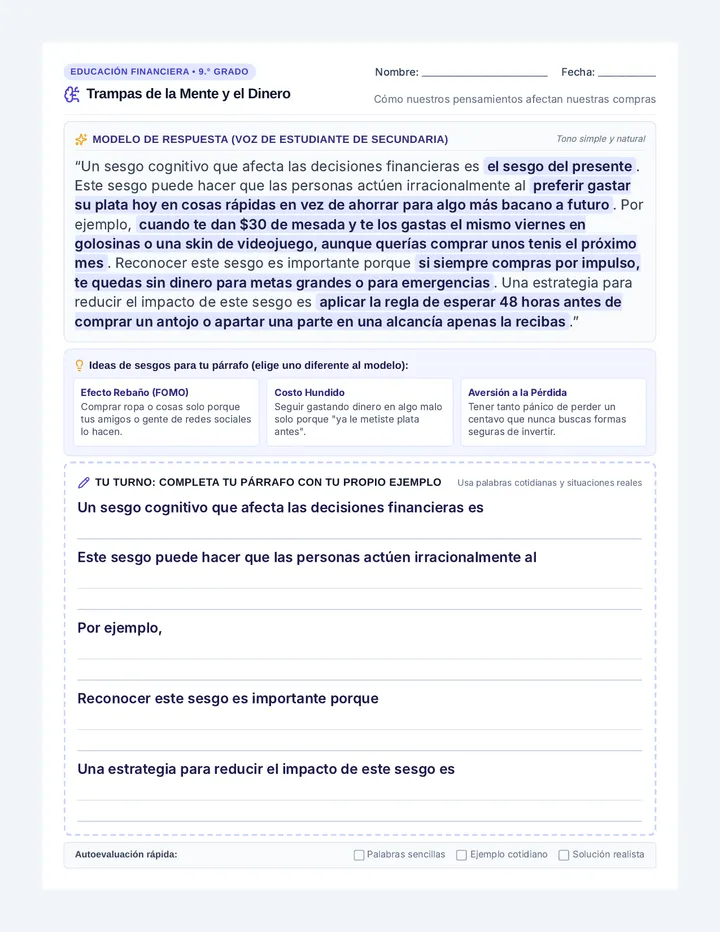
Sentence Frame Assist: "A cognitive bias that affects financial decisions is _______. This bias can cause people to act irrationally by _______. For example, _______. Recognizing this bias is important because _______. One strategy to reduce the impact of this bias is _______."
Your Level 3+ Response (Cornell Notes / Accountable Talk): 4–6 complete analytical sentences
Self-Check: Defines bias Cites gym scenario Future-focused fix Accountable talk
No Class Comment Drop = max 55% | Late = max 60%
Sunk Cost Bell Ringer Key
Teacher Key & Exemplar Bell Ringer #3 • 30 Total Points
Cognitive Biases & Financial Choices: Answer Key
Grading & Model Guide
MP1 • Due Oct 21
Core Concept: Sunk Cost Fallacy (Behavioral Economics)
Key Rule: Rational choices evaluate future marginal costs & benefits, ignoring unrecoverable past expenses.
Part 1 Solution (10 Pts) Correct Answer: B
B. Marcus is falling victim to the Sunk Cost Fallacy, continuing a decision based on past costs that cannot be recovered.
Why B is Correct: The $150 ticket is already spent and non-refundable. Forcing himself to attend with a high fever adds physical distress and medical risk without recovering the $150, making his total utility worse.
Distractor Breakdown: A is irrational (ignores health costs); C falsely claims he is prioritizing health; D is false because cognitive biases frequently impact personal everyday finances.
Workplace Scenario Analysis: Peer Financial Mentor Gym Membership Dilemma ($80/mo)
Mentor Diagnostic: The classmate believes canceling $240 already paid is "wasting" money. In reality, that $240 is already gone. Keeping the membership commits an additional $80 every month ($960/year) for a service never used. The rational decision is to cancel immediately, stopping future financial bleed.
Model Level 3+ Written Responses (20 Pts) Class Comment Drop Exemplars
Exemplar 1: Standard Prompt Model (Sentence Frame Aligned)
"A cognitive bias that affects financial decisions is the Sunk Cost Fallacy. This bias can cause people to act irrationally by continuing to pour money, time, or physical effort into an unproductive decision simply because they already invested in it. For example, Marcus forced himself to attend a concert while sick with a high fever just because he spent $150 on an advance ticket. Recognizing this bias is essential because historical spending cannot be recovered, and clinging to past costs only compounds total losses. One effective strategy to reduce the impact of this bias is to focus strictly on future costs and marginal benefits rather than capital that is already gone."
Exemplar 2: Peer Financial Mentor Application (Accountable Talk)
"As a peer financial mentor, I would explain that my classmate is trapped by the Sunk Cost Fallacy. Continuing to pay $80 a month does not magically bring back the $240 already spent; instead, it guarantees wasting another $80 every month with zero return. I would validate their frustration, but advise them to cancel the contract immediately and redirect that $80 into an emergency fund or a workout routine they will actually use. Evaluating future cash flow rather than past unrecoverable costs is the key to rational wealth building."