Sunk Cost Analysis Handout
Behavioral Economics & Cognitive Biases Concept Analysis & Application
The Sunk Cost Fallacy: Marcus’s Concert Dilemma
Mastering rational decision-making by evaluating future marginal costs and benefits rather than unrecoverable past costs.
1
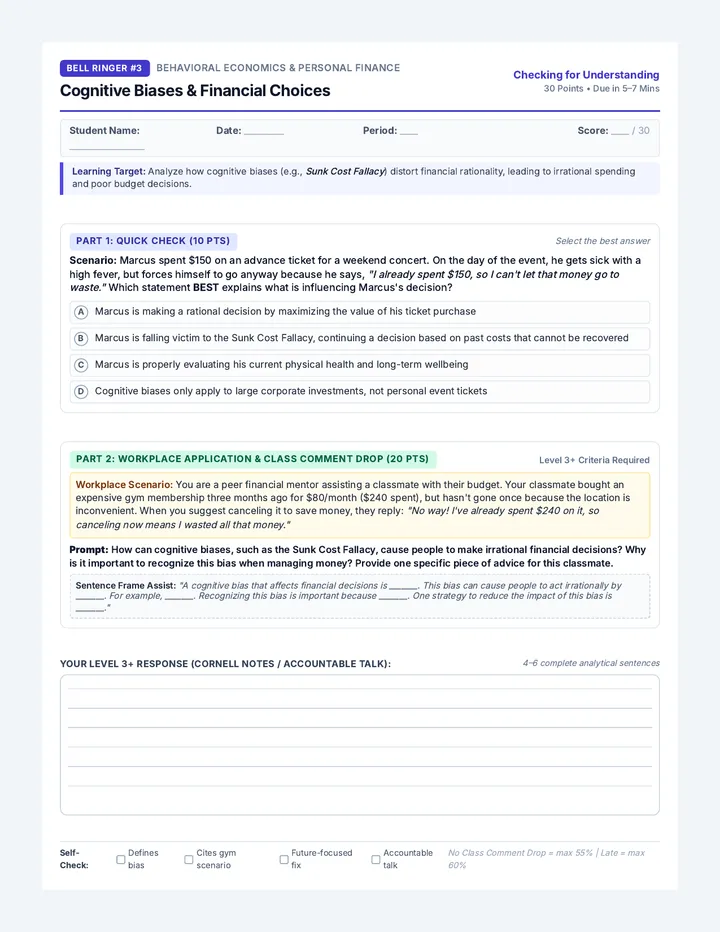
Exam Scenario & Best Response Analysis
“Marcus spent $150 on an advance ticket for a weekend concert. On the day of the event, he gets sick with a high fever, but forces himself to go anyway, claiming: 'I already spent $150, so I can't let that money go to waste.'”
B
BEST RESPONSE: Option B Correct
Marcus is falling victim to the Sunk Cost Fallacy, continuing a decision based on past costs that cannot be recovered.
Why: The $150 was spent in the past and cannot be refunded. Going to the concert while sick does not return the $150—it only adds physical misery, risk of worsened illness, and poor utility.
Option A (Incorrect):
Going sick reduces net well-being; forcing oneself does not “maximize value.”
Option C (Incorrect):
Marcus directly compromises his physical health by attending with a high fever.
Option D (Incorrect):
Cognitive biases affect individuals frequently in everyday personal financial choices.
2
The Economic Decision Framework
× What Sunk Cost Thinking Does
Fixates on backward-looking, historical costs that are already paid and unalterable regardless of what choice you make today.
Past Spend ($150) → Dictates Present Action
✓ What Rational Thinking Does
Considers only marginal future benefits versus marginal future costs from the current moment forward.
Future Health vs. Future Concert Misery
3
Quick Check: Spot the Sunk Cost
Practice Work Area
Scenario 1: The Half-Read Book
Elena has spent 6 hours reading a 400-page novel she strongly dislikes. She keeps reading because “giving up would waste 6 hours.”
Rational Action & Explanation:
Scenario 2: The Money-Pit Vehicle
A business pays $3,000 to overhaul an aging delivery van worth $2,000, reasoning “we already put $1,500 into new brakes last month.”
Rational Action & Explanation:
Key Takeaway
Sunk costs are gone forever. Never throw good money, time, or well-being after bad.
Rule: Marginal Benefit > Marginal Cost
Peer Budget Mentor Guide
Peer Financial Mentoring • Writing Level 3+ Personal Finance & Decision Making
Peer Budget Mentor Guide: The $240 Gym Trap
Helping classmates overcome the Sunk Cost Fallacy and make forward-looking money choices.
1
The Mentoring Scenario & Cost Analysis
Cost Breakdown
Classmate's Sunk Cost Dilemma
“I already spent $240 ($80/mo × 3 months) on this gym membership. If I cancel now, that entire $240 is wasted!”
The Trap: Believing continuing to pay protects past spending.
Future Decision (Next 3 Months)
Keep Paying (Still no visits): -$240 lost
Cancel Immediately: +$240 saved
*Past $240 is unrecoverable in both options. Canceling saves future cash.
2
Class Comment Drop: Level 3+ Model Response
Completed Sentence Frame
“A cognitive bias that affects financial decisions is the Sunk Cost Fallacy. This bias can cause people to act irrationally by continuing to pour money into a bad choice simply because they already invested money into it in the past.
For example, my classmate spent $240 on a three-month gym membership they never use because the location is inconvenient, but they refuse to cancel because they feel guilty about the money already gone.
Recognizing this bias is important because past spending cannot be recovered, so staying enrolled will never bring the $240 back—it only costs an extra $80 every month without any benefit.
One strategy to reduce the impact of this bias is to ignore unrecoverable past costs and evaluate only future costs and benefits: ask yourself if spending the next $80 brings real value to your life today.”
3
Accountable Talk Strategies for Class Discussion
Building on an Idea
“I agree with your point about sunk costs, and I would add that looking forward prevents ongoing budget leaks.”
Respectful Challenge
“While it feels like canceling wastes money, mathematically, continuing to pay wastes an additional $80 each month.”
Clarifying Question
“If you were offered this gym contract today starting at zero dollars spent, would you sign up right now?”
Peer Mentor Rule: Never let guilt over spent dollars make your next dollar disappear.
Future Benefit > Future Cost